Tel/WeChat:
  Email:


 Home
HomeWhat Is A Sensor Housing? Types, Materials & CNC Machining

 Published:Jul 25,2026
Sensor Enclosures protect sensitive electronics from such factors as vibration, moisture, temperature changes, and chemicals. Failure to choose the right sensor housing or material during procurement can shorten the lifetime of the device and increase its rate of failure. This guide provides information on types of sensor housings, materials used in their construction, and methods of production using CNC machines.
What Is a Sensor Housing?
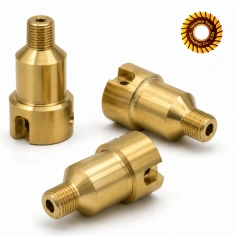
Sensor housing is the case that protects the electronics or sensing element of the sensor. This case protects the sensor against various environmental conditions and also ensures accurate measurements, reliable mounting, and optimal performance.
Is a Sensor Housing a Precision Part?
Yes, since sensor housings must be highly precise so as to ensure the proper alignment, sealing, and measurements of sensors. In general, majority of the sensor housings are produced using ISO 2768-m tolerances (0.05-0.10 mm). However, some of the sealing and alignment features may require even tighter tolerances such as 0.01-0.025 mm. That is why machining is preferable in such cases.
How Do Sensor Housings Impact the Sensor Performance?
The housing impacts the performance of the sensor directly through:
- Accuracy of measurements (wall thickness affect the performance of sensors)
- Precision machining of sealing surfaces ensures the absence of contamination and leakages.
- Proper alignment
- Correct design increases the resistance to thermal cycles, vibrations, and loads
Types of Sensor Housings
There are different types of sensor housings that are determined by the type of physical element needed to be protected against.
|
Housing Type |
Primary Function |
Typical Material |
|---|---|---|
|
Temperature |
Conduct heat efficiently to the probe while sealing it from the environment |
Al, SS Steel, Cu Alloys |
|
Humidity |
Allow air and moisture exchange |
Engineering plastics, SS steel mesh |
|
Pressure |
Contain internal pressure and prevent media leakage |
SS, Ti, Hardened Alloys |
The following is a representation of the common sensor housings .
Temperature Sensor Housing
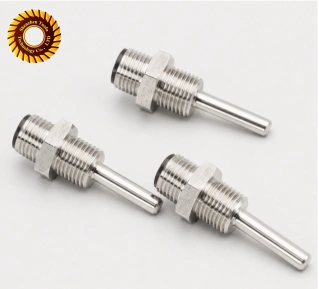
Temperature sensor housings are manufactured in order to facilitate proper heat transfer, provide protection to the sensing element and ensure good sealing in tough environments.
Transfer Heat to the Sensor
The housing for temperature sensors is necessary to enable efficient heat transfer, which will provide fast and accurate measurements. CNC machining allows keeping the wall thickness constant and thus minimizing thermal lag and improving the sensor response.
Protect the Temperature Probe
The housing should protect the temperature probe from physical damage, corrosion, wear, process pressure, and provide good thermal performance. There are thermowell-like constructions, which can be machined with high precision to have sufficient strength and durability during repetitive heating cycles.
Seal the Mounting Interface
Threaded connections, flanges, and O-ring grooves should be machined to tight tolerances to avoid any fluid or gas leaks. High precision machining provides good sealing despite thermal expansion and long-time usage.
Humidity Sensor Housing
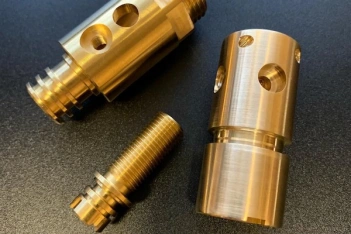
Humidity sensor housings allow for airflow to the sensing element and protect it from dust, water, contamination for precise measurement of humidity.
Allow Air to Reach the Sensor
The housing for humidity sensors must provide free access of air and moisture vapor to the sensing element and protect it from any external influence. There are special vents, slots, or membranes integrated into the housing design and CNC-machining is used to provide precise holes for airflow.
Block Dust, Water & Contaminants
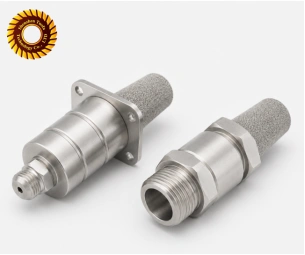
The housing must prevent the contamination with dust, water, oils, and other substances but allow airflow. It can be done by the installation of hydrophobic membranes or labyrinth vents in precisely machined manner to ensure the sealing and filtration
Hold the Sensor Module
The humidity sensor module requires accurate mounting inside the housing to provide correct positioning with respect to the airflow direction. CNC machining allows producing standoffs, slots, and locating elements with tight tolerances to avoid movement and vibration.
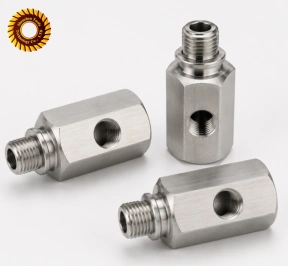
Pressure Sensor Housing
Pressure sensor housings are designed for tough conditions of operation and allow preventing media leakage and measuring pressures with high precision.
Withstand Internal Pressure
Pressure sensor housing must withstand internal pressure without deformation or fatigue failure. High-strength materials, such as stainless steel and titanium, sufficient wall thickness, and smooth geometry are required for that. Uniform wall thickness and precise internal parts provided by CNC machining improve the strength.
Prevent Media Leakage
To prevent fluids or gases from leaking through ports and sealing interfaces, pressure sensor housings commonly use O-rings and seals. Their grooves, threads, and sealing surfaces must be precisely machined to achieve the required compression and sealing performance.
What Common Materials Are Suitable for Sensor Housing?
The choice of materials for sensor housing depends on the expected working conditions, sensor performance and manufacturing.
|
Material |
Density |
Best Suited For |
|---|---|---|
|
Al 6061-T6 |
2.70 g/cm³ |
Weight-sensitive, thermally conductive housings |
|
SS 304/316 |
~7.9 g/cm³ |
Corrosive, high-pressure, hygienic environments |
|
Titanium |
~4.43 g/cm³ |
Aerospace, medical, extreme corrosion resistance |
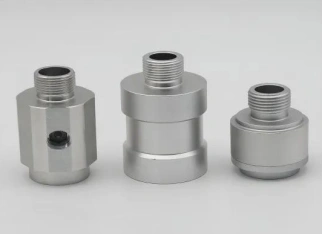
Aluminum Sensor Housing
Aluminum 6061-T6 is commonly used as a housing for sensors which work in temperature, vibration, and general industrial environments. Its density is only 1/3 part of the weight of steel, and the thermal conductivity of the alloy is around 167 W/(mK) (almost 10 times higher than Stainless Steel 304 about 16 W/(mK)). The combination of good machinability and good heat dissipation makes it ideal material for lightweight and precise housing of sensors.
Stainless Steel Sensor Housing
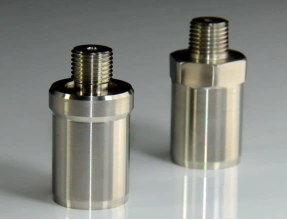
Stainless steel types 304 and 316 are used for housings of sensors exposed to pressure, chemicals or washdown environments. SS 316 has molybdenum added to improve chloride corrosion resistance. Stainless steel has the density of about 7.9 g/cm³, and thermal conductivity close to 16 W/(m*K). This material provides high strength, corrosion resistance and ensures reliable IP67/IP68 seal performance.
Titanium Sensor Housing
Titanium grade 5 (Ti-6Al-4V) is used in aerospace and medical application. The density of the material is approximately 4.43 g/cm³, meaning that it is 45% less heavy than steel, but still has tensile strength of about 895-950 MPa. However, relatively low thermal conductivity of titanium increases difficulties in machining and increases processing cost.
Is a Sensor Housing Made by CNC Machining?
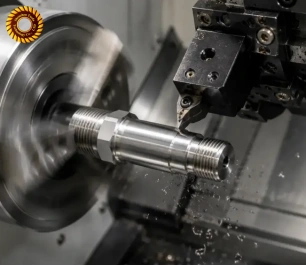
Yes. A professional CNC machining service is commonly used to produce metal sensor housings for industrial, automotive, aerospace, medical, and robotic applications. It offers high dimensional accuracy, tight tolerances, and repeatability, thus ensuring precise sealing surfaces and accurate alignment of the sensors.
When CNC Machining is Used for Sensor Housings?
CNC machining is chosen for sensor housing production when:
- Low tolerance is required
- Precise sealing surfaces, including O-ring grooves and gasket faces
- Precise threads, holes, and bores
- Fast prototyping and design verification
- Metal sensor housings with high strength and thermal conductivity
CNC Sensor Housing vs Other Sensor Housing
The following sections compare CNC machining with other common manufacturing processes used for sensor housings.
Forged Sensor Housing vs. CNC Sensor Housing
Forged components have high mechanical strength because of the optimal arrangement of the grain flow. However, they can not provide dimensional accuracy and complex shapes which are necessary for the sensor housing. Most of the forged parts need additional CNC machining to create sealing surfaces, threads and precise bores. Boring operation ensures higher accuracy than drilling, and tapping creates standardized internal threads to fasten the part.
Die-Cast Sensor Housing vs. CNC Sensor Housing
Die casting is optimal for high volume production since it ensures low costs for each part once tooling is paid for. CNC machining is better than die casting because of high dimensional accuracy, tight tolerances, and lack of porosity in the interior.
Stamped Sensor Housing vs. CNC Sensor Housing
Stamping is an economical manufacturing technique of producing simple enclosures and protective covers from sheet metal. CNC machining is better for producing sensor housing requiring three-dimensional shapes, cavities inside, and precise threads.
CNC Machining Processes Used for Sensor Housing Features
There are various features of a sensor housing that are manufactured with different CNC machining processes to meet particular dimension and performance requirements.
Housing body
Both the exterior shape and interior cavity of the housing body are manufactured through 3-axis or 4-axis CNC milling. While the complicated geometries and angles require 5-axis milling to manufacture the component features.
Mounting Features
Housing holes, flanges, and threads are produced through drilling, milling, boring, and tapping. Understanding the differences between drilling, boring, and reaming helps manufacturers select the appropriate process for each hole: drilling creates the initial hole, boring improves its dimensional and positional accuracy, and reaming provides a more precise diameter and surface finish.
Sealing Features
The important sealing features like O-rings, gaskets, and threads are manufactured through milling, boring, and CNC turning. These features require tight tolerance and good surface finish to ensure effective sealing.
Common Surface Finish for CNC Sensor Housing
CNC manufactured sensor housings often require some type of surface finishing process which improves corrosion resistance, wear resistance, aesthetics, and the ability to coat surfaces. The type of surface finish depends on the material used for the housing and the use of the housing.
Anodization
Anodization can be used on aluminum houses in order to increase corrosion and wear resistance and to color code the housing. Type II anodization can be used for regular applications and Type III (hard anodization) is used for durable conditions.
Passivation
Passivation is a common procedure for stainless steel housings. It involves removing the contaminants from the surface of the material as well as increasing its natural corrosion resistance and therefore making the housing less prone to rust.
Electropolishing
Electropolishing is primarily used for stainless steel housings used for medical applications, food processing, and cleanroom environments.
The Future of Sensor Housing: AI-Powered Devices Upgrade
With increasing integration of sensors into AI systems, autonomous cars and smart factories, sensor housings will require increased precision, more compact design and accelerated product development.
More Compact Design
Multiple function sensors featuring temperature, humidity, pressure, etc. need small housings providing maximum size while maintaining structural integrity.
Higher Precision Features
Precision and low noise are the main requirements for sensors used in AI systems. High tolerance in optical and LiDAR alignment is usually needed up to 0.01-0.02 mm. CNC machining is the best way to get such products.
Rapid Prototyping
Rapid changes in design are typical for hardware development in artificial intelligence. CNC machining allows quickly making changes in prototypes and does not require special tooling to do it.
How to Customize Your Sensor Housings Through CNC Machining?
The majority of the CNC sensor housing orders come from a design that already exists with the customer. The next step is to look for an experienced custom sensor housing supplier.
Choose Reliable CNC Manufacturer
Choose a CNC machining manufacturer that has an internal inspection department, has expertise in machining of the chosen material, and has a track record of making high-quality tight-tolerance parts.
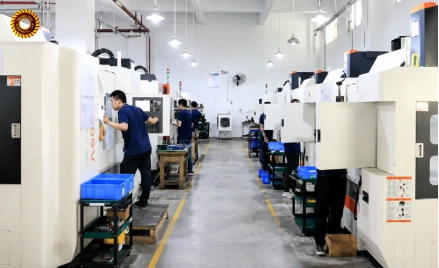
The difficulty in spotting flaws on the sensor housing after manufacture makes inspection capability just as important as machining. With over 20 years of manufacturing experience, Tuofa can meet customers'requirements for sensor housing customization with well-trained staff and professional engineers.
Provide 2D/3D Drawings for Sensor Housing
Submit a 3D model along with a 2D drawing that contains dimension, tolerances, thread callouts, surface finish callouts, and material or heat treatment information. At Tuofa, all drawings are analyzed for their feasibility, design changes recommended if required, and technical support is provided.
Optimize Design Based on DFM Review
DFM review evaluates the design of sensor housing generally through:
- wall thickness
- Radii
- machining accessibility
- critical tolerances
In practice, other important factors are considered based on the required sensor housings. By doing that, the manufacturing problems of the design can be identified.This is always essential for reducing costs and optimizing the performance of the parts.
Prototyping is Often Preferred
After the prototype passes fit, sealing, and functional testing, the product can move directly into low- or medium-volume production using the validated CNC program. Tuofa’s rapid prototyping service uses the same CNC machining process, enabling a smoother transition from design validation to production. See more details from Tuofa's sensor housing case.
What are Common Sensor Housing Applications?
Sensor housings are used widely across many fields, few of the applications are discussed below:
Automotive Sensor Housing
For automotive sensor housings meant for parking, tire pressure, and proximity sensors, vibration resistance, saltwater, and temperature resistance are necessary. CNC machined aluminum parts along with protective coating provide dimensional accuracy and corrosion resistance in large quantity.
Industrial Automation Sensor Housing
The industrial sensors that are used for detecting position and motion should have housings capable of resisting oils, cleaners, and vibrations. CNC machining ensures exact dimensions for integration into the already-existing automation equipment.
Medical Equipment Sensor Housing
Housings for medical sensors need biocompatibility, precision sealing, and tight tolerance to withstand sterilization. CNC machined stainless steel and titanium parts have very good corrosion resistance and dimensional accuracy.
Environmental Monitoring Sensor Housing
Environmental sensors that are required for air quality, water quality, and weather monitoring require housing that is capable of surviving outdoors. CNC machined IP67/IP68 housing prevents entry of dust and water while allowing passage of airflow through vents designed for humidity and gas sensors.
Robotics
Force, torque, and proximity sensors used in robotics require housing materials that have low weight along with good strength for reducing inertia. CNC machined aluminum and titanium provide high strength to weight ratio.
Conclusion
Sensor housing is not only a protective case, but also a component affecting measurement accuracy, sealing, and service life of the sensor. CNC machining allows getting highly precise and repeatable parts with the required tolerance level. From prototyping to mass production, Tuofa machining manufacturing provides precision housing for sensors based on customers' drawings with full manufacturability support.
FAQs
What material is best for a sensor housing?
There is no ideal material. Aluminum 6061 is ideal for lightweight applications and heat dissipation, Stainless Steel 304/316 is good for corrosion resistance, while Titanium is preferred for aerospace and medical applications because of its durability and low weight.
Can other materials be used for sensor housings?
Yes. For light-weight or moist environment ABS, PEEK, and polycarbonate can be used; for high temperatures ceramics and refractory metals should be chosen.
What is a bearing housing?
Bearing housing supports and aligns bearings and carries their loads including radial and axial ones to ensure smooth shaft rotation.
How to choose a right sensor housing?
Choose a housing based on:
- Operating environment (temperature, moisture, chemicals, vibration)
- Required IP rating
- Suitable material
- The ability of the manufacturing process to achieve the required sealing and dimensional tolerances
 Bottoming Tap: A Complete Guide for Blind Hole Threading in CNC Machining