Tel/WeChat:
  Email:


 Home
HomeHow to Select a Clevis for Your Application: Types, Design, and Manufacturing

 Published:Jul 24,2026
Clevis is an important class of mechanical connectors. Whenever a question of angular movement and pivoting action arises, clevis is the answer. They support tensile, compressive, bending, shear, and fatigue loads. Clevises can be found in quite a few types and designs. So, a certain type accommodates a certain application. There are numerous options in material selection to suffice the needs to various industries. Let's get a glimpse about clevises!
What Is a Clevis?
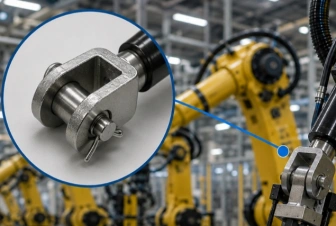
A clevis is a fastening component used in mechanical assemblies. It provides a hinge-like connection. The pivoting feature of a clevis gives limited freedom of movement while the components are securely attached. Geometrically, it is U-shaped, having the following parts:
- Forked Body
- Pin Holes
- Threaded or Mounting End
Is Clevis a Pin?
No. A clevis is different from a pin. In fact, pins are used in the clevis assemblies to fasten the components. These clevis pins act as pivots. They allow components to rotate around them in a limited manner.
Clevis vs Clevis Joint
The table below compares the clevis with the clevis joint:
|
Feature |
Clevis |
Clevis Joint |
|---|---|---|
|
Definition |
U- shaped connector |
Assembly of clevis, pin and mating part |
|
Function |
mounting interface |
Pivoting motion |
|
Components |
Single part |
Multiple parts |
|
Movement |
No |
Rotational movement |
|
Role |
Part |
Working joint |
Types of Clevis by Connection
Clevises can be classified according to their connection types. The different connection types determine the deployment of clevises in different applications. Some clevises prioritize strength, while others capitalize on adjustability or modularity. Designers can thus select the most appropriate clevises for their applications.
Threaded Clevis
Threaded clevises provide ease in installation, assembly, and adjustability. They have an adjustable connection whose length can be adjusted by simply screwing in or out. The lock nuts are tightened to lock the linkage in place. Threaded clevises can be male or female.
- Male-threaded clevises: havean externally threaded shank.
- Female threaded clevises: have an internally threaded socket.
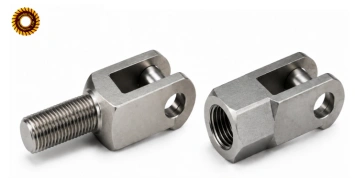
Threaded clevises are commonly used in:
- agricultural adjustment rods
- automation fixture linkages
- brake linkage systems
These applications take advantage of modularity and adjustability features. By comparison, in female-threaded clevises, the threads are concealed and remain protected from dirt and moisture.
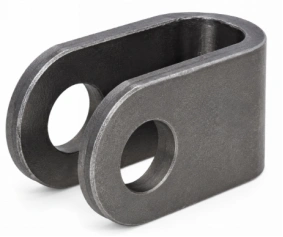
Weld Clevis
Weld clevises make a permanent connection. They are commonly used in applications where strength is prioritized over modularity. Welding locks the connection in place. So, positioning is more stable. These clevises are preferred in places where frequent assembly and disassembly are not required. Some common applications of weld clevises include:
- fixture-mounting structures
- small equipment support brackets
- industrial support frames
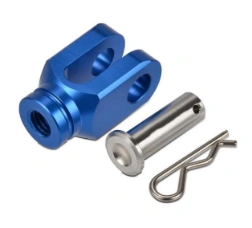
Bolt-On Clevis
Bolt-on clevises have detachable mounting. This feature promotes modularity. Bolt-on clevises can be frequently installed, uninstalled, or replaced. So, bolt-on clevises fit in applications like:
- industrial robot fixtures
- packaging machines
- modular machinery systems
Types of Clevis by Geometry
The geometric shape and configuration of a clevis determine its usage in a specific area. These features are purposely incorporated to accommodate different fitting requirements. After all the main goal is to align and fit clevises accurately. Lets check some common geometric types of clevises.
Twist Clevis
Twist clevis has its forked end twisted relative to the mounting end. As shown in the picture, a twist clevis can connect two components in different planes. If a straight clevis is used under such conditions, it will introduce undesirable bending stresses in the assembly.
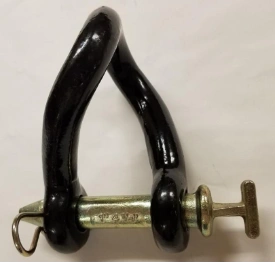
Twist clevis undermines the requirement of additional brackets in misoriented connections. So, a smooth load transfer can take place between misaligned components. Some common applications of twist clevis include:
- Chain linkage assemblies
- Cable tension systems
- Small towing linkage systems
Offset Clevis
Offset clevises have a laterally displaced linkage point from the centerline. This creates clearance for adjacent parts or interfering components.
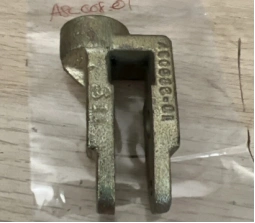
So offset clevises can offset installation without any major alteration in the fitting of other components in the assembly. Some typical applications include:
- Automotive suspension linkages
- Custom tooling fixtures
- Mechanical linkage assemblies
Double Clevis
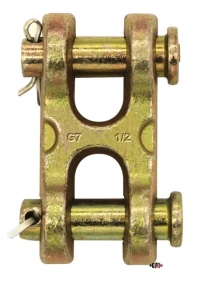
Double clevises have forked ends on both sides. It gives freedom of rotation at both ends. So in bidirectional loading situations, forces are distributed evenly. Some specific applications of double clevis include:
- Automation swing arm systems
- Precision linkage assemblies
- Compact industrial drive linkages
Understanding the Clevis Connection System
The real significance of clevises can only be showcased by understanding the clevis connection system. A good knowledge of the main parts of a clevis assembly is thus beneficial. The role of clevises in mechanical systems should be understood to get a glance of its usefulness.
Main Parts of a Clevis Assembly
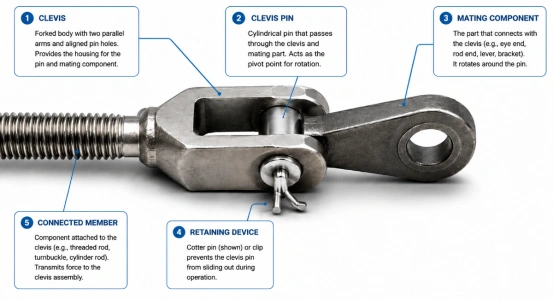
A typical clevis assembly consists of a clevis, a mating component, and clevis pins. The clevis housing provides the main structural support during load transfer. The mating component provides the linkage for connection. The clevis pin gives the pivoting mechanism to the assembly. Retaining devices like cotter pins keep the clevis pins in place.
How Clevises Work in Mechanical Systems
Allow Pivoting Motion
One of the main functions of a clevis is to give a controlled rotational movement to the connected parts. In this sense, the clevis pin acts as the rotational axis. Connected components can swing freely around this axis. It allows slight variations in bending angle during operation.
Transfer Mechanical Loads
A smooth transfer of load is critical in assemblies. It becomes especially important in mechanical systems where rigid fixing can introduce unwanted stress concentrations. Clevises allow rotational movement that reduces bending and shear stresses. They also distribute loads more evenly.
Provide a Removable Connection
Clevises accommodate frequent replacement of parts. The clevis assembly can be easily disassembled and reassembled without any major disruptions. A clevis assembly can be disassembled by removing the retaining clip and withdrawing the clevis pin It is in line with regular service goals.
Simplify Linkage Assemblies
Clevises provide a standardized connection. It promotes modularity. Clevises are designed to accommodate variations in alignment. Falling on a strict alignment criterion is often not required. So, this simple linkage mechanism solves many hurdles.
Materials Used for Clevis Manufacturing
A proper material selection is as important as the clevis design. The operating conditions determine the suitability of a material in a given environment. Some of the commonly used materials are discussed below.
Carbon Steel Clevises
By far the most commonly used material for clevises is carbon steel. It is strong and cost-efficient. In many clevises, a combination of strength and low cost is often deemed favorable. However, its susceptibility to corrosion can limit its use in some specialized applications.
Stainless Steel Clevises
As its name suggests, stainless steel clevises are used mainly in corrosion-prone applications. In highly corrosive environments like marine installations or chemical plants, other materials may not function properly.
Aluminum Clevises
Aluminum is often selected to reduce the weight. But the downside is its low strength. So, aluminum might not be suitable to accommodate heavy loads. However, a thicker cross section might compensate for the relatively low yield strength. In short, aluminum clevises prioritize low density over strength.
Alloy Steel Clevises
Alloy steel clevises are used in specialized applications. Their performance often exceeds that of other clevises. They can quite often withstand exceptionally high loads. Their high yield strength can be beneficial in lowering weight by reducing the cross-sectional area. Some alloy steel grades are creep-resistant. So, clevises made up of those grades can be used in high-temperature applications.
Common Applications of Clevises and Clevis Joints
Almost every industry has some usage of clevises.
Hydraulic Cylinders
A typical example of a clevis used in a hydraulic cylinder is with its actuator. Clevis allows angular movement occurring during extension and retraction of the piston. Forged clevises are used in high-load applications. Machined clevises are used in high-precision applications. Heat-treated clevises often have enhanced properties compared to untreated ones.
Industrial Machinery
Clevises are installed in industrial machinery due to their pivoting action. Clevises also facilitate quick assembly and disassembly, capitalizing on their removable pin. The suitability of a clevis depends on the industrial environment. As an example, 304-grade stainless steel clevises are used in food-grade applications.
Agricultural Equipment
Agricultural applications often have heavy loads, vibration, mud, moisture, and dust. Keeping in view these conditions, high load-bearing clevises are used. Common areas of clevis usage include:
- tractor implements
- hitch systems
- Steerings
- lift arms
- hydraulic linkages
Robotics and Automation Equipment
Robotics and automation equipment utilize the pivoting action of clevises a lot. So, clevises are used in pneumatic cylinders, electric actuators, robotic arms, and positioning mechanisms. CNC machined precision clevises give freedom of angular movement while securely attaching the components.
Why CNC Machining Is Used for Custom Clevises
CNC machining process perfectly aligns with customization goals. In metrics like precision, customization, and prototyping, CNC machining is very useful. For making replacement parts like custom clevis pins, CNC machining is at times the only option.
Precision Hole Machining
The level of precision that can be achieved by CNC machining is unmatched by any other process. By avoiding excessive clearance, issues like vibration can be alleviated. A good hole concentricity can be achieved by using CNC machining. It promotes accurate pin fit, which results in uniform load distribution.
Custom Sizes and Geometry
Unlike other processes that rely on fixed dies and assemblies, CNC machining can accommodate customization. This is especially useful in manufacturing clevises with non-standard dimensions. In applications that require specialized clevises, customized sizes and geometries can be manufactured. Design features like fork widths, custom clevis pin, thread profiles, and mounting configuration can be modified easily.
Small-Batch Clevis Manufacturing
Manufacturing a small batch of clevises is often desired in prototyping. Evaluation of fit, function, and performance can be done on the small batch before moving to large volume production. If replacement parts for clevises are not available in the market, then they can be easily manufactured by CNC machining.
How Do You Choose the Right Size of Clevis for Your Project?
While a clevis is being deployed in a specific application, its suitability must be determined. Its load capacity, dimensions, and geometry are important. This ensures proper fit and functionality. If a standard clevis cannot meet these criteria, then customization might be needed.
Determine the Required Load Capacity
While designing a clevis, the load capacity requirement should be well understood. In addition to the tensile and shear loads, other loading factors should be checked. During service, the clevis may be subjected to impacts or fatigue. The operating temperature during service influences the strength of the clevis. So all these loading factors should be considered in the clevis design.
Check the Required Fork Width
The clevis fork width should match the thickness of the mating component. If the fork width is narrower than that then the mating component might not join. If it is too loose, there will be unnecessary play that can lead to premature failure.
Choose the Proper Pin Hole Size
The pinhole size should be large enough to accommodate the pin diameter. A thicker clevis pin means more load-bearing capacity. But the pinhole alters the stress profile of the housing. An excessively large pin hole can reduce the strength of the clevis assembly.
Match the Pin Hole Size
Clearance between the pin and the hole should be optimized. A large clearance would create play between the pin and the hole. It can introduce an impact loading condition that negatively impacts the durability of the clevis. A narrow clearance can restrict the movement of the pin that hinder a smooth angular motion.
Surface Finishing for Clevises
After an efficient part design for a clevis is created, efforts are made to make it durable. In that sense, surface treatment is a step forward. It improves aesthetic and corrosion protection. Some common techniques of surface treatment are discussed here.
Why is Surface Treatment Required?
In practical situations, clevises are exposed to dirt, moisture, seawater, and other contaminants. Without a protective coating, a layer of rust and contaminants can build up over them. This can alter their dimensions. Rust can also change the frictional behavior of the clevis pin. So, the pivoting motion can be compromised. Surface treatment may also be required for aesthetic purposes. In some applications, an electrically insulating surface might be desired.
Common Surface Treatment Methods for Clevises
Zinc Plating
Zinc plating is done over mild steel clevises. Zinc atoms sacrificially protect the underlying steel surface. They give steel a glossy silver-gray color. But, care must be taken to prevent dimensional changes
Black Oxide
Black oxide creates an iron oxide layer over the mild steel clevis. It prevents rust from forming on the surface. It gives a professional look to clevises. A big advantage of black oxide is that only negligible dimensional changes occur.
Passivation
Passivation surface treatment is mainly carried out on stainless steel clevises. Visually, it doesn't create any big change. On the other hand, it removes free iron atoms and strengthens the chromium oxide layer.
Clevis vs Other Mechanical Connections
Clevises are often confused with other mechanical connectors. Rod end and shackle are two common connectors that people confuse with clevises. A distinction between them must be made. The below tables compares clevises with shackles and rod ends.
Clevis vs Rod End
|
Feature |
Clevis |
Rod End |
|---|---|---|
|
Design |
Forked connector |
spherical bearing with threaded shank |
|
Motion |
Single -plane pivoting |
Multi- directional angular movement |
|
Connection |
Clevis pin |
bolt through bearing |
|
Misalignment |
Low |
High |
|
Load Capacity |
High static loads |
Misaligned loads |
|
Adjustment |
with threaded clevis |
with threaded shank |
|
Cost |
Economical |
Higher cost |
|
Applications |
Hydraulic cylinders, linkages |
steering, suspension, robotics |
Clevis vs Shackle
|
Feature |
Clevis |
Shackle |
|---|---|---|
|
Purpose |
Mechanical linkage |
Lifting and rigging |
|
Motion |
Pivoting |
limited movement |
|
Connection |
Rods and brackets |
Chains and slings |
|
load Type |
Mechanical loads |
Lifting loads |
|
Material |
Steels |
Forged steel |
|
Applications |
Hydraulics, machinery |
Cranes, hoists |
Tuofa Case Study: Custom CNC Machined Clevis for Hydraulic Linkage
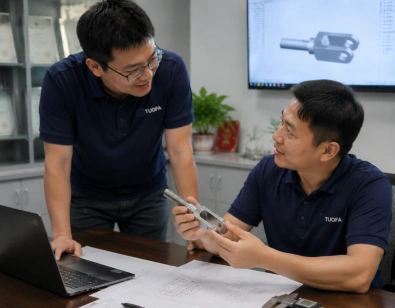
A customer needed a custom threaded clevis for a hydraulic actuator linkage used in industrial equipment. The standard clevis components available on the market could not fit the existing assembly because the required fork opening, mounting position, and connection dimensions were different from standard specifications.
Challenges
The main challenge was maintaining the accuracy between the two fork arms and the pin holes.
Tuofa Solution
- After reviewing the customer's drawing, Tuofa recommended increasing the fork thickness from the original 10 mm to 14 mm. This adjustment improved the load-bearing capability of the clevis while maintaining compatibility with the existing assembly.
- To reduce stress concentration during repeated loading, Tuofa optimized the fork root design by adding an R2 fillet at the internal corner of the clevis.
- Tuofa increased the reinforcement thickness around the pin hole area by 3 mm to improve the local strength and reduce the risk of hole deformation caused by repeated pin loading.
- Considering the customer's assembly requirements, Tuofa added a 1 mm chamfer around the pin hole entrance. This modification improved pin installation and ensured smoother assembly with the mating component.
Conclusion
A clevis is an important mechanical connector. In addition to a normal load transfer, they permit angular movements and rotations. There are different clevis types based on different geometries, materials, and attachment features. Numerous industries, ranging from robotics to agriculture and many more, reap the benefits of this connector. An optimized design and careful manufacturing unleash the true potential of clevises. Only a good supplier can help in achieving this goal.
FAQ
What is a clevis pin?
A clevis pin is a component of the clevis assembly. It is cylindrical in shape and supports shear and rotational loads.
How to measure size of clevis?
Dimensions of fork width, pin hole, shank length, and thread need to be measured.
What is a clevis clamp?
Clevis clamps are used to support heavy pipes from overhead structures.
 What Is A Sensor Housing? Types, Materials & CNC Machining