 Tel/WeChat:
  Email:


 Home
HomeTuofa Helped Upgrade Sensor Housing for AI Plants’ Electrical Signals
Combining AI-driven data analysis with plant-sensing technology is becoming an important direction in plant signal monitoring. Reliable analysis depends on sensors collecting stable, real-time signals, and the sensor housing directly affects the protection, position, and assembly of the internal components.A Canadian client wanted to develop an AI-enabled plant signals monitoring device needed a compact aluminum housing for its sensor electronics. And he attached Tuofa.
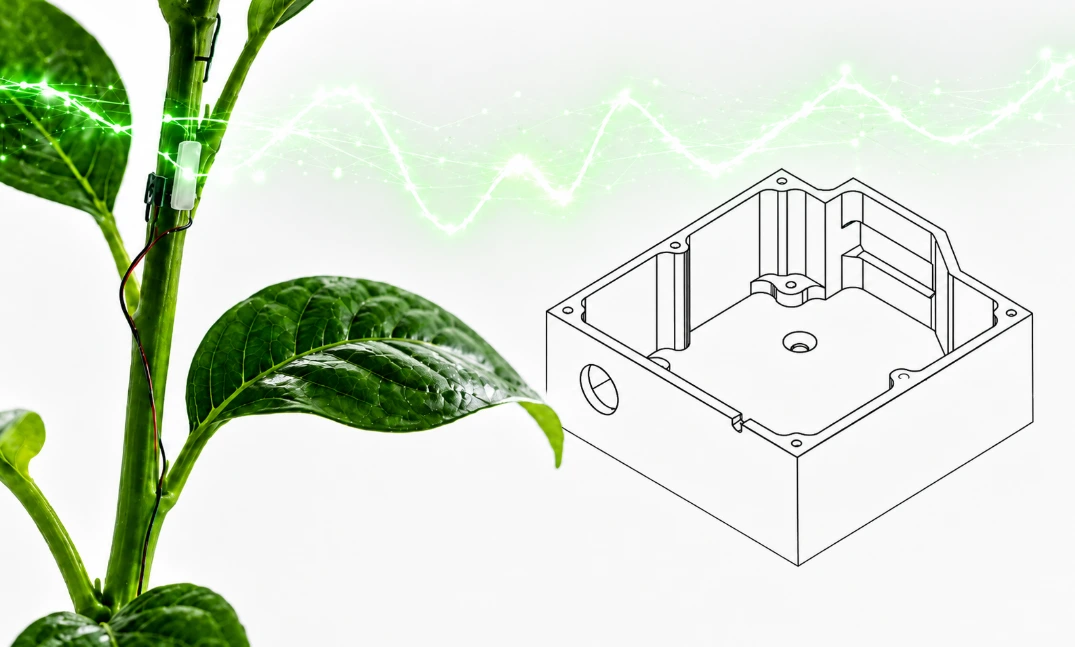
Project Overview
As demand grows for real-time plant-status data in plant care, landscaping, and environmental monitoring, our client wanted to upgrade the sensor housing by optimizing:
- Material
- Structural Design
- Assembly Precision
Project Details
| Country | Canada |
|---|---|
| Industry | AI-Enabled Plant Monitoring |
| Product | CNC-Machined Sensor Housing for an AI-Powered Plant Electrical-Signal Monitoring Device |
| Material | 6061-T6 Aluminum |
| CNC Machining Techniques | CNC 4-Axis Milling, Precision Drilling, Tapping, and Internal Pocket Milling |
| Surface Treatment | Type II Black Anodizing |
| Tightest Tolerance | ±0.05 mm |
Client Requirements
Our client wanted to upgrade sensor housing to achieve:
Easier Mounting
The housing required accessible mounting holes so that the sensor could be secured near the plant without interfering with the connector, cover, or internal PCB assembly.
Resistance to Humidity & Irrigation
Help the housing withstand humidity, irrigation, and condensation.
Reliable Inner Assembly
Maintain sufficient clearance and accurate positioning for the PCB, connectors, fasteners, and cover after machining and black anodizing.
The Challenge
Limited Internal Space
The compact housing leaves limited clearance for PCB assemblies, connectors, screws, and the cover.
Black Anodizing Allowance
The coating thickness can affect the usable space of holes, slots, threads, and mating features.
Post-Finish Assembly Fit
The final anodized housing still needed to assemble normally without compromising function.
Tuofa’s Solution
Anodizing Allowance Plan
We confirmed the black anodizing thickness range and identified holes, slots, threads, and other critical features that could be affected.
Feature Compensation
Critical holes, slots, and openings were slightly enlarged where needed. Internal and external threads were compensated before anodizing.
Process Control
After the internal pocket and locating features were machined, their dimensions and relative positions were inspected before the part moved to the remaining drilling and tapping operations. This intermediate check helped identify dimensional deviation before additional machining and anodizing costs were added.
Two Full Quality Inspections
Full inspections were carried out before and after anodizing to verify machining accuracy, tolerance, and final assembly fit. The first full quality inspection is to make sure the features that are machined by CNC machining, and the second one is to ensure the quality of coating on the sensor housing’s surface.
Result
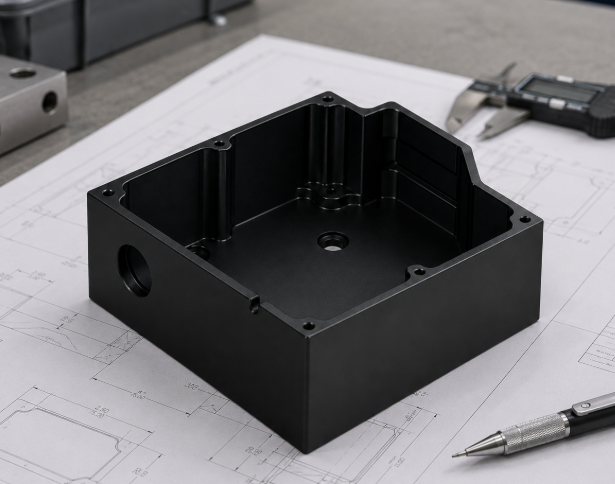
Tuofa CNC manufactured a compact 6061 aluminum sensor housing with a black anodized finish for our client. The sensor housing’s design, fit, and functional performance were validated through prototype testing. It met the requirements for dimension, ±0.05mm critical tolerance, and surface finish, and importantly, its function was not compromised. The precision compact design helped the sensor match the AI technology for the plants’ electrical-signals project.
Customize Your Parts- ✓Prototype design, fit, and function validated
- ✓±0.05 mm tolerance requirement achieved
- ✓Type II black anodized finish verified
- ✓Stable internal component assembly retained
FAQ
Can other materials be used for a sensor housing?
Sure. Both metals and plastics are suitable for manufacturing sensor housing. The material should be chosen based on your project requirements. In general, materials can affect the function, appearance, weight, corrosion resistance, and application environment of the parts.
Tuofa Multi-Materials Manufacturing →Can you machine a sensor housing based on our own drawing?
Of course. We provide custom CNC machining service. After receiving your 2D or 3D drawings, our engineers can provide DFM review as soon as possible. We also provide prototyping service, so your part design can be verified through a cost-effective prototype before moving forward.
Do you also provide surface finish service for sensor housing?
Yes. Tuofa has rich experience helping clients choose suitable surface treatment. Our team can evaluate whether a surface coating is compatible with the material and part design, helping avoid predictable risks such as poor coating adhesion, tolerance shift, or assembly interference.
Tuofa Surface Finishes →




Customer’s Comment