Tel/WeChat:
  Email:


 Home
HomeCNC Drilling Guidelines for Improving Hole Quality

 Published:Apr 18,2026
Across different industries, such as aerospace, medical, machines and equipment, and the construction industries, all of them rely on holes for assembly and structural integrity. So, these holes are crucial for successful assembly and further functions. To drill that hole with high precision, the CNC drilling operation is commonly used. This article provides insights into how we can improve the hole quality by using the CNC drilling operation.
When CNC Drilling Is Needed?
Likewise, other CNC operations, such as CNC drilling, are widely used manufacturing operations across almost every industry, including automotive, aerospace, medical, and construction. CNC drilling is an essential process for assembly and structural integrity. During manufacturing, CNC drilling is used for:
Creating Holes
For joining two components in a part, different processes, such as welding, can be used. Another method is through nuts and bolts after creating the holes. In most metallic parts, where the reliability of the joint is very critical, the CNC drilling process is used.
High Precision Requirement
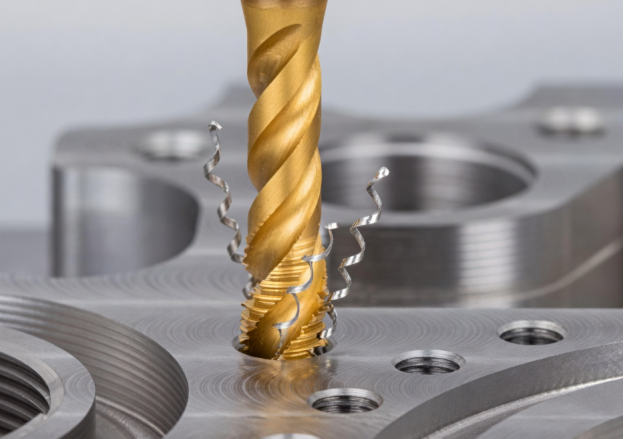
In manufacturing, precision is an extremely important factor for the successful employment of parts in applications. When two components of a part are joined, precision becomes more important because any failure, like a poor surface finish, results in reduced fatigue life, which ultimately results in failure. In expensive applications, precision in these holes is of the utmost preference, so to meet those safety standards, most manufacturing industries rely on high-precision CNC drilling operations.
How to Choose CNC Drilling Methods
There are many CNC drilling methods that are efficient for different types of applications. Let's discuss these methods one by one to understand in which scenarios the following methods can be used.
Standard Drilling
It's a common and basic CNC drilling operation, in which the twist drilling bit is placed perpendicular to the workpiece to make the round holes. Under stable machining conditions, this process is used for shallow-to-moderate hole depths. It's a versatile CNC drilling operation for many materials and is used when high precision and accuracy are required at cost-effective prices.
Peck Drilling
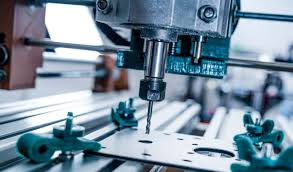
Peck means an increment when the drill bit advances in the workpiece to create high-depth and precise holes. The drilling tool retracts slightly to remove chips and allow coolant to reach the cutting zone. It is the best CNC drilling method when heat reduction while cutting is very important, especially for those materials which poor thermal conductivity, like Ni alloys.
Gun Drilling
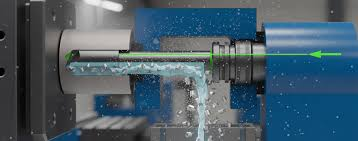
This CNC drilling method is called gun drilling because it was originally developed to create straight bores in firearm barrels. This method can create holes with a high depth-to-diameter ratio, like 10:1 and often reaching 100:1. This drilling method is used in the automotive industry for crankshafts and camshafts, for valve bodies in the oil and gas sector. This method stands tall when extremely deep holes with superior surface finish are required.
Center Drilling
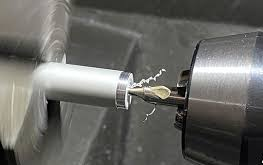
When the requirement is to create conical holes in the center of the workpieces, the center drilling method is used. It uses center drills to create a small, conical hole. This process is efficient in making holes at precise locations in hard and round workpieces.
Types of CNC Drills for Drilling
CNC drills with respect to materials and the type of holes required. Different types of tools include twist, center, step, indexable, solid, and gun.
Twist Drills
These drills can be identified by their helical flutes, which help in evacuating the chips from the holes and efficiently cut.
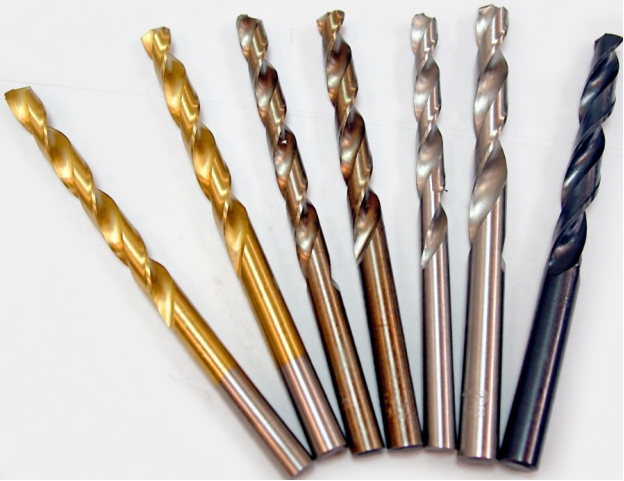
- Most widely used types of CNC drills
- Used for a wide variety of materials, including metals, plastics, and composites
- Made of high-speed steel, carbide steel, and coated with TiN coatings
- Best for general-purpose drilling where cost-effectiveness is required
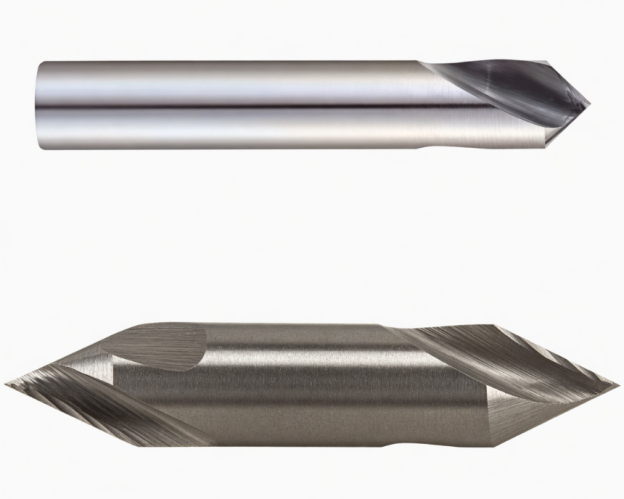
Center Drills
These are essential drills for high tolerances and precision engineering. Due to strong construction, they resist breakage really well during the drilling process. These drills are used to create chamfered seating surfaces. These short and rigid tools create accurate starting holes. These drills work best for metals and plastics.
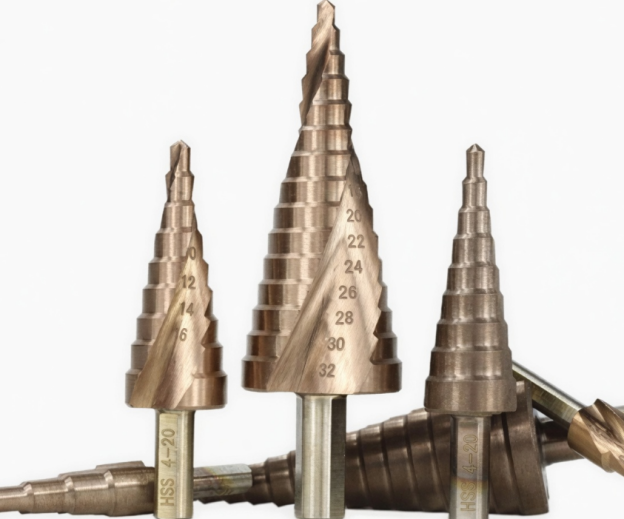
Step Drill
These drills have different diameters in steps which allow the creation of multiple holes of different diameters with one drill. These drills are suitable for both metals and non-metals.
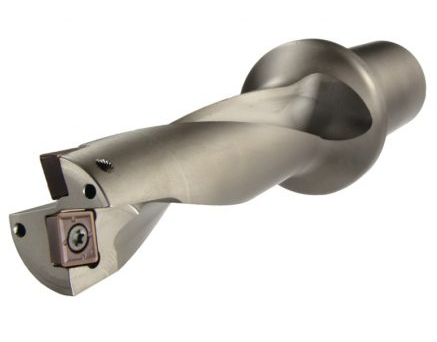
Indexable Drills
These are the advanced drills, which are used when high-speed and high-volume production is required. For these drills, the inserts can be replaced without discarding the entire drill, which reduces downtime and tooling costs. These drills are used for ferrous and non-ferrous metals, including high-temperature alloys.
Solid Carbide Drills
Only tungsten carbide is used to manufacture these drills. Their applications include:
- Precision holes in aerospace components
- Engine blocks and transmission parts
- Medical implants and surgical tools
- Hydraulic and pneumatic components
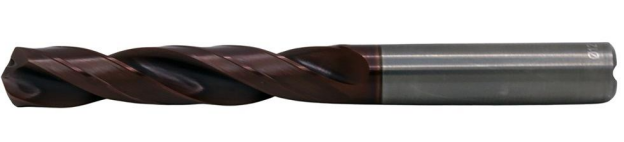
These drills provide exceptional dimensional accuracy and are suitable for hard and abrasive materials.
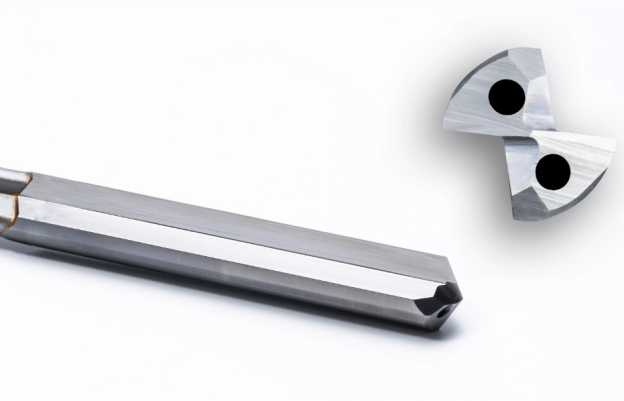
Gun Drills
Gun drills can produce deep, straight, and accurate holes. An internal coolant and guide pads for precision are built in with gun drills. Carbide-tipped steel and high-speed steel are used to make these drills. For metals and non-metals, the gun drills are used.
How to Set CNC Drilling Parameters
During any CNC machining operation, the parameters, like cutting speed, spindle speed, feed rate, and depth of cut, are important to set before machining the actual workpiece with high precision.
Cutting Speed
The speed at which the cutting tools operate to remove the material is called cutting speed. Set high-cutting speed for easy-to-machine materials, like Al, and for hard-to-machine materials, like Ni-alloys, set slow cutting speeds.
Spindle Speed
It is the rotating speed of the cutting tool or the workpiece. High spindle speed for easy-to-machine materials and slow spindle speed for hard-to-machine materials.
Feed Rate
It is the distance a drill covers while advancing in the workpiece. If the feed rate is high, then there will be more tool load. In the case of a lower feed rate, cutting is smooth, and tool life increases. So, a lower feed rate is advised.
Depth of Cut
It is the axial penetration of the drill into the workpiece during drilling. Easy-to-machine materials allow deeper penetration in one operation. The following table presents these parameters for different materials:
|
Material |
Cutting Speed (m/min) |
Spindle Speed (RPM for 10 mm drill) |
Feed Rate (mm/rev) |
|---|---|---|---|
|
Mild Steel |
25 - 35 |
800 - 1100 |
0.10 - 0.25 |
|
Stainless Steel (304/316) |
12 - 20 |
400 - 700 |
0.08 - 0.18 |
|
Aluminum Alloys |
80 - 150 |
2500 - 4800 |
0.15 - 0.35 |
|
Cast Iron |
20 - 30 |
600 - 1000 |
0.10 - 0.22 |
|
Brass |
60 - 120 |
2000 - 4000 |
0.10 - 0.30 |
G-Code Programming & CNC Machining
G-code is a geometric language that is used to instruct the CNC machines through setting the parameters, like G00, which is used for rapid positioning of the drill to the desired location.
Canned Cycles Selection
To perform the machining tasks, such as drilling, boring, etc., automatically in a sequence, these programmed commands are used. These cycles control cutting, dwell time, tool movements, etc. For instance, for simple drilling, the G81 code is used.
Hole Positioning and Coordinates
First, a coordinate system is selected, in which the X and Y axes are specified. After that, the locations of holes to be drilled are defined accordingly. For example, G90 is used for fixed positioning.
Set the Workpiece Zero
This step establishes a reference point from which all dimensions are measured. This step is also called work offset. G54 - G59 are standard work coordinate systems.
Position the Tool to the Hole
This step is responsible for the tools to approach the workpiece without causing collisions or damage to other materials. G00 code is responsible for the rapid positioning of tools.
Common CNC Drilling Mistakes
Any machining operation demands very careful, flawless processing to achieve the desired results, like dimensional accuracy. Like in other CNC machining operations, machinists make these common mistakes.
Tool Breakage
Due to improper feed rate, poor chip evacuation, excessive cutting speed, improper tool selection, and improper tool alignment and runout, tool breakage happens. It is a very expensive mistake because, with the tool itself, the workpiece also gets damaged.
Incorrect Cutting Parameters
CNC machining is an automated programming-based machining tool in which, once the parameters are set, the tools operate accordingly. So, if any parameter is fed incorrectly, for instance, a slow cutting speed for a hard-to-machine material, it will result in tool breakage and poor dimensional and surface accuracy.
Drill Walking
This mistake happens due to the absence of center drilling, incorrect tool geometry, excessive feed or speed, or due to the lack of a proper starting point. Due to these issues, the drill bit starts deviating from the intended position before penetrating the workpiece. It results in oversized or misaligned holes.
How to Inspect Holes Quality
To employ the parts in applications for longer times, the quality of the components of the parts should be excellent and flawless. Different parameters, such as dimensions, positions, accuracy, and edges, are inspected.
Dimensional Accuracy
Generally, plug gauges and bore gauges are used for dimensional accuracy. A Coordinate Measuring Machine (CMM) is mainly used to inspect the dimensional accuracy of holes in critical applications.
Positional Accuracy
Height gauge and surface plate are commonly used for the inspection of positional accuracy. To achieve high positional accuracy, CMM is used for micron-level inspection. It can measure full 3D geometry.
Surface Quality
For general applications, visual inspection and a surface roughness comparator are used to inspect the surface quality. Surface profilometer is a contact-type tool, used to inspect surface quality at the micron level.
Edge Condition
Edge condition means the physical state of the entrance and exit of the holes. It can be inspected using optical microscopy, a profile projector, a surface roughness tester, an endoscope, and a scanning electron microscope.
What Are the Advantages of CNC Drilling?
CNC drilling is an automated process and is used in highly critical applications, such as aerospace, medical, and automotive industries, etc. The following advantages make CNC drilling more useful:
High Precision and Accuracy
Since CNC drilling is an automated drilling process, it provides high precision and accuracy. Due to low human interaction, the tools continuously operate in the feed directions, so dimensional accuracy is high.
Excellent Repeatability
Since tools operate automatically, it makes it easier to get dimensional precision repeatedly because tools keep operating at the same cutting speed, spindle speed, feed rate, and depth rate. Due to no change in any parameter, excellent repeatability is easy to achieve.
High Efficiency and Productivity
CNC drilling operations provide high efficiency and productivity due to:
- High precision and accuracy
- Multi-axis capability
- Reduced setup and changeover time
- Automation and reduced human intervention
- Capability to perform multiple operations like tapping, drilling, etc.
Better Hole Quality
CNC drilling machines can easily achieve tight tolerance ±0.05 mm to ±0.10 mm, which means high-quality holes can be produced repeatedly.
Design Considerations for Drilled Hole
Sometimes, drilling unnecessary holes makes machining difficult as well as reduces the material's integrity. So, it is necessary to consider the following factors for drilled holes:
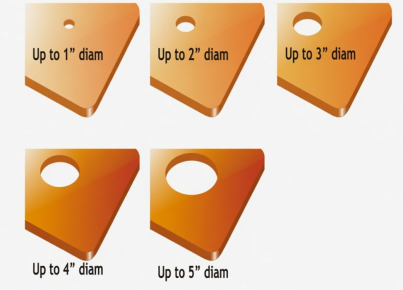
Hole Size and Spacing
Hole sizes should be optimum and according to the design and fastener fitting. For instance, if the hole size is too large or many holes are created at a little distance, it will weaken the material, so it will fail under loads. Furthermore, it becomes difficult to meet tight tolerances when the spacing is too low.
Depth-to-Diameter Ratio
This ratio is important to consider because, as the depth with respect to the diameter increases, the drilling tool becomes more prone to bending, which creates vibrations and results in poor dimensional accuracy. Secondly, in deep holes, chip evacuation becomes difficult.
Material Properties
The machinability and other mechanical properties vary from material to material. So, holes should be drilled according to material properties. For instance, in the case of hard-to-machine materials, like tungsten alloys, it will be quite difficult to create high-depth holes.
Drilling Sequence
To maintain dimensional accuracy, workplace rigidity, good tool life, easy chip removal, and machining, a correct drilling sequence is very important. Like, the process should start with the center drilling and end with deburring.
Conclusion
CNC drilling is an important subtractive machining operation used extensively in important industries, like automotive, aerospace, and medical. To maintain the automation in the machining, G-codes are used. There are different drilling operations, such as peck, center, etc. These operations vary based on requirements and different tools, such as twist drills, etc. Multiple tools, like a coordinate measuring machine (CMM), surface profilometer, and optical microscopy. Hope this Tuofa's complete drilling guideline can help you solve some questions, as an experienced CNC-parts manufacturer, Tuofa has professional manufacturing skills. Welcome to contact us for your drilling project.
FAQ
How to drill pocket holes?
A jig-guided or angled stepped drill is used to drill pocket holes with high accuracy and efficiency.
How do you drill a pilot hole?
I will use a twist drill bit and the spot drilling method to drill a pilot hole.
What is deep hole drilling?
This drilling operation is used to drill holes of high depth-to-diameter ratio, like 10:1. Gun drilling is a commonly used deep hole drilling operation.
 Tool Manufacturing: Materials, Techniques & Suppliers