Tel/WeChat:
  Email:


 Home
HomeUnderstanding Plate Machining: From Processes to Applications

 Published:May 07,2026
Plate machining is one of CNC machining techniques by removing materials from plates. It is typical used for plate-shape parts such as mounting plates, base plates, structural panels, etc. Different from sheet metal fabrication, plate machining can achieve excellent precision and high quality surface. Read this article to learn what is plate machining and when to choose it.
What Is Plate Machining?
The machining of metal or non-metal flat plates through the drilling, milling, or tapping, etc., processes to get a desired shape of the product is called plate machining. Plate machining is subtractive machining to create different components for the different industries, such as aerospace, construction, medical, etc.
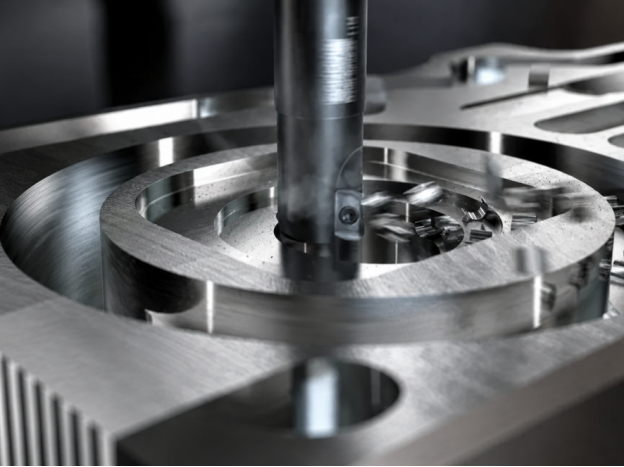
Thin Plate Machining vs Thick Plate Machining
The major difference between these plates is the thickness of the plates. For instance, thickness is low for thin plates and is high for thick plates. Another difference is the transverse shear deformation, which is negligible for thin plates and vice versa for thick plates.
|
Aspect |
Thin Plate Machining |
Thick Plate Machining |
|---|---|---|
|
Rigidity |
Low, easily flexible |
High, structurally rigid |
|
Stability |
Prone to vibration/deflection |
Stable during machining |
|
Cutting Force |
Requires light cutting force |
Requires high cutting force |
|
Tooling |
Sharp, precision tools |
Strong, heavy-duty tools |
|
Heat Impact |
Affects shape quickly |
Distributed across material |
|
Applications |
Electronics, sheet components |
Construction, heavy machin |
What Machines Are Used for Plate Machining?
Different machines are used for plate machining. The selection of machines is based on the material, thickness, and required precision. For instance, for a high-precision hole, CNC drilling machines are used. CNC laser cutting machines are used for size and profile cutting. CNC milling machines are used for manufacturing complex-shaped components.
Typical Features of Machined Plate Parts
What features of machined parts can be created by plate machining? CNC-machined parts are often made for baring loads, aligning or structural sealing, which requires parts to have features like:
- mounting holes
- flat surface
- slots or pockets
- special angles
- chamfer and edge
Then how to create these features on plates? Below we introduce the commonly-used machining methods for you.
Common Plate Machining Processes Explained
These are the commonly employed processes used for plate machining in modern manufacturing:
Face Milling
When the requirement is for large, flat, accurate surfaces in the fastest and most efficient ways, face milling is an ideal machining option, because face milling excels in maintaining the flatness of the plates.
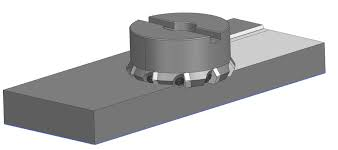
Face milling is used for plate machining in different important industries, such as:
- In aerospace, it is used to manufacture wing ribs, bulkheads, etc.
- In automotive, it is used in the manufacturing of engine blocks, brake components
- In the heavy machinery industry, it is used for machine bases, mounting brackets,
Contour Milling
When the target is to create complex internal or external profiles on a workpiece, contour milling stands tall in machining processes. In this process, the cutting tool can move in X, Y, and Z directions simultaneously, making it easier to achieve 3D shapes. This process is used in the manufacturing of turbine blades, medical implants, molds and dies, and cams.
Drilling and Tapping
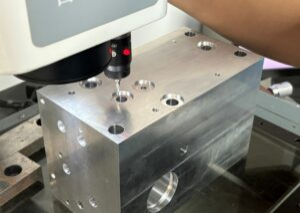
The drilling process is used to drill holes in plates to accommodate screws, rivets, and pins for joining purposes. It is used as a primary operation to create threaded holes. Tapping is the process which is used to make threads in external and internal surfaces. For instance, it is used to make threads in the holes to accommodate the fasteners.
Pocket Milling
In plate machining, to reduce the weight, such as in aerospace applications, pockets are often made in the components. To manufacture these pockets, pocket milling is used.
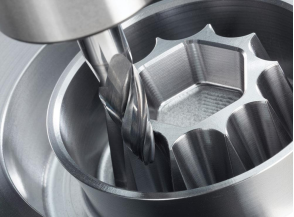
Plate Machining for Common Metals
Those materials are used to make plates that are easy to machine, stable, and suitable for the respective applications. The common materials include Al, steel, Ti, and tool steel.
Aluminum Plate Machining
Aluminum material is commonly used in almost every industry due to its high strength-to-weight ratio, good strength, and excellent corrosion resistance. It is a highly machinable material. To machine Al plates, choose the following cutting parameters:
|
Parameter |
Roughing |
Finishing |
|---|---|---|
|
Cutting Speed (Vc) |
200-400 m/min |
300-600 m/min |
|
Spindle Speed (RPM) |
Medium-High |
High |
|
Feed Rate (fz) |
0.10-0.30 mm/tooth |
0.02-0.10 mm/tooth |
|
Depth of Cut (ap) |
1-5 mm |
0.2-1 mm |
|
Width of Cut (ae) |
30-80% of tool dia |
5-20% of tool dia |
|
Tool Type |
Carbide, 2-3 flute |
Sharp carbide, 2-3 flute |
|
Coolant |
Air blast / light coolant |
Coolant or mist |
|
Surface Finish |
Moderate |
Smooth, high finish |
Steel Plate Machining
Steel exists in different compositions. It can be low-carbon steel, stainless steel, or hardened steel. Low alloy steels are easy to machine, but stainless and hardened steels are difficult due to their high strength. These are the cutting parameters used for steel:
|
Parameter |
Roughing (Steel Plates) |
Finishing (Steel Plates) |
|---|---|---|
|
Cutting Speed (Vc) |
80-150 m/min |
120-200 m/min |
|
Spindle Speed (RPM) |
Low-Medium |
Medium |
|
Feed Rate (fz) |
0.08-0.25 mm/tooth |
0.02-0.10 mm/tooth |
|
Depth of Cut (ap) |
1-4 mm |
0.2-1 mm |
|
Width of Cut (ae) |
40-80% of tool dia |
5-20% of tool dia |
|
Tool Type |
Carbide, 4-6 flute |
Carbide, fine edge |
|
Coolant |
Flood coolant recommended |
Flood / mist coolant |
|
Surface Finish |
Moderate |
Smooth finish |
Titanium Plate Machining
Titanium is one of the hardest metals to machine because of its lower thermal conductivity and high strength. To machine Ti plates, use these cutting parameters:
|
Parameter |
Roughing (Titanium Plates) |
Finishing (Titanium Plates) |
|---|---|---|
|
Cutting Speed (Vc) |
30-60 m/min |
50-80 m/min |
|
Spindle Speed (RPM) |
Low |
Low-Medium |
|
Feed Rate (fz) |
0.05-0.20 mm/tooth |
0.02-0.08 mm/tooth |
|
Depth of Cut (ap) |
0.5-3 mm |
0.2-0.8 mm |
|
Width of Cut (ae) |
30-60% of tool dia |
5-20% of tool dia |
|
Tool Type |
Carbide, TiAlN coated |
Sharp carbide, coated |
|
Coolant |
High-pressure coolant |
High-pressure / flood |
|
Heat Control |
Critical (poor heat dissipation) |
Critical for surface integrity |
Tool Steel Plate Machining
Tool steel is difficult to machine after the heat treatments because of the high carbon content and high hardness. Tool steel plates are machined generally using these machining parameters:
|
Parameter |
Roughing (Tool Steel) |
Finishing (Tool Steel) |
|---|---|---|
|
Cutting Speed (Vc) |
40-100 m/min |
60-120 m/min |
|
Spindle Speed (RPM) |
Low |
Low-Medium |
|
Feed Rate (fz) |
0.05-0.20 mm/tooth |
0.01-0.08 mm/tooth |
|
Depth of Cut (ap) |
0.5-3 mm |
0.1-0.5 mm |
|
Width of Cut (ae) |
30-70% of tool dia |
5-15% of tool dia |
|
Tool Type |
Carbide, TiAlN/AlTiN coated |
Carbide, fine edge coated |
|
Coolant |
Air blast / controlled coolant |
Light coolant or dry |
|
Hardness Range |
~30-45 HRC (pre-hardened) |
Up to ~60 HRC (hardened) |
Tools for Plate Machining
During plate machining, different types of tools are used, such as cutting, workholding, and measurement tools. Let's understand them:
Cutting Tools
These tools are used to remove the extra material from the workpiece to get the desired shape. Cutting tools generally depend on the respective cutting process. For instance, during face milling, face mill cutters are used; during the drilling process, drills are used. Other cutting tools include a chamfer mill, T-slot cutter, and fly cutter.
Workholding Tools
For CNC or conventional machining setups, these workholding tools are used for plate machining:
- Machine vice
- T-slot clamps
- Magnetic chuck
- Vacuum chuck
- Fixture plate
- Angle plate
- Tie clamps
- Parallels
Measurement Tools
Measurement tools are used to measure the dimensions of plates during or after machining processes. These tools include:
- Vernier caliper
- Digital caliper
- Micrometer
- Height gauge
- Dial indicator
- Surface plate
- Try square
- Bevel protector
Common Issues of Plate Machining
Plate machining is not generally easy because they are often thin or flat, so they don't always have the rigidity to bear higher cutting forces. The following issues generally arise during the plate machining:
Plate Warping
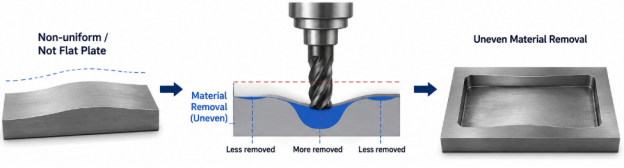
In plate warping, an undesired bending or distortion of a flat plate occurs, so the plates do not remain flat during or after the machining process. These issues arise because of uneven residual stresses, non-uniform material removal, expansion or contraction due to heat generation, or thin plate geometry.
Poor Flatness
In this issue, the plate does not remain perfectly flat within the specified tolerances. Due to this issue, the plates may show a bow, twist, or waviness. This issue arises when the workpiece has residual stresses in it, material is non-uniformly removed, improper clamping is done, or the thickness of the plate is low.
Uneven Thickness
Uneven thickness refers to plates with different thicknesses at different locations. The causes of this issue include:
- Residual stresses in the raw material
- Tool wear or deflection
- Due to heat, contraction or expansion at different points of a plate
- Non-uniform material removal
Inaccurate Hole Position
Inaccurate hole position results in functional failures. This issue arises because of improper CNC programming, machine backlash, workpiece shifting during machining or drilling, drill deflection, or wrong datum setup.
How to Optimize Plate Machining?
During plate machining, different issues can arise, as discussed in the above section. To avoid those issues, the machining of plates can be optimized by the following tips:
Improve Workholding Stability
It is the fundamental requirement in machining any workpiece and is the main cause of issues that arise during or after the machining process. So, the basis of plate machining is that the plate should be firmly and uniformly secured so it does not move, vibrate, or deform during machining. This workholding stability leads to accurate dimensions, better surface finish, reduced vibrations and chatter, and longer tool life.
Optimize Machining Sequence
Machining operations should be arranged in an efficient and logical order to achieve maximum accurate production. The typical machining sequence can be:
- Facing
- Rough machining
- Semi-finishing
- Drilling
- Profile machining
- Final finishing process
Use Layered Cutting Strategy
Instead of removing the extra material in one deep and heavy cut, it should be removed in multiple shallow passes. This approach can provide different benefits, such as reduced cutting forces, minimized tool deflection, improved dimensional accuracy, enhanced surface finish, and extended tool life.
Control Heat and Cutting Load
During plate machining, maintain cutting temperature and machining forces within safe limits. High heat generation can cause expansion or contraction, and higher cutting forces can result in tool deflection and workpiece distortion. It can be achieved by selecting optimum cutting parameters, using sharp tools, and applying proper lubrication.
What Is Plate Machining Used for?
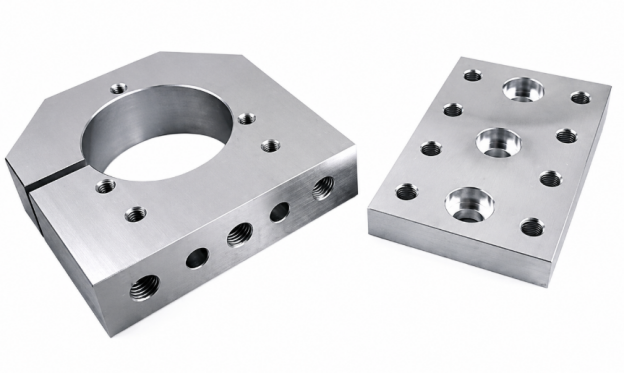
Flat metal plates are machined, drilled, and shaped into precise components, which are further employed in different industries. Especially, in the field of new energy, like Lithium battery systems, plates are used for manufacturing battery trays, cooling plates, etc.
Aerospace Industry
In the aerospace industry, plates are used because this industry needs high precision in the dimension meeting the tight tolerances and safety standards. Plate machining is used in the manufacturing of critical parts, such as mounting plates, high-precision supports, and lightweight structural components. Mounting plates are used to secure avionics, sensors, etc.
Automotive Industry
In this field, machining plates are used in the production of high-strength and reliable components, such as connection plates and engine mounting.
- Connection plates are responsible for connecting structural and mechanical assemblies.
- Engine mounting is responsible for attaching the engine to the vehicle chassis.
Machinery Industry
In this field, plates are converted into machine base plates, load-bearing structures, and linkage plates.
- Machine bases provide vibration-free, stable foundations for heavy equipment
- Load-bearing structures are designed to support static and dynamic forces
- Linkage plates transmit motion and forces between interconnected components
Robotics Industry
Frame plates, functional plates, and precision fixtures are made using plate machining.
- Frame plates form the structural backbone of the robotic systems
- Precision fixtures support accurate assembly, calibration, and positioning of robotic components
- Functional plates are responsible for mounting actuators, sensors, and control units
Plate Machining vs Other Machining Process
This section presents differences between plate machining and other machining processes.
Plate Machining vs 3D Machining
3D machining is an operation in which 3D complex shapes are produced after removing the unnecessary material. The following table concludes the differences between plate machining and 3D machining:
|
Aspect |
Plate Machining |
3D Machining |
|---|---|---|
|
Shape Complexity |
Simple, flat or prismatic parts |
Complex 3D shapes and contours |
|
Cost |
Lower |
Higher |
|
Machining Process |
Basic cutting, drilling, 2.5D milling |
Advanced multi-axis (3-5 axis) machining |
|
Material Usage |
More efficient, less waste |
More material removed (higher waste) |
|
Typical Applications |
Brackets, plates, battery trays |
Housings, molds, aerospace components |
Plate Machining vs Lathe Machining
In lathe machining, the workpiece rotates while the cutting tools remain stationary and remove the material. This table shows the key differences between plate machining and lathe machining:
|
Aspect |
Plate Machining |
Lathe Machining |
|---|---|---|
|
Part Shape |
Flat or prismatic parts |
Round / cylindrical parts |
|
Machine Type |
CNC mill, router, or cutting machines |
Lathe (turning machine) |
|
Process |
Cutting, drilling, milling on flat surfaces |
Rotating the part while cutting (turning) |
|
Material Orientation |
Fixed workpiece, tool moves |
Workpiece rotates, tool is mostly stationary |
|
Typical Parts |
Plates, brackets, battery trays |
Shafts, rods, bushings, fittings |
Plate Machining vs Sheet Metal Fabrication
In sheet metal fabrication, parts are produced through operations like bending, forming, and cutting. The differences between plate machining and sheet metal fabrication include:
|
Aspect |
Plate Machining |
Sheet Metal Fabrication |
|---|---|---|
|
Material Thickness |
Thick plates |
Thin sheets |
|
Process |
Milling, drilling, cutting |
Cutting, bending, stamping |
|
Shape Capability |
Rigid, solid parts |
Folded and formed parts |
|
Precision |
High precision and tight tolerances |
Moderate precision |
|
Typical Parts |
Base plates, brackets, battery trays |
Enclosures, panels, covers |
Factors for Choosing Plate Machining Services
Consider the following factors when it is about the selection of plate machining services selection.
Flat Plate Geometry
A non-uniform plate or a plate with not sufficient flatness can lead to uneven material removal from the plate, so variations in thickness, poor surface finish, and inaccurate dimensions will be produced.
High Precision and Tight Tolerance
This factor is important because it guarantees a proper fit, seamless assembly, and reliable performance in the critical industries, such as aerospace, automotive, medical, etc.
Load-Bearing Requirements
Proper consideration of load requirements results in safe support against static, impact, and dynamic loads while maintaining the dimensional stability and long-term reliability in service.
Conclusion
Plate machining is widely used in almost every industry due to the requirements of high precision and performance of the components. Different machining operations, such as drilling, milling, tapping, etc., are used during plate machining to get the desired products. Al, steel, titanium, and tool steel are commonly used materials in plate machining because of their mechanical properties. During plate machining, several issues, such as plate warping, thermal effects, etc., can arise, which can be tackled by optimizing machining parameters and using proper lubrication.
With over 20 years of manufacturing experience, Tuofa has mature plate machining techniques, which can help customer produce precision plate-shape components in short time.
FAQ
How to machine plates?
Plates can be machined by different processes, like drilling, milling, etc. It depends on the requirement of the precision level and the component shape.
What machines are used for plate machining?
CNC lathe machines, CNC drilling machines, CNC laser cutting, CNC tapping, etc., are used for plate machining. It depends on the required shape and precision of the product.
What are aluminum plates used for?
Al plates are known for their excellent strength-to-weight ratio and corrosion resistance, so they are used in the aerospace and automotive industries.
 Mounting Plate: Types, Materials, Design & Custom Machining