Tel/WeChat:
  Email:


 Home
HomeMilling M/C: Capabilities, Pros & Cons, and Selection Guide

 Published:Mar 26,2026
A milling M/C, or milling machine, is one of the core pieces of equipment used in CNC machining to produce metal and plastic parts with a wide range of functional features. However, milling machines vary significantly in configuration, axis capability, work envelope, spindle performance, and machining capacity, so the right machine depends heavily on the part being produced.
This also raises an important question when choosing a CNC machining supplier: does the shop have the right mix of milling equipment to handle different part sizes, geometries, materials, tolerances, and production requirements? In this article, we explain how different types of milling M/Cs relate to different machining applications and what equipment capabilities you should expect from an experienced CNC machining manufacturer. Understanding these differences can also help you evaluate whether a supplier is properly equipped for your parts.
What Is the Milling M/C?
Milling M/C is a specialized piece of equipment and widely used in manufacturing industries to cut material from solid blocks or billets as per engineering designs. In contrast to turning machine, a milling machine usually has a stationary workpiece and a movable tool. A movable worktable lets the workpiece move inwards/outwards and sideways. The cutting tool spins at high speeds. This arrangement allows manufacturers to fabricate intricate geometries, slots, surfaces, and specialized features with great precision. Industrial milling machines are extensively used in industries where subtractive manufacturing is needed. Common examples of parts include automotive engine parts, medical precision components, and industrial structural parts.
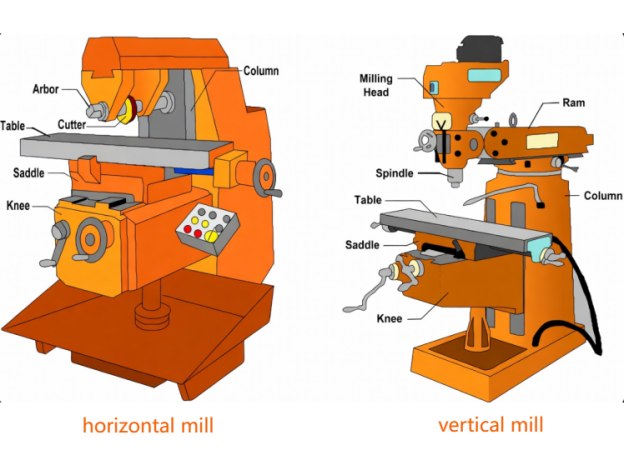
What Is Another Name for A Milling Machine?
A milling machine is often just called a “mill”. Some industries call it a “precision mill” in the production field. A milling m/c that is operated digitally is referred to as a CNC milling machine or CNC mill.
Is Milling Machine Automatic or Manual?
Milling machines can be manual or automatic. A manual milling machine needs an operator to manually set the feed rate, tool movement, and cutting parameters. They are usually applied as training machines, small-scale machining machines, and maintenance machines. On the other hand, a CNC milling machine is a machine that is programmed using digital files. CAM files are used to set toolpaths. The operator will only be required to load the program and supervise the process. CNC machines offer high repetition and accuracy.
Is It Hard to Use a Milling M/C?
The complexity of using a milling machine is determined by the type of machine.
- Manual milling machines need operators with limited machining knowledge such as cutting speed, tool geometry, and positioning of the machined work.
- CNC milling machines are simpler to use in the manufacturing process. The machining process is automated. Nevertheless, they need CNC programming, CAD/CAM software, and machine setups. After successful programming, CNC machines are capable of producing parts with little human effort.
What Is A Milling M/C Composed of?
A milling m/c has several structural components. These facilitate machining and provide stability and accuracy.
Base
Base is the foundation of a milling m/c. It sustains the complete structure and dampens vibrations produced in the course of machining. A rigid base guarantees that the machine is stable. It gives accuracy in dimensions during milling.
Column
Column is a vertical structure that is attached on the bottom. It helps in supporting the spindle, and motor. There are also internal mechanical systems of the column including drive mechanisms and electrical wiring.Column can affect the spindle alignment because if the column deflects, the position of tools can probably change slightly, which can influence the dimension of milled-parts.
Knee
Knee is a vertically adjustable part which slides on the column. It is in favor of the saddle and worktable. It is used to adjust the height of the workpiece with regard to the cutting tool. Only vertical mill has.
Saddle
The saddle is attached to the knee, and provides horizontal movement of the worktable. It facilitates the positioning of the workpiece accurately when they are under machining.
Worktable
Workpiece is mounted on the worktable. It position is adjustable. Moving worktable is a peculiarity of milling machine that provides performing of complex machining.
Spindle
The cutting tool is attached to the spindle and turns with it. It spins very fast usually between 500 and 10,000 RPM. Parameters depends on machine and material being machined.
Feed Mechanism
The feeding system is used to regulate the motion of the cutting tool and worktable. It determines the rate at which the feed is fed. It has a direct bearing on the quality of the surface machining and efficiency.
The feed mechanism of a manual milling machine is typically built differently from that of a CNC milling machine because the two machines use different methods to generate and control axis movement.
A manual milling machine may use components such as:
- Handwheel
- Lead screw
- Nut
- Gears
- Shaft
- Clutch
A CNC milling machine may instead use:
- Servo motor
- Coupling
- Ball screw
- Ball nut
- Support bearings
In simple terms, a manual mill relies more on mechanically transmitted operator input, while a CNC mill uses servo-driven components to provide more precise, repeatable, and automated feed motion.
Control System
It controls the milling operations by parameter adjustments. With computer programs, this system is applied in CNC milling machines, where more precise control of the tool movement is carried out.
What Is the Milling M/C Used for?
Milling machines are extensively used in subtractive manufacturing. Material is removed from a workpiece, creating the desired shape or feature. Milling machines are commonly used for operations such as face milling, peripheral milling, profile milling, contour milling, slot milling, and pocket milling. These operations can be understood more clearly by looking at what they create on a part: its overall shape and its localized features. The following sections explain how milling machines are used to produce both.
Milling M/C for Shapes
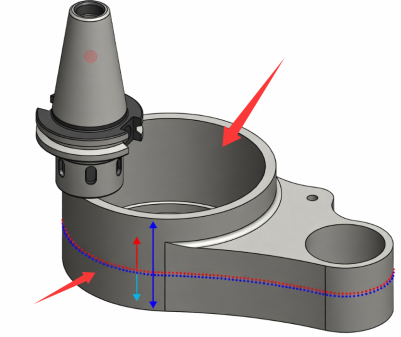
A milling M/C is used to establish the primary geometry of a part by removing material from a solid workpiece. Through controlled movement of the cutter and machine axes, it can create flat faces, stepped surfaces, angled planes, external profiles, prismatic forms, and complex 3D contours. Operations such as face milling, peripheral milling, profile milling, and contour milling are commonly used to shape the main body of the part and establish reference surfaces for subsequent machining.
Milling M/C for Features
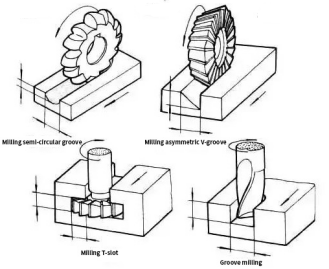
A milling machine is also used for machine specific features of parts, such as slots, pockets, holes, keyways, thread, groove, chamfers and fillets, etc. These features are essential for the functions and assembly of parts.
What Are the Pros and Cons of Milling M/C?
CNC milling machines are highly significant in the manufacturing sector today. It is all due to their high accuracy and versatility in producing complex parts. A CNC milling machine offers many advantages, such as high accuracy and automation. It also has limitations. Therefore, businesses need to consider the advantages and disadvantages of using CNC milling machines. It facilitates them to make informed decisions about the manufacturing processes.
Advantages of Milling Machines
Milling m/c has advantages on dimensional accuracy, surface quality, material selection, and efficiency.
Achieve High Precision
CNC milling machines are capable of maintaining ±-0.01 mm tolerance. This tight tolerance helps in the proper fitting of components in critical applications like aerospace.
Provide Excellent Surface
The mill cutter of the CNC milling m/c have multiple flutes, they can alternately cut materials during rotation.Due to this feature, a surface finish as fine as Ra 0.8 um can be achieved without extra finishing processes.
Keep Consistent Quality
CNC milling machines deliver uniform quality once the setup process is complete. This means that all the parts produced will meet the required quality standards. There will be no significant differences. The probability of defective products will be significantly reduced.
Support Wide Range of Materials
Milling machines may be used to handle a wide array of materials. Some examples are shown in the table below:
|
Type of Materials |
Common materials |
Industrial Applications |
|---|---|---|
|
Metals and Alloy |
Al, Steel, Ti, Stainless Steel, Cu and Brasses |
Automotive, Aerospace, Biomedical implants, Structural parts etc |
|
Polymer/ Plastics |
ABS, Polycarbonate (PC), Acrylic (PMMA), and nylon, |
Consumer Products, Prototyping, Lightweight Parts |
|
Composite |
Carbon Fiber and Fiberglass |
Automotive, Aerospace, Structural Parts, Construction and Decorative applications |
|
Ceramics |
Alumina, zirconia |
Cutting Tools, Industrial Components |
Improve Efficiency
The milling m/c can operate continuously for 24 hours automatically thought programme. Automation increases the overall efficiency. Manufacturers are able to make parts at a faster rate. Manual processes are kept at a minimum.
Disadvantages of Milling M/C
High Cost of Machines
The cost of industrial CNC milling machines is between $ 50,000-500,000 depending on size and capabilities. But this high cost pays off by increasing productivity.
Geometry Limitation
Some geometrical features are hard to machines. Examples are listed below:
- Sharp internal corners
- Deep narrow cavities
- Extremely thin walls
These shortcomings are as a result of milling tools being cylindrically shaped.
Needs Skilled Operators
CNC milling machines need operators with necessary qualifications in CNC programming, tooling and machining parameters.
What Are Types of Milling M/C?
Milling machines are classified according to their orientations, operations, and functionalities. The common types include vertical mill, horizontal milling machine, and universal milling m/c. Each type of milling m/c has its own strengths and limitations. Let’s discuss them in details. Here are some recommended brands for high-quality milling machines:
|
Brand |
Vertical Milling Machines |
Horizontal Milling Machines / HMCs |
Rating |
Key Reason |
|---|---|---|---|---|
|
Makino |
Yes |
Yes |
★★★★★ |
High precision and strong 3D machining capability |
|
Okuma |
Yes |
Yes |
★★★★★ |
High rigidity and stable accuracy |
|
Mazak |
Yes |
Yes |
★★★★★ |
Strong automation and broad machine range |
|
DMG MORI |
Yes |
Yes |
★★★★★ |
Advanced multi-axis and high-precision machining |
|
DN Solutions |
Yes |
Yes |
★★★★☆ |
Good balance of rigidity, productivity, and cost |
|
Haas |
Yes |
Yes |
★★★★☆ |
Versatile, widely used, and cost-effective |
Vertical Milling Machine
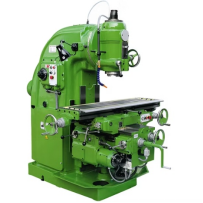
A vertical mill contains a spindle that points in a vertical orientation.
Key Features of Vertical Mill are:
The most distinguishing feature of a vertical mill is its spindle. It is aligned in a vertical orientation. It facilitates the manufacturing of small but complicated components.
How to Use Vertical Milling Machine
- The piece of work is attached to the worktable.
- Fix the cutting tool in place.
- Adjust the speed of the spindle and feed rate
- Carry out the machining process.
Horizontal Milling Machine
A horizontal milling machine has a spindle that is mounted horizontally.
Key Features of Horizontal Mill
The horizontal orientation of the spindle increases the material removal rate. So, a horizontal milling machine is mainly favored for heavy machining. Ideally, large workpieces are milled on horizontal milling machines.
Steps for Using Horizontal Milling Machine
- Secure the workpiece
- Installation of the horizontal cutter.
- Set machining parameters
- Perform cutting operation
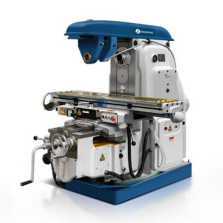
Universal Milling Machine
The universal milling machines are a mix of both vertical and horizontal mills.
Outstanding Features of Universal Mill
The adjustable worktable facilitates multi-direction machining. Milling can be done in both horizontal and vertical alignment. In short it offers greater versatility than either horizontal or vertical mills.
Guide to Using Universal Milling Machine
- Choose machining direction
- Secure the workpiece
- Install the cutter
- Start the machining process
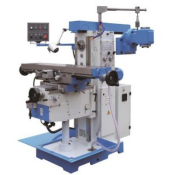
Multi-Axis Milling M/C: CNC Machining Capabilities
The most common multi-axis milling machines are 3, 4-axis, 5 axis milling machines. Out of all of these, the 3-axis is the most common milling m/c type. And 5-axis machining is always used for complex components.Face milling, contour milling, thread milling and other types of milling operations can be done easily.
The Machining Capabilities of Multi-Axis Milling Machines
Multi-axis milling machines can achieve 3/4/5 axis machining capabilities and results.Here let us learn how milling m/c achieve these capabilities.
|
Capabilities of Milling m/c |
How Milling Machines Work |
|---|---|
|
3 Axis Milling |
A CNC milling m/c performs 3 aixs machining by driving the tools along the X,Y,Z linear axes to remove material |
|
4 Axis Milling |
CNC mill integrates a rotary axis to rotate the workpiece |
|
3+2 Axis Milling |
A milling machine rotates the workpiece to a fixed orientation by using two rotary axes, and then starts machining by using 3-axis movements |
|
Simultaneous 5-Axis Milling |
The mill coordinates all linear and rotary axes in real time |
Is 3 Axis or 5 Axis Milling Machine Suitable for 3D Contours?
In practice, a 3-axis milling machine can produce many 3D contours, so 5-axis milling machine is not always necessary. The main limitations are fixed tool orientation, more difficult access to certain surfaces, and the possibility of requiring additional setups. For relatively simple 3D contours with moderate accuracy and accessibility requirements, a 3-axis machine can therefore be a more cost-effective option, provided the machining strategy is confirmed by an experienced engineer.
How to Choose Suitable Milling M/C?
The selection of the appropriate milling machine is dependent on a number of factors.
Evaluate Work piece Size
When choosing a CNC milling machine, the size of the workpiece is an important factor. CNC milling machines can work with both small and large workpieces. Large machines with large worktables are used to handle heavy workpieces. For small workpieces, small machines are used to achieve accuracy and precision.
Assess Precision Requirement
High precision incurs extra cost. For low precision requirements, low-cost machines can give satisfactory results. But for higher precision, high-cost machines shoot up the manufacturing costs. For example, CNC milling machines are needed in industries with tolerances of ±0.01 mm or higher, such as aerospace.
Determine Part Geometry
Simpler geometries can be produced by 3-axis CNC mills. But complex shapes like complex curves, undercuts, inclined features need Multi-axis CNC milling machines like 3+2 axis or 5 axis machines.
Ensure Enough Budget
High-end CNC milling can be costly to at times. On the other hand, simple milling machines can be more cost-effective. But the real difference comes in precision. If the client need a higher precision, they need to consider the budget.If you expect to handle a wide range of machining work, investing in a 5-axis-capable milling machine can provide greater flexibility, since it can also perform many 3- and 4-axis operations. For a narrower range of work or a shop that is just getting started, a 3- or 4-axis milling machine may be a more practical choice for reducing upfront equipment costs.
Benefit of Maintaining Milling M/C in CNC Machining
Maintenance is a key factor in increasing the lifetime of a milling m/c. Well-maintained machines help to achieve accurate machining results. They remain production-ready and give more reliability. Above all, maintenance ensures safety during machining operations.
Maintain Parts Accuracy
Regular maintenance of milling machines ensures that the parts produced are highly precise. This helps in reducing any possible errors that may have occurred.
Extend Machine Lifespan
Service life increases greatly with proper lubrication. Regular checks can prolong their working span to a number of years.
Ensure Safety
Properly kept machines minimize the possibility of mechanical breakdown and accidents.
Optimize Machine Performance
Maintenance is to make sure machines are in optimum performance and productivity.
Tuofa CNC Machining with Advanced Milling M/C Center
Toufa CNC milling manufacturer has a state-of-the-art milling m/c center. We are a leading multi-axis CNC milling manufacturer. Our advanced capabilities encompass numerous aspects of subtractive manufacturing. We're well-equipped with a variety of milling machines. We ensure compliance with international standards.
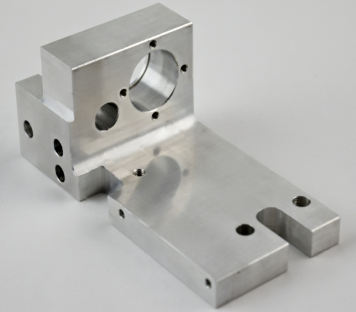
Equipped with Multi-Axis Milling Machines
Tuofa is well-equipped with categories of milling machines. We devise the manufacturing strategy while considering the CAD files. In this way, Toufa Manufacturing Services gives economical yet accurate manufacturing solutions. We are equipped with:
- Vertical mill
- Horizontal mill
- 3/4/5-axis mill
Well-Trained Operators
Toufa's dedicated team of operators has contributed a lot to our successful journey. These skilled operators have attained a high level of professional efficiency. Our on-the-job training further enhances their machining skills.
Professional Machining Capability
Toufa's work center has all sorts of multi-axis milling capabilities,well to the demands of medical, aerospace, automotive, and various other industries. We have the ability to provide custom machining service for small volume production.
Conclusion
Milling machines are among the most valuable tools of the present manufacturing setups. Be it automotive parts, aerospace parts or industrial equipment, milling m/c is relevant everywhere. The knowledge of capabilities and limitations of milling machines enables to select the appropriate equipment. Analyzing the workpiece size, precision needs, material, and budget, helps to choose the most appropriate milling machine.
FAQ
What does milling machine do?
A milling machine is a machine that is used to cut into a solid workpiece as per engineering drawings. It is used to make flat faces, slots, holes, and intricate shapes.
What are the tools used in a milling machine?
In a milling machine, the milling tool system comprises various components, including cutting tools, tool holders, and tool inserts. The cutting tools may comprise end mills, face mills, ball nose cutters, thread mills, and slot cutters, among others. These tools are held in tool holders, which securely hold them in place during the cutting operation. This system is used for precise cutting operations across various materials, offering versatility.
What are different types of milling cutters?
There are types of milling cutters namely:
- End mill cutters
- Face milling cutters
- Slab milling cutters
- Thread milling cutters
What are the different types of milling?
Mounted operations that are used in common milling are face milling, end milling, profile milling, slot milling, and thread milling.
 Understanding Machinability of Materials: Rating, Factors & Comparison