Tel/WeChat:
  Email:


 Home
HomeOn Demand Manufacturing: On Demand Machining and Process

 Published:Mar 11,2026
On demand manufacturing, as a novel manufacturing model, is gaining popularity due to its enormous benefits. It's flexible, adaptable, customizable, and scalable. On demand manufacturing provides benefits to customers and suppliers. Customers can order customizable products with a low MOQ. Instant quotes help them decide early on. Manufacturers also benefited from low buildup of unsold inventory. While traditional manufacturing models are still relevant, many customers find on demand manufacturing more feasible. Let's discuss it further!
What On Demand Manufacturing Means
In contrast to the traditional manufacturing approach, on demand manufacturing begins production after the order is placed. As order details are specific, it caters well to the client's needs. As inventory costs lower down, manufacturers tend to focus more on advancement in manufacturing.
On Demand Meaning
As its name suggests, "on demand" means that production or delivery is made only when required. Take the example of Uber. Instead of keeping a fleet of hundreds of taxis on standby, the Uber app hires a car only when a customer books a ride. Similarly, Domino's bakes pizzas only after order confirmation, rather than in mass production. In the engineering goods context, on demand manufacturing relies on data-driven manufacturing systems that enable production according to customer demands. It does not need mass production and forecast-driven planning. So. It relieves industries of excess inventory buildup. It shortens production cycles,
On Demand Manufacturing Definition
On demand manufacturing is a production model. In this model manufacturing takes place only after an order is placed. Production begins with real-time data. On demand manufacturing utilizes digital platforms for order placement. Design files, automated quoting systems, and adaptable manufacturing processes are the backbone of on demand manufacturing. This digital network links customers, sales team, production facilities, and logistics. Manufacturing processes like CNC machining and 3D printing are adaptable to this manufacturing on demand.
What "Manufactured on Demand" Means for Buyers
On demand manufacturing brings a lot of ease for buyers in many situations. They do not need to worry about the MOQ. Low-volume production is possible. On demand manufacturing offers a high level of customization. Prompt design iterations can be incorporated into products. As on demand manufacturing relies on digital platforms, it brings more transparency in pricing. Overall, buyers need low inventory investment, faster lead times, transparent pricing, and customization in manufacturing.
Why On Demand Manufacturing Is Growing
On demand manufacturing is gaining popularity day by day. It is getting traction among buyers with low MOQ. They can get customization with faster lead times. Digital quoting systems enable them to estimate prices. Prototypes can be created fairly early in comparison to the traditional mass production processes.
How On Demand Manufacturing Works
The process begins when the customer uploads a CAD file to the digital platform. The system analyses the CAD. It then generates a quotation specifying lead time. Once the client approves the order, it is sent to the production facility for production. The customer can track production online and advise on any design revisions. QA/QC compliance is complete. Then the logistics department dispatches the product to the customer's address.
On Demand Manufacturing vs Traditional Production
On demand manufacturing is compared with established production models like MTS, MTO, and ETO. While on demand manufacturing outperforms in many areas, traditional manufacturing models still have great relevance. The table below compares these production models.
|
Aspect |
MTS |
MTO |
ETO |
On Demand |
|
Production basis |
Forecast based |
Order -based |
Order- based but involves engineering |
Digital order: CAD and instant quote |
|
Inventory |
High |
Low |
Very low |
Minimal |
|
Customization |
Low |
Medium |
High |
Medium -High |
|
Lead Time |
Short |
Medium |
Long |
Short - Medium |
|
Applications |
High-volume standard goods |
Customized standard products |
Complex and unique projects |
|
|
Cost Advantage |
Lowest at high volume |
Balanced |
High engineering cost |
Cost-efficient for low volumes |
|
Flexibility |
Low |
Moderate |
High |
Very high |
MTS vs On Demand
MTS stands for "Make-to-Stock". In this model, goods are produced based on demand forecasts. They are then stored in inventory. MTS can be used only when demand is predictable. It cuts production costs because of mass production. However, overproduction, unsold inventory, and storage costs still require due diligence. On the contrary, on demand manufacturing relieves manufacturers of inventory costs and the associated risks. Due to adaptive tools, on demand manufacturing also delivers in a reasonable time. Production cost can be high, but it can be balanced by low inventory costs.
MTO vs On Demand
MTO stands for "Make-to-Order". This model is close to on demand manufacturing. But it may lack digital solutions and rapid manufacturing tools. While on demand manufacturing capitalizes on automated quoting systems, cloud-based CAD file analysis, and networking. MTO may not be fully digitized. So manual coordination for scheduling and planning results in longer lead times. MTO is suitable for customized products with moderate complexity and predictable engineering requirements.
ETO vs On Demand
ETO stands for "Engineer-to-Order". It is commonly used for complex projects where new calculations, drawings, testing, and validation are done for every case. So, it is a very customization-intensive model. Common applications include large infrastructure projects, heavy equipment, power plants, and aerospace systems. In comparison to on demand manufacturing, ETO gives longer project timelines and detailed client interaction.
When Traditional Production Still Wins
On demand manufacturing is gaining widespread popularity day by day. But, still, traditional production is very relevant in many areas. When demand is predictable and long-term mass production is required, traditional manufacturing is the winner. It brings down costs and ensures the immediate availability of products.
Processes Used in On Demand Manufacturing
On demand manufacturing employs agile techniques and adaptive processes. It allows economical and rapid production in small volumes. Processes like CNC machining, 3D printing, and sheet metal fabrication are considered as the backbone of on demand manufacturing.
On Demand CNC Machining
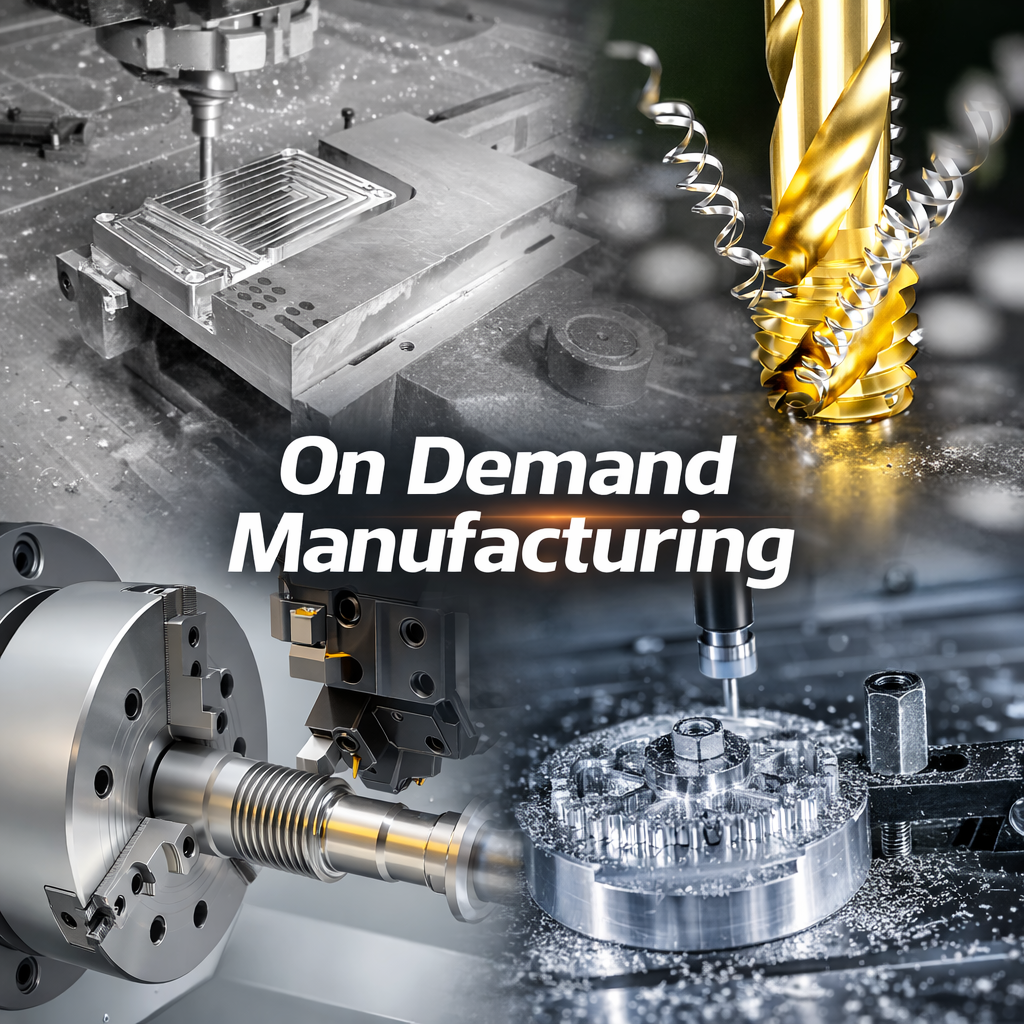
CNC machining is a really important tool for on demand manufacturing. On demand CNC machining can promptly carve out complex geometries, pockets, slots, and contoured surfaces from solid blocks. CNC turning can be used to make cylindrical components such as shafts and bushings. All of this can be manufactured in a very short turnaround time. Just a CAD file and CAM software guide the CNC machine to perform its job.
- 5-axis machining can make highly complex parts used in aerospace and medical applications in a single setup.
- 3+2 machining also gives a good freedom for tool movement. It is more cost-effective than 5-axis machining.
- 4-axis CNC machining also reduces setup time by providing an additional rotary axis. The variants of CNC machines can be employed depending on the complexity of the design and precision requirement.
On Demand 3D Printing
On-demand 3D printing is a common manufacturing method. The process builds parts layer by layer, but the material choices are more limited than CNC machining. Most low-cost 3D printing services mainly work with plastic materials. That's somewhat explain why 3D printing is often not the best choice for high-load, high-precision, or long-term structural parts. It is more suitable for prototypes, custom parts, and small-batch production, while CNC machining still offers better precision.
On Demand Sheet Metal Fabrication
Sheet metal fabrication processes are very flexible. Common processes include laser cutting, punching, bending, and forming. Laser cutting can carve out very precise designs from a sheet of metal. A single CAD file ensures repeatability. CNC press brakes can make accurate bends with precise angles within tight tolerances.
Due to the flexibility of the processes, low-volume orders can be satisfactorily entertained. As a result, custom manufacturing of enclosures, brackets, panels, chassis, and structural assemblies is done by using these fabrication processes.
On Demand Surface Finishing
The well-known feature of surface finishing processes is that they can be batch-produced. On demand manufactured products can be subjected to processes such as anodizing, bead blasting, plating, heat treatment, and marking. The finished goods can be delivered as per the client's requirements.
On Demand and Custom Manufacturing
Both manufacturing models converge at one point. On-demand manufacturing and custom manufacturing begin production after the order is placed. Custom manufacturing uses traditional options like manual correspondence, analyses and production scheduling. On the other hand, on demand manufacturing leverages digital and automated systems. Cloud-based design submission, automated manufacturability analysis, and distributed production networks bring clarity and speedy manufacturing. While both models serve the same purpose, on demand manufacturing stands out in terms of digitization.
On Demand Manufacturing and Machining Examples
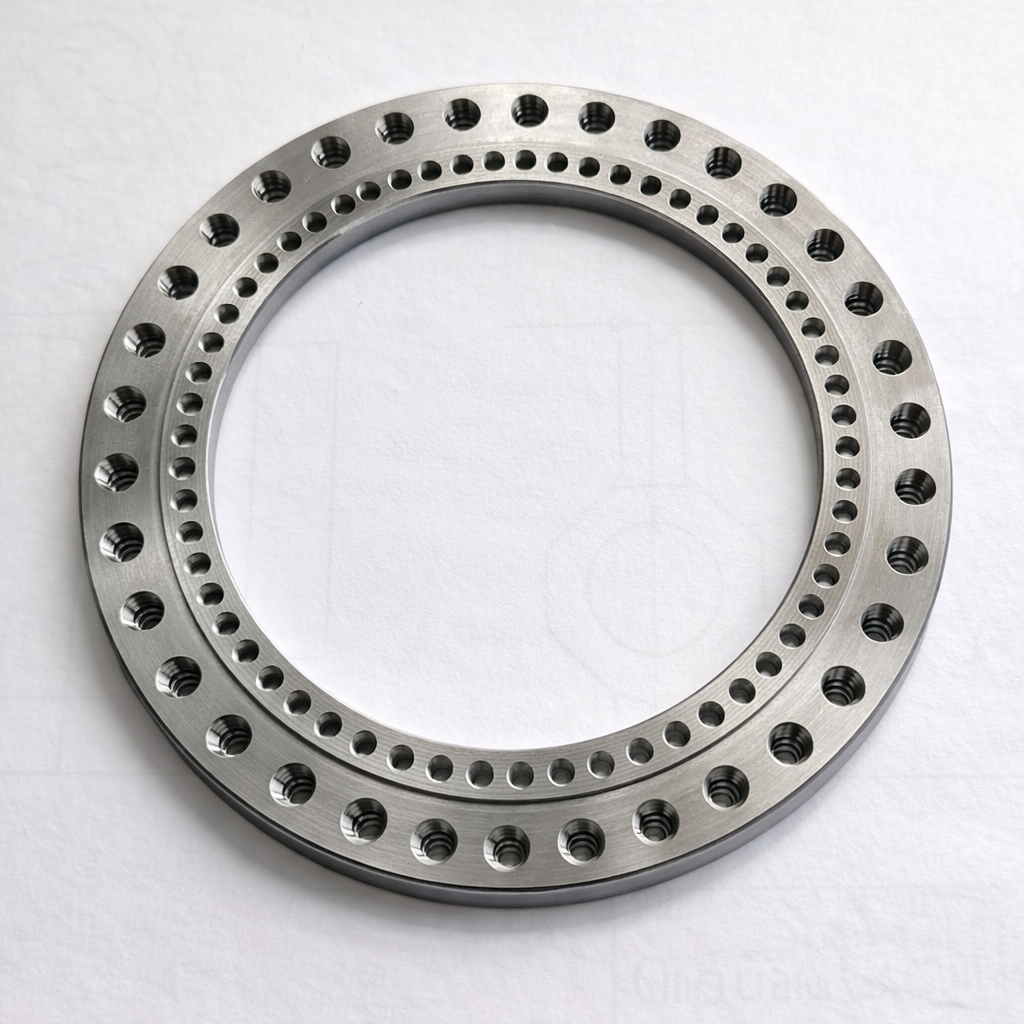
The fruits of on demand manufacturing are reaped for custom-made complex designs. As an example, humanoid robots are not mass-produced. They have a high level of design complexity. Functional testing requires rapid prototyping. Only manufacturers with an established track record can give reliable results in such highly demanding applications. Tuofa, as an established name, presents an example for such a case:
Robot Parts Prototyping
Companies making custom vehicles, machinery, robotics, etc., require an ultra-high level of precision. As with the case of a humanoid robot, even a small deviation at a wrist joint can amplify into a noticeable end-effector. Even minor errors accumulate through the kinematic chain. Tuofa successfully delivered the most difficult design prototypes complying with the IT5 grade of ISO 286. By using 5-axis CNC machining, complex features were made in the tolerance range of 5-10 microns.
On Demand Workflow in Tuofa
Tuofa makes careful consideration of the CAD files. We carry out a detailed feasibility analysis. Suitable materials are selected. As in the example, 17-4PH steel was selected. Next, our engineering team devises toolpath strategies. Setting up the machining parameters in the 5-axis CNC is a critical job. Our dedicated machinists carefully set it up. Then, parts are sent for surface finishing. After QA/QC and dimensional checks, the components are delivered to the client. A good customer satisfaction rate is our hallmark.
Benefits of On Demand Machining from Tuofa
High Precision Machining
Tuofa keeps up the precision standards as per the customers' demands. We advise choosing the most appropriate IT grade that matches functionality and budget. Our capability exceeds even the IT5 grade for tolerancing.
Feasibility Check before Machining
Tuofa's digital system automatically checks feasibility before machining. Our professional team further checks the design.
Advanced 5-Asix Machining
Advance 5 axis machining capabilities greatly reduce re-clamping errors. A level of complexity can be achieved within tight tolerances.
On Demand Manufacturing Software and Platform
Digital platforms are the cornerstone of on demand manufacturing. CAD, CAM, and instant quoting systems are the basis of this manufacturing model. The evolution of AI is further pacing on demand manufacturing towards improvement.
CAD/CAM Software
CAD and CAM software do the foundational work of on demand manufacturing. A digital design in CAD serves as the basis. As an example, Solid Works, a widely used CAD software. It generates native files. The files can then be uploaded to the instant quoting system.
- SLDPRT:It saves individual parts
- SLDASM: It saves the assembly of multiple parts
- STEP File: It is a universal file format that can be imported into other CAD software
- PDF Drawings: 2D drawings can be saved with dimensions and tolerances.
Instant Quoting and Manufacturing Platform
Popularly known platforms like Xometry, Prototek IQ, and Stratasys Direct, offer an instant quoting facility. The process is simple. Just upload the CAD file to the instant quoting system. Specify materials, tolerances, finishes, colors, etc. The system will check the feasibility and then quote accordingly.
Here at Tuofa, you can upload your CAD files. Our engineers will review the design and check for feasibility. They give their suggestions and quote a competitive price. Please feel free to send your inquiries to this page→
When CNC Machining On Demand Is the Best Choice
CNC machining is an agile manufacturing technique. It can quickly adapt to changes. It offers a high level of customization. CAD files are easy to reiterate. It's the best process for making prototypes. CNC machining can entertain low volume production. All of these aspects are consistent with the on demand manufacturing model.
Part Types
Structural Parts
On-demand manufacturing is an ideal solution for customized structural parts. Even for a low volume, it keeps costs within a reasonable range. CNC machining can be used to manufacture brackets, frames, mounting plates, and support arms with precise hole alignment.
Functional Parts
Customized functional parts with high complexity can be made using the on demand manufacturing model. Adaptive techniques maintain accurate bore diameter and tight tolerances.
Precision Fit Parts
Precision-fit components for medical and aerospace applications requiring high complexity and tight tolerances can be made. Examples include brackets, housings, shafts, adapters, and tight-fit components. Even micron-level tolerances can be worked on.
On Demand CNC Machining in Various Industries
On demand custom machining suits well for:
- Robot
- Automotives
- medical
- Aerospace
Is On Demand Manufacturing Good for CNC Machining
Definitely yes! CNC manufacturing caters well to the instantaneous demand of clients. It aligns with the approach of manufacturing after order placement.
5 Benefits of On Demand Manufacturing
While there are numerous benefits to going along with on demand manufacturing. Here are the top 5 reasons that you should choose this model.
1.Instant Quotes
Instant quotes help in early budgeting for the projects. Clients can then adjust their requirements if needed.
2.Faster from Prototype to Production
As soon as the prototype is finalized, full-fledged production can begin immediately.
3.Lower Inventory Risk
Only the products with confirmed order placement are manufactured. So, there is no need to store useless junk of products.
4. Easier Custom Designs
As no permanent tooling is involved, a high level of customization is possible.
5.Easier Supplier Consolidation
All manufacturing happens under a single roof. This one-window approach brings benefits for clients and suppliers.
Disadvantages of On Demand Manufacturing
- Slightly higher production cost.
- High turnaround time for high-volume production.
- No inventory in the store means that immediate delivery is not possible.
How Much Does On Demand Manufacturing Cost?
There is no fixed formula to calculate the cost. But certain indicators estimate cost. Geometric features, machine types, tooling options, material selection, batch size etc., impact the cost of parts.
Geometry Cost
Simpler geometries are less costly to manufacture. But complex geometries often drive up the costs. Additional steps for drilling, boring, slotting, etc., add up to the cost.
Machines and Tooling
Standardized tooling is more cost-effective than customized tools. Similarly, 3-axis machines incur less expense than the more advanced 5-axis machines. 3+2-axis and 4-axis CNC machines come in between from a cost perspective.
Material Selections
Part cost also depends on the material from which it is made. As an example, stainless steel is more cost-effective than aluminum or titanium, or copper. Material selection depends greatly on the application requirements.
Larger vs Smaller Batch Order
As a rule of thumb, the larger the batch order, the lower the per-unit cost. Parts in larger orders can be made from the same setup over and over again. Shipping fees also reduce in the case of larger batches.
How to Reduce Cost Without Losing Function
Cost-cutting depends greatly on design. Standardized features eliminate the cost of custom tooling. It is best to ask the supplier for DFM feedback so that design can be reiterated accordingly.
How to Choose an On Demand Manufacturing Platform or Supplier
A good supplier would be one that can cater to all the design requirements. As on demand manufacturing often requires customization, the manufacturer's response to it should be swift. Apart from manufacturing perfection, shorter lead time and low cost are other metrics.
Common Quoting Types
- Digital Quoting vs Engineer Quoting
|
Aspect |
Digital Quoting |
Engineer Quoting |
|
Speed |
Instant / minutes |
Hours / days |
|
Method |
Automated CAD Analysis |
Manual drawing review |
|
Consistency |
Highly standardized |
Depends on engineer |
|
Complex Parts |
Limited without review |
Better for complex designs |
|
DFM Feedback |
Automated |
Expert driven |
|
Applications |
Prototypes, repeat parts, short runs |
Custom, complex, high-precision projects |
What to Look for in On Demand Manufacturing Companies
- Technical capability
- Digital infrastructure
- QA/QC
- Real time tracking
- Lead time
- Reputation
One-Stop On Demand Machining Solution
Supplier consolidation is a key aspect in on demand manufacturing. All operations under one roof avoid unintended delays and bring consistency. Tuofa provides one-stop on demand machining services. Our instant quoting systems help in budgeting. Moreover, it's free. Tuofa's dedicated engineering team adapts well to all sorts of design complexities. State-of-the-art machining shops bring a high level of advancement. Surface treatment solutions are also provided along with manufacturing. Please feel free to check out your on demand manufacturing queries with Tuofa.
Conclusion
On demand manufacturing is a novel manufacturing approach. Goods are manufactured only when an order is confirmed. It reduces the excessive burden of unsold inventory. On the other hand, incorporation of digital solutions like instant quotes, CAD analysis, feasibility study, etc., reduces lead time while establishing clarity and transparency.
FAQs About On Demand Manufacturing
What is the difference between on demand manufacturing and contract manufacturing?
On demand manufacturing utilizes a digital platform to take orders and then many tasks are done automatically. In contract manufacturing, a long term outsource manufacturing agreement is done with the client to produce a known number of units.
 Mill vs Lathe: How to Get a Custom Machined Parts