Tel/WeChat:
  Email:


 Home
HomeWhat Is Bar Stock in CNC Machining?

 Published:Apr 24,2026
In manufacturing industries, the raw material is supplied in different standardized geometries. The geometry can be a bar, rod, or slab. The form of raw material is chosen based on the type of machining. For instance, for cylindrical components, round bars are used, and for flat components, plates or sheets are used. This article will cover bar stock with respect to its role in CNC machining.
What Is Bar Stock?
A bar is a long, solid product with a constant cross-sectional shape. Its length is significantly greater than its width. These bars can be round, hexagonal, flat, or square. The cross-section of the bars remains consistent throughout the entire length. Bar stock means the form of material when it is supplied as a raw stock for manufacturing and CNC machining.
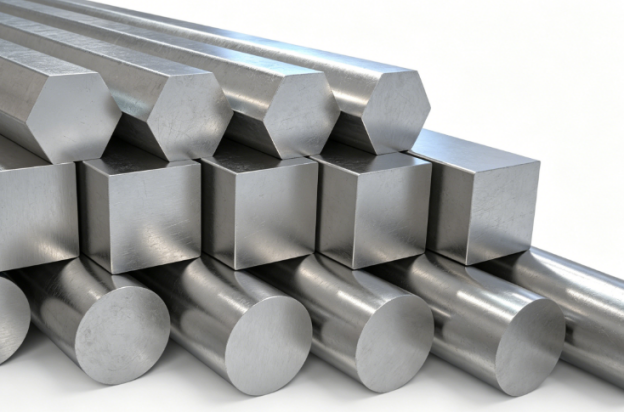
What Is A Bar Stock Used for?
These bars are later used to get final products after cutting, machining, and shaping. For instance, through a round bar, shafts are manufactured. During the manufacturing process, other processes, such as welding or bending, are also used.
What Is Bar Stock Made of?
It all depends on the respective applications. The bar stock can be made of Titanium, Aluminum, or steel, etc. For some applications, even plastic is used for bar stock.
What Are the Different Shapes of Bar Stock?
Let's discuss the shapes of bar stock one by one in this section. These shapes are important with respect to the required precision and applications.
Round Bar
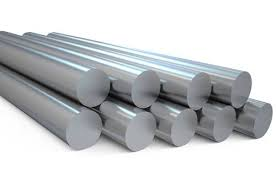
The following figure shows what a round bar looks like:
The diameter of the round bars varies, like 10mm, 20mm, etc. The processes, which are used to produce these bars, include hot rolling, cold drawing, and forging. It all depends on the requirement of desired accuracy and properties. These bars are easy to machine into shafts, bolts, pins, etc.
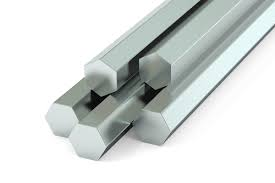
Hex Bar
These are hexagonal bars. These bars do not exhibit a diameter but across flats (A/F), which is the distance between two opposite flat faces. These bars are used when the manufacturing of fittings, valves, spacers, and standoffs is required.
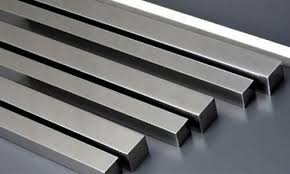
Square Bar
In this type of bar, there are 4 equal sides. It has a square cross-section. It is measured by side length, for instance, 10 mm x 10 mm. These bars are commonly used in the production of machine components, structural supports, and in forging and fabrication work. Please see the following image for an even better understanding:
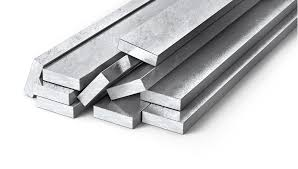
Flat Bar
It is also known as a rectangular bar because it has a rectangular cross-section. It is wide and thin. It is preferred when surface area is more important than bulk strength. Its common applications include brackets, frames, leaf springs, etc.
How Bar Stock Is Manufactured?
Bar stock is produced through various primary manufacturing processes, and each process results in different mechanical properties, surface finish, and dimensional accuracy.
Hot Rolling
For hot rolling, billets or blooms are used. First, they are heated above their recrystallization temperature, e.g., 900 - 1200 °C for steel. Then they are passed through a series of rolling mills. The compressive forces reduce the cross-sectional area and shape it into bars. Due to such a high temperature, it is done without any cracks. This process results in lower dimensional accuracy and a rough surface.
Cold Drawing
After hot rolling, the cold drawing process is applied as a finishing process. The bar is pulled through a die at room temperature, which reduces its diameter and improves its properties. Due to strain hardening, strength and hardness increase while ductility slightly reduces.
Extrusion
In this process, force and a die are used to produce complex shapes of bars, like hexagonal or custom profiles. The billets and high temperatures are passed through the dies with force. This process is common for low-melting-temperature metals, such as Al. The results of this process include excellent surface finish and good dimensional accuracy.
Forging
Hot forging is commonly used to produce bars that refine the grain structure and increase the strength and toughness. The billets in red-hot form are placed under the press or hammer, and compressive forces convert them into bars.
How Shapes of Bar Stock Impact CNC Machining?
The shapes of bars affect the CNC process selection. Let's figure out how the shape of a bar is important with respect to CNC machining:
CNC Machining Selection
The shape of a bar is a base for accuracy, precision, ease of machining, and how economically the process will be. The capabilities of each CNC operation vary, so the correct selection of shape is very important.
CNC turning Round Bar
In manufacturing industries, round bars are considered best for CNC turning operations, because:
- The geometry is already axisymmetric
- Less material is required to remove to make products, like shafts, etc.
- During working, it rotates smoothly, so no imbalance
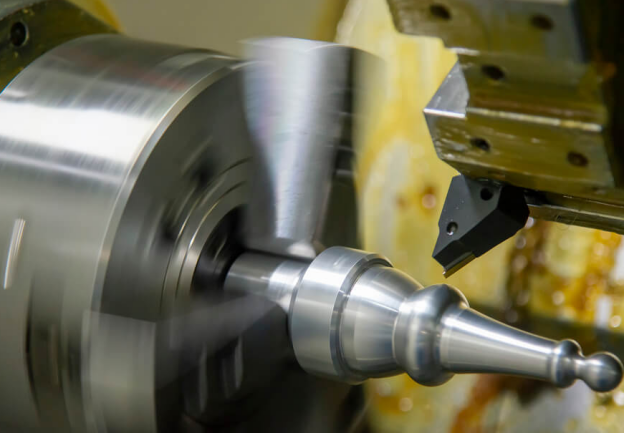
These advantages of round bars for CNC turning operations result in excellent surface finish, less tool wear, and lower machining costs.
CNC Milling Square Bar
The machinists prefer square bars for CNC milling operations because of the flat surface requirement. Secondly, the square bars are used to produce parts, like keys, brackets, and blocks, etc. Square bars are easy to clamp in a vice. Due to the flat surface, less machining is required. Another big advantage is better dimensional control on faces.
CNC Milling and Turning Hex Bar
Hex bars are the choice of CNC milling and turning operations because of machining efficiency, workholding, and function. With CNC turning operations, a hex bar is used to produce:
- Nuts
- Bolt heads
- Fittings
While for CNC milling operations, hex bars provide the advantages of flat surfaces already available, easy clamping, and indexing.
CNC Milling Flat Bar
CNC milling machines work best on flat surfaces, edges, and profiles. Flat bars are considered near-net shape, so less material is required to remove. They are an ideal choice for milling operations, such as face milling, slotting & pocketing, and profile cutting, etc.
Bar Stock: CNC Machined Parts
This section highlights parts of different designs that are produced through the different shapes of bars.
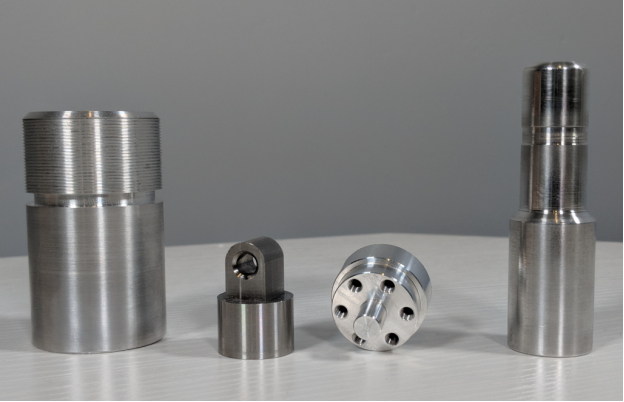
Cylindrical Parts
Through the round bars and CNC turning operations, some of these cylindrical parts are manufactured:
- Shafts and Axles(transmission shafts, motor shafts, and pump shafts)
These parts are used by automotive, manufacturing machinery, and power plants.
Plain bushings and spacer sleeves are common examples of these parts. Heavy machinery, the textile industry, and construction equipment use these parts.
Flat-Surfaced Parts
To produce flat-surface parts, such as tool holder blocks, clamps & fixtures, key & keyways components, and hydraulic manifolds, through the square bars using CNC milling operations. These parts are used in different industries, including CNC machining workshops, automotive manufacturing, and power transmission.
Hexagonal-Features Parts
Hexagonal-features parts include:
- Hex head nuts and hex nuts,
- Hydraulic & pneumatic fittings
- Valve bodies
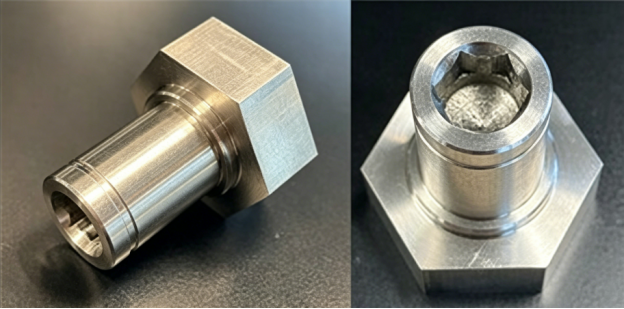
The construction, oil & gas, and chemical plants use these hexagonal-featured parts. To produce these parts, hexagonal bars are used.
Bracket Parts from Flat Bars
Flat brackets are used to produce CNC-machined:
- L-brackets (angle brackets), used in construction and furniture
- U-brackets, used in oil & gas and plumbing
- Mounting brackets, used in automotive and electrical systems
The flat bars are used because they already have wide and flat surfaces, so just bending and CNC machining are required to achieve the final shape.
Limitations of Bar Stock in CNC
Bar stock offers several advantages in machining due to its geometry; however, it also has certain limitations depending on part design. These disadvantages include:
High Material Waste
High material loss is shape mismatch between the bar and the final product. For example, in the case of a rectangular component with complex geometry through casting or forging, the material waste is high if the bars are round. For rectangular components, not all the cross-section is used, so a lot of material is wasted. In addition, subtractive manufacturing performed on CNC operations, like drilling, milling, etc.
Shape Limitations
The geometry of the bars limits the bar stock. For instance, round bars are the best choice because of the uniform cross-section along the length, and are used in the manufacturing of shafts, etc. But modern components have variations in the cross-sections due to difficult geometry, so round bars are not the ideal choice if the desired geometry of parts can't be achieved from bar stock.
Bar Stock vs Other Material Shapes
This section provides insights into the differences between bar stock and other shapes.
Bar vs Plate
The bar stock is a long, metal piece with a uniform cross-section, while a metal piece with a large surface and thickness is called a plate. Other differences are provided in the following table:
|
Aspect |
Bar |
Plate |
|---|---|---|
|
Dimensional Proportion |
Small width relative to length |
Large width and length compared to thickness |
|
Manufacturing Processes |
Hot rolling, forging, extrusion, and cold drawing |
Primarily produced by hot or cold rolling |
|
Machining Suitability |
Ideal for turning, drilling, and bar-fed CNC operations |
Best suited for milling, cutting, bending, and fabrication |
|
Typical Applications |
Shafts, fasteners, pins, rods, and precision components |
Base plates, structural supports, pressure vessels, and shipbuilding |
Bar vs Tube
A tube is a metal piece that has a hollow cylindrical shape with a uniform wall thickness. Other differences are provided in the following table:
|
Aspect |
Bar |
Tube |
|---|---|---|
|
Primary Function |
Provides solid load-bearing material |
Designed for fluid flow, weight reduction, or structural stiffness |
|
Manufacturing Processes |
Rolling, forging, extrusion, cold drawing |
Seamless extrusion, welding, or drawing with hollow forming |
|
Typical Applications |
Shafts, bolts, fasteners, machining stock |
Pipelines, hydraulic systems, heat exchangers, frames |
Bar Stock vs Wire
A wire is a slender metal product that has a very small diameter. Other differences are provided in the following table:
|
Aspect |
Bar |
Wire |
|---|---|---|
|
Size Range |
Medium to large dimensions |
Very fine, thin dimensions |
|
Flexibility |
Rigid, maintains shape |
Highly flexible, can be bent easily |
|
Manufacturing Process |
Rolling, forging, extrusion, cold drawing |
Extensive cold drawing through dies |
|
Typical Applications |
Machined parts, shafts, structural components |
Electrical cables, springs, fencing, reinforcement mesh |
How to Choose the Right Bar Stock for CNC Machining
A bad selection of bar shapes for stock can lead to significant material loss, which is not economical. To compensate for or to avoid that material loss during CNC machining, use the following tips:
Define Part Geometry
Since the geometry of the bar is directly linked with the final shape of the product, the first part geometry needs to be considered. For instance, if the products are cylindrical, like shafts, or they need a uniform cross-section along the length, then round bars should be stocked. For rectangular components, stock flat bars, and so on.
Select the Right Shapes of Bar
The shape of the bar should be selected based on the final product shape. Like, for the manufacturing of keyways, the shape of the bars should be square or flat. For hex nut production, the shape of the bar should be hexagonal.
Choose the Right Material
To select the right material, it is necessary to know the application of the product. For instance, if the primary requirement is hardness, then the material of the bars should be high-carbon steel, Ni-alloys, etc. For high weight-to-strength requirements, Al and Ti are the ideal choices for bars stock.
Select Proper Size
To avoid high material loss, the size of the bars should be carefully evaluated. For instance, if the required diameter of a shaft is 25mm, then select the bar of 27-28mm; in this way, material loss will be reduced and dimensional accuracy will increase.
Evaluate Cost
After carefully evaluating the above factors, evaluate the cost at the end. Evaluate the raw material price, machining time, waste, tooling, and operational efficiency.
Benefit of Using Bar Stock in Prototyping
In manufacturing industries, before the start of actual production of a new product, its prototype is first made. Let's figure out how the usage of bar stock is beneficial for this step:
Immediate Machinability
For cylindrical products, like shafts, it is very easy to make a prototype from a bar, because it is already near net-shape. So, the immediate machinability is possible, which saves time and energy in the production of prototypes.
No Need Custom Tooling
Standard bar geometries eliminate the need for custom preforms or dies, allowing parts to be machined directly using general-purpose cutting tools.
Predictable Dimensions
Since the dimensions of bars remain consistent throughout the structure, the dimensions become predictable. It helps in achieving reduced machining time, improved accuracy, and precision.
Conclusion
For high-precision products, the bar stock plays a vital role because these bars have consistent dimensions throughout the structure. These bars can be in the form of a square, a rectangle, or a round, etc. These bars are already in standard forms, so less machining is required, but if the shape of the final product is different, then the material waste is high in bar stock. The bar stock is also used for prototyping because there is no need for custom tooling, and the dimensions are predictable. Tuofa turns bars materials to various shapes such as cylinder,cone, disc, sleeve and features like threads.
FAQ
How to bend flat bar stock?
A flat bar stock can be bent by manual bending, press brake bending, roll bending, or hydraulic bending machines can be used.
What is 6061 aluminum round bar stock?
It is a stock of round bars, and the material is 6061 aluminum. 6061 aluminum is a high-strength aluminum alloy.
What is the cost of bar stock?
The cost of bar stock varies from shape to shape and material to material. If the bar stock material is mild steel, its cost is $1 per kg.
 Hastelloy C276: Guide for Understanding, Selection & Machining