Tel/WeChat:
  Email:


 Home
HomeWhat Are End Caps? Types, Materials, and Manufacturing

 Published:Jul 03,2026
Pipes, tubes, and hollow sections can have open ends unnecessarily. These open ends pose safety concerns in structural applications. They look ugly in decorative applications. Open ends can cause leakages and contamination in fluid handling applications. End caps are the components that close these open ends. Let's learn more about the types, applications and manufacturing of end caps.
What Is an End Cap?
An end cap is a mechanical component used to cover the end of tube, pipe, rod, enclosure or profile. It can protect both equipment and human. It is a typical CNC-machined component due to the requirements for functions, shapes and precision.
Are End Caps Universal?
End caps are not universal. In fact, there are many different types, shapes, and dimensions of end caps. It all depends on compatibility with a particular application. Each application has its own operating conditions. This triggers demand for different materials, different mounting methods, and different sizes. On a limited scale, some standardized end caps can be used in many instances. But the “one size fits all” condition doesn't exist.
Standard End Caps vs Custom End Cap
The table below compares the key features of standard end caps and custom end caps:
|
Aspect |
Standard End Caps |
Custom End Caps |
|---|---|---|
|
Design |
Mass-produced standard designs |
Application specific non standard designs |
|
Fit |
Common sizes |
unique dimensions and shapes |
|
Cost |
Lower cost |
Higher cost |
|
Lead time |
very short |
Considerably high |
|
Material |
Standard materials |
a wide range of specialized materials |
|
Applications Type |
General applications |
Specific requirements |
|
Appearance |
Standard finishes |
Customizable appearance |
|
Suits |
Standard projects |
Specialized applications |
|
Advantage |
Quick availability and affordability |
enhanced functionality |
What Is the Purpose of End Caps?
End caps have three main functions:
- Preventing the equipment like tubes and pipes
- Sealing the devices
- Providing structural support
Next let us discuss the details of these three functions then you will understand easily why end caps are widely used in many industrial applications.
Protection
As we have said before, safety end caps protect both users and equipment.
1. As for equipment, protective end caps are used to protect tube or pipe from edge deformation or damage to the internal structure.
2. As for human, the covering of sharp edges and corners protects against injury to humans.
Sealing
End caps are used to cover the ends of tube or pipes to prevent contamination like moisture, debris, pollutants, and chemicals from entering the sensitive equipment. That is why end covers are particularly used in piping systems, hydraulic systems, and fluid handling equipment.
Structural Support
Besides other functions, end caps provide structural support in mechanical systems. They help to distribute loads evenly. The dimensions of the end cap matches that of the hollow section, like pipe or tube. So, it fits into that hollow structure. When the load is applied, the end cap prevents distortion in the shape of the pipes. In short, end caps provide structural stability to the system.
Types of End Caps by Features?
End caps incorporate some features that align with the application requirements. Typically, end caps are distinguishable with respect to these features. Common types of end caps include:
- domed end caps
- flat end caps
- flange end caps
- tapered end caps
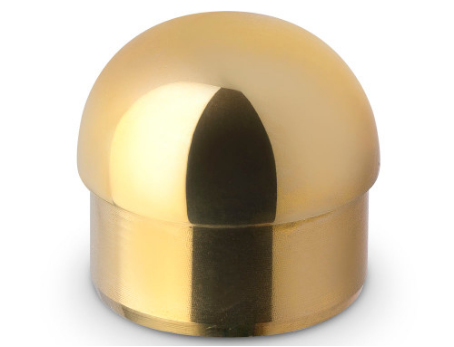
Domed End Caps
Doomed end caps feature a curved top and a smooth surface. They are mostly metal end caps. They give an aesthetically pleasing look. This end cap design distributes impact forces evenly. Commonly, they are used in furniture, handrails, and playground equipment.
Flat End Caps
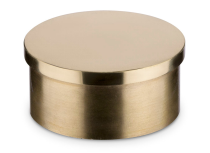
Flat end caps have straight forward design. They prioritize functionality over aesthetics. Their low cost and wide availability make them highly popular. This clean and compact profile end cap design is extensively used in industrial equipment, structural tubing, and machinery.
Flanged End Caps
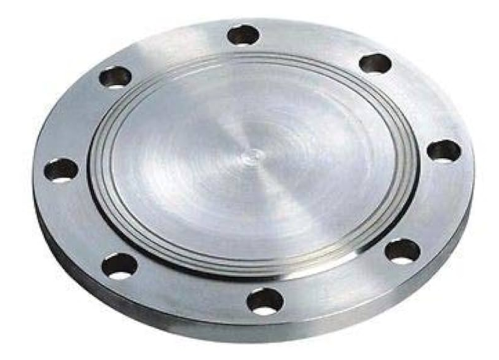
This type has an extended lip or flange around the end cap. This additional feature facilitates positioning and retention. Overall, flanged end caps provide a more stable fit. If gaskets are added in installation, they may be used for pressure containment as well. Flanged end caps are thus used in automotive components and equipment enclosures.
Tapered End Caps
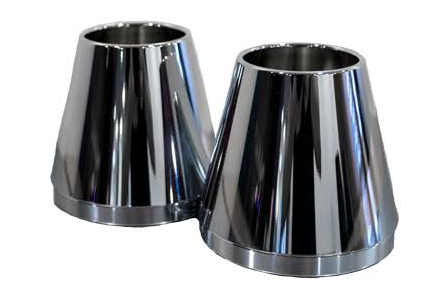
The tapered end cap has a gradually narrowing diameter across its height. This creates a tapered section. These features help in easier and quicker insertion. So, tapered end caps accommodate slight dimensional variations. Tapered end caps are used in tubing systems, protective packaging, transportation equipment, and industrial assemblies.
Types of End Caps by Attachment Method
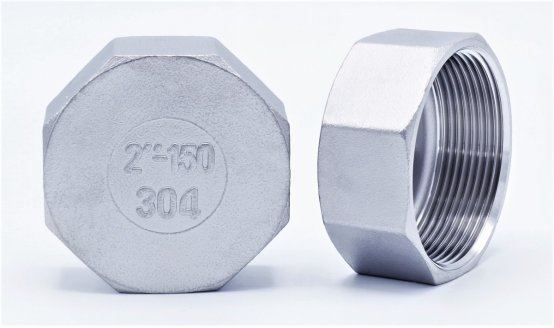
Threaded End Caps
Threaded end caps are quite common. Threads make installation and removal of end caps easy. Usually, there can be male threaded end caps or female threaded end caps. They just need to be tightened on a tube or pipe. Incorporation of sealants, gaskets, or O- rings can create a reliably tight seal. These end caps are commonly used in fluid handling systems, pneumatic systems, hydraulic equipment, and industrial piping.
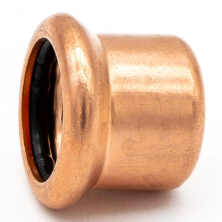
Press-Fit End Caps
Press-fit end caps rely on a push-in mechanism. Retention of the end is due to friction and the bloated curve on it. The simplicity in installation makes them versatile for numerous applications. However, they are not well suited for pressure containment. But these end caps are popular in safety and cosmetic applications.
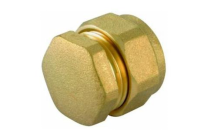
Compression End Caps
Compression end caps provide a tight mechanical connection based on a compression ring. This eliminated the need for welding, threading, or adhesives. Compression end caps are well suited for applications that require a serviceable closure. Examples include plumbing systems and water supply. Common sizes range from 1/2 inch compression end cap to 2 inch compression end cap.
Common Types of End Caps by Materials
Besides features and attachment methods, the material of end caps is another important factor. It's the material properties that influence its performance for a certain application. Thus, here we introduce some common end caps made up of different materials.
Plastic End Caps
Plastic end caps are mainly used for protecting the tubes or pipes or improving decorative appearance. Below are some common end covers made up to different kinds of plastics.
PVC End Caps
PVC is the most commonly used material for end caps. It provides a moderate mechanical strength, excellent chemical resistance, low weight and high manufacturability. These plastic end caps can be easily molded and mass-produced. Other secondary operations like drilling and threading are also easy to do on PVC. So, PVC end cap with threaded hole is quite common.
ABS End Caps
ABS offers many benefits of plastics, such as low weight, chemical inertness, etc. It is specifically well suited for light-to-moderate impact-bearing applications. ABS end caps resist impact better than PVC.
Nylon End Caps
Nylon end caps offer impressive fatigue resistance. So, they find their place in cyclic loading conditions. Nylon has a low coefficient of friction. An important consideration could be its swelling in moisture. DFM engineers often include tolerances for it.
Metal End Caps
Different from plastic end caps, metal end caps often provide higher mechanical durability, strength, heat resistance, and load-bearing capability. Here we introduce widely-used metal end caps for industrial applications.
Aluminum End Caps
Aluminum end caps are greatly valued for their high strength-to-weight ratio. They are corrosion-resistant, machinable, and formable. These factors make them highly manufacturable. Anodization of aluminum end caps gives a range of colors and hues. This enhances their aesthetic appeal for decorative applications.
Stainless Steel End Caps
Stainless steel gives a cost-effective solution for anti-rust properties. Different grades of stainless steel cater to different situations. These end caps are also well suited for sterilization and hygienic environments in medical and food applications.
Carbon Steel End Caps
Carbon steel end caps are the most cost-effective types. They give a very good mechanical performance. But their low corrosion resistance might be a limitation for some applications. Anyways, finishing options like painting, galvanization, and powder coating can alleviate this problem.
Brass End Caps
Brass end caps have a bright gold colour, which makes them attractive. They are corrosion-resistant and antimicrobial. The main takeaway of brass end caps is their high machinability, which results in high dimensional accuracy.
Copper End Caps
Copper end caps have a very good formability. It means that very thin walls are possible without cracking. They have good thermal and electrical conductivity, which is suitable for some applications.
End Cap Applications by Industry
End caps have industry-wise applications. Their performance criteria are determined by their operating environments. So, understanding these application-specific needs is crucial in selecting the type of end caps needed.
Industrial Machinery
Industrial environments contain many tubes, shafts, frames, and structural members. Without end caps, they would have open ends exposed to the external environment. This can cause contamination, seepage of moisture, dust, metal chips, or accidental interference with machinery parts. End caps not only protect machinery but also ensure the operator's safety.
Hydraulic and Pneumatic Systems
Hydraulic and pneumatic systems need robust parts for pressure retention. Fluids must be protected from leaks. In this case, end caps provide a leak-proof and strong connection for covering the ends of pressure pipes.
Automotive Industry
Automobiles need end caps for sealing chassis and frame openings, protecting brakes and fuel line connections. Besides this, they reduce the risk of water and dust ingress. So, maintenance issues can be minimized.
Robotics
Robotic parts need coverings to protect their sensitive components. As an example, wiring routed through tubing must be protected to maintain a smooth working. End caps also give robots an elegant look, which increases their marketable value.
End Cap vs Pipe Cap vs Plug vs Cover
There is often a misconception to use the words “end cap”, “plug”, “blind flange” and “cover” interchangeably. However, they are quite distinct technically. The tables below compare these products to establish a distinction for the readers.
End Cap vs Plug
|
Feature |
End Cap |
Plug |
|---|---|---|
|
Purpose |
Covers the end of a tube or pipe |
seals an opening |
|
Installation |
Fits over the end |
Inserts into the opening |
|
function |
Protects, seals, and finishes |
prevents leaks |
|
Removal |
permanent or removable |
Removable |
|
Applications |
Tubes, pipes, and frames |
Ports, fittings and holes |
End Cap vs Cover
|
Feature |
End Cap |
Cover |
|---|---|---|
|
Purpose |
close the end of a tube or pipe |
encloses a component |
|
Coverage |
Covers only the open end only |
Covers entire assembly |
|
function |
Provides protection and sealing |
Provides protection and access control |
|
Sealing |
Seals against dust and moisture |
May or may not provide sealing |
|
Applications |
Tubes, pipes and frames |
Enclosures, cabinets and equipment |
End Cap vs Blind Flange
|
Feature |
End Cap |
Blind flange |
|---|---|---|
|
Purpose |
Closes pipe or tube end |
Seals flanged pipe end |
|
Connection |
Press- fit, threaded, or welded |
bolted with gasket |
|
pressure |
Low to moderate |
high pressure |
|
Installation |
quick and simple |
Bolted assembly |
|
Application |
Tubes, machinery, general piping etc |
industrial pipelines, process systems |
How to Make End Caps?
Understanding the manufacturing processes of end caps is as important as their technicalities. The types, dimensions, materials, and precision requirements determine the adoption of a particular manufacturing process.
Injection Molding
Injection molding is the preferred choice for mass-producing plastic end caps. It is quite often a low-cost method. However, if it is adopted for low-volume production, then the die cost increases the production cost. Injection-molded end caps can incorporate features like a snap-fit mechanism, ribs, sealing lips, and textured surfaces.
Stamping
Stamping is suitable for mass-producing thin-walled metal end caps. Pieces of sheet metal are stamped on a press to give them shape. A good uniformity is attainable. However, complex shapes might not always be made using stamping. It is also a low-cost method.
Die Casting
Die casting is often used for making load-bearing thick end caps. It can incorporate features such as mounting bosses, threaded inserts, sealing grooves, and reinforcement ribs. Die casting is mainly used for making metal end caps.
Welding and Fabrication
Welding and fabrication are used to make large, customized, and non-standard end caps. By involving different sheet metal operations like cutting, bending, drawing, drilling, and welding, numerous types of end caps can be made. However, this method can be costly in comparison to other mass production methods.
CNC Machining
CNC machining creates end caps with very precise dimensions, especially in custom CNC machining services for aerospace, automotive, and medical applications. In comparison to other methods, CNC machining can be costly. But the level of intricacy that it can handle is unmatched. So, this method is either used for high-end industries like aerospace or medical, or used for creating prototype end caps. CNC machining can create features like internal and external threads, precise sealing grooves, O-ring seats, tapered interfaces, and custom mounting holes.
Key Design Considerations for Custom End Caps
Different from standard end caps, custom end caps place greater emphasis on the feasibility of the design. Here we mainly discuss the design considerations of end caps for applications.
Assembly Compatibility
The key consideration in assembly compatibility is to ensure proper fit. The correct specification of tolerance is necessary in this regard. If tolerances are too tight, then manufacturing would be costly. If tolerance is too loose, then the end cap might not fit properly.
Correct specification of wall thickness is also important. Less-than-optimum thickness will risk dents, deformation, and distortion.
Once you send your drawing of end caps, Tuofa provides DFM analysis and prototyping service for you so that you can avoid unnecessary costs to ensure that your end caps can be used normally.
Edge Design
Edge design is an important design consideration. Chamfers and fillets eliminate sharp edges and corners. This improves user safety. They also give a comparatively elegant look. Optimization of edges also helps in the easy insertion and installation of end caps.
Sealing Features
Sealing features improve the functionality of end caps. Functions like leak proofing and pressure retention can be maintained by proper designing of sealing features. Seats for seals, grooves for O-rings, or inclusion of compression sealing are some of the sealing features that need to be considered.
Tuofa specializes in precision 5-axis machining, we can machine high-precision end caps with sealing features like threads or grooves. Importantly, before manufacturing your end caps, our sales help you avoid potential risks based on their professional skills.
Surface Finish and Coating
Surface finishing not only improves the aesthesis by also enhances functionality. As an example, knurling on the end cap helps in tightening threaded end caps. Coatings like anodization, powder coating, galvanization, and painting enhance the cosmetic appearance while increasing service life.
Tuofa CNC also provides surface treatment after manufacturing end caps, with over 20 years of manufacturing experience, our engineers and sales can help you evaluate whether the surface treatment is suitable for the materials and provide professional recommendations for you.
Conclusion
End caps are an important component of many assemblies. They improve system safety, add decorative value, and fulfil functional goals. They come in a variety of types, shapes, and materials. Each application has its own requirements. The selection of the proper end cap helps in fulfilling those application requirements.
FAQ
What material is best for outdoor end caps?
Outdoor end caps must be made of a corrosion-resistant material such as plastic, stainless steel, or brass. However, corrosion-prone materials can be coated for outdoor use.
How do I choose the right end cap or cover for my project?
At first, determine the purpose of the end cap. Then select the type, attachment method, and material of the end cap.
How to seal gutter end caps?
Apply the gutter sealant on the mating surface. Put it in place and allow it to cure.
 HMLV Manufacturing in CNC Machining: A Practical Guide for Custom Parts