Tel/WeChat:
  Email:


 Home
HomeHMLV Manufacturing in CNC Machining: A Practical Guide for Custom Parts

 Published:Jul 08,2026
Planning a new project that requires the different customize parts in low quantity? The following guide explains what HMLV manufacturing is, its key advantages, common applications, challenges, and the best practices for achieving reliable supplier, cost-effective results.
What Is HMLV Manufacturing?
Let us understand the word “HMLV”; a high mix (HM) means a variety of products are produced within the same production line. While, the low volume (LV) means that products are manufactured in small quantities. High mix low volume manufacturing (abbreviated as HMLV) is a manufacturing approach to produce a variety of inventory according to customer requirements.
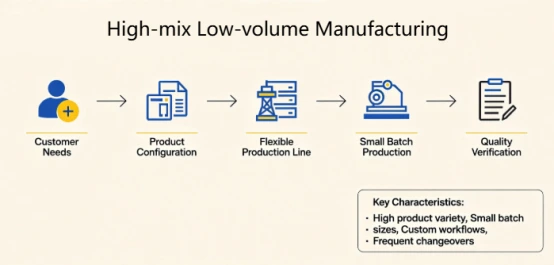
HMLV Manufacturing vs Mass Production
In high-mix, low-volume manufacturing, a variety of customized products are manufactured in low quantities. In HMLV, there is frequent change in design, and thus also need to change the machine setup frequently. In mass production, a large amount of production is done for a product, and there is no frequent change in design. The cost of HMLV manufacturing is higher than that of mass production.
HMLV Manufacturing vs Low-Volume Manufacturing
Low-volume manufacturing only means that a small batch of components are manufactured. While high-mix low-volume manufacturing can not only achieve small-volume production, but also achieve manufacturing of a variety of parts according to the requirements of the customers.
Why Is CNC Machining Suitable for HMLV Manufacturing?
The following section will explain to you why CNC machining is suitable for HMLV manufacturing with some custom parts examples:
Flexible Programming Supports Different Part Designs
One of the best features of CNC machining is its flexible programming. The machining with traditional machines frequently requires changing the tools. But a CNC machine only requires changing the programming setup, and the machine is ready to manufacture the new design. The operator can easily modify the program in the CNC machine for the new design of the product.
Multi-Axis CNC Machining for Complex Parts
For complex parts, it is ideal to use multi-axis CNC machining. For example, the 5-axis CNC milling has the ability to manufacture complex parts such as engine housings, turbine blades, and aerospace components. The CNC machine has the ability to reach the workpiece from multiple angles with high dimensional accuracy. On the other hand, both milling and turning operations can be combined on a CNC machine. Thus, a CNC machine can produce customized complex parts with consistent quality, which is best for the HMLV manufacturing.
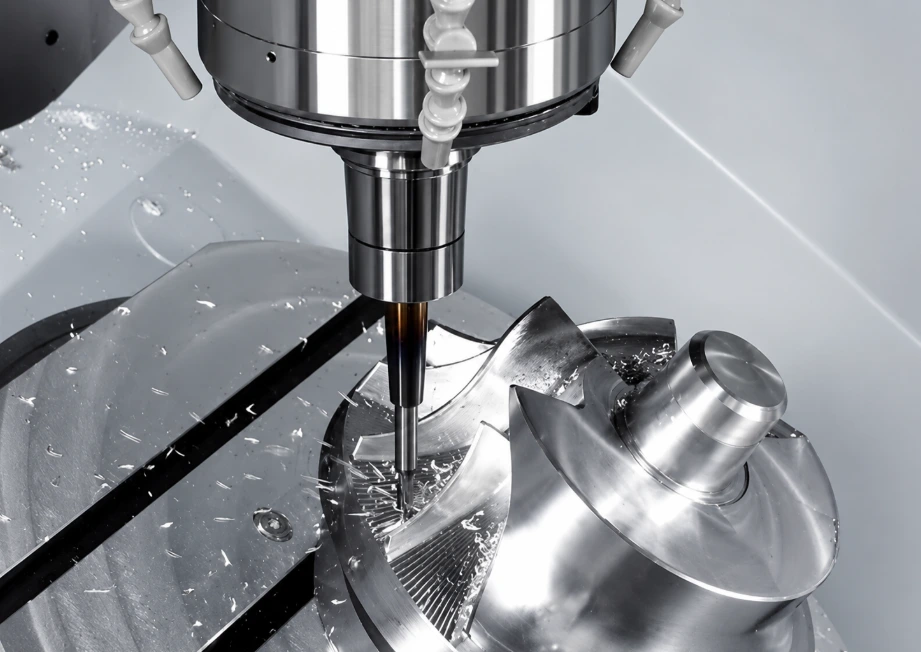
CNC machining Is Suitable for Prototypes
CNC machining is suitable for prototypes as there is no need to manufacture the mold and to buy the expensive tools. Unlike traditional machining, a prototype part can be manufactured directly from the CNC machine with the help of drawings.
Common HMLV CNC Machining Applications and Industries
Let's now explore you the common applications and industries for the HMLV CNC machining:
Aerospace and Defense Components
Aerospace and defense parts are usually produced with HMLV CNC machining because they often need very complex design, strict tolerance and a low volume. In this field, these precision parts are often needed to be verified through prototyping. Besides, there is document requirement for the materials of the aerospace parts.
Medical Device and Surgical Tool Components
HMLV manufacturing also meets the production of medical parts because many medical parts need to be customized for special equipment. Due to the high requirement, the development of medical parts need long time to test. And the design of medical parts are changed frequently. In order to save cost, prototyping is the best solution. Therefore, high-mix low-volume in CNC machining is the best solution for manufacturing medical parts.
Robotics, Semiconductor and Automation Parts
Industries like robotics, semiconductors, and automation parts require frequent design updates, rapid product iteration, and manufacturing of a wide variety of components. High-mix low-volume manufacturing in CNC machining supports prototyping for testing functions and manufacturability and DFM review for optimizing designs. What's more, the lead time can be shortened thanks to HMLV manufacturing.
Main Benefits of Selecting HMLV CNC Manufacturing
Let's explore the main benefits of HMLV CNC manufacturing and why it is suitable for your project.
Lower MOQ is Accepted
Industries like aerospace and defense requires the customize products in small quantities. HMLV CNC manufacturing supports the lower MOQ and gives flexibility to customer to purchase components according to their requirements. Manufacturers also produce the quantity of what the customer requires, and this leads to saving inventory costs.
Faster Design Changes
HMLV CNC manufacturing is ideal for customers in the early stages of product development and new product introduction (NPI) projects, where designs are frequently changed. Since no new mold or tools are required for HMLV CNC manufacturing. This leads to saving the lead time and expense to manufacture the new molds. It also supports the design for manufacturability (DFM), in which engineers can evaluate the initial design and make changes to the design before production.
Easier Transition from Prototype to Low-Volume Production
One of the biggest advantages of HMLV CNC machining is the transition from prototype to low-volume production. Once the prototype is approved by the customer, manufacturers can produce the products in small batches without any delay. The customer does not need to purchase the new molds or tools.
Lower Inventory Risk
You can purchase a small volume of custom parts freely without the need to worry about inventory risk. Many manufacturers accept a minimum order quantity of 1 item.
Key Challenges in HMLV CNC Machining
As we discussed earlier, the key benefits of the HMLV CNC manufacturing, but there are key challenges in this manufacturing which leads to increase the cost per part. Each project in HMLV CNC machining may require different materials, skilled labor, and CAM programming. A professional CNC manufacturer can easily overcome these challenges and produce smoothly with strict quality control.
The following section explains the reason for the higher cost per part in HMLV CNC manufacturing and why a professional manufacturer requires consistent quality.
Frequent Setup and Programming Changes
For a new design part, the HMLV CNC manufacturing requires frequent programming and setup changes. The setup of the cost remains the same. After the setup, if fewer parts are manufactured, then the cost per part is higher than when high-volume of parts are produced by the manufacturer.
Quality Consistency
In mass production, quality control is easy to maintain as there is little change requirement for frequent changes in design, tools, and setup change. In high-mix low-volume manufacturing, it is difficult to maintain consistent quality as there are frequent requests for design changes for fewer parts.
To maintain the quality in HMLV CNC manufacturing, it is necessary to do inspections at every stage with the help of calibrated measuring equipment.
Higher Setup Cost Per Part
The cost per part is higher in HMLV CNC manufacturing, as fewer parts share the total cost of setup.
How Can You Control Cost in Low-Volume CNC Machining?
As we discussed earlier, the setup cost is higher in HMLV CNC manufacturing. The customer needs to follow the following steps in order to control the cost in low-volume CNC machining:
Provide Complete Drawings and CAD Files
Customers should provide the complete drawing and CAD files to suppliers. This leads to a reduction in quotation errors and a reduction in repeated communication between suppliers and buyers.
Avoid UnnecessaryTight Tolerances
It is not necessary to mention the tight tolerance for every side of the component. The customer should mention the tight tolerance where dimensions affect the assembly. Otherwise, the tight tolerance increases the production cost due to more time consumption, more inspections required, and more skilled workers.
Table 01 explains the differences between functional dimensions, assembly dimensions, and non-critical dimensions with examples of parts, recommended tolerances, and impact on cost.
|
Dimension Type |
Purpose |
Cost Impact |
Tolerance Recommendation |
Examples |
|---|---|---|---|---|
|
Non-Critical |
No effect on function or fit |
Lowest |
Standard |
Cosmetic surfaces, non-functional pockets |
|
Functional |
Ensures part works correctly |
Highest |
Tight |
Bearing bores, sealing surfaces |
|
Assembly |
Ensures proper fit with other parts |
Medium |
Moderate to Tight |
Mounting holes, hole spacing |
Choose Cost-Effective Materials
Customers should consider the cost of materials with the functional requirement. A professional CNC manufacturer can suggest a cost-effective material according to the service requirement. For example, instead of using tool steel, choose mild steel if there is no requirement for wear resistance.
Simplify Features that Increase Machining Time
In low-volume CNC machining, the following special features can increase the machining time and cost. Simplifying the following features leads to a reduction in the machining cost as well as overall low-volume CNC machining cost.
- Deep, narrow pockets
- Deep-drilled holes
- Undercuts
- Fine engraved text or logos
- Very small holes
Quality Control for HMLV CNC Parts
In HMLV manufacturing, there is a frequent requirement for design, setup, and programming changes. This leads to increase risk of human errors during the setup and programming change. As shown in figure, the manufacturers always inspect the workpiece throughout the machining process.
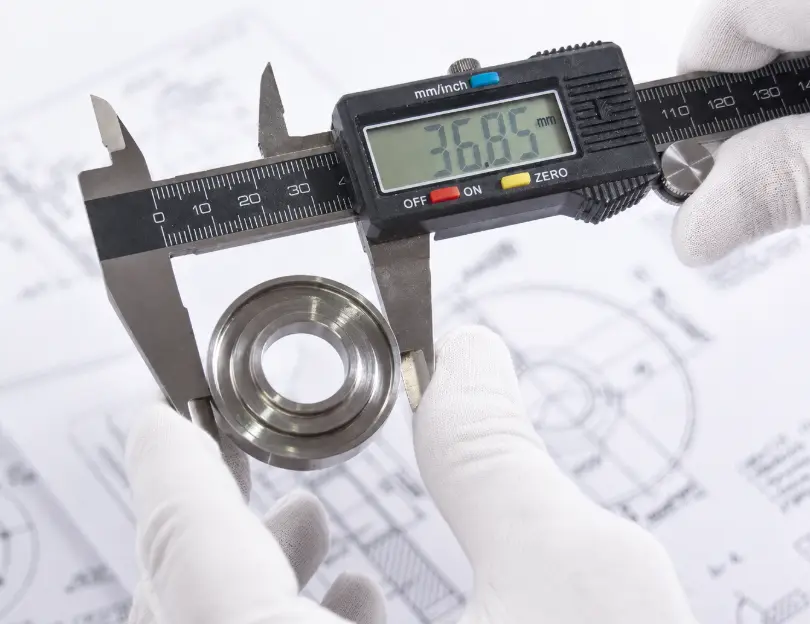
First Article Inspection for New Setups
After the new machining setup, the manufacturers inspect the one sample part instead of producing the new batch of parts immediately. For example, a manufacturer may have a requirement to produce 100 new design parts. In this regard, the manufacturer only produces the first part and then produces the remaining parts.
In-Process Inspection for Critical Features
During the machining process, the inspection is done with measuring tools, checking the surface finish and thread sizes. In this way, the problems can be detected early instead of waiting for the production of a complete part.
The operators inspect the following features given in Table 02 so that the parameters can be adjusted accordingly. This table also lists the common inspection tools and the importance of inspecting these features.
|
Critical Feature |
Why Inspect It |
Common Inspection Tool |
|---|---|---|
|
Surface Finish |
Functional performance |
Surface Roughness Tester |
|
Threads |
Proper fastening |
Thread Gauge |
|
Hole Diameter & Position |
Assembly accuracy |
CMM, Plug Gauge |
|
Critical Dimensions |
Dimensional accuracy |
Caliper, Micrometer |
|
Flatness & Parallelism |
Surface alignment |
Surface Plate, Dial Indicator |
Final Inspection and Documentation
Before shipment, the final inspection is done to match the customer's requirements. The customer can check the quality and maintain the product traceability if the manufacturer provides the inspection report, labels on parts, and MTC.
How to Choose an HMLV CNC Machining Supplier
For your new project, if you are looking for an HMLV CNC machining supplier, then the following points should be confirmed with the supplier.
CNC Capabilities
A reliable HMLV CNC manufacturer should have advanced equipment to handle the complex geometries and different materials. This includes the mill-turn machines, Swiss-type CNC lathes, 3, 4, and 5-axis CNC milling machines, and surface grinding machines. The supplier should have the following CNC machining capability:
- Tight tolerances
- Complex geometries
- Manufacture prototypes and small production batches
- Fine surface finishes
Engineering DFM Support
The supplier should provide the design for manufacturability (DFM) support to the customer. This includes reviewing the drawings, identifying the possible problems in drawing and suggest the recommendations for possible risks related to machinability, reducing the cost, and lead time.
Reliable Project Control from Quality to Delivery
A reliable HMLV CNC manufacturer should have the following project control system:
- Quality:According to the customer's requirements, the supplier should check the quality throughout the production.
- Traceability:The supplier should maintain a complete record of material, machining, and inspection.
- Delivery Control:The supplier should monitor the logistics and production schedule to ensure on-time delivery.
How Tuofa Supports Your Projects by HMLV Manufacturing
Are you looking for a supplier that can produce prototypes or small batches with high quality? Tuofa is a reliable supplier for the HMLV manufacturing, the following are reasons you should choose:
Flexible CNC Machining for Low-Volume Custom Parts
Tuofa has flexible CNC machining support for different designs in low quantities. Their advanced CNC machining setups ensure the best quality even for small-batch parts.
Professional DFM Support for Different Part Designs
Tuofa supports the professional DFM support. Their engineers can improve the manufacturability before production by reviewing the different part designs.
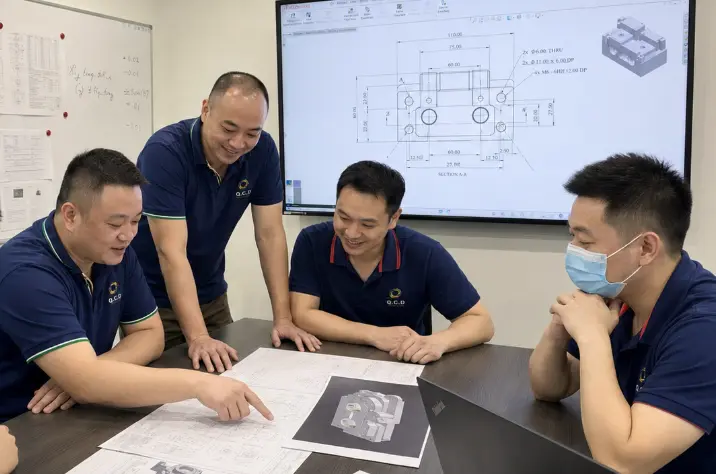
In this stage, we also provide risk evaluation for you to prevent some unnecessary problems. For example:
- Material and surface finish compatibility
- Tolerance and assembly adjustment
- Design and functional rationality
Part Assembly Support for Small-Batch Projects
Before shipment, Tuofa can provide you with assembly support for small-batch projects. In this way, they ensure the fitting and the functions. If customers have certificate requirements for assembly, Tuofa can also cooperate and provide the necessary support.
Conclusion
HMLV CNC machining is an ideal solution for the manufacturing of a variety of parts in low quantities. This manufacturing is widely used in aerospace, defense, medical, robotics, semiconductors industries to produce prototypes and small-batch components. A timely delivery, cost-effectiveness, and quality can be achieved by improving the design, the right material, and reliable supplier selection.
FAQ
What should you provide for an HMLV CNC quote?
For the correct quotation of HMLV CNC machining, the buyer should provide the drawings, material specifications, quantity, delivery time, tolerances, surface finishing, and inspection requirement.
When should you choose HMLV CNC manufacturing?
HMLV CNC manufacturing should be chosen when different custom parts are required in low quantities. This manufacturing offers frequent design changes with quality assurance.
When not to use high mix low volume manufacturing?
HMLV manufacturing should not be used where standard products, high quantities, very low cost, and simple parts with no customization are required.
 Flat Washer Size Chart: Dimensions, Standards, and Selection Guide