Tel/WeChat:
  Email:


 Home
HomeUnderstanding Machinability of Materials: Rating, Factors & Comparison

 Published:Mar 27,2026
Whether you are machining metals, plastics, or other engineering materials, machinability has a direct impact on manufacturing cost. A material that is difficult to machine may require slower cutting speeds, more frequent tool changes, longer cycle times, and additional finishing, all of which increase the final part cost. This is why machinability matters when choosing a material that offers the best balance between performance and cost.
Machinability can also indirectly affect how a finished part performs. Difficult-to-machine materials may be more prone to poor surface finish, burrs, residual stresses, or machining defects, which can create local stress concentrations and increase the risk of cracking during service.
In this article, we explain what machinability is, why it matters for both CNC machining cost and part performance, and which material and process factors affect it. If machinability is making it difficult to choose between materials, you will also find practical material-selection advice in this article.
What Does Machinability Mean?
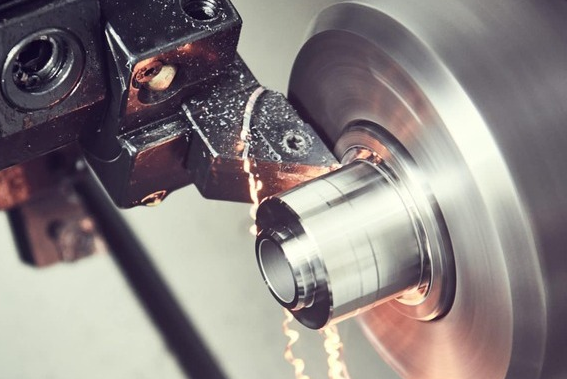
Machinability means how easily a metal, plastic, or other material can be cut and shaped by removing material with machining tools. It is usually expressed as a relative ratio rather than an absolute value. Instead, a reference material is usually assigned a baseline rating, and other materials are compared with it using a percentage. In general, a higher machinability rating means the material is easier to machine, while a lower rating indicates greater machining difficulty.
Machinability vs Machining Properties
The difference in machinability and machining properties is described in the following table:
|
Aspect |
Machinability |
Machining Properties |
|---|---|---|
|
Definition |
Ease of machining a material |
Material traits affecting machining |
|
Nature |
Performance-based |
Property-based |
|
Focus |
Tool life, surface finish, forces, chips |
Hardness, strength, ductility, thermal behavior |
|
Measurement |
Relative (e.g., % vs AISI 1112) |
Direct (HB, MPa, etc.) |
|
Role |
Indicates ease of machining |
Explains material behavior during machining |
|
Example |
Aluminum → high; Ceramics → low |
Aluminum → soft/ductile; Ceramics → hard/brittle |
|
Changeability |
Can be improved (tools, parameters, coolant) |
Mostly fixed (slightly via heat treatment) |
Is Machinability Important?
Yes, the machinability of materials not only affects machining cost, but also influences lead time, part performance, service life, and production yield. However, machinability should only be considered after the part’s functional requirements have been met. Important performance requirements should not be sacrificed just to make a material easier to machine.
What Factors Can Affect Machinability of Materials?
Machinability is not a fixed property. The same materials under different conditions have different machinability. Alloying elements added during material production can change how easily the material cuts, and heat treatment before CNC machining can also significantly affect its machinability. Here let us explore how these factors affect the machinability of materials.
Chemical Composition
It is the fundamental factor that affects the machinability because every element in the chemical composition adds new properties. Elements such as Ti, V, Nb, and W can combine with carbon to form very hard compounds such as TiC, VC, NbC, and WC. For example, adding titanium to low-carbon steel can increase its hardness and strength by forming fine TiC or Ti(C,N) precipitates. As the material becomes harder, higher cutting forces are required and tool wear usually increases, which reduces machinability.
Microstructure
The microstructure means how the grains are aligned. For instance, after the quenching process, grains are not arranged in any order, but pile up in martensitic microstructure, which results in poor machinability.
Material Condition
Heat-treatment conditions such as normalizing, annealing, and tempering can change a material’s machinability because they alter its microstructure and mechanical properties. In this context, material condition refers to the fact that the same alloy can machine very differently depending on the condition it is in. For example:
|
Same Material |
Condition |
Typical Effect on Machinability |
|---|---|---|
|
4140 |
Annealed |
Lower hardness and cutting force; generally easier to machine |
|
4140 |
Pre-hardened |
Higher strength and hardness; faster tool wear and lower cutting speeds |
|
4140 |
Fully hardened |
Much harder to cut; may require hard turning or grinding |
Surface of Materials
The rough surface of the materials leads to poor machinability because of unstable tool engagement. A material with a hardened surface exhibits poor machinability because higher cutting forces are required.
How to Calculate Machinability of Materials
In fact, machinability is not an absolute value but a relative property. The machinability of materials is calculated through the following methods:
Select Reference Material
First, the reference material is selected. It is that material for which a machinability rating of 100% is assigned. AISI B1112 free-cutting steel is commonly used as a reference material.
Measure Cutting Speed
Then, the cutting speed is calculated from the spindle speed and the diameter of the tools. The maximum cutting speed of the test material is determined under the same processing conditions as the reference material.
Formula for Calculating Machinability
Formula:
Machinability Rating% =(cutting speed of test material / cutting speed of standard material )x 100
Machinability rating stands for how easily a material can be cut, drilled, or machined under given conditions.
What Materials Have Machinability?
The materials vary from each other based on their chemical composition, microstructure, and crystal structure. So, the machinability of different materials is different.
Machinability of Metals
Steel, aluminum, and copper are the common metals that are widely used around the world in different applications. But each metal of them exhibits a different level of machinability.
Machinability of Steel
There are thousands of grades of steel used in the world. Below are machinability rating of common grades of steel(Reference: AISI B1112 = 100%):
|
Grade of Steel |
Machinability Rating (%) |
|---|---|
|
AISI 1018 |
~78 |
|
AISI 1045 |
~64 |
|
AISI 1095 |
~42 |
|
AISI 4140 (annealed) |
~66 |
|
AISI 4340 (annealed) |
~57 |
|
AISI 304 (stainless) |
~45 |
|
AISI 316 (stainless) |
~45 |
|
D2 Tool Steel |
~27 |
|
EN31 (≈52100) |
~40 |
The machinability of each grade is different due to the different chemical composition. For instance, in AISI 1018, there is only 0.18% carbon, due to which it is a ductile and highly machinable grade. But, in AISI 1095, carbon is very high, which makes it a very hard metal to machine.
Aluminum and Alloys Machinability
Pure Al is easy to machine because it is soft compared to Al alloys because of their chemical composition. Machinability rate of common Al alloys (Reference: AISI B1112 = 100%):
|
Aluminum Alloy |
Machinability Rating |
|---|---|
|
6061 |
~270% |
|
7075 |
~120-140% |
|
2024 |
~140-150% |
6061 is the most widely used Al alloy due to its balanced strength and corrosion resistance. 7075 is an aerospace-grade alloy that exhibits very high strength. In Al alloys, only 1100 shows poor machinability due to its very soft nature.
Copper Machinability
Cu is used in various fields, especially in electronics due to its higher conductivity. Brass C36000 exhibits excellent machinability, but C95400 bronze is difficult to machine because of its high strength.
Machinability of Plastics
Mostly, plastics are soft, which they are hard to machine because they cannot withstand machining forces. But some engineered plastics are machinable.
PEEK Machinability
PEEK is a thermoplastic and engineered polymer. It provides high stiffness and dimensional stability, making it easy to machine because cutting forces do not deform the structural integrity.
Nylon Machinability
Polyamide (PA), also known as nylon, is a thermoplastic polymer and exhibits good mechanical properties. Compared to PEEK, it is difficult to machine because it is difficult to maintain dimensional stability because of its moisture-absorbing nature. It is very easy to cut.
PVC Machinability
Polyvinyol Chloride polymer shows good properties. It is very easy to machine and maintains better dimensional stability than nylon. Thermal degradation is a limit, though.
Polycarbonate Machinability
It is a heat-sensitive and ductile polymer and is easy to machine. But its ductile nature leads to smearing and chip control issues.
Polypropylene Machinability
Polypropylene is easy to cut, but its machinability is challenging because of thermal and mechanical sensitivity. It's such sensitivity leads to burrs and dimensional errors.
What Materials Don't Have Machinability?
Many materials offer poor machinability. These materials include brittle ceramics, glass, and gemstones. The brittle nature of these materials is the fundamental reason for their poor machining because they do not exhibit plastic deformation but fail catastrophically.
Machinability and Workability: What Differences?
Although machinability and workability both come under the broader term of manufacturing, fundamentally, they are different from each other.
Purpose
- Converting a raw material into the final desired product through the machining processes is called machinability.
- If a raw material is converted into the final product only through plastic deformation, it is called workability.
Processes
For machining, different CNC machining operations:
- Turning
- Milling
- Facing
- Drilling
They are used to achieve high precision in dimensions and geometries. For instance, CNC precision turning is used to machine shafts. For workability, the processes used to turn the raw material into its desired shape include:
- Sheet forming
- Forging
- Extrusion
Measurement
Machinability is measured using:
- Tool life
- Surface finish
- Cutting forces
- Chip formation
- Power consumption
Workability can be measured using:
- Tensile test
- Compression test
- Bend test
- Forming limit diagram
Material Factors
Different material factors, such as microstructure (fine grains result in uniform cutting), thermal conductivity affects heat accumulation, high hardness results in poor machinability, etc. The factors such as ductility, yield strength, strain hardening, etc., affect workability.
Differences between Machinability and Formability
In general, both machinability and formability are properties of a material. However, machinability is related to material removal, and formability relates to material deformation.
Definition: Machinability vs Formability
Machinability means the level of ease to machine a raw material from cutting to its final shape. Formability is the ability of a material to get into the final shape without failure or cracking, only through plastic deformation.
Primary Processes
Machinability is defined through different machining processes, which include CNC turning, CNC milling, CNC facing, CNC drilling, etc. Formability is defined by those processes in which force is used to deform the materials into the final shape. These processes are bending, stamping, and deep drawing.
Key Factors: Machinability vs Formability
These factors affect machinability:
- Microstructure of the material: distorted grain structure =>low machinability
- Chemical composition: alloying elements, a higher percentage of C results in poor machining
- Surface condition: corroded surface requires higher cutting forces
- Hardness is in inverse relation to machinability
Formability of a material is affected by:
- Thickness: the higher the thickness, the more difficult to deform
- Strain hardening results in higher forces
- The higher the yield strength, the higher the forces required to start plastic deformation
Typical Applications
In applications, such as:
- Threading and hole-making
- Aerospace components
- Finishing operations
- Automotive parts
To achieve higher precision, machinability is required.
Formability is required in:
- Forging
- Rolling
- Extrusion
- Wire drawing
- Sheet metal forming
CNC Machining: Good Machinability vs Poor Machinability
Let's understand good and poor machinability with respect to the CNC machining:
Cutting Force
For material with good machinability, like Al, lower cutting forces are used compared to a material with poor machinability, like Tungsten.
Tool Wear
Tool wear is high in the case of materials with poor machinability, like Ni-based alloys, because of their hardness.
Chip Formation
Chip morphology is different for materials with good and poor machinability. Segmented or discontinued chips are produced in the case of high machinability, and vice versa.
Surface Finish
Due to ease of machining, materials with good machinability produce a smooth surface finish easily compared to materials with low machinability.
Cutting Speed
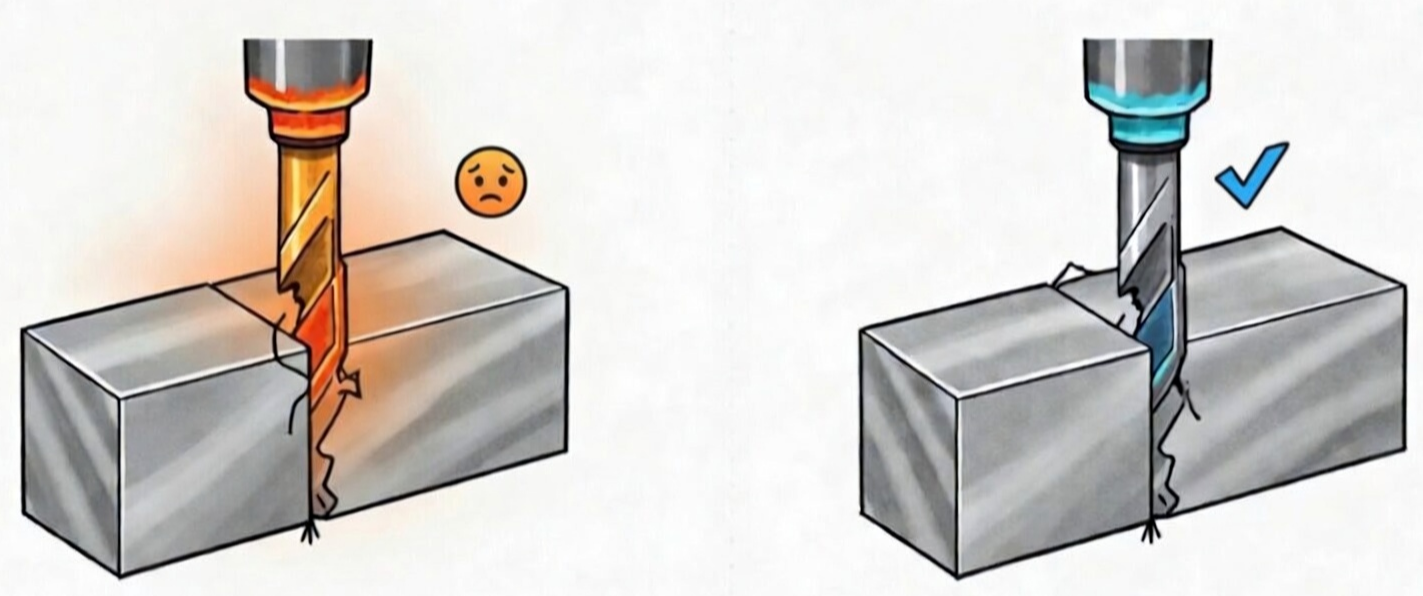
The materials with good machinability allow higher cutting speed, while the materials that are difficult to machine can only allow lower cutting speed to maintain the life of cutting tools.
Machining Requirements
Standard CNC tools can be easily used for materials with good machinability, while materials with poor machinability require specialized tools for machining.
How to Improve Machinability?
Although machinability is a relative property of materials, it can still be improved from a machining perspective by using the following tips:
Choose Materials with Good Machinability
Materials are mostly selected based on the applications. For some applications, two different materials can be used. In such cases, materials with good machinability should be selected. For instance, for the mass production of fasteners, free-cutting steel can be used instead of low-carbon steel.
Adjust Cutting Parameters Properly
Cutting parameters change with respect to the machinability of materials. For instance, higher cutting speed, lower feed rate, etc., are preferred for difficult-to-machine materials because of some specific requirements.
Select Appropriate Cutting Tools
Appropriate tools should be used based on the machinability of materials. For instance, for hard or low-machinability materials, special tools, such as diamond-coated tools, are used.
Improve Chip Control
Machinability can be improved by improving the chip control, such as by forcing the chip to fracture or curl tightly instead of flowing plastically.
Modify Material Composition
The machinability can also be improved by alloying. For instance, Sulfur is added to steel to improve its machinability. S reacts with Mn and forms MnS precipitates, which break the chips efficiently and enhance machinability.
Apply Heat Treatment Before Machining
The microstructure of the material changes with heat treatment. The classic example of this scenario is the formation of martensite when steel is quenched in water from the austenitic state. Then, to make it machinable, tempering heat treatment is performed.
Can Part Design Affect Material Machinability?
The design of a part has a great influence on its machinability. In simple words, with difficult designs, a greater amount of machining is required.
Influence of Part Design on Material Machinability
The design of a part affects its machinability through these things:
Geometries of Parts
Geometry controls the machinability of a part through thickness, feature accessibility, surface continuity, corners, and internal radii, etc. The common example is uniform thickness, which results in stable cutting, so better machinability.
Tolerance Requirement
Tighter tolerances in the design of a part require higher machining, so the machinability of that part is reduced.
Surface Quality Requirement
In the case of the higher surface finish, higher machining is required.
How to Improve Machinability by Optimizing Part's Design
By optimizing the design, the machinability of the part can be improved:
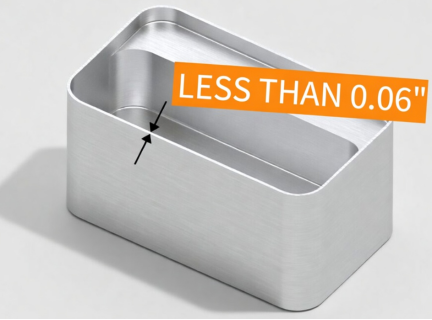
Use Appropriate Wall Thickness
Do not add unnecessary, very thin walls in the structure because they result in increased machining and reduced dimensional accuracy.
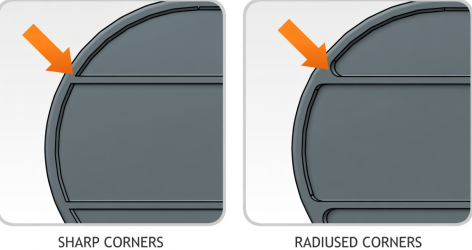
Increase Corner Radii
Sharp corners in the designs are stress concentrators, so they should be avoided. Minimal tool wear can be achieved by reducing the sharp corner radii.
Reduce Deep Pockets and Cavities
Deep pockets and cavities are sometimes made within the parts to reduce their weight. But unnecessary pockets and cavities make machining of that part difficult.
Conclusion
Machinability of the materials is a relative property which vary from material to material. Some important factors that affect it include chemical composition, microstructure, surface finish, heat treatment, and design of the part. To measure machinability, the cutting speed of the subjective material is compared with that of a reference material. Workability, formability, and machinability are relevant terms in manufacturing, but the process to convert the raw material into the final product is different. Through the optimization of heat treatment and design, machinability can be improved.
FAQ
Is manufacturing and machining the same thing?
Manufacturing is a broader term that includes every process that turns raw material into its final shape. Machining converts the raw material into the desired shape through cutting processes specifically.
What materials are good for machinability?
These materials include Al, Cu, low-carbon steel, stainless steel, etc., because they offer appropriate strength and toughness, and exhibit good machinability.
What is the hardest material to machine?
Ceramics, such as Alumina, are the hardest to machine materials because they are hard and brittle.
 Types of Robot Joints and Degrees of Freedom: Complete Engineering Guide