Tel/WeChat:
  Email:


 Home
HomeHow to Clean CNC Machined Parts: Precision Parts Cleaning Process

 Published:Jul 17,2026
Precision cleaning is an essential post-machining process. It removes contaminants remaining after CNC machining, grinding, polishing, and finishing operations. It preserves dimensional accuracy and surface quality. Even microscopic particles can affect component performance. Proper cleaning prevents assembly and coating defects. Here we will know about each precision cleaning step an much more.
What Is the Precision Parts Cleaning Process?
Precision cleaning of parts is a systematic and highly specialised process. Here parts are cleaned to remove dirt, stains, oils, grease or debris. Its performed to achieve a specified micro level of cleaning. It involves cleaning any sort of contamination that can hinder part performance. Such cleaning is done by using advanced cleaning solutions. Such solutions include like vapour degreasers and ultrasonic cleaners.
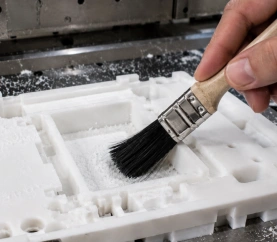
Is Precision Cleaning Different from Regular Parts Washing?
Yes, precision cleaning is different from regular cleaning. Regular cleaning includes removing dirt, debris, oil or grease from parts. However, precision cleaning goes to a microscopic level of cleaning. Such cleaning makes components contaminant-free.
In precision cleaning, even ionic particles are being cleaned. Using specialised equipment like ultrasonic cleaning. Here part is required to pass microscopic inspections. This inspection clearance is essential for aerospace, medical devices, and electronics.
When Should Precision Parts be Cleaned During Manufacturing?
During manufacturing parts should be subjected to precision cleaning in a sequential way. Its done just before surface treatment, assembling or packaging. We recommend cleaning parts during these stages of manufacturing:
- Between machining operations to remove heavy cutting fluids and debris. Because tools or measurement equipment operate on an uncontaminated, highly precise surface.
- Before thermal or surface treatments, such as prior to painting, plating, or heat-treating.Proper cleaning is essential before using a surface finishing service because contaminants on the metal can hinder effective coating adhesion.
- Final pre-assembly cleaning to meet micron-level of cleanliness standards before parts are sealed or integrated.
Why Is Precision Parts Cleaning Important after CNC Machining?
CNC machine parts require precision cleaning so that components can be contaminant-free of any metal chipping or fluids. Precision cleaning will ensure optimal performance.
For Smooth Assembly
For smooth friction-free assembly in hydraulic engines or electronics, friction-free interaction of joints is important.Precision cleaning of surfaces of CNC parts also helps in proper coating or adhesion between two surfaces. Ensure that assembly features such as threads and grooves have correct tolerances, and that surfaces provide sufficient friction for proper assembly.
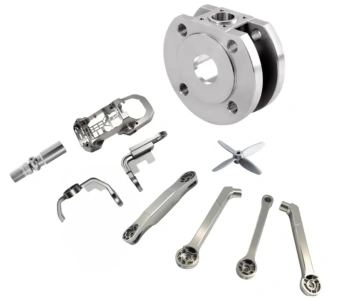
For Reliable Use
Any contamination, like acidic coolants or machining fluids can cause pitting and corrosion. It leads to operation failure. Not only this, even minute layers of dust and oil can block cavities, affecting the functional capacity of components.
For Surface Finish
Because machined parts have oils, machining lubricants, and greases. Such contaminations when left untreated hinder surface finishing treatments like plating and coatings.
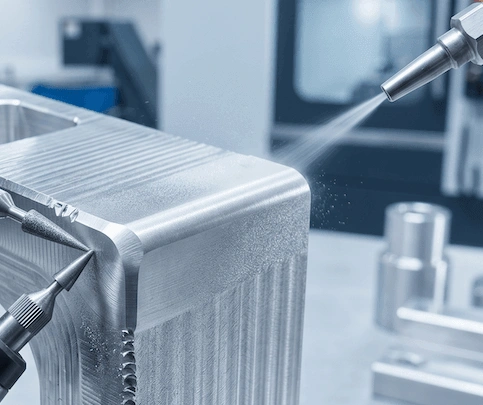
For Good Appearance
Post-processing residues such as tool marks, coolant deposits, oil stains, and machining chips may compromise the part's appearance. This is precisely why cleaning plays a critical role for surface-treated components.
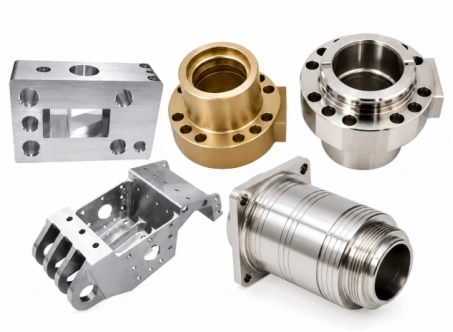
Why Is Cleaning Critical before Surface Finishing?
Machining oils, dirt, metal particles, and other leftovers after CNC must be cleaned for effective surface finishing. It improves surface adhesion, lowers corrosion risk and more.
To Improve Surface Adhesion
For proper adhesion of surface coating, it's important that some mechanical or chemical bond develops the surface coating and the substrate. Even minute layers of organic molecules or leftover fingerprints can create hindrances.
Like in case if oil partice or Colleen leftover on the surface, it will reduce the adhesion power of the surface. Due to which coating will get blistered or chip out with time. Precision cleaning is what removes them for proper adhesion.
To Prevent Uneven Finishes and Surface Defects
Machine parts cleaning is critical before surface finishing, as the contaminants can cause uneven finishing. If parts are not properly cleaned before surface finishing, residual contaminants can create a barrier between the coating and the part. This prevents good coating adhesion and may result in uneven coating thickness, blistering, and other surface defects.
To Reduce Corrosion Risk
Coolants and lubricants used in CNC machining contain water. Meanwhile some fluids, oil or metal swarf residues are left in the blind. Oxygen can diffuse through the fluid layer at different rates, creating areas with low and high oxygen concentrations. This forms an electrochemical cell, leading to pitting corrosion or rapid crevice corrosion.
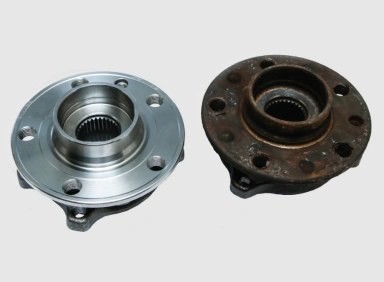
To Avoid Color Difference and Surface Stains
If parts are not properly cleaned before surface finishing, residual contaminants can interfere with surface reactions and prevent uniform treatment results. Some finishing processes rely on controlled chemical reactions to form protective layers, such as oxide films.
When contaminants remain on the surface, these reactions may occur unevenly, leading to inconsistent film thickness, color variation, or surface stains. Aluminum anodizing is a typical example where proper cleaning is essential for achieving a uniform finish,especially when producing black anodized aluminum parts that require consistent color and coating quality
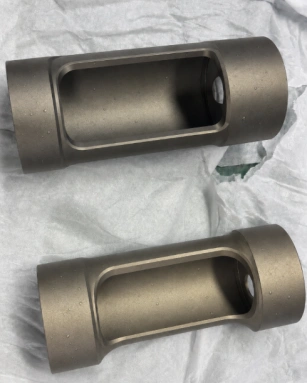
Clean Your Precision Parts Step by Step
Cleaning your precision parts needs strategic planning and careful implementation. Since parts manufactured from high-demand metals like Aluminium, Stainless Steel (SS), plastic and titanium are contaminated after machining. Such contamination can affect their performance and durability by causing rust, friction or uneven surface finishes. That's why it's important to clean your precision parts by following proper guidance.
Five Steps of Precision Parts Cleaning Process
Basically there are five major step that we recommend to follow for precision cleaning:
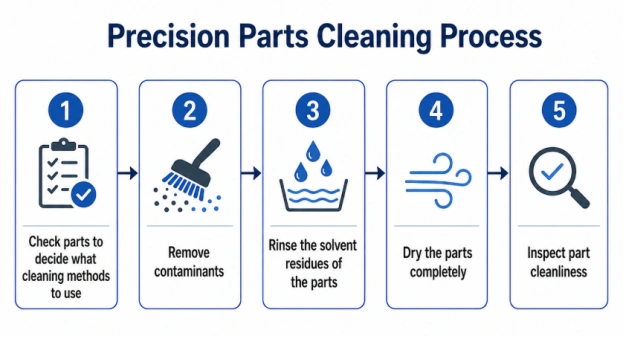
Now we are gonna discuss all these steps in detail one by one so that you can learn how your parts are manufactured with high-quality surface.
Step 1: Check Parts before Cleaning
Confirm customer's cleanliness requirement before selecting any cleaning method. Their requirements will let you know about level of cleanliness they want.
Inspect if there are contaminants existing on the parts such as:
- visible soil
- Damage
- Corrosion
- Burrs
- Coatings
- Mixed materials
Checking the situations of the parts can decide which one of the following cleaning methods to choose:
- Manual Cleaning
- High-Pressure Cleaning
- Chemical Cleaning Methods
- Ultrasonic Cleaning
Check Materials of Parts
Identify the base material before cleaning. You must know whether components is made with aluminum, stainless steel, and plastic. They all look similar after machining, but they respond very differently to chemistry, heat, and agitation. So, wrong wrong cleaner can stain, pit, crack, or deform the part.
Aluminum, Brass and Copper Parts
Use mild, non-abrasive cleaning methods for aluminium, brass, and copper, as these materials can scratch easily. Such parts also need effective drying; if water is left on a brass fitting, spots or surface discolouration can form due to tarnishing.
Stainless Steel and Titanium Parts
While cleaning parts made with stainless steel or titanium, avoid harsh chemicals like chloride; these will damage its protective passive layer. We recommend not to use tools made with carbon steel, like carbon steel brushes. This will leave embedded contamination, like iron particles, creating localised corrosion problems later.
Carbon Steel and Alloy Steel Parts
If a steel shaft is left wet on a bench, it can flash rust within a short time. So such parts require removal of oil, coolant, and chips quickly.
Plastic and Non-Metallic Precision Parts
Use only materials and cleaners approved for the specific plastic or non-metallic part. Reason is that polymers get damaged or react easily with harsh chemicals. This causes swelling, cracking, or loss of dimensional accuracy.
Check the Surface Situation of Parts
Before performing any precision cleaning method, it's essential to analyze surface of parts. It will help you decide the cleaning based on its material and contaminations.
Check the Part Geometries
Analyzing parts geometry is also a key point to perform before performing cleaning. As some geometries may have:
- Pores
- Threaded features
- Grooves
They are highly prone to getting clogged with contaminants. Such geometries require specialized methods of cleaning, like ultrasonic agitation.
H4 Threaded Features
Fine, tightly tolerance threads are suitable for trapping oils, swarf, and cleaning solutions. Not only this, but blind threaded holes are particularly difficult to dry, often requiring vacuum-assisted air cleaning.
Hole Features
Components with hole features also require special care while cleaning. As they can entrap cleaners in them. Such incomplete draining can cause watermarks, corrosion, or staining during drying.
Internal Passage Features
Internal passage components need attention while cleaning, as they can get built up with oils or cleaners easily. Which, if left unnoticed, can cause operational failure of component.
Groove and Slot Features
Grooves and slot features are more susceptible to clogging contamination, as it's difficult for cleaners to reach them easily.
Identify the Contaminants on the Parts
Before you finalize precision cleaning process, make sure to understand the type of contaminants. Visually clean parts can still hold contaminants like bacteria. So identify contaminant type and clean accordingly. Generally speaking, most common contaminants include:
- Machining Particles
- Machining Fluid Residue
- Abrasive and Finishing Residue
- Chemical Residue
- Handling and Environmental Contamination
Step 2: Remove Contaminants
Each specific type of contaminant removal requires specialized methods. Method is selected in such a way that it does not affect component material. However, it precisely cleans it at a microscopic level. Here we are going to tell you about some most important cleaning methods.
- Manual Cleaning
For prototypes, oversized parts and localized contamination manual cleaning is performed. In this process workers use brushes, swabs, and lint-free cloths to remove visible chips, grease. Its main advantage is low cost and flexibility.
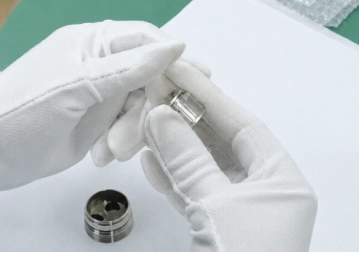
However, cleaning quality depends on operator skill. One more thing is that manual leaning is not a reliable way to remove particles trapped inside threads, blind holes, or narrow grooves.
- Ultrasonic Cleaning
Engineers prefer ultrasonic cleaning for components that have complex geometries like valves and fuel injectors. Here, high-frequency sound waves typically 20-80 kHz are used for cleaning.
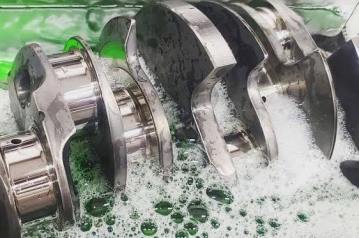
These waves generate microscopic cavitation bubbles that penetrate threads, blind holes, cooling channels, and intricate features. As a result, particles, oils, and machining residues are removed. Ultrasocnic cleaning delivers highly uniform cleaning. If a component has a thick layer of carbon deposit, it requires chemical pretreatment before ultrasonic cleaning.
- Wipe Cleaning
Fingerprints, light oil, and dust particles are cleaned using wipe cleaning method. Such method is considered effective for final surface preparation step. Used for optical, electronic, and cosmetic-grade parts. But this method cannot clean internal passages. It can introduce fibers if improper wiping materials are used.
- Spray Washing
Helps to clean production parts. Here pressurised precision cleaning solutions spryed onto the surface. You can remove machining coolant, loose chips, and grinding debris with spray washing. The best thing about this method is it offers fast cycle times for high-volume manufacturing.
- High-Pressure Cleaning
Engineers find this method suitable for surface cleaning to remove rust, chipping, stubborn dust layers, or sludge from large castings. They use high-pressure water with 10,000-40,000 PSI on engine blocks and hydraulic components to clean their surfaces.
- Chemical Cleaning
As the name suggests, it uses alkaline, acidic, or solvent-based formulations. These chemicals dissolve oils, oxides, and corrosion products. Before you use this method, be sure you are using right cleaning chemistry. If you pick wrong chemical, you might end up damaging components' material.
Clean Machining Particles
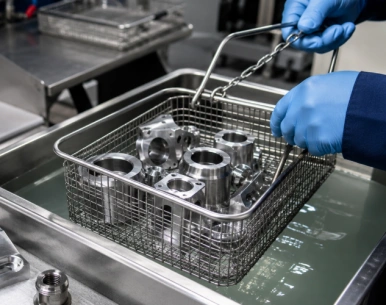
We recommend using an ultrasonic cleaner for parts for removing following particles:
- Metal chips
- Swarf
- Burr particles
- Fine metal dust
- Tool wear particles
Its because ultrasonic transducers transmit high-frequency sound waves into a liquid cleaning bath. This creates millions of microscopic vacuum bubbles that rapidly expand and collapse.
When these bubbles collapse, releasing intense energy that acts as a powerful scrubbing mechanism. This penetrates blind holes, deep threads, and micro-cracks. Standard spraying or manual wiping cannot reach there.
Clean Machining Fluids
Oils, greases, lubricants, and rust inhibitors are organic contaminants. They bond to metal surfaces as a continuous film rather than loose particles. That's why mechanical methods such as manual wiping or spray washing alone often leave microscopic residues.
So, engineers use chemical cleaning to remove such contaminants. It dissolves or emulsifies these films at the molecular level, allowing them to be rinsed away completely.
Clean Abrasive and Finishing Residue
Abrasive residues are among the most critical contaminants. Because particles cause premature wear in bearings, hydraulic systems, and precision assemblies. Ultrasonic parts cleaning is preferred finishing process.
When residues contain wax, grease, or polishing binders, chemical cleaning is performed first. It dissolves the organic film before ultrasonic cleaning removes the remaining solid particles. This combination provides the highest cleanliness for precision CNC components.
Step 3: Rinse the Parts Thoroughly
After performing cleaning, parts are rinsed thoroughly to remove cleanness and contaminants.
Use the Right Rinsing Method
Here are some rinsing methods you can adopt:
|
Rinsing Method |
When to Adopt |
Suitable Parts |
|---|---|---|
|
Tap Water Rinse |
Initial rinsing |
Non-critical machined and cast parts |
|
DI Water Rinse |
Final residue-free rinse |
Aerospace, medical, electronic, and precision CNC parts |
|
Spray Rinse |
High-volume production |
Automotive and general machined components |
|
Ultrasonic Rinse |
Complex geometries |
Parts with threads, blind holes, grooves, and internal channels |
|
Immersion Rinse |
Delicate or intricate parts |
Small precision components and instruments |
|
Cascade Rinse |
Highest cleanliness requirements |
Semiconductor, aerospace, and medical components |
Remove Cleaning Residue from Complex Features
Cleaning chemicals can remain trapped inside threads, holes and other enclosed features. We recommend using DI water rinsing followed by ultrasonic rinsing. Then apply vacuum drying to remove detergent-trapped cleaning liquids. This will help in preventing corrosion and residue-related performance issues.
Step 4: Dry the Parts Completely
Drying your parts is also important, as any moisture left behind will cause rusting. Here is how you can dry your components.
Choose a Drying Method
You need to select the following drying method:
- filtered compressed air
- hot-air drying
- vacuum drying
Remove Moisture from Internal Features
Internal features may trap water during cleaning, so drying them is necessary. You can use vacuum drying for effective drying.
Step 5: Inspect Part Cleanliness
After cleaning, inspect whether the part meets the customer's specified cleanliness requirements. These checks can also be integrated into the broader quality testing process for CNC machined parts.
Basic Cleanliness Checks
We have put togather some basic checks to perform in table here:
|
Cleanliness Check |
Purpose |
|---|---|
|
Visual Inspection |
Detect visible chips, dust and stains |
|
White Wipe Test |
Inspecting loose particles and oil residue |
|
Water Break Test |
Verifying removal of oils and grease |
|
UV Light Inspection |
Detecting fluorescent oils, grease, and organic residues |
|
Borescope Inspection |
Inspecting blind holes, threads, and internal passages |
|
Gravimetric Analysis |
Measuring total particulate contamination |
|
Non-Volatile Residue (NVR) Test |
Quantify remaining organic residue |
Functional Cleanliness Checks
- Internal channels
- Fluid passages
- Hydraulic ports
- Pneumatic passages
- Deep holes
- Blind holes
If contaminants are not properly removed, they can interfere with assembly, restrict fluid flow through internal passages, reduce sealing performance, and affect overall part functionality.
When Customers Need a Cleanliness Report
Many industries, particularly automotive, aerospace, and medical device manufacturing, require a cleanliness report. It's a part of their quality documentation. It acts as evidence that parts have been cleaned according to their requirements. You need to state:
- Cleaning process
- Inspection methods
- Particulate contamination results
- NVR measurements
- Acceptance criteria
- Pass/fail
How Tuofa Checks Part Cleanliness During Quality Inspection
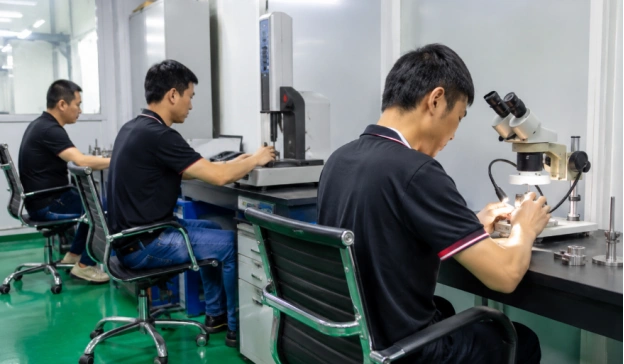
As part of Tuofa's custom CNC machining service, our expert team helps you perform precision cleaning of your CNC components according to your requirements. Our customer satisfaction and following strict guidelines are our key. You will get parts that are carefully and effectively cleaned and ready to install.
Confirm Customer Cleanliness Requirements Before Inspection
We determine required cleanliness level of a part by integrating packaging requirements:
- Drawings
- RFQ specifications
- Surface treatment requirements
- Assembly applications
After that, decided procedure is applied. Proper cleaning and drying is performed to enhance the functionality and lifetime of CNC part.
Inspect High-Risk Features for Residue
The quality inspection will focus particularly on areas where residual pollutants are likely to accumulate. For example, cavities are small pores and holes. To clean them we use ultrasonic cleaning method.
Prevent Recontamination During Inspection
At Tuofa, our experts handle clean components using clean gloves and lint-free materials. It's done to prevent recontamination after precision cleaning.
Conclusion
Precision cleaning of CNC components is essential for components to function effectively. Performing precision cleaning in right way is essential. As any leftover contamination can cause functional failure. At Tuofa we offer precision cleaning under the supervision of our expert engineers and workers.
FAQ
How do cleaning requirements affect cost?
Higher cleaning requirements, alternatively, mean higher cost. As it will cause using more chemical equipment and labour.
Is ultrasonic cleaning always required for precision CNC parts?
No, ultrasonic parts cleaning is not required for all parts. It provides effective cleaning; it is preferred for components with holes, cavities, and grooves.
Can cleaned carbon steel parts rust?
Yes, cleaned carbon steel parts can rust as they undergo oxidation. To avoid this, we recommend cleaning parts be coated with protective layers like mineral oil or light machine oil.
What should you tell your CNC supplier about cleaning requirements?
You must inform your cleaner about your cleaning standards. Including what type of contamination you want them to remove and which are restricted chemicals.
 How to Select a Clevis for Your Application: Types, Design, and Manufacturing