Tel/WeChat:
  Email:


 Home
HomeWhat Is Oxygen Free Copper? Common Grades, Properties, Applications & CNC Machining

 Published:Jan 16,2026
Oxygen-free copper(OFC) can be CNC-machined but is not very easy to machine. It is often used to manufacture parts for vacuum equipment or conductive parts. If you are hesitating to choose oxygen-free copper or not, read this guide for understand its chemical content, properties, common grades and machinability.
What Does Oxygen Free Copper Mean?
Oxygen free copper means the copper that has been processed to have exceptionally low residual oxygen content (less than 0.001%). This feature makes oxygen free copper has outstanding electrical conductivity and thermal conductivity, which makes it is usually used in some industries that have high requirement for heat or electron transfer such as communication cables, electrical components, and vacuum devices.
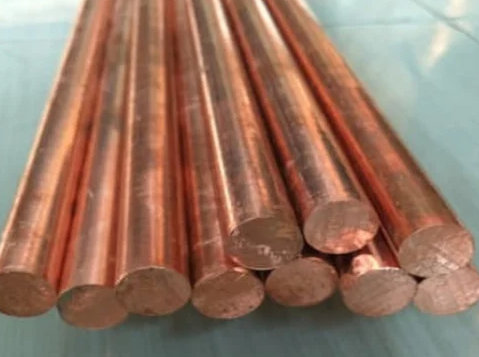
The purity helps to eliminate the tiny copper-oxide particles that are normally present along the grain boundaries in impure coppers. These oxides can slightly block the flow of electrons and affect conductivity.
Is Oxygen Free Copper Widely Used?
Yes. As CNC-machined parts, oxygen-free copper is usually used for special applications such as vacuum electronic equipment, semiconductor devices, or scientific research equipment.
How Is Oxygen Free Copper Made?
OFC is produced through refining processes to avoid any re-exposure to oxygen. A common method is melting and casting pure copper in a furnace with inert atmosphere like nitrogen or argon, or under a charcoal cover. This controlled atmosphere prevents oxygen from dissolving into molten metal.
Common Grades of Oxygen Free Copper
Oxygen free copper has many grades but C10100 and C10200 are the most common ones. The difference between them is the level of purity.
C10100 Alloy
This copper alloy is 99.99% pure. Oxygen content is very low with 0.0005% (5 ppm) max. It has conductivity of 101%IACS and is the highest among all copper alloys due to the purity level. C10100 is preferred due to its corrosion resistance, ductility and low volatility under vacuum.
C10200 Alloy
C10200 is 99.95% pure copper. It has maximum oxygen content of .001% (10 ppm). This grade is able to achieve 100% IASC conductivity and is used in places where conductivity and resistance to hydrogen embrittlement are needed.
Properties of Oxygen Free Copper
Oxygen free copper is a high-purity material with 99.95% to 99.99% purity. It is known for its exceptional electrical and thermal conductivity, corrosion resistance, and ductility.
Excellent Electrical Conductivity
The electrical conductivity of oxygen-free copper including C10100 and C10200 is 101% IACS(20°C/68°F), which means they are high-conductivity copper materials, suitable for electrical devices.
Thermal Conductivity
Similarly, they show exceptional thermal conductivity typically ranging from 386 to 394 W/m·K(223 Btu/(ft·hr·°F)). That is why OFC is the best choice for high-performance cooling parts or heat sink parts that need resistance to hydrogen embrittlement.
Mechanical Properties
Mechanical features of OFC vary with specific grades like C10100 or C10200 or treatments like annealed or cold-worked conditions. According to data from multiple material suppliers, you can find the corresponding values for each mechanical property of oxygen-free copper. The following table shows the typical mechanical properties of C10100 and C10200 oxygen-free copper in the EN 1652 R220 condition.
|
Properties |
C10100 Alloy(Cu-OFE) |
C10200 Alloy(Cu-OF) |
|---|---|---|
|
Material Condition |
Annealed / Soft, R220 |
Annealed / Soft, R220 |
|
Tensile Strength |
220–260 MPa |
220–260 MPa |
|
0.2% Yield Strength |
≤140 MPa |
≤140 MPa |
|
Elongation, A50 |
≥33% |
≥33% |
|
Hardness, Vickers |
40–65 HV |
40–65 HV |
|
Modulus of Elasticity |
Approx. 117–130 GPa |
Approx. 117–130 GPa |
|
Poisson’s Ratio |
Approx. 0.33 |
Approx. 0.33 |
|
Machinability Rating, C36000 = 100 |
20% |
20% |
|
Shear Modulus |
Approx. 44 GPa |
Approx. 44 GPa |
Corrosion Resistance
Extremely low oxygen concentration reduces the risk of oxidation and corrosion. This also increases the durability in OFC components in marine and inaccessible wiring installations. OFC also has resistance to hydrogen embrittlement which standard copper does not have. Unlike OFC, standard copper becomes brittle when exposed to high temperatures in a hydrogen-rich atmosphere.
Oxygen Free Copper vs Other Materials
As mentioned above, OFC is high-purity copper, but its remarkable properties are comparable to other materials like pure copper, aluminum or brass alloys.
Pure Copper Vs Oxygen Free Copper
Pure copper is the standard grade of copper while OFC are additionally gone through a reining process to remove oxygen to the lowest possible level. OFC is 99.95-99.99% pure copper while standard Cu is 99.9% pure. Overall, OFC has better conductivity, corrosion resistance and hydrogen embrittlement resistance than pure copper due to low oxygen levels. But OFC is more expensive due to additional manufacturing process.
Oxygen Free Copper vs Aluminum Alloy
Oxygen Free Copper has higher electrical and thermal conductivity than aluminum alloys. Aluminum alloys are lighter than OFC, but they have lower strength and durability than OFC. OFC is used high-performance wires while Al alloys are for lighter-weight wiring.
Brass vs Oxygen Free Copper
OFC is nearly pure copper while brass is a copper alloy of zinc and copper mainly. Brass has higher hardness, machinability and strength than OFC. OFC is used for mainly electrical or thermal applications while bras is used in mechanical fitting.
ETP Copper vs Oxygen Free Copper
ETP (Electrolytic Tough Pitch) is a common and cost-effective copper. ETP copper like C11000 has 99.9% purity with controlled oxygen for maximum conductivity. OFC is more ductile and better resistance to hydrogen embrittlement but is expensive. ETP is great for general electrical wiring.
|
Features |
Oxygen-Free Copper |
ETP Copper (C11000) |
|---|---|---|
|
Purity |
>99.99% pure |
~99.9% pure |
|
Oxygen content |
<0.001% |
~0.02% |
|
Conductivity |
Higher, stable at high temps |
High, less stable at high temps |
|
Costs |
Higher |
Lower |
|
Advantages |
Hydrogen Embrittlement and corrosion resistance, high conductivity copper |
Cost-effective for general use |
What Are Applications for Oxygen Free Copper?
Oxygen Free high conductivity copper is used in high-performance applications that prevent hydrogen embrittlement and provide reliability in critical parts.
Oxygen Free Copper Machined Components
OFC also has a number of applications due to its thermal conduction, formability, ductility and resistance to hydrogen embrittlement. It is ideal for where precision and performance are crucial.
Electronic & Electrical Components
OFC machined parts are used in connector terminals, busbars, vacuum tube filaments and anode. The lack of oxygen prevents reaction within vacuum atmosphere at higher temperatures. Furthermore, efficient power distribution within electrical systems minimizes energy loss.
Thermal Management Parts
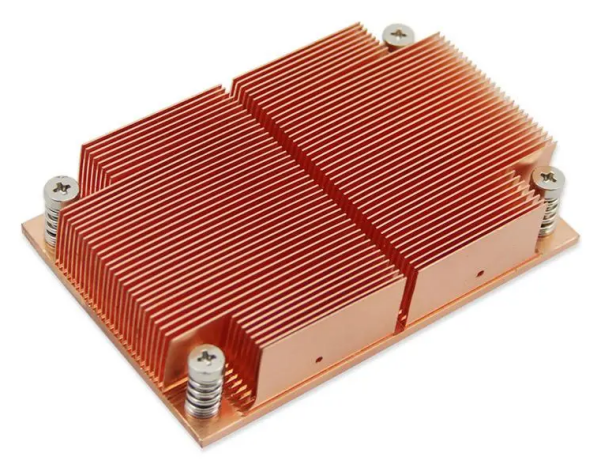
Oxygen free copper machined parts are used in cooling high-performance electronics like copper heat sinks and cold plates and lasers to have rapid heat transfer.
High-Precision Components
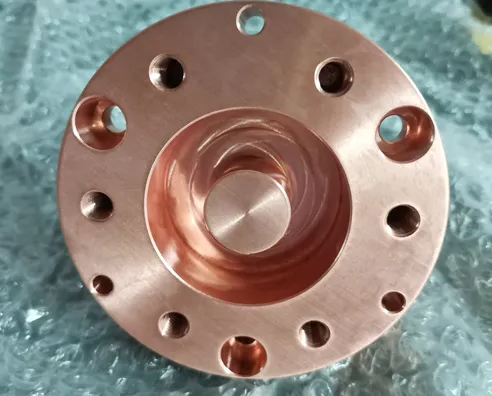
High-precision parts like vacuum devices, scientific instruments like cold shields and particle accelerators are the common applications of OFC. OFC in vacuum devices like seals and chambers make ultra-high vacuum system due to low outgassing properties. scientific instruments used in cryogenic systems need thermal properties at lower temperatures and particle accelerators require high conduction and radiation resistance which OFC offers.
Aerospace Components
Oxygen-free copper is not commonly used for supporting parts in aerospace. Instead, it is used for functional parts like vacuum seals, microwave component bases, etc.because of its high electrical conductivity and high thermal conductivity.
Is Oxygen Free Copper Easy to CNC Machine?
No, oxygen-free copper is not easy to machine due to the following reasons:
- Itis soft and has highly ductile structure.(prone to sticking to the cutting tool)
- It easily producesbuilt-up edge.
- It easily produces longand continuous chips.
- Thin-walled and flat parts easily deform.
Considerations for Machining Oxygen Free Copper
For CNC machining copper, follow these instructions:
- Use high clearance cutting tools and chip breaker for chip control
- Use oil-based coolants for lubrication
- To prevent cracking or distortion, apply stress-relieved heat treatment after machining.
- work-hardened state of OFC increases machinability
Is It Easy to CNC Turning or CNC Milling Oxygen-Free Copper?
According to our practice, CNC milling OFC is easier than CNC turning OFC because milling is usually interrupted cutting while turning is continuous cutting. The former is not easily influenced by soft OFC, while the latter is pron to creating continuous chip during processing. Badly, the created chip can damage the surface of the parts.
Is Easy to Drill Holes When Machining Oxygen-Free Copper?
OFC’s soft may lead to difficulties in drilling holes. The issues include:
- Poor chip evacuation.
- Drillmay breakage.
- Difficulty controlling hole diameter and straightness.
Machine Threads on Oxygen-Free Copper Parts
To avoid chip evacuation problems, it is better machine threads through:
- Form Tapping
- Thread Milling
Form tapping doesn’t produce chip, thread milling produces chip but the chip is small and usually easier to evacuate.
Can You Get Custom Oxygen Free Copper Parts?
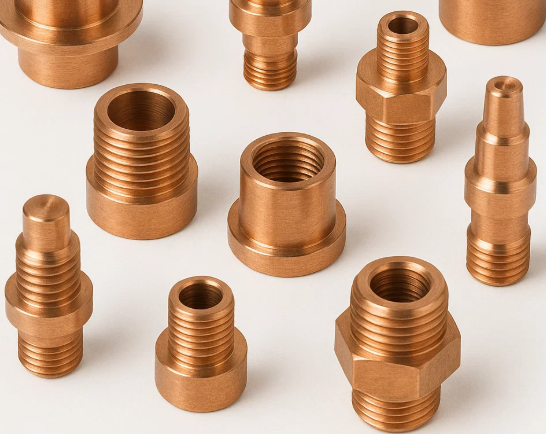
Yes, absolutely. CNC machining offers great flexibility for custom designs and can make unique and high-precision Oxygen free copper parts. You can contact Tuofa custom machining services for your custom OFC parts. We can produce custom shapes and sizes for your specific Oxygen Free Copper application.
Challenges in Machining Oxygen Free Copper
As we have introduced before, oxygen-free copper is difficult to machine because it is soft. It can easily cause deformation, inaccurate dimensions, chip evacuation and heat accumulating.
Material Adhesion
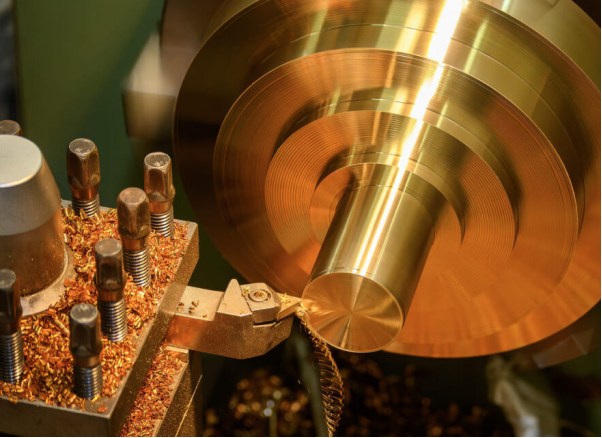
The soft and ductile nature of copper makes it stick to the cutting edges, especially at lower speed. This makes it gummy and prone to pressure welding onto the cutting tool surface.
Burr Formation
Oxygen free copper has high ductility and material side-flow nature. During cutting, this results in large and difficult-to-remove burs, especially at cut exit points.
Tool Wear
Adhesion and the high thermal conductivity of oxygen free copper rapidly transfer heat to the tool. This leads to overheating and premature degradation. Also, work hardening can occur with improper cuts.
Solutions for These Challenges
To reduce these challenges and make machining of Oxygen free copper easy and optimized, these are the solutions:
Use Sharp Cutting Tools
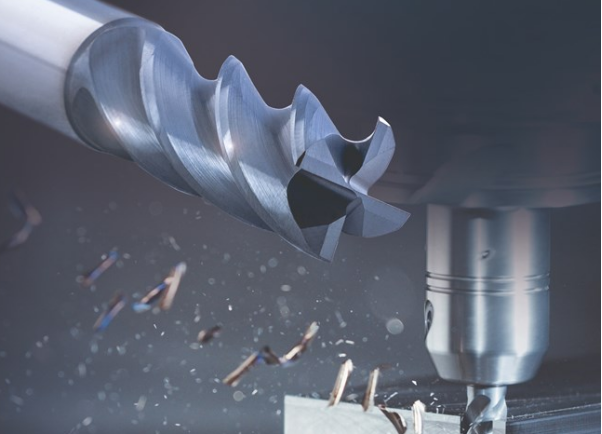
Use sharp cutting tools with positive rake angles and high cutting speed. This will prevent formation of built-up-edges. Polished tools like Diamond-like Carbon (DLC) or TiN coatings on carbide tools will also reduce the surface area of adhesion and use of lubricants ensures clean shearing action.
Adjust Cutting Parameters
Optimize tool geometry with sharp edges and appropriate rake angles. High spindle speeds with controlled or reduced feed rates will also minimize the burr formation. Use solid workholding to prevent vibration and minimize unsupported features in part design or use secondary deburring operations.
Here provides an example:
A machinist initially encountered excessive cutting noise, unstable cutting, and surface smearing when turning Copper 101.
The process was then adjusted to a 0.015 in radial depth of cut, with 0.005 in left for the finishing pass. For a 1.25 in diameter workpiece, the spindle speed was set to approximately 600 rpm, with a feed rate of 2 ipm.
After the adjustment, the cutting process became more stable, material dragging was reduced, and the final pass produced an accurate diameter with a bright, mirror-like surface.
Reduce Cutting Temperature
Hard and wear-resistant tool materials and coatings will minimize the cutting temperature. Consistent and high-pressure coolant applications with optimized parameters can reduce the diffusion wear. Water-soluble oils or mist coolants can efficiently manage heat friction. Use of coated carbide, or Polycrystalline Diamond (PCD) for ultra-precise work will also help in temperature reduction.
Conclusion
Oxygen free copper is a highly pure copper with extremely low oxygen content. It is electrolytically refined copper to reduce the oxygen level at the minimal level up to 0.001%. Common grades of OFC are C10100 and C10200. C10100 is the ultra-pure grade with 99.99% copper and has 0.0005% oxygen limit. Oxygen free copper has superior electrical and thermal performance compared to standard copper. It is demanded in many applications due to its conductivity and reliability. For example, in high-end audio and video equipment, electronics, scientific and medical devices, power distribution, aerospace and automotive industries.
FAQ
What is the difference between OFC and ETP copper?
The major difference between OFC and ETP copper is their purity and oxygen level. OFC has high purity of 99.99% Copper and has minimum oxygen levels up to <0.001%. while ETP is standard copper with 99.9% pure and has 0.02-0.04% oxygen.
What is ETP copper used for?
ETP (Electrolytic Tough Pitch) copper is used in electrical wiring, motor and generators due to electrical conductivity. In radiators and heat sinks due to its thermal properties and in architectural elements due to its corrosion resistance.
Is copper magnetic?
No, copper is not magnetic. It does not attract magnets, but it is diamagnetic. That means it weakly repels magnetic fields due to its paired electrons.
 What Is Duralumin Material? Know Its Properties & Applications