Tel/WeChat:
  Email:


 Home
HomeWhat Are Mechanical Seal Parts and How to Customize Them?

 Published:Sep 17,2026
The slightest variance on a shaft sleeve or gland plate of a few thousandths out of tolerance is enough to shut down an entire pump. It is known that the materials and manufacturing methods can affect the performance of mechanical seal parts and these mechanical seal parts are often low-volume, multi-material, and highly varied. This will be discussed in the following guide on mechanical seal components, their machining processes and how a manufacturing partner like Tuofa approaches them.
Key Takeaway
- Mechanical seal parts include primary sealing components, secondary seals, loading components, drive and retaining hardware, mounting and supporting components.
- CNC machining can effectively improve the sealing performance and surface quality of the mechanical seal parts.
- Commonly used surface finish for mechanical seal parts include passivation, electropolishing, hard chrome plating, electroless nickel plating.
- Mechanical seal parts are usually applied in oil and gas, chemical processing,power generation, automotive, semiconductor and electronics.
- Tuofa HMLV manufacturing is one of the reliable CNC manufacturer for custom mechanical seal parts.
What Is a Mechanical Seal?
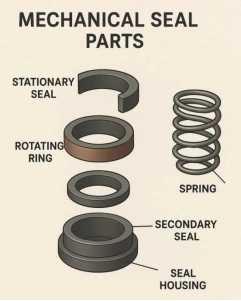
A mechanical seal is a precision dynamic sealing system which ensures prevention or reduction of fluid leakage at a point where a rotating shaft penetrates a stationary casing. The mechanism entails two surfaces which are polished highly with one moving together with the shaft while the other is stationary. Fluid and spring or bellows forces ensure that there is controlled contact between the faces during use.
What Is a Mechanical Seal Used for?
Mechanical seals prevent leakage from areas where a shaft is rotating within stationary housing. They are commonly found in applications such as pumps, compressors, mixers, agitators, and other rotating machinery in chemical plants, oil and gas refineries, power plants, water treatment facilities, and pharmaceutical plants.
How Does a Mechanical Seal Work?
The rotary and stationary rings are lapped to a flatness tolerance of 1-3 helium light bands (which corresponds to 0.4 to 1.3 microns), then squeezed together by a controlled face load of 8-15 pounds per square inch, defined by a balance ratio of 70-85%. The result is a fluid film of less than a micron thick between the surfaces of the rings. This is sufficiently thick to provide lubrication and cooling.
What Are the Main Parts of a Mechanical Seal?
There are several components that perform specific tasks, either for sealing, loading, rotating, or positioning the seal, and all of them are normally made of different materials or techniques.
Primary Sealing Components
|
Component |
Function |
Typical Material / Notes |
|---|---|---|
|
Rotary Ring |
It rotates together with the shaft and constitutes half of the dynamic sealing surface. |
Carbon graphite or SiC based materials |
|
Stationary Seal Ring |
Provides the mating lapped surface for the ring in motion. |
Silicon carbide, WC, or ceramic |
Secondary Seals
|
Component |
Function |
Typical Material / Notes |
|---|---|---|
|
O-Rings |
Seal the static interfaces between the seal ring, sleeve, and shaft, and allow the rotary ring to move axially as faces wear. |
EPDM, Viton (FKM), Kalrez |
|
Gaskets |
Seal flat static joints, typically between the gland plate and the seal chamber. |
PTFE, graphite, or Elastomeric sheet |
|
V-Rings |
Provides an adaptive, self-powering secondary seal. |
Polymers (PTFE or elastomer), V-shaped cross-section |
|
Wedges |
A stiff, inelastic backup seal used where O-ring seals fail. |
Polytetrafluoroethylene (PTFE) |
|
Elastomer Bellows and Diaphragms |
Integrate both the secondary sealing and spring loading action into one flexible element. |
Elastomer or metal based bellows |
Loading Components
|
Component |
Function |
Typical Material |
|---|---|---|
|
Single, Multiple, and Wave Springs |
Provide the axial load at start of the process and as the surfaces wear. |
Hastelloys (Ni based superalloys) or 316 stainless spring wire |
|
Metal Bellows |
Replace spring coils for bellows seals |
Thin-wall welded SS or nickel based alloys |
Drive and Retaining Hardware
|
Component |
Function |
Typical Material |
|---|---|---|
|
Drive Pins, Lugs, and Set Screws |
Apply torque to the shaft from the transmit shaft so that the seal face rotates with the shaft. |
Hardened SS |
|
Drive Collars, Clamp Rings, and Retainers |
Secure the rotating assembly against axial movement on the shaft, and adjust the spring tension. |
316 stainless, precisely bored and keyed |
Mounting and Supporting Components
|
Component |
Function |
Typical Material |
|---|---|---|
|
Gland Plate |
These bolts attach to the seal housing and hold the static ring, secondary seals, and sometimes the flush port. |
316 stainless |
|
Shaft Sleeve |
Prevents wear and corrosion of shaft OD. |
316 stainless, Hard coated material for abrasive service |
|
Seat Holder |
Keeps the stationary seal ring in position and keeps it away from housing bore tolerance stack-up. |
316 stainless or duplex SS |
|
Adapter Rings |
Transform a cartridge seal or a different chamber depth to match the pump configuration. |
316 stainless steel (machined as per standard) |
What Materials Are Used for Mechanical Seal Parts?
Various materials are chosen depending on several factors such as mechanical behavior, chemical resistance, friction, and wear. These are:
Stainless Steel
Stainless steel is generally used for hardware parts such as gland plates, shaft sleeves, seat holders, and drive collars. The austenitic grades 316 and 316L have good corrosion and machining characteristics with an annealed hardness of about 150-200 HB. The precipitation hardened 17-7PH stainless steel is often used for springs which need high yield strength. Stainless steel parts are usually passivated to ASTM A967 after machining.
Carbon Graphite
Carbon graphite is one of the common materials for soft sealing surfaces since it has lower friction and it self-lubricates and can compensate for small surface irregularities. It has a hardness of 1-2 in Mohs scale and is able to wear preferentially against hard surfaces without galling. It has an elastic modulus of 15-25 GPa.
Silicon Carbide
Silicon Carbide can be in Reaction Bonded or Sintered forms and is commonly employed as an abrasive facing material. The hardness of Silicon Carbide as per Moh's scale is 9-9.5, which makes it very resistant to abrasion from slurries or fluids that may contain contaminants.
PTFE
PTFE is used in secondary seals such as wedges, V rings, and certain types of gaskets due to the material's low coefficient of friction (around 0.05-0.10) and wide-ranging chemical resistance.
Mechanical Seal Parts You Can CNC Machine
Unlike the lapped carbon and silicon carbide sealing faces, the hardware of a mechanical seal is ideal for CNC milling and turning. For a low-volume, multi-material, multi-variety shop like Tuofa, these parts are routine—but the difference lies in how we review them before cutting. We check part function, functional surfaces, sealing requirements, coaxiality, parallelism, and assembly relationships, and volunteer process and cost-down suggestions
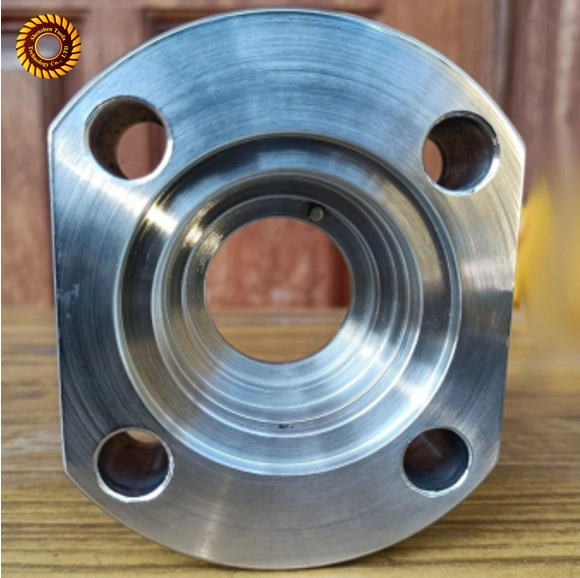
Gland Plate
The gland plate is where the static seal ring is mounted and holds the seal in place inside the seal chamber. The ring bore and face of the gland plate must be perpendicular to the shaft centerline, usually to within 0.0005 in per inch of bore diameter. It is possible to machine the ring bore, the face, and the bolt circle on a CNC lathe in one setup.
Shaft Sleeve
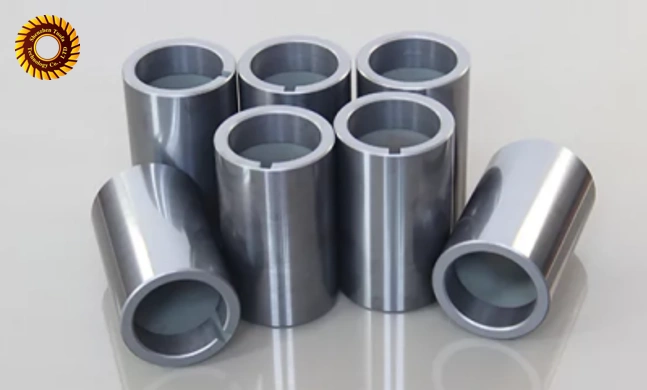
The shaft sleeve offers a surface on which the rotating elements move while protecting the shaft from wear and interaction with the processing fluid. The important considerations for this part are a tolerance of less than 0.002 in TIR for OD runout and a roughness specification of the order of 32 Ra for the O-ring contacting surface. This can be done using CNC turning between centers and grinding when dealing with hard or coated sleeves.
Seat Holder
The seat assembly holds the fixed ring and shields it from variations in the dimensions of the bore of the housing. The seat bore needs to be accurately machined in order to avoid over constraining the brittle SiC ring. The CNC boring process is able to hold a tolerance of about ±0.005 inches.
Adapter Rings
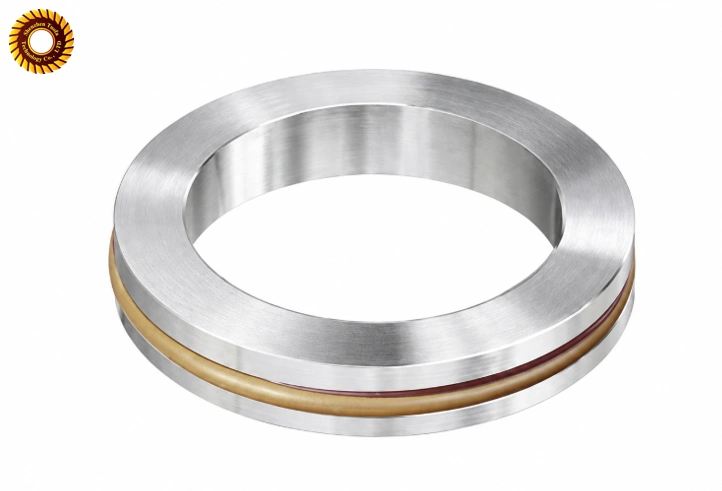
Cartridge adapter is used to modify a normal cartridge seal envelope such that it corresponds to the bore and axial depth dimensions of the chamber of the pump. The important dimensions include the step diameter and axial depths that have to be compatible with the bore dimensions of the OEM housing. This part can be CNC turned into one single program.
Drive Collars
Torque transmission from the shaft to the rotating assembly is done by the drive collar. It also sets up the spring compression. The keyway and set screw arrangement on the drive collar need to be precisely located with respect to the bore. The use of CNC lathe and machining together in one operation ensures correct location of the bore and drive elements.
What Surface Finishes Are Used for Mechanical Seal Parts?
Machining establishes the component's geometry, dimensions, and tolerances, while surface treatment can improve its resistance to corrosion, wear, and other service conditions. There are many ways of surface finishing; the four mentioned below are sufficient for seal hardware.
Passivation
This process involves treatment of stainless-steel gland plates, sleeves, and seat holders right after machining with either nitric acid solution or citric acid solution. It allows the formation of the protective chrome oxide layer under the surface.
Electropolishing
Electropolishing is an electrochemical finishing process that involves removal of very fine peaks from the surface. It can reduce the surface finish of a stainless-steel machine surface to less than 0.4 µm Ra.
Hard Chrome Plating
Electro-plated hard chrome increases the surface hardness of a shaft sleeve to 68-72 HRC, which is higher than the surface hardness of the base stainless steel itself, at thickness levels ranging from 0.005 in. to 0.001 in. Hard chrome plating has been traditionally used on sleeves that operate in an abrasive or slurry environment.
Electroless Nickel Plating
Electroless Nickel Plating uses chemical reactions, and it covers all parts of the substrate even the bore and keyways. The hardness of the coating before heat treatment is about 500-600 HV, while after heat treatment, the hardness increases to about 900-1000 HV.
What Part Defects Can Cause Early Mechanical Seal Failure?
In most cases, failure of a seal occurs due to improper hardware tolerances even before installation, not because of the elastomers or the faces themselves.
Excessive Shaft Sleeve Runout
Excessive sleeve runout beyond about 0.002-in. (0.05-mm) total indicator reading (TIR) results in eccentric operation of the rotary face, which opens and closes the sealing clearance with each rotation of the shaft. Such operations cause vibrations and faster wearing of the faces and can cause leakage. It is preferable to machine the outer diameter and bore of the sleeve in one set-up operation.
Poor Seal Face Flatness
If the seal faces cannot be lapped to within 1 to 3 helium light bands, there will be non-uniform clearances leading to dry contact and heat checking. The lapping should be done on a cast iron plate using diamond compounds of graded abrasive fineness and checking the faces for uniformity using an optical flat under monochromatic light.
Burrs, Scratches, and Machining Contamination
Even a single burr on the OD of the sleeve or a scratch on the lapped face is enough to ruin a secondary seal or the sealing surface while installing the component. To avoid such issues, make sure that all the edges are deburred properly, use proper lapping machines, and check the critical surfaces using magnification before packaging.
When Is Custom CNC Machining Needed for Mechanical Seal Parts?
There is a wide range of standard pumps that use catalog seals, yet there are certain cases when a custom seal should be considered.
Standard Parts Do Not Match Existing Equipment
The older, regional pumps may employ bores in chambers, shaft diameters, or bolting arrangements cannot match any of the seals available in catalogs. Hence, they require machining of the sleeve, gland, or adaptor to match the equipment specifications.
Replacement Parts Are Obsolete or Unavailable
In cases where the original manufacturer no longer produces part or even the entire pump has become obsolete, then it can be more expedient to reverse engineer and manufacture a CNC machined copy.
Application-Specific Features Are Required
If the flush port, quench connection, or gland pilot has been specially designed for a particular bore diameter, then a custom-made sealing arrangement must be made.
Special Materials Are Needed
Seals made from duplex or super duplex stainless steel, Hastelloy, titanium, or PEEK are not usually carried in catalog lines due to their use in harsh chemical or high temperature applications.
Tuofa' s Tips for Designing Mechanical Seal Parts?
Between a seal that mounts correctly and one that will not mount at all, the difference is often just a few design features. We point these out during review, before they become costly changes.
Add a Gland Pilot
Use of the correct register (pilot) that sits between the gland plate and the bore of the seal chamber will ensure proper concentricity of the gland and the shaft regardless of the alignment of the bolts.
Relieve Shaft Sleeve Shoulders
Cutting out the stress concentration area at the bottom of a sleeve shoulder will ensure there is no sharp corner that might be cut into an O-ring during assembly.
Control Seal Ring Interference
The press fit interference between the sealing ring and its holding ring should have sufficient tightness to ensure no looseness, but at the same time, it should not be too much in order not to cause any undue stress on a ceramic or SiC ring.
Add a Drive Collar Keyway
The use of a keyway (instead of using only set screws) makes for better torque transfer from the shaft to the rotating mechanism and is especially important when there is high torque involved. If a feature cannot be manufactured as drawn, or a function needs a design suggestion, we flag it and offer alternatives before production, not after. Problems are shared and solved together, never shifted onto the customer.
Tuofa's One-Stop Solution for Custom Mechanical Seal Parts
Tuofa manufactures the parts of the mechanical seal using your existing seal design and drawing without any need for a new product redesign on our part. In case there is something that cannot be manufactured, or a certain function requires design suggestions, we will inform you about it and offer alternatives before manufacturing, but not the design of the sealing system. Tuofa is built on repeat business, so our incentives align with yours: a part that works, delivered reliably.
Optimize Part Design
We examine your drawing to check its feasibility with respect to tolerances, fixture ability, and other features that would otherwise increase the cost of manufacturing the part.
Evaluate Materials Selection
The specified grade of stainless steel, carbon graphite, silicon carbide, or PTFE is checked for compatibility with the required machining and finishing methods by our team. Instead of saying “no problem” to everything, we flag risks early, explain constraints, and tell you why. Most overseas buyers prefer a supplier who is honest about limitations over one who overpromises.
Flexible Manufacturing
Tuofa provides low-volume prototyping service and mass production. Even when your project involves multiple materials and several different part types, Tuofa can provide low-volume custom machining for the full range of mechanical seal parts.
Cost-Down & Process Advice
With Tuofa's design optimization, you are buying more than a part, you are buying reduced risk.
Project Updates
You will not need to chase us. Heat-treatment, surface finishing, inspection, packaging, and delay risks are reported as they happen. The project is always moving, and you always know where it stands.
Full Quality Inspection
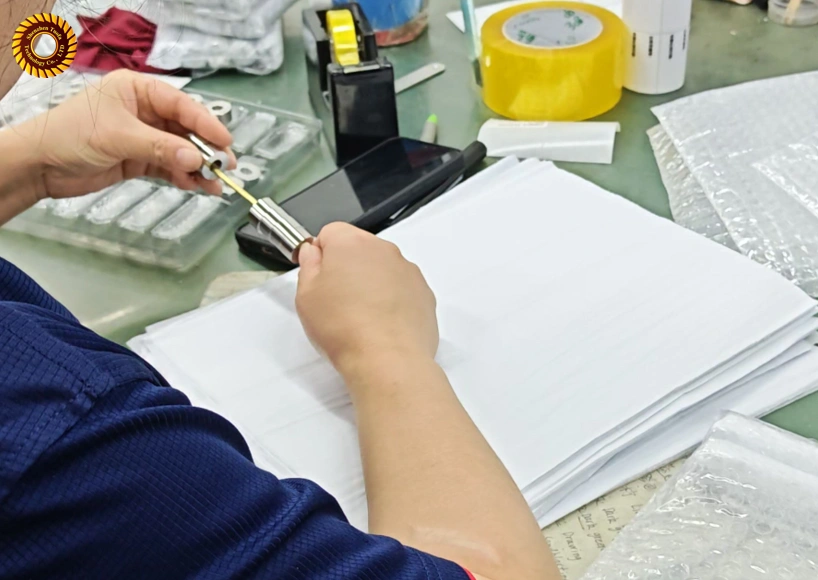
The critical dimensions of sleeve OD run out, gland face squareness, and ring bore diameter are checked using the print via CMM and dial indicator measurement. Once we take on your custom mechanical seal parts project, we apply strict quality control throughout production so that mating components fit and assemble as specified. Each part undergoes two full inspections: one before surface treatment to verify dimensional accuracy and machined surface quality, and another afterward to confirm the quality and consistency of the finished surface.
Conclusion
The performance of the mechanical seals' components depends on the tolerances and the quality of material used. If you need to purchase mechanical seals' components such as gland plates, shaft sleeves, or seat holder, then it is the correct material grade, surface finish, and machining tolerance that will make your mechanical seals run for many years instead of just weeks. If you need mechanical seal components manufactured to a well-known design, you can contact Tuofa team for a quotation.
FAQ
What are the different types of mechanical seal?
There are two types of mechanical seal. One is pusher seals, where the spring-loaded secondary O-ring is actuated by movement along the sleeve, and the other is non-pusher seals, which have a flexible metal bellow.
Why does a mechanical seal leak after replacement?
Leakage after replacing occurs due to poor installation procedures that include improper gland seating, run out in shaft/sleeve, and contamination of the faces.
How to install mechanical seal parts properly?
Clean and deburr the shaft or sleeve and seal chamber bore, ensure that the runout of the shaft does not exceed the tolerance of the seal. Also, lubricate the secondary seals as per the manufacturer's directions. The springs should be compressed as per the required pressure and the gland bolts tightened in a crisscross fashion to avoid any alignment problems.
 What Is A Machined Housing: Types, Comparison & Manufacturer