Tel/WeChat:
  Email:


 Home
HomeCNC Machined Valve Stems: Materials, Applications, Design & Machining

 Published:Aug 05,2026
Fluid delivery is an important aspect of engineering and technology. Be it oil and gas, chemical manufacturing plants, power plants, water utilities, or even hydraulic systems, an optimized fluid flow is desirable. While these fluids can travel chaotically, there must be a mechanism to regulate their flow. Valve stems are instrumental in this regulation. There are quite a few types, designs, and materials of valve stems. Let's learn about valve stems in depth.
What Is a Valve Stem?
A valve stem is basically an elongated component that connects the actuator with the sealing element inside the valve. Depending on the feedback from the sensors, actuators transfer motion to the sealing element through valve stems. This feedback loop involving the valve stem regulates the flow of fluids. Even in manual systems, a handwheel is connected to valve stems to position the sealing elements. Valve stems are often confused with similar terms. The tables below compare these terms to make a distinction between them.
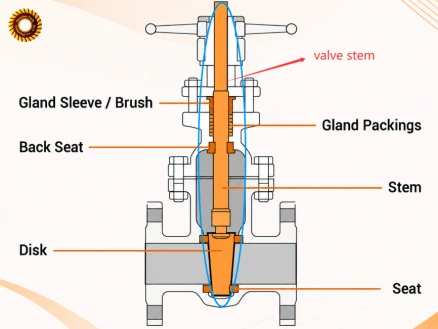
Valve Stem vs Valve
|
Feature |
Valve Stem |
Valve |
|---|---|---|
|
Definition |
Internal shaft that operates the valve |
a complete device that includes valve stems for fluid flow control |
|
Function |
Transfers motion to the closure element |
Regulates flow |
|
Construction |
Single machined component |
Assembly of multiple components |
|
Location |
inside the valve |
Installed in the piping system |
|
Materials |
stainless steels, alloy steels, brass, bronze |
combinaton of multiple materials in assembly |
|
Replacement |
it can be replaced separately |
May require partial or complete replacement |
Valve Stem vs Tire Valve Stem
|
Feature |
Valve Stems |
Tire Valve Stem |
|---|---|---|
|
Purpose |
Used in industrial valves |
Inflates and seals a tire |
|
Application |
Industrial piping systems |
Vehicle tires |
|
Working Medium |
Liquids, gases and steam |
Compressed air |
|
Construction |
Precision- machined metal shaft |
stem with a valve core |
|
Operating conditions |
High pressure and temperature |
Moderate tire pressure |
|
Motion |
Linear or rotary movement |
Opens only during inflation or pressure checks |
Valve Stem vs Engine Valve Stem
|
Feature |
Valve Stems |
Engine Valve Stem |
|---|---|---|
|
Purpose |
controls fluid flow |
Controls intake and exhaust valves |
|
Application |
Process and piping systems |
Internal combustion engines |
|
Motion |
Linear or rotary |
Rapid reciprocating motion |
|
Actuation |
Handwheel or actuator |
Camshaft and valve springs |
|
Environment |
Pressurized fluids and chemicals |
High- temperature combustion chamber |
|
Design Focus |
Strength and corrosion resistance |
Heat resistance and wear resistance |
How Does a Valve Stem Work in an Industrial Valve?
Valve stems might be unnoticeable to some laymen. But the importance of their working is immense in fluid flow. They basically complete the feedback loop from the sensor to the actuator to the closure element. This is to bring the fluid flow rate to the desired level. During operations, valve stems maintain dynamic sealing to prevent leakage of fluids.
Transfer Motion
The primary function of a valve stem is to transfer motion from the actuator to the closure element. Sensors send a signal to the actuator. The actuator then utilizes a pneumatic, hydraulic, or mechanical system to move valve stems. In manual operations, an operator turns a handwheel to transfer motion.
Change Valve Position
The transferred motion through valve stems results in changing the position of the closure element. So, depending on the valve design, the following can happen:
- A gate may be lifted
- A disc globe may be raised,
- A ball may be rotated, or
- A plug be turned
So, fluid flow can be fully permitted, fully restricted, or regulated.
Maintain Dynamic Sealing
For efficient flow control, the sealing should be robust in dynamic conditions. It must stay leak-tight during motion. If leaks are prevented, the desired flow rate can be achieved with no wastage. In industrial environments, leaks can cause environmental damage, wastage of resources, contamination, and/or equipment damage. So, well-selected packing materials, glands, and stem seals are employed for this purpose. The valve stems maybe PTFE packing, graphite packing or bellows seal.
Common Types of Valve Stems for Industrial Valves
Valve stems come in a few types. Each type accommodates a specific function. Be it compatibility with confined spaces, quick closure or opening of valves, the types of valve stems help achieve these goals. The most common types include rising valve stems, non-rising valve stems, and rotary valve stems.
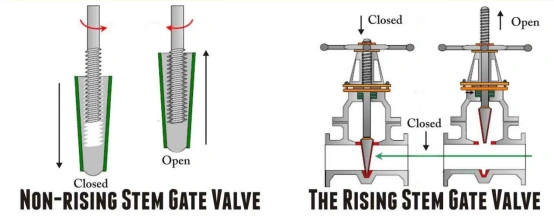
Rising Valve Stems
A rising valve stem moves upward and downward in sync with the position of the closure element. It gives a visible indication of the level of flow to the operator. As the threaded portion can be brought outside of the casing, it is easier to maintain. Rising valve stems are commonly used in gate and globe valves.
Non-Rising Valve Stems
Non-rising valve stems are concealed inside the valve casing. The valve stems remain at a fixed height. This design has some advantages and some limitations. The compactness of non-rising valve stems makes them suitable for space-constrained areas. Typically, they are used in underground pipelines and water distribution systems. Since the valve stems are concealed, they remain protected from contaminants and corrosive chemicals. But they do not give a visible indication to the operator.
Rotary Valve Stems
Rotary valve stems rely on a turning motion rather than linear movement. It gives an on/off position to the valve. Commonly, ball valves, butterfly valves, and plug valves are equipped with this mechanism. It makes operation fast. The hand wheel can have quarter-turn or half-turn rotations.
Custom and Specialty Valve Stems
When standard valve stems fail to meet the operating requirements of a process, custom valve stems might be needed. As an example, the acid synthesis industry may require specialized materials like Inconel or Hastelloy. In other conditions, standard dimensions might not fit with the existing equipment. In that case customized design might be used. CNC manufacturers can create special thread profiles, keyways, splines, or actuator connections
Best Materials for CNC Machined Valve Stems
A quest for using the most appropriate materials for valve stems remains an issue for the manufacturers. A balance between cost, durability, and performance needs to be maintained. Common material options for valve stems include stainless steel, Inconel, Monel, nickel alloys, and high alloy steels.
Stainless Steel Valve Stems
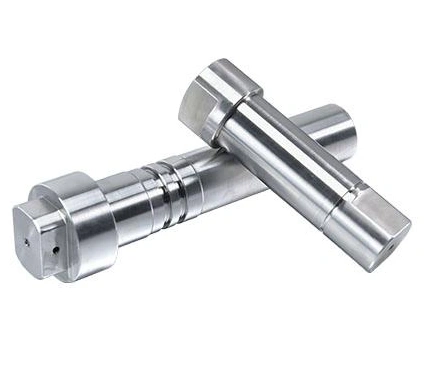
Stainless steel valve stems are widely accepted in many service conditions. They can resist corrosion while maintaining a good surface finish. Common grades include AISI 303, AISI 304, AISI 316/316L, and 17-4 PH. AISI 304 is a widely used, readily available grade used in most general-purpose valve stems. AISI 303 offers better machinability that accommodates machining of complex features. AISI 316 / 316L have good tolerance for chlorides and seawater. 17-4 PH stainless steel valve stems are used in high-pressure applications.
Alloy Steel Valve Stems
The performance of alloy steel in high-stress environments supersedes that of stainless steels. They are mainly used in applications like power generation, hydraulic systems, and high-pressure valves. As an example, AISI 4140 steel can withstand a great deal of tensile and fatigue loads. AISI 4145 gives even greater support in mechanical loads. AISI 4340 has good toughness and impact resistance.
Nickel Alloy and Inconel Valve Stems
Nickel alloys are promising in environments that are subjected to aggressive chemical attack and high temperatures. Since nickel alloys are more expensive than stainless steels, they are only preferred where stainless steel valve stems cannot meet requirements.
Valve stems made up of nickel alloys or Inconel, can endure extreme temperatures, high pressures, seawater exposure, sour gas service, and aggressive chemical processing. Common grades include Inconel 625, Inconel 718, Monel 400, and Hastelloy C-276.
Where Are CNC Machined Valve Stems Used?
Valve stems manufactured through CNC machining offer excellent dimensional accuracy, precision, and repeatability. CNC manufacturers can handle a wide array of materials. They can process various surface treatment options on valve stems for specialized uses. Another big advantage is that CNC machining is quick to adapt to modifications in designs.
Oil and Gas Equipment
A lot of oil and gas equipment needs valves, and thus valve stems for the transmission of oil and gas. Quite often these fluids are pressurized. In some applications like LNG plants, the condition can be cryogenic. In other applications like wellheads, the valve stems might need to endure high temperatures. Other than that, valve stems may be subjected to abrasive media and sour gas in delivery stages. So, materials used need to be robust enough to withstand these conditions. 17-4 PH stainless steel, AISI 4140, Inconel 718, and Monel 400 are often preferred for valve stems of oil and gas equipment.
Chemical Processing
Chemical process lines are required to handle acids, alkalis, and solvents. While corrosion is the main concern, high temperatures and high pressures often aggravate the situation. So, corrosion-resistant materials like 316L, Hastelloy C-276, and Inconel 625 are employed for these applications. Mating surfaces might need fine grinding and polishing to make a leak-proof.
Hydraulic and Pneumatic Systems
These systems include cylinders, pumps, actuators, and control valves. Common grades like AISI 303, 304, and 4140 often suffice for the operating conditions. A good balance of strength and machinability must be established to enhance manufacturability and service life. Heat treatment may be done to improve the toughness of valve stems.
Marine System
Marine systems are often subjected to seawater, salt spray, and humidity. Cost-effective options for valve stems include 316L stainless steel. But for aggressive environments or specialized uses, 2205 duplex stainless steel, Monel 400, or Inconel 625 may be used. High-quality materials in valve stems enhance service life with a low requirement for maintenance.
Why Do Valve Stems Fail?
Every component has a finite lifetime. So is the case with valve stems. But manufacturing defects, excessive loads, and unsuitable material selection further reduce the lifespan. If these shortcomings can be controlled, then the service life of valve stems can be enhanced.
Excessive Torque
Loading valve stems beyond their design limits can definitely cause them to fail. Above that, poor machining quality, incorrect stem diameter, poor thread geometry, or improper heat treatment further aggravate the situation. Low-quality materials with lower torsional strength can be expected to fail below operating conditions. Hence, good quality control over designing, CNC machining, and material is necessary to meet operating requirements.
Poor Surface Finish
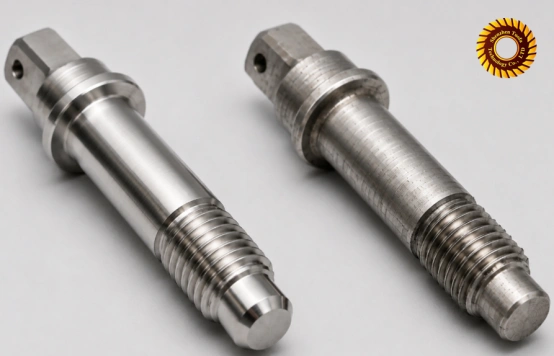
Poor surface finish results in improper fit, bad sealing reliability, and valve stem wear due to abrasion. Poor-quality CNC machining can create defects such as machining marks, tool chatter, burrs, and scratches. These act as stress concentration sites. So, these areas are likely to be the failure sites of valve stems.
Corrosion and Wear
Corrosion is one of the top reasons for valve stem failure. Valve stems are likely to encounter aggressive chemicals, seawater, oils, sour gas, etc. This chemically reactive environment makes valve stems susceptible to corrosion if proper materials are not selected. Some fluid streams carry abrasive media like sand particles. These can create holidays in protective coatings. Incorrect dimensions lead to excessive friction between surfaces, which can thin out dimensions. These factors contribute to valve stem failure. So, corrosion-resistant materials and correct GD&T can solve this problem.
Fatigue
Valve stems experience thousands or even millions of cycles during their service life. Bad quality of machining generates stress concentration sites that initiate microcracks. An efficient part design optimizes design features. Some examples include fillet radii, smooth surface finishes, accurate concentricity, and controlled heat treatment. This way, fatigue failure can be prevented.
Key Design Features of Industrial Valve Stems
Industrial valve stems have a few design features that need special attention. If these features are designed efficiently, then a good performance of valve stems can be expected. Here, stem diameter, thread geometry, packing area, and drive end are discussed.
Stem Diameter
Stem diameter is a critical parameter in valve stem design. The larger the stem cross sectional areas, the greater the load that it can bear. A diameter less than critical can result in twist or fracture of the valve stem under torsional or bending loads. An excessively large stem diameter can unnecessarily increase the size of the valve. So, an optimum stem diameter should be nominated for valve stems.
Threaded Sections
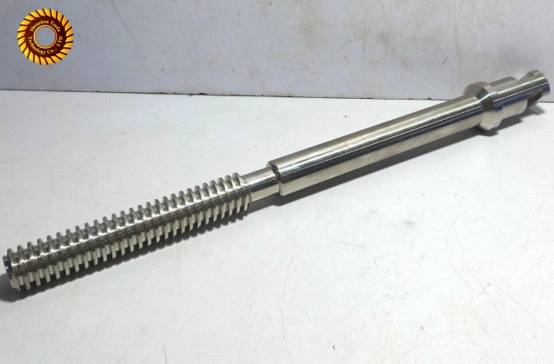
Threaded sections of valve stems convert rotational motion into linear movement. Well-optimized thread profile, pitch, and engagement length transmit load efficiently. CNC machining gives incredibly good and repeatable accuracy of thread geometry.
Packing Area for Stem Sealing
Valve stems pass through the valve packing and sealing system. To fulfil the sealing functionality of this packing area, dimensions must be very precise. A smooth surface finish is needed. Lack of concentricity creates leakage and wear of the sealing. So, a good quality of manufacturing is required.
Drive End Geometry
The drive end connects the valve stems to the handwheel or actuator. Design features like square ends, keyed shafts, splined ends, threaded ends or double-D profiles might be needed.
CNC Machining Processes for Valve Stems
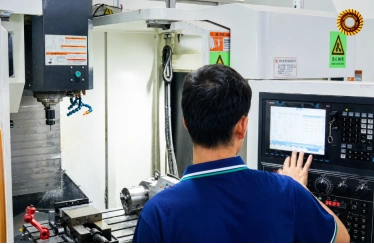
CNC turning, milling, and drilling are the basic processes used in valve stem manufacturing. Ideally, these processes should be done in a single setup to avoid misalignment and dimensional errors. CNC machining centers are often equipped with finishing options like polishing, nitriding, heat treatment, and chrome plating.
CNC Turning for Shaft Profiles
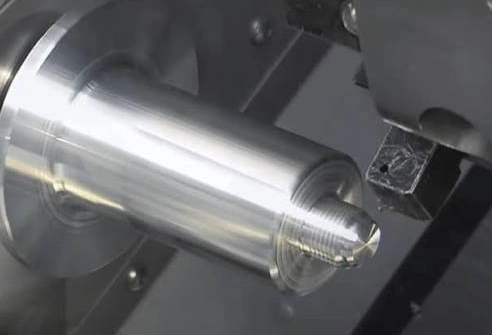
CNC turning is the primary process in valve stem manufacturing. Major features like cylindrical shape, stepped sections, sealing surfaces, shoulders, fillets, and threaded profiles are created through CNC turning. The key takeaways of CNC turning are high concentricity and tight dimensional tolerances. Moreover, CNC machining creates excellent surface finishes for smooth movement of valve stems.
CNC Milling for Flats and Slots
CNC milling is mainly required to create drive ends of valve stems. Features like flats, keyways, slots, and splines can be incorporated in drive ends. The main goal is to efficiently transmit torque and prevent slipping.
CNC Drilling for Holes
Holes are required in valve stems for assembly, locking mechanisms, pins, and actuator connections. They may be done radially or axially depending on the design. Modern CNC machines can drill holes in the same setup as turning and milling. This creates holes in accurate locations.
Quality Inspection for CNC Machined Valve Stems
Quality inspection of valve stems is critical in ensuring smooth working. Accurate dimensions ensure proper fitting. Meeting geometric parameters prevents excessive torque and wear on valve stems. Proper surface and hardness characteristics enhance the longevity of valve stems.
Dimensional Inspection
Dimensional inspection confirms the accuracy of dimensions. It also verifies that dimensions are within the specified tolerance range. Accurate and precise dimensions ensure proper fitting of components. For dimensional inspection, tools like digital calipers, outside micrometers, thread gauges, height gauge, and CMMs are used.
Geometric Inspection
Geometric inspection is done to verify geometric parameters like straightness, roundness, cylindricity, concentricity, coaxiality, runout, and perpendicularity. For that purpose, tools such as dial indicators, V -blocks, and CMMs are used.
Surface and Hardness Inspection
Surface roughness is usually measured with a profilometer. For hardness inspection of valve stems, commonly a Rockwell tester or Vickers hardness machine is used. Visual inspection also catches defects like burrs, tool marks, scratches, dents, and cracks.
Tuofa Machining Case: Custom High-Precision Industrial Valve Stems
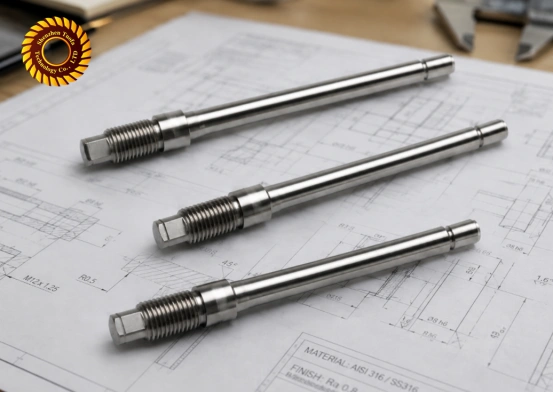
Our customer wanted to manufacture 5 stainless steel valve stems used in industries. The valve stems are required to be manufactured with correct dimension and rational tolerance. In addition, smooth surface is required.
Key Machining Parameters:
- Overall length: 250 mm
- Main stem diameter: Ø20 mm
- Straightness: ≤0.02 mm/100 mm
- Runout: ≤0.03 mm
- Thread tolerance: 6g
Tuofa used grinding and finishing to improve the surface quality of the valve stems. The surface finish of the finished valve stems is Ra 0.4 μm, and there was no scratches or tool marks on the surface.
Result
Tuofa optimized the machining plan and strictly control the tolerance of the critical area. During machining processes, we positively communicated and confirmed the changes with our customers. Finally, the custom valve stems satisfied the requirements for assembly and stable operation.
Conclusion
A valve stem is an important component of valves. They help to regulate the flow of fluid. They are used in numerous industries, namely oil and gas, chemical plants, water delivery, hydraulic systems, etc. Every industry has its own operating requirements. Thus, valve stems come in different designs and materials to accommodate the demands of these industries.
FAQ
Is a tire valve stem the same as an industrial valve stem?
No. There is a big difference between them. Tire valve stems are used for filling compressed air in tyres. On the other hand, industrial valve stems are used in valves to regulate the flow of fluids.
Can you custom industrial valve stem?
Yes, with the help of our advanced CNC machining centers, we can customize valve stems as per your designs.
Why is surface finish important for valve stems?
Polishing reduces friction while enhancing sealing performance. Corrosion-resistant coatings protect against corrosion. Heat treatment or nitriding enhance waer resistance.
Can a broken valve stem be welded and reused?
Welding and reusing will introduce unwanted defects like pinholes, stress concentration points, corrosion sites with dissimilar metals, and so on.
What Types of Valve Stems Are Used in Industrial Applications?
Common industrial valve stems include:
- Ball Valve Stems
- Gate Valve Stems
- Butterfly Valve Stems
- Globe Valve Stems
 Slider Crank Mechanism: Working Principle, Design, CNC Machining, and Applications