Tel/WeChat:
  Email:


 Home
HomeRocker Arm in Custom Racing Applications: Types, Materials & CNC Machining

 Published:Jun 05,2026
Rocker arms are important tuning components in custom racing engines and can influence valvetrain performance. Knowing about types, materials and CNC machining of these rocker arms will help you select right configuration, optimize valve lift, and enhance high-RPM efficiency in performance applications. This article focuses on rocker arms used in pushrod OHV racing engines. So, stay with us to explore rocker arms with different geometries and manufacturing requirements.
What Is a Rocker Arm?
So, what's a rocker arm? Well, a rocker arm is a pivoting lever in valvetrain of an overhead-valve (OHV) engine. Cam rocker arm is responsible for transferring and multiplying motion from camshaft to engine valves. In an OHV engine, the rocker arm transfers motion from the camshaft to the engine valves through the lifter and pushrod system.
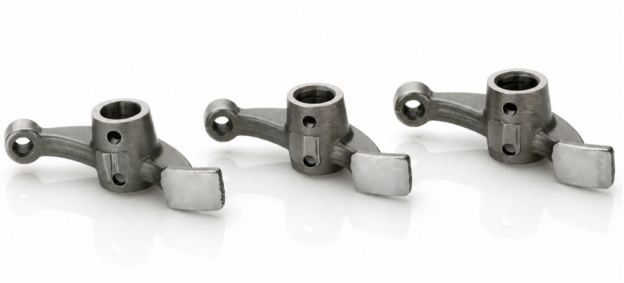
Basically, Rocker Arm pivots on a fulcrum, converting Camshaft's rotational motion into linear valve movement. Such transfer of motion allows intake and exhaust valves to open and close at precise timing. So that air-fuel intake and exhaust gas discharge can occur effectively.
Importance of Rocker Arm in Custom Racing
In custom racing, a rocker plays a typical role for enhancing the efficiency, power and output of an engine. It acts as a tuning device for your overhead engine. With its variant ratios, one can increase valve lift and enhance engine breathing and torque.
Using rocker arms in your next vehicle projects ensures an increased valve lift without replacing camshaft. Unlike stock engine rocker arms, racing rocker arms are available in higher ratios such as 1.7:1.
For example, Camshaft producing 0.300 inches of lift will generate 0.510 inches of valve lift if paires with a 1.7:1 rocker arm. Such additional lift allows more air and fuel to enter combustion chamber. So making rocker ratio upgrades a cost-effective way to gain performance without installing a different camshaft.
Using high-performance lever rocker also improves engine breathing. As it optimizes valve motion. Toufa manufacture rocker arms using CNC machining with premium material. Our rocker arm operate effectively under extreme conditions.
What Do Rocker Arms Do?
Rocker arms basically serve as a mechanical link between camshaft and valves of engine. Transferring rotational motion of camshaft to linear motion of valves. As camshaft rotates lifter and push rod move upward. Rocker arm pivots and pushes engine valve stem down; as a result engine valve opens.
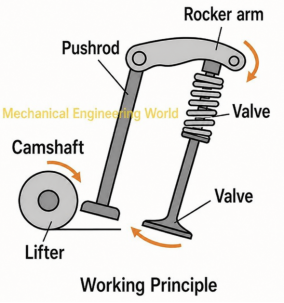
In same way, when cam lobe rotates away valve spring returns valve to its closed position. Finally, rocker arm returns to its original position. In this way, rocker arm helps in opening and closing of engine valves for proper combustion and maximum output.
Types of Racing Rocker Arms by Mounting Structure
Based on mounting structure, rocker arms are further classified into sub-types. Each type offers its unique rpm limit, valvetrain limits and functioning. Here we are gonna some light on two major types that are used in custom racing engine stud-mounted and shaft-mounted rocker arms.
Stud Mount Rocker Arms
A stud-mounted rocker arm is named so as it pivots on an individual threaded stud. Stud is usually installed in cylinder head. In order to secure lever rocker arm, both an adjustable nut or polylocks are used.
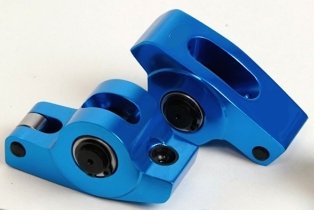
These adjustable nuts make this rocker more effective for tuning. Stud-mounted systems allow racers to install higher-ratio rocker arms. These ratios include 1.6:1, 1.7:1, or even 1.8:1 designs without replacing camshaft.
Shaft Mount Rocker Arms
Compared with stud-mounted rocker arms, shaft mount rocker arms generally provide greater rigidity and consistent alignment. In this design, individual studs are replaced by rigid shafts that span the cylinder head and support multiple rocker arms.
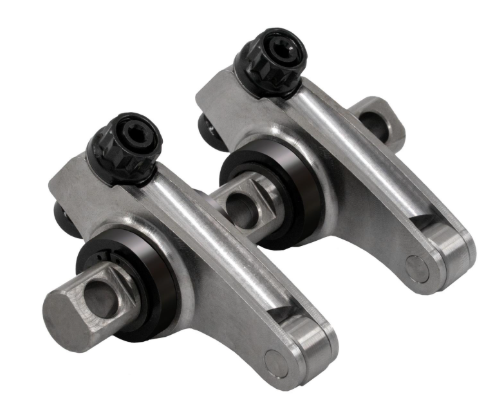
As a result, Rockers offer superior valvetrain rigidity. Shaft-mounted systems are commonly used in racing engines operating above 7,000 RPM. Exceeding valve lifts over 0.750 inch.
Types of Racing Rocker Arms by Contact Mechanism
Rocker lever arms are also classified by their way of contact with fulcrum and valve tip. Understanding these contact mechanism-based types will help you select right solution for your next custom engine project. As right rocker arm is critical for valvetrain stability, friction control, durability, and high-RPM performance.
Slider Rocker Arms
As named, Slider rocker arms have a slider as a contact point. Here a sliding surface contacts rocker tip with stem of valve. These rockers have simple designs and easy manufacturing compared to roller arms. That's why they are a cost-effective solution for production engines.
But for racing engines where high rpm loads are there, such rocker arms are not suitable. Because they produce friction and heat, causing side loading and wear and tear.
Roller Rocker Arms
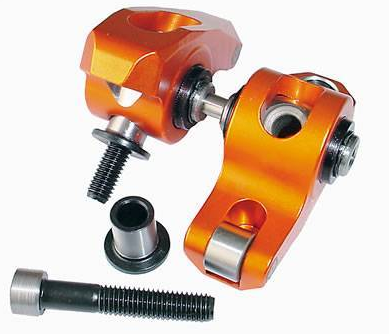
Roller rocker arm uses a needle bearing wheel at contact point instead of sliding surface. Reducing friction and valve stem wear. Roller rocker arms can reduce friction and valve-stem wear. The amount of valve lift depends on the rocker ratio rather than the roller contact design itself. Making them a suitable choice for custom racing engines. As such engines require optimal valve operation at high rpm under stress.
Full Roller Rocker Arms
Just like roller rocker arms, full roller tokers also use a rolling contact surface. In this case its rolling bearings used at pivot point of pushrod and valve tip. Such contacts make valvetratin more stable under aggressive conditions.
When upgrading to a full roller rocker with a higher ratio from a stock 1.5:1 to an aftermarket 1.6:1 or 1.7:1, it multiplies your Camshaft's lobe lift. Allowing valves to open wider, leading to more effective engine breathing.
Types of Racing Rocker Arms by Material
Number of materials have been used for manufacturing of rocker arms. To attain required strength, resistance to corrosion and weight. We are gonna talk about three leading materials with which valve rocker arms are now manufactured.
Aluminum Rocker Arms
Engineers use aluminium-based rocker arms because of easy machinability and light weight of aluminium. It reduces weight of valvetrain leading to low inertial forces. Reduced valvetrain mass improves dynamic response and reduces valve float risk. This enables a higher usable RPM range.
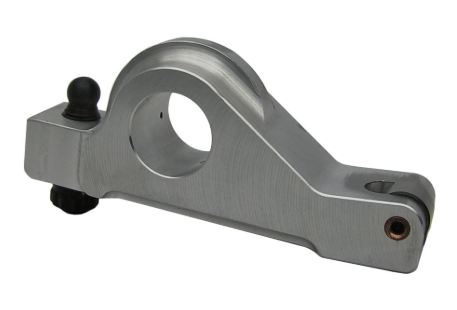
But aluminium's lower fatigue resistance compared to steel; that's why these rocker arms are generally better suited for high-performance, short-duration applications. For instance, for drag racing or circle racing.
Steel Rocker Arms
Steel rocker arms can provide high strength, stiffness, and fatigue resistance. Their actual performance depends on the steel grade, heat treatment, surface condition, geometry, lubrication, and valve spring load. It is often selected for applications in which durability and rigidity are prioritized over minimum component weight.
Titanium Rocker Arms
As said before, aluminium offers light weight for effective valve operation, and steel offers strength. Titanium is what used when effective valve operations are needed without losing structural integrity. Offering excellent strength-to-weight ratio, as its 40% lighter than steel.
Types of Racing Rocker Arms by Manufacturing Method
Racing rocker arms are manufactured using different methods. Manufacturers select these methods based on material, design complexity and mechanical capabilities. Here is table comparing all manufacturing methods:
|
Method |
Key Structure |
Advantages |
Limitations |
Used in |
|---|---|---|---|---|
|
Stamped Steel |
Thin, basic geometry |
Low cost, light, OEM suitable |
High flex, low RPM stability |
Stock engines |
|
Cast |
Moderate strength but chances of porosity |
Cheap mass production |
Lower fatigue strength, less precision |
Street engines |
|
Forged |
Dense grain flow and strong body |
High fatigue strength |
Limited design complexity |
Performance and endurance racing |
|
CNC Billet |
Fully optimized geometry |
Highest precision, best ratio accuracy, superior weight optimization, excellent repeatability in tuning |
High cost, less grain-flow advantage than forging |
High-RPM racing, drag, motorsport builds |
Cast Rocker Arms
Iron and steel rocker arms are manufactured using casting. Casting produces complex geometries and is a cost-effective method. But while cooling material can get micro-pores in it, raising concern for strength at high RPMs.
For instance, titanium is highly reactive and absorbs oxygen and nitrogen from environment. Leading to formation of bubbles or pores inside material. The rocker obtained will be brittle and can break under stress.
Forged Rocker Arms
Froged rockers' arms possess more fatigue resistance and work effectively under stress. As these are manufactured under extreme compressive forces. Forged designs are widely used in high-performance and racing engines.
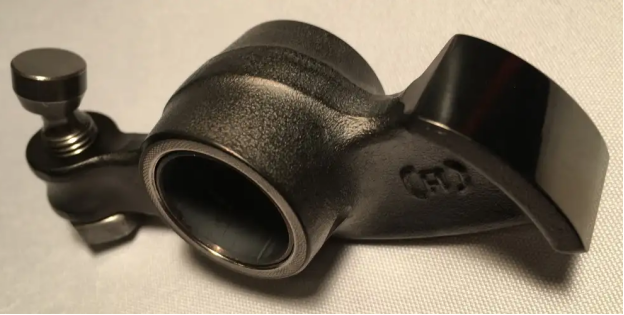
Since in such cases rocker arms must withstand high valve spring pressures, elevated RPMs, and repeated cyclic loading without deformation or failure. Such rocker arms are typically made from forged aluminum or forged steel.
CNC Billet Rocker Arms
CNC billet rocker arms offer exceptional dimensional accuracy. Offering tight tolerances suitable for high-performance valvetrain alignment. CNC machining using billets results in significant mass reduction compared to forged or cast designs.
Such manufacturing lowers inertial load on the valvetrain and improves engine response at high engine speeds. CNC billet rocker arms are widely used in applications where precise valve control and high RPM are required.
At Tuofa CNC we manufacture high precision rocker arms through specialised CNC machining techniques.
Common Rocker Arm Failures in Racing Applications
In racing applications, rockers' ram faces continue stress and load. Such harsh conditions cause rocker arm failure, leading to poor engine performance. Here are some common failure modes:
Rocker Arm Body Cracking
In a racing engine where rocker lever arm continuously faces high cyclic stress, it can lead to cracking. Cracking can result from stress concentrations, unsuitable material selection, poor heat treatment, excessive valve spring loads, or inadequate structural geometry. CNC machined rocker arms are considered more reliable under harsh conditions with precise geometry and structural integrity.
Trunnion Bearing Wear
Poor lubrication and high temperature in in racing engines cause trunnion bearing wear. When rocker pivots, trunnion bearings experience continuous rolling contact stress. Meanwhile, any lubrication breakdown will lead to accelerated wear. Also, poor alignment or excessive side loading further compounds this issue.
Edge Chipping
In racing engines, imperfect contact geometry between rocker tip and valve stem and valve spring pressure causes edge chipping of valve rocker arm. Such edge cupping affects valve lifting. Resultingly decreasing performance of engine.
Manufacturer uses highly controlled edge geometry through CNC machining to overcome this failure. They opt for optimised load distribution at contact interface. Which reduces localized stress peaks.
Hole Damage
In rocker arms, hole damage usually occurs at bore locations like trunnion bore or pivot hole. It happens because of repeated cyclic loading. Also elevated RPMs generate continuous compressive and shear forces on these internal surfaces. Leads to ovalisation, fretting wear, surface pitting, or micro-crack initiation.
Custom Rocker Arms by CNC Machining for Your Project
CNC machined custom racing parts are a reliable and effective choice for your projects. Let's get to know why standard OEM rocker arms may not be a good choice.
Limitations of Standard OEM Rocker Arms
Standard OEM rockers are cost-effective and good for daily deriving. But it might not be a good choice for custom racing rocker arms. Here is why:
- OEM rockers are manufactured using stamped steel. Stamped steel flexes under stress, reducing the efficiency of racing engine.
- Traditional rocker arms possess a slotted or pivot ball design. Such designs generate friction and heat. Leading to increased wear.
Advantages of Custom CNC-Machined Rocker Arm
Custom CNC machine rocker arms offer many advantages over traditional engine rocker arms. For instance with their high strength-to-weight ratio and precision geometry, they prevent engine performance failure at high RPMs. Let's dig into more details of these advantages.
Custom Complex Geometry
CNC machining with advanced techniques like multi-axes shaping helps to create highly precise complex geometries. With a tight tolerance of ±0.0001 to ±0.002 inches. By using CNC geometries with optimized stress-relief contours, reinforced trunnion areas and weight-reduction pockets are created. Leading to enhanced engine performance.
Optimize Lightweight Performance
Custom CNC lever rockers sho a high strength to weight ratio. Because in CNC, premium-grade materials like steel billets and 7000 series aluminium are used. These materials are not only lightweight but strong enough to bear cyclic stress under high RPMs.
Custom Rocker Arms Ratios
CNC manufacturing enables production of rocker arms with application-specific ratios . Which are tailored to engine's airflow and performance requirements. Custom ratios allow builders to increase or fine-tune valve lift without changing camshaft. Hence providing greater flexibility in optimizing horsepower, torque, and overall engine response.
Enhanced Durability
CNC-machined rocker arms deliver superior durability under high loads. It's done by minimizing stress concentrations and maintaining precise valvetrain geometry at high RPM.
Surface Treatments for Racing Rocker Arms
Yes, racing rocker arms need surface treatment to maintain their performance. Here is a detailed reason for hwy do they need surface treatment.
Why is Surface Treatment Required for Rocker Arms?
Racing rocker arms are under continuous cyclic stress. They need to endure high valve spring pressure, metal-to-metal friction, and aggressive camshaft profiles. That's why different surface treatments like DLC, anodising or nitriding are performed.
Surface Treatments Methods for Rocker Arms
Hard Anodizing
Hard anodising is performed on rocker arms manufactured with 6000 or 7000 aluminium series. It makes an oxide layer over metal surface. Preventing it from scuffing reduces friction.
DLC Coating
Diamond-like carbon (DLC) coating is applied to cam lever arm to minimise friction. Reducing valvetrain drag and parasitic losses by up to 60-70%. DLC coating exhibits a hardness of 1700 to 4500 HV, guarding against scuffing and micro-welding.
Nitriding
Nitriding is done to increase surface hardness and durability of engine lever rocker arm. Its preferred for those rocker arms which face high stress under higher rpms.
Tips for Optimizing Design of Rocker Arms
The performance of a rocker arm depends not only on material selection but also on its structural design and geometry. Careful optimisation can improve valvetrain stability. It also reduces frictional losses, increases fatigue life, and enhances high-RPM performance. Here are some tips from ou experts for design optimisation:
Lightweight Structural Design
Use hollow internal sections and CNC-machined pocketing to remove non-load-bearing material. Because lower rocker mass reduces valvetrain inertia. Which allows more stable operation at high rpm and reduces load on valve springs.
High Rigidity Design
Incorporate reinforced rib structures around trunnion and lever arm. Combine it with optimized I-beam or box-section profile. It will increase stiffness without a significant weight penalty.
Optimize Pushrod Angle
Design rocker geometry to maintain most efficient pushrod-to-rocker contact angle throughout valve lift cycle. Proper alignment reduces side loading and extends service life of pushrods, rocker cups, and valve-train components.
Conclusion
In short, rocker arms are important valvetrain components in custom racing engines. Rocker arms, which are often neglected, are a critical component of any custom racing engine. These components serve as a base for optimal performance of engine. CNC machines, costumes, rockers, and arms are perfect choices for racing engines with long rums. At Toufa we manufacture CNC machine rocker arms with high precision. Knowing in detail about rocker arm wil help ou make right decision for your next racing engine components.
FAQ
Is it expensive to replace rocker arms?
Yes, replacing a rocker arm is expensive. Although a single racing rocker arm is not that expensive, its labour is. As accessing them requires significant labour.
How long can you drive with a bad rocker arm?
You should not drive with a bad rocker arm, as it can lead to minor issues for the whole engine's failure.
How to calculate rocker arm ratio?
Rocker arm ratio is calculated by comparing the distance the valve moves to the distance the cam. Here is the formula:
Rocker Arm Ratio = Valve Lift ÷ Pushrod (Cam) Lift
 Flow Restrictor Guide: Functions, Applications & CNC Machining