Tel/WeChat:
  Email:


 Home
HomeUnderstanding EMI Shielding through Theory, Materials, Applications & Machining

 Published:May 29,2026
EMI stands for Electromagnetic Interference (EMI). EMI shielding means to stop other electromagnetic waves from interfering with and disrupting the performance. Its performance mainly depends on the materials and machining processes. This study focuses on theory, materials, applications, and machining for EMI shielding.
What Is EMI Shielding?
In simple words, EMI shielding is a way to stop or reduce the unwanted electromagnetic waves to stop or reduce the interfere with electronic devices. You can say it's a barrier. In engineering terms, it is the use of conductive or magnetic materials to stop the electromagnetic waves by reflection, absorption, and multiple internal reflections, so protecting the electronic system from electromagnetic disturbances.
Why EMI Shielding Is Important?
Without EMI shielding, electronic systems may experience data loss, malfunction, overheating, signal distortion, or complete failure. For instance, a Wi-Fi router or a GPS could malfunction due to interference from nearby electronics or radio signals.
EMI vs RFI vs EMC
RFI stands for Radio Frequency Interference, and EMC stands for Electromagnetic Compatibility.
|
EMI |
RFI |
EMC |
|---|---|---|
|
General EM noise |
RF-range noise |
Interference control |
|
Broad category |
Type of EMI |
System compatibility |
|
Motors, switching |
Radios, Wi-Fi |
Shielding, filtering |
|
Affects electronics |
Affects wireless |
Ensures coexistence |
|
Noise problem |
RF problem |
Design standard |
How EMI Shielding Works
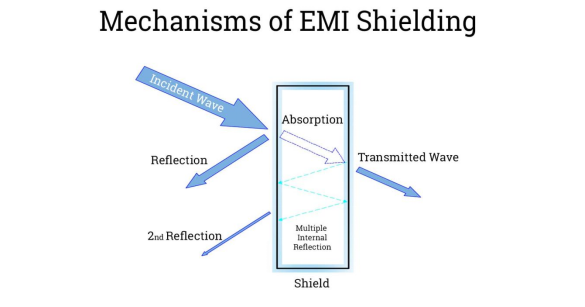
An EMI shielding works by reflection and absorption processes. Here provides insights into the details of these processes:
Reflection
Reflection means the electromagnetic waves bounce back after colliding with the shielding material. Its mechanism is as follows:
Shield materials are mostly metals, which have free electrons that can create the electromagnetic field. When an electromagnetic wave hits the surface, an electromagnetic field is generated at that surface. This electromagnetic field pushes electrons, so they create the opposing electromagnetic field, which pushes back the incoming electromagnetic waves.
For this reflection, metals with higher electrical conductivity are used. For instance, Al is commonly used.
Absorption
In this mechanism, the electromagnetic waves enter the material and gradually lose their energy and eventually get attenuated. Its mechanism is as follows:
When the electromagnetic waves enter the material, they create induced electrical currents (Eddy Currents). These currents face resistance, so the energy is converted into heat. Ultimately, as the waves move deeper, the more they get attenuated. For this process, materials with high magnetic permeability or resistive losses are used. Ferrite coatings are commonly used inside the cables.
Types of EMI Shielding Methods
Three common EMI Shielding methods include structural, conductive coating, and board-level. Let's discuss these methods one by one:
Structural Shielding
In this type of EMI shielding method, the body of the part itself reacts as an EMI shielding, like no separate layer is applied. This method operates using two mechanisms, i.e., Reflection and Absorption. To make this type effective, highly conductive materials with continuous metallic enclosures are used. To avoid even a single seam, designing involves seams, joints, etc. CNC precision machining is used to make components of this structural shielding to avoid even a single crack because a single crack causes the electromagnetic waves to interfere.
Conductive Coating Shielding
As the name of this EMI shielding method suggests, a thin layer of coating is used for shielding. The shielding mechanism is the same, i.e., reflection and absorption. The types of coatings include metal-based, conductive paints, carbon-based, and conductive polymers. To achieve a good surface finish for good adhesion of the coating, CNC machining is used for components. Its applications can be found in plastic electronic enclosures, military electronics, mobile phone casings, etc.
Board-Level Shielding
It is a large-scale shielding structure instead of shielding individual parts separately. It means the entire system is designed to reduce the electromagnetic radiation. In this process, a metallic enclosure is used to block the incoming or outgoing electromagnetic waves. This method is used in aircraft, automotive ECUs, etc.
What Factors Affect the Effectiveness of EMI Shielding?
There are many factors besides material and machining operation that affect the effectiveness of the EMI shielding system. These factors are important to understand to get better results from the EMI shielding process.
Material Conductivity
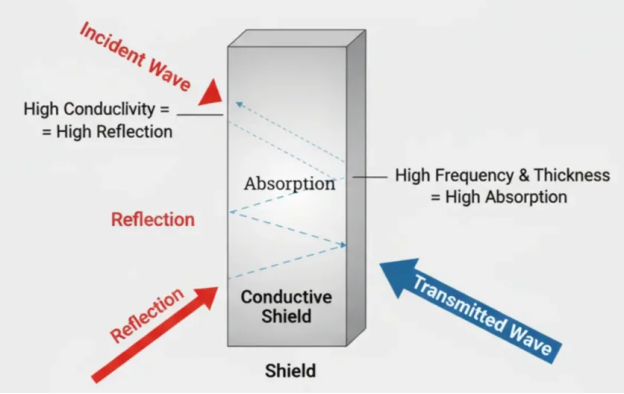
The material's conductivity relies on the number of free electrons available in the metal. Higher conductivity of materials leads to more effective EMI shielding because there are many electrons available to move. When an electromagnetic wave hits the highly conductive material, due to the large number of free electrons, they move and produce eddy currents. These eddy currents generate an opposite field against the incoming electromagnetic waves, so good reflection occurs, and EMI shielding becomes more effective.
EMI Frequency Range
EMI shielding reacts differently to different frequencies of electromagnetic waves. Low-frequency waves have long wavelengths and strong magnetic components, which can easily penetrate through the shielding materials. So, need to use thick shielding materials.
As frequency increases, the wavelength gets shorter, and the magnetic components become weaker. So, the effectiveness of the EMI shielding systems gets better.
Shielding Material Thickness
The thickness of the shielding material is directly proportional to the effectiveness of the EMI shielding system. Thick materials can easily reduce or attenuate the energy of electromagnetic waves because they provide better absorption loss, especially for low-frequency electromagnetic waves.
Conductive Continuity
It is a very important factor for EMI shielding, because if there is any discontinuity in the shielding system, the electromagnetic waves can easily pass through the system and interfere with the electronic devices. It is an essential requirement that there should be no gaps, breaks, loose joints, or high-resistance areas to achieve better effectiveness of the EMI shielding system.
Surface Treatment
Since the electromagnetic waves interact with the surface first, so it has a great role in achieving the effectiveness of surface treatment. The surface of the material affects electrical conductivity, corrosion resistance, and wave reflection capability. To get a fine surface, different surface treatments are applied, such as conductive coatings, nickel plating, copper plating, conductive paints, and anodizing with conductive sealing.
Grounding
Grounding is also an important factor because it provides a pathway for unwanted electromagnetic waves or induced currents to safely dissipate instead of interfering with nearby electronics. Grounding becomes even more important when the waves have low frequencies because, in the case of low-frequency waves, just reflection can't shield the system from interference, so, due to good grounding, some waves dissipate through that pathway to the earth.
Common EMI Shielding Materials
Every material exhibits different properties, such as electrical conductivity, surface finish, etc. The material selection is mainly based on the type of frequencies. Let's discuss these materials one by one in this section.
Copper EMI Shielding
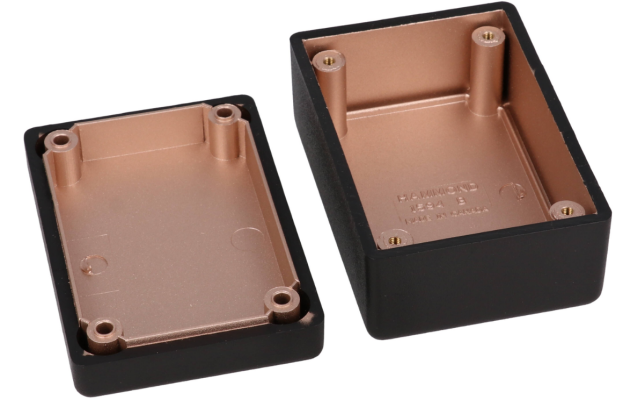
Copper metal is known for its high electrical conductivity, which is the essential requirement for EMI shielding. This high conductivity results in high reflection of electromagnetic waves. Besides the reflection, copper metal can be used for good absorption as a secondary effect. Other useful properties include non-magnetic behaviour and easy fabrication.
Aluminum EMI Shielding
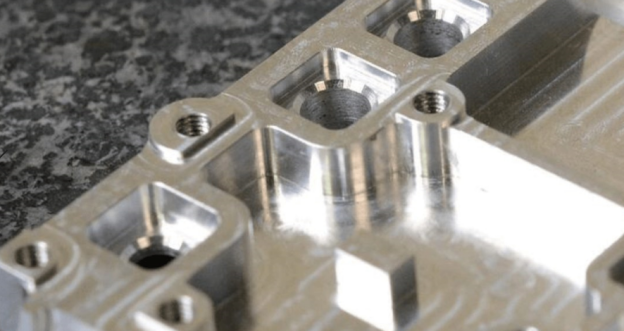
Al is an effective EMI shielding material, especially when the requirement is lightweight. It offers good electrical conductivity, high machinability, and a passive layer of Al2O3. It is a cost-effective material, so the ideal choice for large-scale and lightweight applications.
Stainless Steel EMI Shielding
Stainless steel offers a combination of strength and excellent corrosion resistance because of the Cr2O3 passive layer. The electrical conductivity of this material is not so good, but it can still reflect a part of electromagnetic waves. To control the electromagnetic waves from the interference, stainless steel relies more on the absorption mechanism. It is a durable and cost-effective material.
Carbon Steel
Carbon steel is another popular material used for EMI shielding because of its properties, such as good electrical conductivity and magnetic permeability. Due to good magnetic permeability, the incoming low-frequency waves lose their energy through an absorption mechanism.
EMI Shielding Plastics
Plastics come with lightweight, easy molding, and corrosion resistance. They are modified to block or reduce the interference of electromagnetic waves. These plastic materials include:
- Acrylonitrile Butadiene Styrene (ABS)
- Polycarbonate
- Nylon
- PEEK
EMI Shielding Applications
EMI shielding has various applications in different fields. The parts of the EMI shielding system have complex designs and require high precision, so mostly CNC machining is used to manufacture EMI shielding enclosures or their parts.
Consumer Electronics
Modern consumer electronics consist of high-speed processors, wireless communication modules, displays, and batteries, etc. These components release electromagnetic waves, which can cause malfunctions, disturb nearby circuits, create false data, etc. To avoid such scenarios, EMI shielding is used in housings, frames, etc.
Automotive Vehicles
Now, most vehicles are equipped with many sensitive electronics, which release electromagnetic noise. These parts include the ignition system, electric motors, ECUs, switching signals at high speed, etc. This electromagnetic noise can affect infotainment and GPS, disturb sensors and control units, etc. In automotive vehicles, EMI shielding is used in the engine control unit, battery management system (EVs), power electronics, etc.
Aerospace Industry
EMI shielding is a very important component in the aerospace industry as it prevents electromagnetic waves from interfering with and disrupting avionics, communication, navigation, and control systems. It is used in avionics enclosures, electronics housings, military communication equipment enclosures, etc.
Medical Devices
In the medical devices industry, EMI shielding plays its role by blocking electromagnetic interference and ensuring accurate diagnosis and safe operation near other equipment. It is used in MRI and CT scanners, implantable devices, ECG machines, and surgical robots, etc.
How CNC Machining Affects EMI Shielding Performance?
EMI shielding is a very critical part of our electronics system. The components of an EMI shielding system and EMI shielding enclosures require high precision machining to perform best, so CNC machining is required for many reasons.
Burrs Can Cause EMI Leakage
Traditional cutting tools do not machine the parts cleanly. There are always burrs at the edges after the machining with traditional tools, which further cause EMI shielding. To avoid that leakage, CNC machining stands tall with its capability to produce tight tolerance edges with high precision.
Surface Flatness Affects Conductive Contact
Since the surface of the material is the very first thing that interacts with the electromagnetic waves, the part must have a flat and clean surface. CNC machining can easily achieve high surface flatness and precision contact surfaces, which ultimately enhances conductive contact, so the reflection of electromagnetic waves also increases.
Surface Treatment Can Affect Conductivity
Different surface treatments are used to increase the conductivity of the metal because good conductivity so the good reflection of electromagnetic waves. These treatments include anodizing, silver plating, gold plating, carbon coatings, etc.
Thin-Wall Deformation Can Create Gaps
If the parts or enclosures have thin walls, then during the CNC machining, deformation can occur, which will create gaps or poor contact, so there will be a reduction in conductivity, and EMI performance will reduce accordingly.
Machining Precision of Parts
Machining precision has a great importance in the EMI shielding system as it affects:
- Gap control
- Surface flatness and contact quality
- Dimensional accuracy of mating features
- Repeatability in mass production
CNC machining is required for precision machining to achieve better electrical conductivity, fewer leakage points, and ultimately enhanced EMI shielding effectiveness.
How to Choose the Right EMI Shielding Solution
The following tips can be helpful when choosing the right EMI shielding solution:
Determine the EMI Shielding Requirements
First, the EMI shielding requirements should be analyzed, such as low or high frequency electromagnetic waves, the distance between the system releasing electromagnetic noise and nearby electronics, etc.
Determine Suitable Shielding Strategy
The strategy involves shielding material, shielding method, design factors, and application requirements, etc. So, each of them should be clearly determined before being employed in the actual EMI shielding system. Another very important factor is that CNC machining is required for the arts to be employed in an EMI shielding system because of the high precision and accuracy requirements.
Choose the Right EMI Shielding Materials
Every material has its chemical, physical, and mechanical properties, so the selection of the right material affects the performance of the EMI shielding system. For instance, for high-frequency electromagnetic waves, the materials with high electrical conductivity, like Cu, are used.
Consider Manufacturing Method
The accuracy and precision of the parts are different in every manufacturing method. Some are better in producing parts with tight tolerances, and some excel in mass production. Generally, for critical applications, like aerospace parts, CNC machining is used to achieve high precision and accuracy.
Cost Evaluation
This is one of the primary factors that need to be considered before manufacturing and employing an EMI shielding system. It is advised to analyze the budget before getting into practically achieving EMI shielding.
When to Use Custom CNC EMI Shielding?
Custom CNC machining can be used for EMI shielding. The following are the common situations when custom CNC machining becomes necessary:
For High Shielding Precision
Traditional cutting tools can leave burrs on the edges of the parts, poor surface finish, etc. So, it is very difficult to achieve precision in such a situation. Here, custom CNC machining is the best option.
For Complex Shielding Structure
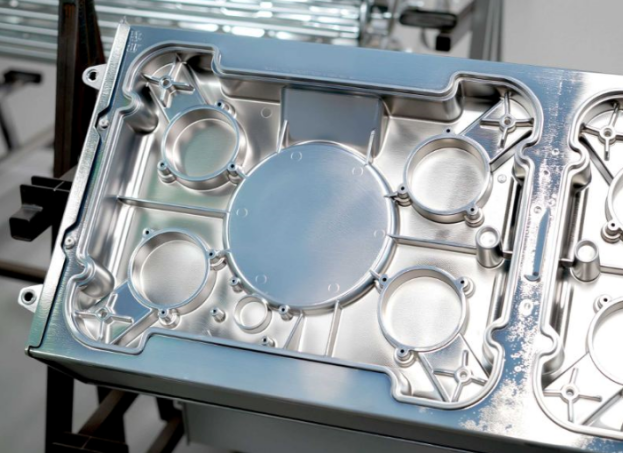
Custom CNC machining can easily machine non-standard, complex-designed parts with repeated accuracy and precision. Precise cutouts, internal cavities, and stepped structures are common complex structures of EMI shielding parts, they can be created by CNC machining easier than stamping.
For Thin-Wall Lightweight Structures
Thin-wall lightweight parts do not exhibit high strength for machining, which is why they often get deformed. Custom CNC machining can be an ideal solution for this problem.
Prototyping and Low-Volume Production
If your EMI shielding components need prototyping to test the performance, CNC machining allows you to custom dimensions, materials, finishes, and design features.
Conclusion
An EMI shielding system is used to stop the interference of electromagnetic waves with the nearby electronics or electric circuits. The reflection and absorption mechanisms are used in this system. Different materials, such as Cu, Al, stainless steel, and carbon steel, etc., can be used based on the frequency of electromagnetic waves and application requirements. To machine the parts of an EMI shielding system, Tuofa high precision CNC machining is an ideal solution when the requirements are high precision, repeated accuracy, and the machining of thin-walled structures.
FAQ
What are EMI shielding gaskets?
These are the conductive sealing components used between two mating surfaces, such as doors, etc. They maintain electrical conductivity for the continuous reflection of electromagnetic waves.
What is the best EMI shielding material?
It depends on the application's requirements. Generally, Cu is considered a good shielding material because of its excellent electrical conductivity. So, it provides high EMI shielding performance.
Can plastic shield EMI?
Yes, some engineered plastics, such as PEEK, ABS, Nylon, etc., are used in EMI shielding systems because of their lightweight and electromagnetic waves absorption capability.
 Efficient Part Design: Tips for Reducing Cost and Improving Parts Quality