Tel/WeChat:
  Email:


 Home
HomePermanent Magnets and Residual Magnetism in CNC Machined Parts

 Published:Jun 27,2026
Planning a new project with permanent magnet assemblies or precision steel components? Understanding how permanent magnets work, this will help you design better products and meet your requirements for your CNC machining.
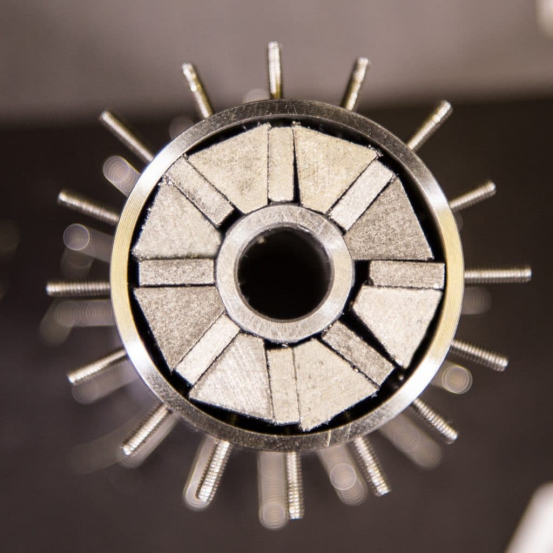
What Is a Permanent Magnet?
Permanent magnets are among the very basic building blocks of modern engineering. They maintain a constant magnetic field without the need for any external power source. It is definitely worthwhile getting acquainted with the very concept of a permanent magnet before ordering magnet-related assemblies for your project; there is no doubt that it will save your time and reduce the possibility of making costly design changes.
Permanent Magnet Definition
A permanent magnet is a material that holds a magnetic field for a very long time after being magnetized, without requiring a source of electrical energy. To the contrary of an electromagnet, it does not need any power to keep its magnetic state. Permanent magnets are also called 'hard magnets' or ‘static magnets’. In materials science, 'hard magnet' refers to a material with high Coercivity, which means that it very strongly resists becoming demagnetized.
Permanent Magnet Examples
Permanent magnet are used from our everyday life to industrial applications. The following are some permanent magnets:
Everyday Permanent Magnet Examples
We deal with permanent magnets on a daily basis without even realizing it. Some examples include fridge door seals, cabinet latches, speakers, smartphone vibration motors, headphones, and magnets on whiteboards, all of which depend on them.
Industrial Permanent Magnet Examples
On the other hand, permanent magnets are found in industrial gear servo motors, wind turbine generators, magnetic encoders, linear actuators, MRI machines, magnetic bearings, and magnetic workholding chucks used inside CNC machining shops. All these applications require very precise CNC machining of housings, brackets, or pole pieces.
Permanent Magnet vs Permanent Magnetic
"Permanent magnet" is a term used for the actual physical material, i.e., the magnetized material itself.
"Permanent magnetic" is a physical property, i.e., something that has permanent magnetic properties, e.g., a permanent magnetic chuck or permanent magnetic coupling. The difference is important for writing, drawing notes, or purchase orders.
Permanent Magnet vs Temporary Magnet vs Electromagnet
The following table 01 shows the difference between the permanent, temporary and electromagnet.
Table 01: Difference between the permanent, temporary and electromagnet
|
Type |
Power Required? |
Field Duration |
Usage |
|
Permanent Magnet |
No |
Indefinite |
Motors, sensors, speakers |
|
Temporary Magnet |
No |
Short |
Paper clips, soft iron cores |
|
Electromagnet |
Yes (continuous) |
Only while powered |
Lifting magnets, MRI coils |
How Do Permanent Magnets Work?
The properties of permanent magnets at the atomic level influence how parts surrounding these magnets are designed. Understanding this phenomenon will help you prevent costly mistakes during manufacturing or in the final use of the product.
The Science Behind Magnetism
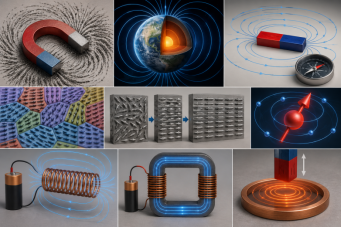
Every magnetic material has very small areas in its microstructure known as magnetic domains. As shown in figure below, in each domain, the spins of electrons are arranged in one direction only, making that area magnetic. A piece of steel that is not magnetized has its domains oriented randomly, and their magnetic effects cancel out each other. If the material is subjected to a strong magnetic field, these domains will turn so as to be in line with the field. In a hard magnetic material, the domains will remain in line even after the magnetic field is taken away. It is this remaining magnetism that is perceived as a permanent magnet.
Why Ferromagnetic Materials Can Become Magnetic
There are some materials that can be turned strongly magnetized. Some common examples include Iron, nickel, cobalt, and different iron-based alloys.
They have crystal lattices that help the magnetic moments of nearby atoms to get lined up in the same direction. Due to this property, they are extensively used for magnetic assemblies, magnetic circuits, and flux-guiding elements.
Why Permanent Magnets Hold Magnetism Without Power
Materials that are hard magnets are characterized by strong resistance to demagnetization (High coercivity). This means that only a very strong demagnetizing field can force the domains to be completely random again. Without that demagnetizing force, the domains remain in concert, and the magnet is able to maintain its field forever or at least until it encounters very high temperature, mechanical shock or a demagnetizing coil.
Main Types of Permanent Magnets
Not all permanent magnets are alike. Different kinds of magnets provide different values in strength, temperature tolerance, resistance to corrosion, and price. The choice of a magnet will be based on its working environment and the needs of the project. Here is what your engineering team needs to know before choosing a type for a specific application.
Neodymium Magnets
Neodymium iron boron magnets have the highest energy product of any magnet, up to 52 MGOe (Megagauss-Oersteds). Because of their high magnetic strength, they are often used in small high-force applications such as servo motors and sensor assemblies. Their main drawback is that their maximum operating temperature is limited; standard grades start to demagnetize at 80 °C, but special grades can go up to 200 °C. Furthermore, NdFeB magnets are easily corroded and need to be covered by protective coatings like nickel, epoxy, or zinc.

Samarium Cobalt Magnets
Samarium cobalt (SmCo) magnets remain a first choice for users with needs for very strong magnets and stable performance over 150 °C. SmCo Grade 2:17 magnets can even work continuously at 300 °C. They are more expensive and more brittle than NdFeB magnets, but they offer better magnetic stability and resistance to demagnetization at elevated temperatures. These are mostly used in aerospace actuators, high-temperature sensors, and turbomachinery applications.
Ferrite or Ceramic Magnets
Ferrite magnets are the most widely used due to their low cost. Their energy product is modest, 1- 4 MGOe typically, but they are resistant to corrosion, need no coating, and have a temperature range from, 40 °C to +250 °C. These magnets are mainly used in small DC motors, door latches, loudspeakers, and magnetic sensors, where the force is not a key factor.
Alnico Magnets
Alnico magnets (alloys of aluminum, nickel, and cobalt) were the main technology for permanent magnets before rare-earth magnets came along. They are very persistant in terms of stability at high temperatures up to 540 °C and have also very good resistance to corrosion. On the other hand, their coercivity is so low that they can be easily demagnetized. They can be found up to this day in guitar pickups, instruments, meters, and similar applications that require a stable flux at rather high temperatures.
How to Choose Between Permanent Magnet Types
The following table 02 shows you the main criteria and their examples for the selection between permanent magnets.
Table 02: Main criteria for the selection of permanent magnet types
|
Magnet Type |
Max Energy Product |
Max Operating Temp |
Corrosion Resistance |
Cost Level |
|
NdFeB |
52 MGOe |
80–200 °C (grade-dependent) |
Low |
Medium |
|
SmCo |
32 MGOe |
300 °C |
Good |
High |
|
Ferrite |
4 MGOe |
250 °C |
Excellent |
Low |
|
Alnico |
9 MGOe |
540 °C |
Good |
Medium |
Hard Magnetic Materials and Soft Magnetic Materials
Hard magnetic materials are those that maintain their magnetism after the removal of an external magnetic source. Hard magnetic materials have the ability to maintain their magnetism for a long time. On the other hand, the soft magnetic material can be easily magnetized and demagnetized. The main reason behind this is that less energy is required to demagnetize them.
What “Hard” and “Soft” Mean in Magnetism
In magnetism, hard and soft refers to how easily a material can be magnetized and demagnetized. If a material cannot be demagnetized easily after magnetization, then its mean it is a hard magnet.
Why This Difference Matters in Machined Parts
The selection between hard and soft magnet is critical in machined parts. For example, if a soft magnet is selected for sensors or rotor assemblies, then this leads to affecting the performance, and failure to meet requirements.
Is Iron, Steel, or Stainless Steel a Permanent Magnet?
Different materials show different magnetic behavior. Their magnetism depends on the manufacturing, microstructure, and composition. The following section discusses how the different materials respond to magnetism:
Is Iron a Permanent Magnet?
Iron is a strong ferromagnetic material. But it is not a permanent magnet. The reason behind this is that when you remove the external magnetic field, it will lead to loose its magnetism.
Is Steel a Permanent Magnet?
Different types of steel are widely used as permanent magnets. They have the ability to retain their magnetization after being exposed to a magnetic field.
Is Stainless Steel Magnetic?
The magnetization of stainless steel depends on its crystal structure. Annealed 304 and 316 stainless steels are generally considered non-magnetic or only weakly magnetic. However, cold working, forming, machining, and welding can increase local magnetic permeability, especially in Type 304. On the other hand, the ferritic and martensitic stainless steel are magnetic but not commonly used as permanent magnets.
Residual Magnetism in Steel Parts
Some steel parts keep the residual magnetism after machining due to the alignment of magnetic domains in steel with the machining process. Machining processes such as grinding and cutting may leave a small permanent magnetic effect after the process is completed.
Magnetic Material vs Permanent Magnet
A magnetic material is not always a permanent magnet. A magnetic material may retain some residual magnetism after exposure to a magnetic field, but this does not necessarily make it a permanent magnet. Machined steel parts may therefore show residual magnetism even though they are not permanent magnets.
Where Are Permanent Magnets Used?
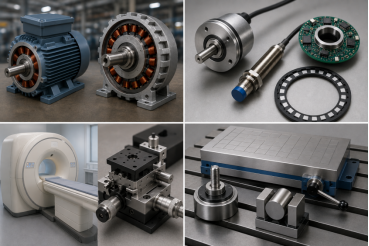
Permanent magnets are used in a wide range of applications. Permanent magnets' main function is to generate the magnetic force for sensors, precision equipment, workholding, and energy conversion. The following section and figure below gives you the main idea about the applications of permanent magnets:
Permanent Magnets in Motors and Generators
In a motor, the permanent magnets generate the magnetic field to convert the electrical energy into mechanical motion. For the generators, the permanent magnets convert the mechanical motion into electrical energy.
Permanent Magnets in Sensors and Encoders
Many sensors and encoders rely on permanent magnets. These magnets provide a stable magnetic field to generate accurate signals to detect speed, position, and motion.
Permanent Magnets in Medical and Precision Equipment
Permanent magnets are widely used in medical and precision equipment's such as in surgical tools, MRI systems, and for laboratory equipment. Permanent magnets ensure accurate positioning, sensing, and stable performance.
Permanent Magnets in Magnetic Clamping and Workholding
Permanent magnets are used in magnetic clamping and workholding systems to hold the magnetic workpiece during the welding and machining process. In CNC machining shops, the magnetic chucks and fixtures are used to avoid the unnecessary conventional mechanical clamps.
How Are Permanent Magnets Installed
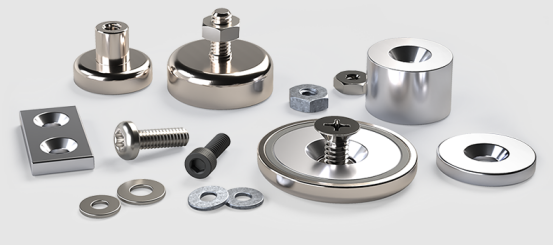
Permanent magnets are commonly used along with the bases, plates, and housing to give the mechanical support. This helps to protect the permanent magnet from damage. The following section will explain to you the common methods to install the permanent magnets and their manufacturing:
Bonded Mounting
This method is common in industrial applications because it is cheap. In this, the adhesives are used to attach the permanent magnets to the mounting bases, plates, and housing using two-part structural epoxy adhesives.
However, bonded mounting is not recommended as the sole retention method in safety-critical or heavily loaded areas. Adhesive strength can decline under prolonged vibration, impact, peel loads, thermal cycling, moisture, or chemical exposure, increasing the risk of magnet detachment. Where structural loads are significant, use a machined pocket with a retaining plate, sleeve, clamp, or cover, and treat the adhesive only as secondary retention.
Embedded Mounting
In this, the permanent magnets is installed into the machined pockets, cavities. After this, the magnets are secured using the adhesives. This will help protect the magnet from impact, corrosion, and damage.
Mechanical Retention
In mechanical retention, the permanent magnet is physically secured with the help of a clamp, fastener, and housing. This will help protect the magnet from vibration, shocks, and temperature fluctuations.
Encapsulated Mounting
In this, the permanent magnet is completely secured within the housing of epoxy resin, stainless steel, and rubber. This will help maintain the performance of the permanent magnet by avoiding damage from corrosion, chemicals, and shocks.
Magnetic Circuit Mounting
In this, the permanent magnets are installed within the ferromagnetic components such as housing, plates, and pole pieces. Then, these magnets are secured through the bonding and press-fitting methods.
Installation Design Factors
To ensure the durability and reliable performance, the following factors should be considered:
- Magnetic force requirement
- Magnet grade selection according to operating temperature.
- Select an appropriate mounting method to avoid the shock, impact, corrosion, and damage to the permanent magnet.
- Maximize the magnetic efficiency by considering the air gaps and steel components.
Permanent Magnets in Machined Parts
Permanent magnets are used in machined parts to provide the magnetic force. The machined parts, such as shafts, yokes, pole pieces, and clamps, are used to hold and protect the magnets.
The Magnet as the Functional Core
The permanent magnet in the machined parts serves as a functional core that produces the magnetic force for different applications.
Machined Housings, Sleeves, Brackets, and Retainers
The machined housings, sleeves, brackets, and retainers are used to hold the magnets. These parts serve the magnetic field in the right direction and protect the permanent magnets from corrosion, impact, and vibrations.
Pole Pieces, Yokes, and Flux-Guiding Components
The following components are used to concentrate and increase the efficiency of the magnetic field:
- Pole pieces: They concentrate the magnetic field at the desired location.
- Yokes: They increase the magnetic field efficiency by providing the return path.
- Flux-guiding: It reduces the magnetic losses.
Why CNC Machining Matters for Permanent Magnet Assemblies
CNC machining plays an important role in permanent magnet assemblies by producing the components that hold and protect the magnets. These parts include the mounting bases, plates, brackets, sleeves, and housing.
Tight Assembly Tolerances
It is necessary to align the permanent magnets and surrounding components to maximize efficiency. For this, CNC machines produce the components with tight tolerances to ensure that the components fit and provide accurate positioning.
Better Concentricity and Runout
The better concentricity and low runout are achieved by producing the components with tight tolerances from CNC machining. This will lead to give the maximize efficiency and reliable performance.
Prototype-to-Production Support
CNC machining help manufacturers from the initial prototype to the final full-scale production. In the prototype stage, CNC machines allows to test and improving mounting, brackets, sleeves, and plate components. In full scale production, a repeated production with precise tolerances can be achieved.
Magnetic Components and Magnetic Assemblies
As the technology advances, the permanent magnets provide higher accuracy and reliable performance. But their performance does not only depend on the magnet itself, but the alignment, protection, and tight dimensional accuracy also play a major role. The following section explains to you the common industrial magnetic assemblies and the major differences between magnetic components and magnetic assemblies.
What Is a Magnetic Component?
A single foundational part that is used to generate the base magnetic field. The examples are core and coils.
What Is a Magnetic Assembly?
A magnetic assembly consists of one or more permanent magnets with the housing, plates, sleeves, yokes, and shafts.
Permanent Magnet vs Magnetic Assembly
The following table 03 shows you the main difference between the permanent magnet and magnetic assembly.
Table 03: Main difference between the permanent magnet and magnetic assembly.
|
Aspect |
Permanent Magnet |
Magnetic Assembly |
|
Design |
Simple geometry |
Engineered system |
|
Definition |
Magnet material |
Magnet + components |
|
Function |
Generates magnetic field |
Delivers controlled magnetic performance |
|
Components |
Magnetic material only |
Magnet, housing, pole pieces, fasteners |
|
Application |
Basic magnetic uses |
Industrial systems |
|
Manufacturing |
Magnet processing |
Machining + assembly |
|
Cost |
Lower |
Higher |
Common Industrial Magnetic Assemblies
The industrial magnetic assemblies consist of magnets and their components. This will lead to the maximum magnetic performance. The common industrial magnetic assemblies are given below:
Pot Magnets
It consists of a steel cup to concentrate the magnetic field. In a pot magnet, the permanent magnet is enclosed inside the steel cup.
Magnetic Couplings
In this, a permanent magnet is used to transfer the motion from one part to another part without any contact. They are used for chemical processing and leak-free operation.
Rotor Magnet Assemblies
In rotor magnet assemblies, the permanent magnet is mounted on the rotor. The rotating magnetic field are interact with the stator winding, and this leads to the production of motion.
Sensor Magnet Assemblies
In sensor magnet assemblies, the permanent magnet is combined with the supporting parts, such as housing and brackets. These magnets provide the controlled magnetic force for sensing and positioning applications.
Magnetic Workholding Assemblies
Magnetic workholding assemblies are used to hold the workpiece stable with the help of permanent magnets. This is common in the CNC machining, milling, and grinding operations.
How Are Parts for Permanent Magnet Assemblies Machined?
The permanent magnet assemblies do not contain only the magnet. But it also contains other components for the support of magnets. These machine parts must be machined precisely to ensure proper fit and performance.
Machining Parts Around the Magnet
The holders, magnet housing, sleeves, pockets, yoke, and back iron plate are some common machining parts around the magnet.
- Metals
Milling, grinding, tapping, and mill-turning operations are used to manufacture the shafts, pole pieces, brackets, and housing.
- Plastics
Plastic parts such as spacers, insulators, covers, and support structures are used in magnetic assemblies. The common manufacturing methods for these parts are milling, CNC routing, precision machining, and turning.
- Others
Composite and ceramic materials are machined through laser cutting, waterjet cutting, and grinding methods. This is important for applications requiring high wear resistance and to reduce the weight in magnetic assemblies.
Risks During Magnet Assembly
Even when the magnet itself is not machined, errors in surrounding components or the assembly process can still damage it. The main risks include mechanical chipping, heat-related loss of magnetic performance, and coating damage that may later lead to corrosion.
Chipping
Mostly, permanent magnets are brittle, and an impact during assembly or collision leads to chipping of the material.
Heat Damage
High temperature is produced during the grinding and machining operations. This leads to affecting the performance of permanent magnets.
Coating Damage
Coating on the magnets can be damaged during the assembly. Improper handling and corrosion can reduce its service life.
Tolerance Requirements for Permanent Magnet Assemblies
Air Gap Tolerance
Air gap tolerance is basically the allowable distance variation between the magnet and its mating component. Balancing with mechanical safety is important to get the maximum magnetic field.
Flatness and Parallelism
Flatness tolerance is the allowable variation for the magnetic surface from a perfect flat surface. This affects the air gap and overall performance of the assembly. Parallelism is defined as the two parallel surfaces that ensure a constant orientation to each other. If parallelism tolerance is exceeded or decreased, this leads to an effect on the air gap, and hence it affects the magnetic performance.
Concentricity and Runout
Concentricity is the alignment between the central axis of the magnet and the shaft with the reference axis. Better concentricity helps maintain a uniform air gap and more consistent magnetic performance. On the other hand, the runout is the deviation of the rotating surface from its ideal rotation. Excessive runout leads to noise, an inconsistent magnetic field, and a variable air gap during rotation.
Positioning Accuracy
Positioning accuracy is how accurately a magnet is placed at its position. Accurate positioning of magnet leads to the generation of a magnetic field in the correct direction.
Adhesive Clearance
Adhesive clearance is the gap between the magnet and its mating surface. The enough gap leads to evenly spread of adhesive and excellent bonding.
Press Fit and Retention Features
In a press fit, the magnet dimension is slightly larger than the hole where it is installed. Due to large dimensions, the magnet fits tightly without the need for adhesives. During vibration, high speed rotation, the retention features avoids the magnets from moving.
Polarity and Orientation Control
In polarity control, the south and north poles are positioned exactly according to the requirement. Whereas, in orientation control, the magnet is positioned in the correct direction. The correct polarity and orientation lead to avoiding an effect on the performance of the assembly.
Surface Treatments and Coatings for Permanent Magnet Parts
Different coatings and surface treatments are used to increase durability, protect from corrosion, and enhance the appearance.
Common Magnet Coatings
The main functions and visual effects of the common magnet coating are explained below:
Nickel Coating
Nickel coating gives a bright silver metallic finish. Nickel coating improves the appearance, adhesion, and protection against corrosion.
Epoxy Coating
Epoxy coating gives the glass-like shiny appearance. Epoxy coatings are used to provide a barrier against the environment.
Zinc Coating
Zinc coating gives a bright silver appearance. It is commonly used, cost-effective, increases durability, and protects against corrosion.
Parylene Coating
The thickness of this coating layer is very thin. That is why it is used where precise dimensional accuracy is required. This coating gives a transparent appearance and has the following functions:
- Wear and Surface Protection
- Maintains Magnetic Performance
- Electrical Insulation
- Corrosion Protection
Surface Finishes for Machined Metal Parts
The surface finishing is the last step for the machined metal parts. This is required to achieve the long-term performance in various environments.
Anodizing
In anodizing, an aluminum oxide layer is formed to protect the metal from corrosion and increase the wear resistance.
Passivation
In this, the free iron is removed from the surface of stainless steel. The resistance to corrosion can be increased by optimizing the natural oxide layer.
Black Oxide
It chemically alters the metal's surface layer into the magnetite layer. Like the coating and plating, the black oxide layer does not significantly change the dimensions of the components.
Electroless Nickel
This layer give the silver metallic appearance and gives excellent resistance to corrosion. This layer is uniformly deposited onto the surface without using an external source of current.
Zinc Plating
A layer of zinc is deposited onto the surface, and this layer gives the bright silver-blue appearance.
How Environment Affects Coating Selection
The operating environment is the critical factor in the selection of a coating. Exposure of a coating in different environments can affect its performance. The following are some recommended coatings for the different environments:
- Humidity and Moisture: Electroless Nickel, Epoxy Coating
- Chemical Exposure: Epoxy and parylene coating
- Wear and Abrasion: Nickel plating and electroless nickel
When Machined Parts Become Accidentally Magnetized
Sometimes the machined parts accidentally become magnetized. In the following components and inspection techniques, there may be residual magnetism. It is necessary to demagnetize the components to avoid the effect on the performance. This phenomenon is common in ferromagnetic materials, such as stainless steel.
Magnetic Workholding
In magnetic workholding, the workpiece is stabilized by a strong magnetic force. However, the long exposure to the magnetic field may leave residual magnetism.
Magnetic Particle Inspection
Magnetic particle inspection is used to check the cracks on the surface and sub-surfaces. If there is already residual magnetism in the material (from the machining process), then this leads to the accumulation of magnetic particles in the wrong area and gives the wrong indication of error.
Magnetic Lifting and Handling
A component can be magnetized during the magnetic lifting and handling operations. Residue magnetization in components can attract the nearby components, such as metals and chips.
Contact With Strong Magnetic Tools
During machining, the parts may become magnetized when in contact with the strong magnetic tools and magnetic chuck.
Grinding and Fine Metal Particles
During the grinding, fine metal particles can be produced. These particles may attract the residue magnetize components. So, proper cleaning and demagnetization are necessary to overcome this problem.
Why Accidental Magnetization Matters Before Shipment
After machining, residual magnetism may cause parts to retain metal chips, interfere with magnetic inspection, or stick together during handling and transportation. Therefore, unintentionally magnetized components should be demagnetized before shipment to prevent contamination, inspection errors, and handling problems.
Residual Magnetism in Machined Parts
The following section will give you an idea about the residual magnetism, effect, causes, and importance of demagnetization.
What Is Residual Magnetism?
After machining , the retained magnetic field in components is called the residual magnetism. It is basically the product that is not required after the machining process. The common causes of residual magnetism are given below:
- Magnetic workholding
- Grinding operations
- Magnetic lifting and handling equipment
- Magnetic particle inspection (MPI)
- Exposure to strong electromagnetic fields
Why Steel Parts Can Keep Residual Magnetism
After machining, internal magnetic domains of some steel parts do not come to its neutral state. These parts keep the same alignment even after the removal of the external magnetic field. That is why some steel parts can keep residual magnetism.
How Residual Magnetism Affects Cleaning
A steel shaft may retain the magnetism after the grinding. After grinding and the removal of the external magnetic field, some domains remain aligned. This leads to small metal particles that may attracts with the magnets.
How Residual Magnetism Affects Assembly
During assembly, the residual magnetism in machined components of the gearbox may attract the metal chips. This will lead to affecting the dimensional accuracy as well as the alignment more difficult.
How Residual Magnetism Affects Inspection
Residual magnetism in machined parts may also affect the magnetic particle inspection. Due to residual magnetism, the magnetic particle may accumulate in an area where there is no defect.
How Residual Magnetism Affects Bearings, Sensors, and Precision Gaps
The following section will explains you how residual magnetism affects the sensors, precision gaps, and bearing.
- Bearing: A residual magnetism component of the bearing may attract the metal particles from the lubricant. This leads to overheating and reduces the bearing life.
- Precision gaps: The residue magnetism may attract the small steel particles on the surface. This leads to reducing the gaps between bearing surfaces. This affects the performance, increases friction, and creates problems during the fitting of components.
- Sensors:A residual magnetic field in a steel component may interfere with the sensor’s intended magnetic signal. This leads to effects on the reading due to signal error.
Magnetization Direction in Magnet Applications
Let’s figure out in this section how magnetic direction is used in magnet applications:
What is Magnetization Direction
The direction in which magnetic domains are aligned during the magnetizing process is called magnetization direction.
Common Magnetization Directions
These are the common magnetization directions:
Axial Magnetization
This type of magnetization direction is used in disc and ring magnets. In this type of magnetization, the magnetic field runs straight through the central axis or thickness of the magnet.
Radial Magnetization
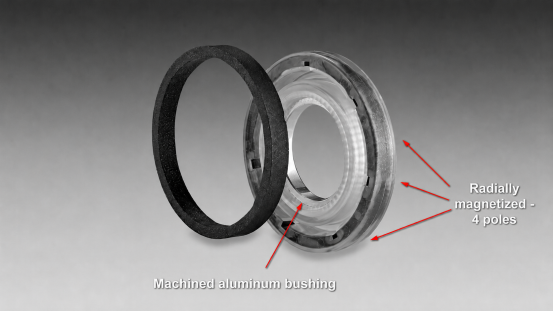
In this type, the magnetization pattern is directed radially rather than axially or diametrically. It is used in ring magnets.
Diametrical Magnetization
In this type, magnetic fields run across the diameter. It is commonly employed in cylindrical magnets. The north and south poles are on opposite curved sides.
Multi-Pole Magnetization
In simple words, in multi-pole magnetization, there can be more than 2 poles in one magnet. This type is employed in rotary encoders, BLDC motors, and servo motors.
Working Face and Pole Orientation
Working face refers to the surface of the magnet that is intended to perform the magnetic function in the assembly.
Pole orientation specifies where the north and south poles are located.
They should be clearly mentioned on the drawings because they ensure correct assembly, proper magnetic performance, and prevention of functional failures.
Demagnetization of Machined Parts
This section provides insights into the demagnetization of machined parts:
What Is Demagnetization?
Partial or complete loss of magnetic strength in a magnet is called demagnetization.
Demagnetization vs Making a Material Non-Magnetic
The following table briefly describes the differences between demagnetization and making a material non-magnetic.
How AC Demagnetization Works
In this process, the magnetic domains in a material are forced to repeatedly reverse direction under a decreasing magnetic field. Basically, AC demagnetization applies an alternating magnetic field, which means the field continuously switches polarity.
When Buyers Should Request Demagnetization
The following are the points when the buyers should request demagnetization in machined parts:
After Magnetic Chuck Grinding
The grinding process can leave residual magnetism in the part, which is dangerous with respect to functionality, quality, and assembly problems in the later stages. That’s why the buyers must ask for demagnetization after magnetic chuck grinding.
After Magnetic Particle Inspection
During magnetic particle inspection, the magnetic fields can remain behind in the part, which affects the functionality in later stages. So, demagnetization must be asked after magnetic particle inspection.
Before Precision Cleaning
Demagnetization must be required before precision cleaning because magnetism in the parts can attract contamination during cleaning, and it helps in achieving better surface chemistry control.
Before Assembly Near Sensors or Bearings
- Magnetism in the parts can create an unintended local magnetic field, which can distort sensor readings.
- While in the case of bearings, magnetism attracts metallic particles, due to which abrasive wear accelerates.
Before Packaging Fine Steel Parts
Demagnetization before packaging fine steel parts helps in the prevention of attraction of metal particles, avoiding parts sticking together, and reducing corrosion risk.
Magnet-Related Drawing Notes for CNC Parts
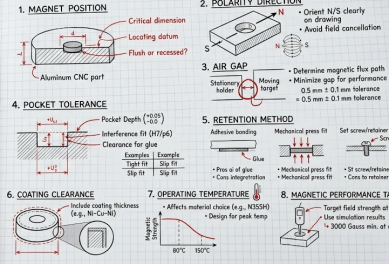
The following figure, shows some magnet-related drawing notes for CNC parts, which are helpful for you in designing the parts:
Magnet Position
The magnet position is important to consider because the performance of the whole system depends on the location of the magnetic field relative to other components. Furthermore, it ensures proper alignment with sensors and maintains rotational accuracy.
Polarity Direction
Polarity means which side of the magnet will be north or south. It is important because:
- Sensor operation depends on polarity.
- Rotary encoders require a specific pole orientation.
- The performance of the motor and actuator gets affected.
Air Gap
The air gap directly affects the magnetic force and performance. It is critical because it controls magnetic flux and force, so CNC drawings must specify and control it accurately.
Pocket Tolerance
Pocket tolerance controls how accurately the magnet fits and is positioned inside the pocket. It matters because it:
- Prevents the magnet from being too loose.
- Prevents the magnet from being too tight.
- Ensures the correct air gap.
Retention Method
It is important in magnet-related drawings for CNC parts because it prevents magnet movement, determines pocket dimensions and tolerances, prevents magnet damage, and ensures assembly consistency.
Coating Clearance
Coating clearance is critical because the coating adds thickness to the machined surfaces. It ensures proper magnet fit, prevents excessive press-fit force, and maintains critical air gaps.
Operating Temperature
It is important because the magnetic properties of magnets change with temperature. During operation, thermal expansion affects the assembly, and material selection depends on temperature.
Magnetic Performance Target
It is the minimum capability that the finished part must achieve to perform its intended function. It is important to consider:
- Ensures functional requirements are met
- Provides a measureable acceptance
- Prevents underperforming magnets
- Reduces assembly field failures
Residual Magnetism Limit
Since unwanted magnetism can interfere with the operation, assembly, and inspection of the CNC part, so it should be considered important when it is related to magnet-related drawings for CNC parts.
How to Choose the Right Custom Machining Supplier for Your Project
When you are exploring custom machining suppliers, confirm the following points with the suppliers before choosing them for your projects:
Material Selection Support
Since magnetism is an inherent property of materials, selecting materials with respect to the required magnetic requirements is a difficult step. The chosen supplier should support in that step.
Machining Capability
Machining capability of a supplier is a very basic thing because it affects surface finish, dimensional accuracy, and ultimately the performance. So, a supplier should be equipped with advanced CNC machines and experienced operators to meet performance requirements.
Magnetic Assembly Experience
A supplier who has experience in magnetic assembly should be prioritized because that supplier knows how the magnetic poles, etc., are specified with respect to the requirements.
Such as Tuofa CNC Machining, who have been making custom parts for nearly 20 years, helps customers to do parts demagnetization and make sure they are working during the process of assembly and delivery. What’s more, Tuofa also provides semi-assembly services, too.
Surface Treatment Control
It is important because it affects system reliability, durability, and functional performance. So, the supplier should have an excellent experience of surface treatment control.
Magnetization and Polarity Control
It is important when it comes to selecting a custom machining supplier because it affects:
- Functional correctness
- Assembly behavior
- Safety of magnet-based system
Inspection Capability
Inspection ensures that the machined parts do not contain any flaws because these flaws affect the performance and ultimately cause disasters. So, the supplier should be chosen who has the best inspection technologies.
Packaging and Cleanliness Control
This ability of any supplier is important because it determines whether a fully machined part remains usable when it reaches assembly.
Machining capabilities, magnetic assembly experience, inspection capabilities, packaging, and cleanliness control are the capabilities that should be satisfied. Tuofa is a kind of supplier that is equipped with advanced CNC machines and experienced operators and can provide semi-assembly, assembly, or other services, which makes us a one-stop solution.
Communication Before Quotation
Communication before quotation includes technical, manufacturing, quality, and delivery context, so the supplier can generate an accurate and manufacturer quotation without assumptions.
Conclusion
It is important to understand the permanent magnet and residual magnetism, specially for machining of CNC parts. The longer performance and reliability of the product can be improved by proper management of magnetism. Permanent magnet has ability to retain their magnetism for a long time even after the removal of the external source. However, the machining parts may retain some magnetism. This residue magnetism can creates problems such as the attraction of metals parts with the residual magnetism parts. This leads to effects on the machining and assembly operation. This problem should be overcome by the selection of the right permanent magnet and the demagnetization of machined parts.
FAQ
Are permanent magnets AC or DC?
Permanent magnets, such as neodymium magnet provides the consistent magnetic field, so it is DC magnetism.
Is there any truly permanent magnet?
Yes, truly permanent magnets exist, and they can provide the magnetic field without an external source for a long time.
How long will a permanent magnet last?
Under suitable operating conditions, the permanent magnets can last from ten to a hundred years. For example, the Samarium Cobalt (SmCo) can last for more than 100 years.
What is the strongest permanent magnet?
Neodymium Iron Boron (NdFeB) – N52 grade is the strongest permanent magnet. Its life is more than 100 years with a very strong magnetic force.
How do I choose the right permanent magnet assembly for my project?
The factors such as required magnetic force,working air gap,magnet size limitations,environmental exposure, required lifetime,mechanical mounting method and cost requirement should be consider during the selection of right permanent magnet assembly.
 CW617N Brass Guide: Properties, CNC Machining, Parts & Surface Treatment