Tel/WeChat:
  Email:


 Home
HomeMounting Plate: Types, Materials, Design & Custom Machining

 Published:May 12,2026
Although mounting plates are not very noticeable in assemblies, their significance is compelling. They not only provide a stable platform for attachment, but they also transfer loads, manage space, align components properly, and damp vibrations. Without mounting plates, the proper functioning of components can be challenging. Let's learn about the types, materials, and manufacturing methods of mounting plates.
What Is a Mounting Plate
Mounting plates are quite often used in mechanical and electrical assemblies. A mounting plate is basically used to attach, support, and align components. From an alignment perspective, the flatness and precise hole pattern of the mounting plate enable accurate positioning of components. Mounting plates can be classified according to thickness. Thin mounting plates are normally used in light-weight fixtures, while thick mounting plates are used in load-bearing installations. Their manufacturing methods are also different. Thin mounting plates are manufactured using sheet metal processes. On the other hand, thick mounting plates are manufactured using CNC machining, plasma cutting, etc.
Functions of Mounting Plates
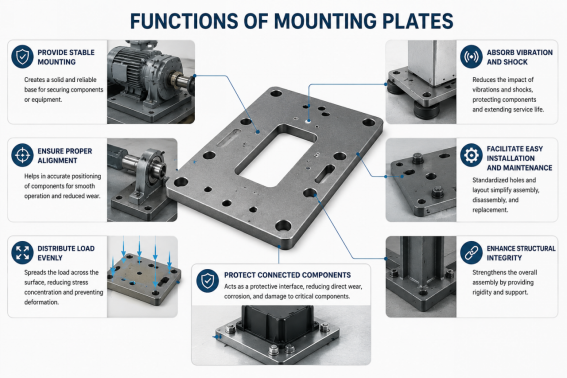
The foremost function of a mounting plate is to provide a stable platform for components in assemblies. On top of that, mounting plates simplify installation. Components can be attached to their pre-defined positions. Precise alignment ensures proper fitting. Mounting plates distribute weight evenly. As the mounting plate serves as a separate interface, space management becomes better. In some electrical applications, a mounting plate can also act as a heat sink. It also helps in vibration damping.
Difference Between Mounting Plate, Base Plate and Bracket
The table below compare mounting plate, base plate and bracket:
|
Aspect |
Mounting Plate |
Base Plate |
Bracket |
|---|---|---|---|
|
Definition |
Flat interface for attaching components |
Heavy plate for anchoring foundations |
Support component used to connect or reinforce parts |
|
Core Function |
Alignment and load distribution |
Load transfer to foundation |
Angular support |
|
Thickness Range |
1 -12 mm |
12 mm to 100+mm |
1-12mm |
|
Manufacturing |
Laser, punch or CNC machining |
Plasma cutting and CNC machining |
Bending, welding, casting, or machining |
|
Geometry |
Flat |
Flat and thick |
L, U, T, sections |
|
Load Handling |
Moderate to high |
Very high |
Moderate |
|
Mounting location |
Panels, machines, frames |
Concrete foundations |
Walls, frames, and structures |
|
Fastening Method |
Bolts, screws, welds |
Anchor bolts and grout |
bolts, screws, welds |
|
Design Flexibility |
High |
Medium |
High |
Types of Mounting Plates by Application
Mounting plates are used in numerous applications. The space management, vibration damping, and load transfer characteristics mark the usefulness of the mounting plate in a lot of areas. Generally, they can be categorized based on application areas, such as electrical, mechanical, or structural.
Electrical Mounting Plates
Electrical mounting plates are usually made from thin sheets of metal. CNC laser cutting, punching, and bending create accurate profiles and holes. These mounting plates are widely used in control panels, distribution boards, and enclosures. They provide access to electrical components such as circuit breakers, relays, PLCs, and terminal blocks. Space management, neat wiring, and heat dissipation are some of the key advantages of electrical mounting plates.
Mechanical Mounting Plates
Mechanical mounting plates are used in mechanical assemblies for alignment, load distribution, and/or damping. Precise hole alignment and adjustable mechanisms ensure accurate positioning of motors, gearboxes, and bearings.
Structural and Support Plates
Structural mounting plates play a crucial role in the stability of the whole structure. The primary function is to transfer the load evenly to the supporting structure. These mounting plates are usually attached to concrete foundations and steel structures. Owing to their performance criteria, structural mounting plates are made with thick materials. For high precision, CNC machining and plasma cutting are used in manufacturing.
Common Materials for Mounting Plates
While the list of materials that can be used in mounting plates is endless, metal mounting plates are common. Even in metals, factors like cost, corrosion resistance, and low weight affect the material selection. Here we are discussing the common materials used in mounting plates.
|
Material |
Common Grades |
Characteristics |
|---|---|---|
|
Carbon Steel |
ASTM A36, 1018, 1045, SS400. Q235 |
Strong, and cost effective |
|
Stainless Steel |
304, 316, 430, 201 |
Corrosion resistant |
|
Aluminum |
6061- T6, 5052, 7075 |
Lightweight and machinable |
|
Tool Steel |
D2, H13 |
Good wear resistance |
|
PVC |
- |
Electrical insulation and chemical resistance |
|
HDPE |
- |
Moisture resistant and impact resistant |
|
ABS |
- |
Lightweight, and easy fabrication |
|
Nylon |
Nylon 6, nylon 66 |
Strong, wear resistant, and low friction |
Carbon Steel Mounting Plates
Carbon steel is the most common material for mounting plates. Its low cost and high strength are key advantages. But it is prone to corrode over time. So, surface treatments such as painting, powder coating, or galvanizing are required. The most common grades for producing mounting plates are ASTM A36, AISI 1018, SS400, and Q235. They are equivalent grades belonging to different systems. They offer good strength and formability. For heavy machining applications, AISI 1045 may be preferred.
Stainless Steel Mounting Plates
Stainless steel offers excellent corrosion resistance. Low-cost mounting plates can be manufactured from grades like 201 or 430. For most general-purpose applications like food processing, chemical industries, and outdoor applications, 304 stainless steel is used. In marine and aggressive chemical environments, 316 stainless steel is the most suitable grade.
Aluminum Mounting Plates
The biggest advantage of using aluminum in mounting plates is its light weight. 6061 T6 is the most common aluminum grade that offers moderate strength and good machinability. 5052 aluminum is also used in producing mounting plates due to its high formability and corrosion resistance. For high-performance applications, 7075-grade aluminum is used. Its strength matches that of steel.
Plastic Mounting Plates
Polymers offer good electrical insulation, chemical resistance, and low density. These are ideal in corrosive environments and low-load applications. They are also aesthetically appealing. Common plastic materials for mounting plates include PVC, HDPE, ABS, and Nylon
How to Choose the Right Material
The choice of materials depends on applications. As an example, plastics can be used for electrical insulation, but they cannot withstand high loads. On the other hand, carbon steel can withstand high loads, but it doesn't offer electrical insulation. Then comes the cost factor. While stainless steels can replace carbon steels in almost all types of mounting plates, high cost is a limitation. In short, the choice depends on factors like cost, corrosion resistance, mechanical strength, weight, and electrical insulation.
Manufacturing Methods for Mounting Plates
Manufacturing methods for thin mounting plates differ from the methods for thick mounting plates. Sheet metal processes are generally used for thin mounting plates. Whereas CNC machining is employed for thick mounting plates.
Sheet Metal Fabrication
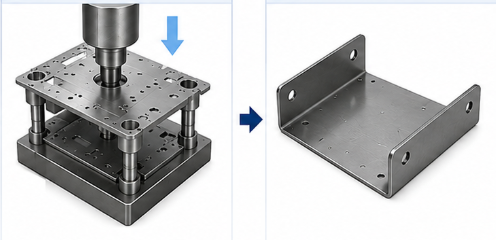
Sheet metal fabrication processes are often used to produce mounting plates up to 8mm thick. It produces simple geometries. Mass production makes it highly cost-efficient. Operations like cutting, punching, and bending are commonly used. CNC laser cutting and CNC bending are used for intricate cuts and profiles. They give repeatable quality with clean edges. Finishing operations such as powder coating, anodization, or galvanization may be required depending on the application.
CNC Machining Mounting Plates
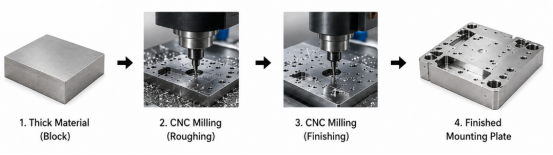
CNC machining is ideal for manufacturing thick mounting plates. Dimensional accuracy, complex design, flatness, and repeatability are highlighting features of this process. As a result, proper fitting and precise alignment of components can be expected.
CNC Milling for Precision Features
CNC milling is used to carve out grooves, pockets, and stepped surfaces in solid blocks. The inclusion of specialized features facilitates the proper mounting of load-exerting components like motors, gearboxes, or columns.
CNC Drilling for Holes of Mounting Plates
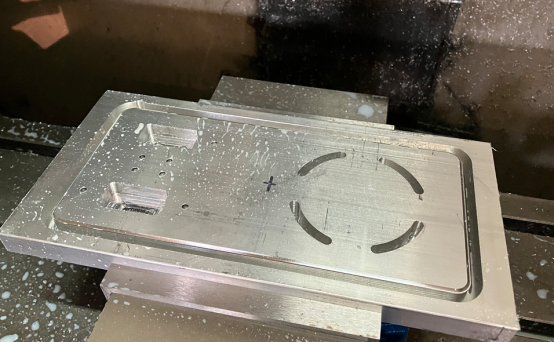
CNC drilling generates holes in the exact spots that are intended in the design. Consequently, bolts and fasteners fit exactly without any alteration needed. Tapping can then be done to thread the holes.
Common Applications of Mounting Plates
Mounting plates cover all sorts of industries. In this era, where industries are racing towards precision, the role of mounting plates is critical. Advanced processes like CNC machining are inching that goal closer. Applications of mounting plates range from automotive to industrial control to advanced robotics.
Automotive Industry
In automotive applications, different components use different types of mounting plates. Mounting plates supporting stationary components like batteries, radiators, and control modules withstand a static load. On the other hand, winch mount plates that are used in off-road applications are designed for dynamic loads. Design depends mainly on the application.
Motor and Power Transmission
Power transmission is another common mechanical application. Mounting plates provide a stable platform for the proper fitting of motors, gearboxes, and transmission systems. CNC-machined mounting plates are dimensionally very accurate. So, they offer perfect fitting of components. Proper alignment ensures smooth working without the risk of deformation or failure.
Electronics
In electronics, mounting plates provide an interface for securing circuit boards, relays, and control units. They give a neat wiring. Nowadays, monitor mounting plates are trending. This adjustable interface for screens is popular in offices, workstations, and gaming environments.
Industrial Automation
In industrial process control systems, mounting plates hold a lot of different components. Sensors, actuators, and controllers are either installed on top of machines or inside an enclosure with mounting plates. They simplify the installation of these components.
Robotics
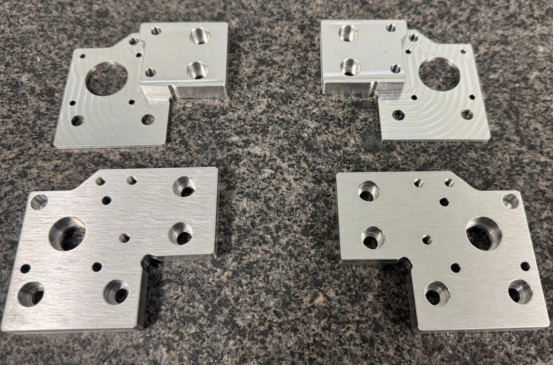
Robotics represents the pinnacle of advancement in machinery. These parts in robots are dimensionally sensitive. Even a slight misalignment or dimensional inaccuracy renders the robots useless. Mounting plates that support motors, joints, sensors, and end-effectors are thus in a very tight tolerance range.
In addition to above applications, mounting plates also can be found on some consumer products such as camera, consumer electronics, home appliances, etc.
How Does Mounting Plate Work Well in Applications?
Engineers and designers give extensive consideration to factors that can affect the performance of mounting plates. Design includes a lot of provisions that should make mounting plates work well. Some of the design features are discussed here.
Control Plate Thickness
Thickness optimization is a key parameter in mounting plate design. Thinner than needed thickness leads to deformation or failure. Thicker than needed results in excessive weight and cost. A novel approach is to use Finite Element Analysis (FEA) to optimize thickness. Only an optimum thickness gives satisfactory strength and rigidity for the intended applications.
Ensure Dimensional Accuracy
Dimensional accuracy is critical in ensuring proper fit and alignment. A seamless assembling operation can be expected with good dimensional accuracy. In addition to good alignment, it promotes even load distribution.
Optimize Hole Design
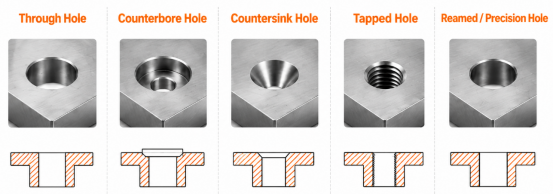
Hole design is also a performance-determining factor. Size, location, and type of hole matter a lot in mounting plate performance. Proper spacing of holes prevents mounting plates from losing strength.
Meet Load Requirements
A good design must meet load requirements. Engineers quite often keep a factor of safety 30-100% above the operating conditions. Static loads are more predictable. But other load types, like dynamic loads or cyclic loads, invite additional problems. As an example, fatigue behavior of the material is considered when cyclic loads are applied. Dynamic loads and impact forces add momentum, which increases load requirements.
How to Inspect Quality of Mounting Plates
In mounting plate manufacturing, QA / QC is as important as the manufacturing itself. Defective pieces not only incur losses due to scrap generation but also create hurdles to the operational reliability of mounting plates. A robust QA/QC system helps ensure that a mounting plate meets the intended results.
Measure Dimensional Accuracy
QC personnel mainly use handheld tools like vernier calipers, micrometers, height gauges, and surface plates. All key dimensions can be measured with these tools. For complex designs, CMMs can be used that give very precise measurements.
Verify Hole Position and Alignment
In addition to other dimension measuring tools, go/no-go gauges, CMMs, and optical measuring systems are used. The hole dimensions, hole depth, edge to hole distance, and hole to hole distance are important measurements.
Validate Load Performance
Load performance is validated by using static load testing machines, hydraulic presses, and fatigue testing setups. FEA is a non-destructive method for validating load performance even before actual production.
Surface Treatments for Mounting Plates
Some metal mounting plates, like stainless steel plates, can be used as they are. But most of the time, mounting plates require surface treatment. It can be performed over the surface for aesthetics, corrosion protection or wear resistance.
Galvanizing for Steel Mounting Plates
Galvanization is often performed on plain carbon steel mounting plates. A layer of zinc is coated over the steel surface that protects the steel from rusting. Further, it gives it a neat and good look. In some galvanization processes, spangles are created that add a pattern to the surface.
Powder Coating for Steel Mounting Plates
Just like galvanization, powder coating protects steel against corrosion. Instead of a single silvery-grey color, powder coating gives endless color options. The color can even be matched with the environment. It also makes the surface electrically insulative.
Anodizing for Aluminum Plates
Anodizing surface treatment is commonly used for aluminum alloys. Anodization has a spectrum of colors and hues. Apart from aesthetics, anodization gives wear and corrosion protection to the mounting plates.
Why Custom Mounting Plates Are Needed?
Whenever standardized mounting plate designs fail to meet application requirements, the need for customization arises. A mismatch of dimensions, hole pattern, or surface treatment invokes the need for customization.
Application-Specific Dimensions
Mass-produced mounting plates cannot necessarily be compatible with all applications. Some specific applications require custom designs. Only the application-specific dimensions suffice the proper fitting and alignment requirements. So, Custom CNC machining is often necessary in that case.
Application-Driven Hole Patterns
Even if the dimensions match the intended use, customization in the hole pattern might still be needed. If the holes match the attachable components' holes, only then can it fit.
Reliable Mounting Plates Manufacturer
Customized mounting plate manufacturing is resource and skill-intensive. The quest to find a reliable manufacturer can be frustrating at times. A reliable manufacturer would be well equipped with all the required machinery. It would provide a one-window, complete solution. Tuofa Custom CNC machining service can help you manufacture desired mounting plates. Over the years, it has won the trust of many industries around the globe. Please feel free to send us an inquiry.
Conclusion
Mounting plate is an important component in electrical and mechanical assemblies. It has some critical functions. It attaches components securely, manages space, aligns properly, and distributes loads evenly. Depending on the design and material thickness, manufacturing processes can be distributed into two categories. Thin mounting plates are manufactured by sheet metal processes. Thick mounting plates are made by CNC machines. Material selection is also an important aspect. It is dependent on factors like strength, corrosion resistance, machinability, formability, and cost.
FAQ
How to drill mounting holes for license plate?
Accurately mark the hole locations. Use a drill machine to create hole at the intended locations.
How to make a mounting plate?
The first step is designing. After the design is validated, a suitable manufacturing method is adopted. Thin mounting plates are made by sheet metal processes. Thick mounting plates require CNC machining.
What is metal plate mount made out of?
Commonly used metals for mounting plates include plain carbon steel, stainless steel, and aluminum.
 Lock Ring Explained: Everything You Should Know