Tel/WeChat:
  Email:


 Home
HomeLock Ring Explained: Everything You Should Know

 Published:May 21,2026
From the high-speed turbines of a power plant to a simple bicycle, any slide, vibrations, or disconnection under the load is restricted to prevent any catastrophic failure. To avoid these failures and to secure the components, the lock rings are used. This article will highlight all the important information an engineer needs to know about the lock rings.
What Is A Lock Ring?
In simple words, a lock ring is called a “stopper.” In technical words, it is a mechanical retaining device that performs the function of holding parts securely in place. Its actual purpose is to stop any kind of movement at joints.
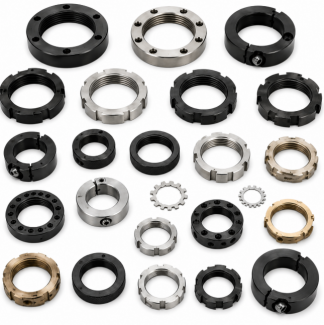
Lock Ring vs Retaining Rings
A lock ring is different than a retaining ring in the following aspects:
|
Feature |
Retaining Ring |
Lock Ring |
|---|---|---|
|
Function |
Holds components in place |
Prevents movement |
|
Installation |
Fits into a pre-cut groove |
Typically tightened/locked in place |
|
Location |
On a shaft or inside a bore |
Usually on threaded parts or assemblies |
|
Working Principle |
Acts as a shoulder to stop movement |
Applies locking force to prevent loosening |
Why Lock Rings Are Widely Used?
From a simple bicycle to a gigantic aero plane, small components are connected to make such products. To hold these components firmly, these lock rings are necessary and are commonly used in all industries. Another reason is that they are simple and do not add weight and complexity in design.
Function of Lock Rings
A lock ring can perform the following functions:
Fixation
In engineering, fixation means holding the component firmly in axial position and preventing it from any kind of movement. A lock is used for fixation in every machine or device to hold the components tightly. For instance, if a lock ring is installed in a groove on a shaft, it will act as a physical barrier against the movements of bearings, gears, etc.
Improve Safety
It's a simple rule: when all the components of a machine are working without any kind of movement, it ensures the safety of the equipment as well as the operator. So, a lock ring performs the function of keeping the environment safe by holding the components firmly.
Simplify Assembly
A lock ring does not need any kind of threads, extra fasteners, or welding, so it makes the process of putting components together faster and easier.
Support Load
A lock ring can also support the load distribution within a machine or piece of equipment. For instance, if a lock ring is installed in a groove on a shaft, it will support the load distribution by transferring the force from that component (bearing) to the shaft.
Locking Mechanisms of Lock Rings
A lock ring can perform the functions using the following mechanisms.
Groove-Based Locking
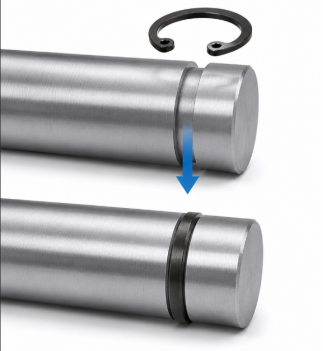
Groove-based mechanisms are mostly used by retaining rings, snap rings, and spiral retaining rings. In this mechanism, the groove plays the main role.
- There is a groove on a shaft, where a lock ring, like a retaining ring, sits and acts as a physical barrier. Due to its elasticity, a retaining ring gets snapped tightly into the groove.
Thread-Based Locking
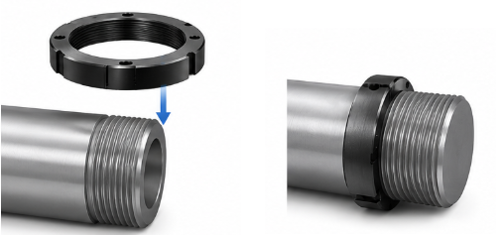
In this mechanism, both the rings and mating surface have threads. The components are locked when the threaded ring meets the threaded surface. The ring is rotated onto a thread and tightened until it creates an axial force. This force then locks the component and prevents it from moving. This mechanism is used by threaded and bearing lock rings.
Clamping Locking
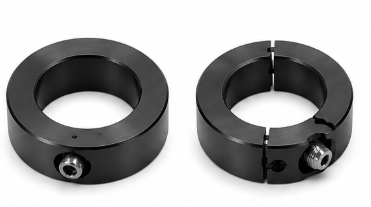
Shaft collars and split clamp rings use this locking mechanism. In this kind of mechanism, there are no threads or grooves. Only the clamp force does the job. Split clamp rings have a gap through the bolts or screws when tightened, so the ring contracts inward.
Taper Locking
As name of this mechanism clarifies itself the locking against the movement of components is done through the tapered surfaces. Tape lock rings use this mechanism. The lock is made when a tapered surface meets a matching tapered surface. It slides along the taper due to the applied force. Due to the slide, the tapered surface radially expands or contracts, which causes a strong grip.
Common Applications of Lock Rings
Lock rings are employed in the following applications:
Bearing Mounting
Bearing mounting means to keep a bearing tightly in its position on a shaft when forces are applied. Usually, snap rings are used for the application of bearing mounting. The snap rings are placed grooved and stop the components from moving. These grooves can be made on the shaft or inside the shaft. Besides the snap rings, spiral retaining and threaded lock rings are also used.
Gear Mounting
An external circlip is a lock ring that is used in this application, where it is placed in the groove using circlip pliers. When it gets fit into the groove, it expands and locks in place, so it stops the gears from slipping. Generally, it is used with a washer and circlip + shoulder combination.
Sprocket Mounting
A sprocket on a shaft is responsible for correctly driving a chain system by accurately rotating with the shaft. For this application, an external circlip is the best option to firmly secure this sprocket on a shaft. It works by being in the groove in the shaft, so it stops the sprocket from sliding out.
Shaft Stops
Shaft stops are the end points on a shaft that stop the axial movement of components on a shaft. These components include gears, bearings, spacers, and sprockets. For this application, an external circlip is inserted into a groove on a shaft, which acts as a removable stop for axial movement.
Pipe Connections
In this application, two or more pipes are connected to equipment, like valves, pumps, etc., so that fluids can flow safely. In this application, collect lock rings, compression ferrules, and grooved coupling rings are used.
Standard Lock Rings vs Custom Lock Rings
Standard lock rings are made according to industrial norms, like ISO, ANSI, etc. A custom lock ring is specifically designed for a unique application.
When Standard Lock Rings Are Enough
For high-volume, low-to-medium complexity mechanical assemblies where loads and conditions are well understood and don't require special, only standard lock rings are enough. These applications include hydraulic and pneumatic cylinders, automotive transmission components, etc.
When Custom Lock Rings Are Needed
Custom lock rings are used when there are special dimensions, high loads, unique materials, tight tolerances, or installation methods; then the lock rings are designed based on these requirements. The applications, like aerospace engine shafts and turbines, heavy industrial machinery, etc., use customized lock rings.
Are Lock Rings CNC Machined?
Yes, CNC machining is used for lock rings when the requirements are high efficiency, precision in the dimensions, and the lowest possible material waste. Sometimes, due to custom designs, traditional tools are not good enough to manufacture lock rings.
When Lock Rings Require CNC Machining
Generally, stamping or wire forming processes are used for the fast and cost-effective production of lock rings. But these processes do not yield the accurate and precise dimensions when the designs are complex and tight tolerances need to be met. In such cases, CNC machines are brought to the manufacturing field of lock rings.
CNC Turning for Lock Rings
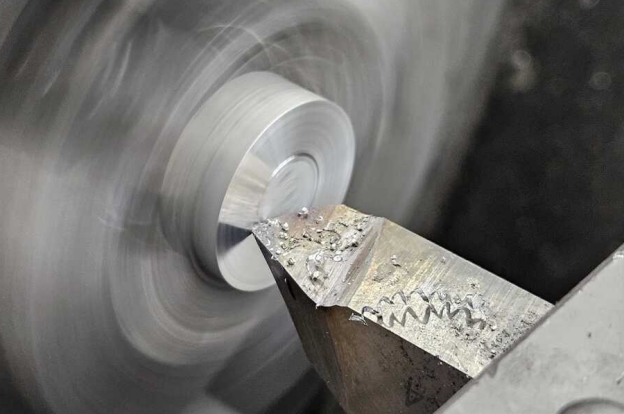
CNC turning stands tall with its efficiency to produce round or circular lock rings when the tolerances are very tight and important to meet. Through the turning process, the features like inner diameter, outer diameter, threads, grooves, and end faces are made through this process. The CNC turning process makes sure that the lock fits properly in the groove on a shaft.
Lock rings mainly made by CNC turning include:
- Threaded Lock rings
- Bearing Lock Ring
- Optical Lock Ring
CNC Milling for Lock Rings
When the design of the lock rings is complex or non-axisymmetric, then the CNC milling operation is employed. This operation is useful in the production of bolt holes, pockets, flats, and custom designs.Clamp lock ring and split lock ring are mainly manufactured by CNC milling.
Whether you need lock rings with specific features or require high precision, Tuofa custom CNC machining services can deliver an ideal solution for you.
Common Materials Used for Custom Lock Rings
Every material has its own characteristics, so they are used based on the environment during applications. Some of the common materials used for lock rings are:
Aluminum Alloy
The lock rings made by this material are mostly employed in robotics, aerospace, and automotive secondary components. 6061 and 7075 are the most commonly used Al alloys for such conditions. If the requirement is lightweight, decent strength, high machinability, and excellent corrosion resistance, then Al alloys, like 6061 and 7075, are used.
Alloy Steel
To meet the mechanical properties of high strength, toughness, wear and fatigue resistance, and reliability under the loads, alloy steel, such as AISI 4140, AISI 10145, and 42CrMo, is the ideal choice. The applications of alloy steel lock rings include:
- conveyor systems
- agricultural equipment
- gear mounting assemblies
- shaft retaining rings.
Stainless Steel
Stainless steel is a material known for its excellent corrosion resistance because of 17-19% Cr content, which provides a passive layer of Cr2O3. Its common grades used for lock rings are 304 and 316. Stainless steel lock rings are employed in:
- marine applications
- food processing equipment
- water handling systems
- automotive light-duty assemblies
Titanium
Titanium, especially its grade 5 (Ti-6Al-4V), is used. It provides very high strength along with excellent corrosion resistance and reliability in extreme environments. It is an expensive material and is used only in critical applications:
- racing vehicles
- high-speed rotating equipment
Key Design Considerations for Lock Rings
During the design of a lock ring, the following factors are important for long-term and reliable performance of lock rings.
Groove Design
Groove design is a fundamental factor for the performance of lock rings. Its width, depth, edge radius, and tolerance affect the fitting of the lock ring. So, the lock ring must be designed considering these factors of a groove to get the maximum performance. Any difference in design and these parameters will lead to inaccurate fitting, so performance will directly be affected.
Load Requirement
A lock ring does not just perform the function of holding components securely, but it is also a load-bearing retaining component. So, it is important during the design of a lock ring to assess the amount of load the lock ring will bear. If the load is higher than the bearing capacity of the lock ring, it will crack and cause failures.
Dimensional Tolerance
A lock ring consists of the following dimensions:
- Inner diameter tolerance
- Outer diameter tolerance
- Thickness tolerance
- Concentricity
These dimensions are important to consider because a lock ring works by mechanical engagement. If the dimension of internal diameter exceeds, it will cause problems in engagement and so locking mechanism failure.
Surface Finish
Surface finish is also important to consider, especially when there are chances of fatigue, during the design of a lock ring. The factors, such as surface roughness, burrs, and sharp edges, must be understood before the design of a lock ring.
Common Lock Ring Failure Causes
The following are some of the main causes why lock rings fail, mostly during the applications:
Incorrect Installation
It is the first step in employing a lock ring in any application. If the installation is incorrect, there will be no mechanical engagement of the lock ring, resulting in poor locking. When the components are not securely held, they will move, slide, and vibrate, which will ultimately cause failures.
Groove Wear
Groove wear causes lock failure because this problem loses the tight seating of the lock ring. When the lock ring is loose in its groove, the components start axial movement, stress becomes uneven, and it starts deforming, so it fails ultimately.
Overload and Impact
Load beyond the bearing capacity of the lock ring will definitely cause the lock ring to deform, crack, and ultimately fail. Furthermore, if the material of the lock ring is not tough, it will not be able to resist an impact load.
Corrosion and Surface Damage
Corrosion and surface damage are interrelated causes that cause the lock rings to fail. If the material does not have good corrosion resistance, due to the corrosive environment, the lock ring will get corroded and lose its strength.
Conclusion
Lock rings are an important part of any equipment or machine because these parts securely hold the other components and prevent them from sliding, moving, and vibrating. Generally, the stamping process is used to produce lock rings, but for critical applications and to meet tight tolerances, CNC machines are used. Alloy steel, stainless steel, Al alloys, and Ti are the common materials used for the manufacturing of lock rings.
FAQ
Lock ring vs retaining ring: are they the same?
- A lock performs two functions: retaining the components and actively locking the components under stress.
- A retaining ring has many types and is mainly used to hold the components on a shaft or inside a bore.
What's the difference between a retaining ring and a snap ring?
- A retaining ring means any ring used to retain the components on a shaft.
- A retaining ring that snaps into a machined groove during installation is called a snap ring.
What are the two main types of retaining rings?
External retaining ring and internal retaining ring are the main types of a retaining ring. An external retaining ring is installed on the outside of a shaft, while an internal retaining ring is installed inside a bore or housing.
 What Are Threaded Pins? Exploring Types and Custom Machining