Tel/WeChat:
  Email:


 Home
HomeIf You Paint Copper, Will It Lose Its Conductiveness?

 Published:Jul 22,2026
The surface conduct conductivity of copper can be affected if it is painted, while it won';t lose its internal conductivity. However, it doesn';t mean that all coating or painting can affect the surface conductivity of copper. Read this guide to knowing how to choose suitable surface treatment material and how to paint copper parts properly, which are essential for the performance of parts.
Does Paint Stop Copper from Conducting Electricity?
Painting the copper metal does not affect its ability to carry electrical current internally. Painting the copper affects the conductivity of the electrical current on the surface of the copper metal. It is necessary to make clear the difference between the conductivity that occurs inside the copper metal and the conductivity on the surface of the copper when there is contact between the copper metals.
Internal Conductivity
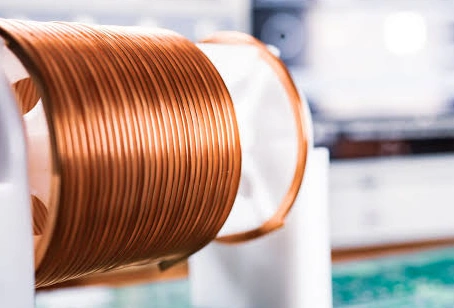
Internal conductivity is the capability of copper to transmit electric current from one end to another internally within itself. Due to the face-centered cubic crystal lattice of copper, it has an extremely large number of free electrons, which is the reason why its bulk electrical conductivity is 58.5 × 10⁶ S/m with a rating of 100% IACS (International Annealed Copper Standard). This property remains completely unaffected by anything happening on the surface. The typical example is the copper wire.
Surface Contact Conductivity
Surface contact conductivity is defined as the conductivity of electricity passing through copper surface in direct physical contact with another copper surface such as in case of contacts, connectors, bolts-joint surfaces and grounding.
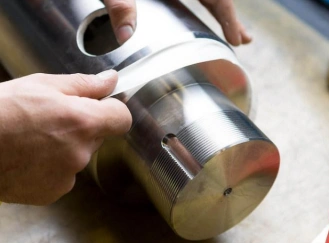
Surface contact conductivity is always considered important when discussing the CNC copper parts, because choosing different surface treatment materials can definitely affect its surface contact conductivity. However, not all paints can make copper parts lose their surface contact conductivity. It depends on surface treatment materials and surface treatment process. During the painting process of copper components, the areas that need to be conductive are typically covered.
Why Are Copper Components often Painted?
Copper is an element that can be used without any problems even in a usual, dry environment, and it cannot be corroded like iron. However, when it comes to an industrial use, where elements are subject to heating, moisture, chemical substances, or salty air.
Copper should be protected in order to ensure its effectiveness and longevity. Painting is the most efficient method of providing such protection for non-contact areas. Here are three main reasons why your engineers may request painted copper pieces.
Copper Easily Oxidizes
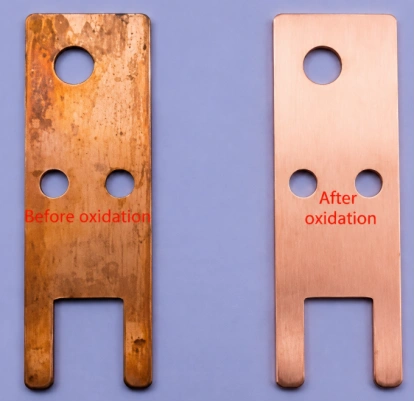
Copper oxidizes through interaction with air in the form of oxygen and moisture, thereby forming copper oxides (Cu₂O and CuO). Under normal environmental conditions, this reaction starts to take place in less than a day after the surface is exposed, especially after machining, since new metal surfaces get exposed. Generally, copper parts are painted to prevent or slow down oxidation because oxidation can lead to surface discoloration or tarnishing. For example, continuous oxidation results in the development of copper carbonate, which appears as green verdigris.
Copper Corrosion in Harsh Environment
Copper has been known to corrode with time, in a very demanding environment, such as marine environment or a chemical processing facility, or in place with high humidity and airborne contaminant. It does not happen in all conditions since copper is very stable in clean dry atmospheres.
However, when chlorides, sulphur compounds or acids are present, pitting and structural failure may occur, especially on thin walled or precision machined parts. The lifespan of components is therefore increased as a paint or coating protects the copper from contact with the environment, which would cause degradation in months if it were unpainted.
What Types of Paint Affect the Conductivity of Copper?
The relationship of copper's conductivity with the coatings will not be the same with all. There are two general types:
- coatings which inhibit surface conductivity altogether
- coatings which are formulated to preserve surface conductivity
It is important before finalising a surface treatment specification, to understand which category the coating belongs to, and the impact that this has on the conductivity of the surface of your particular copper component.
Epoxy Paint
Epoxy paint, a dense, cross-linked polymer film, adheres well to copper, and is highly resistant to chemicals, moisture and mechanical abrasion. These properties make it popular as protective coatings for copper enclosures and in non-contact applications. The same property which makes epoxy so tough, however, is that which makes it so useful as a dielectric.
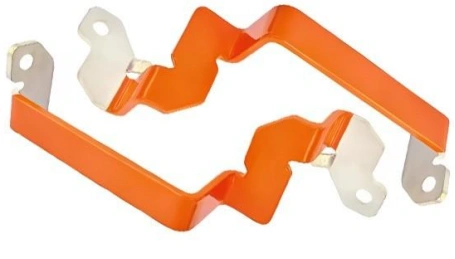
For copper in particular, an epoxy coating increases a surface's resistivity to greater than 10¹³ Ω·m, so that an epoxyized copper surface will not pass current to another part or contact. Epoxy is appropriate when protection is a priority, but can never be used on areas where electrical connection is desired.
Acrylic Paint
Acrylic is a popular paint for copper casings and housing because it won't fade and resists the damaging effects of UV light. Acrylic is electrical insulator on copper surfaces giving a surface resistivity > 10¹² Ω·m, which is equal to the resistance value of epoxy and blocks surface contact conductivity equally well.
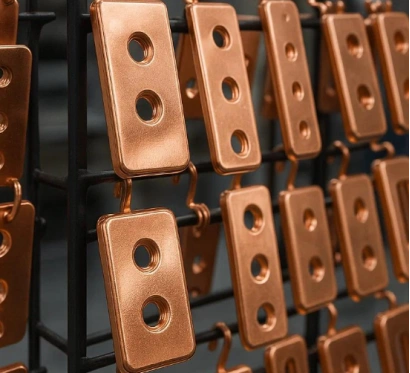
Internal application of acrylic to copper terminals/grounding pads prevents current flow by contact across those surfaces. Therefore, the acrylic can only be used for decorative/protective surface coatings and cannot perform electrical function on copper elements.
Powder Coating
Powder coating is a dry polymer film electrostatic applied and oven cured which results in the formation of one of the thickest and most uniform insulation material available. Powder coating offers surface resistivities in excess of 10¹⁴ Ω·m, which is the highest level of insulation in any common coating type, on copper.
Powder-coated copper surfaces do not have any substantial surface conductivity at all due to the thickness and dielectric strength of the surface. Used for copper electrical enclosures and other applications with a requirement for durability and surface protection. Mask all grounding points, bolt-hole contact faces and terminal pads prior to powder coating.
Conductive Paint
Conductive paint is formulated by mixing metal-particle fillers with a binder, typically a polymer. If applied to copper surfaces, these metallic particles ensure that there is always an electrical pathway through the coating layer, so that surface conductivity can be kept at a useful level. Good conductive paints for 1 mil dry film thickness on copper can provide surface resistances of less than 1 Ω/sq and high EMI values of more than 75 dB in the 30 MHz through 1.5 GHz frequency range.
Painting Copper vs Plating Copper
Plating can also provide better protection and preservation of electrical characteristics than other methods when protection of the surface is desired. The comparison below can help you understand their differences, and then you can know which surface treatment to choose for your copper parts.
Differences in Surface Conductivity
Painting copper is adding a non-metal layer on the copper parts, which can prevent the transmission of current. On the contrary, plating copper is applying a metal layer on the copper parts, which can not only protect the surface of parts, but also keep the normal surface contact conductivity of parts.
Oxidation Protection
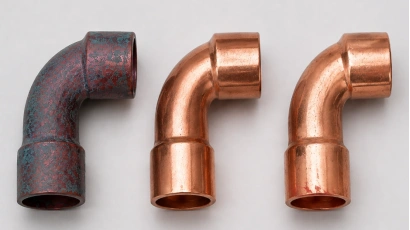
Both painting and plating are effective surface treatment methods for protecting copper against oxidation, however, they protect in different ways. Painting can form a physical barrier to prevent oxygen and moisture, while plating applies a stable protective layer to reduce oxidation. In the same way, both of them can protect copper parts from corrosion while the protecting ways are different.
Processing Difficulty
It's easy to paint copper. Powder coating is second phase coating and scales well in production, but needs electrostatic application equipment and oven curing and can only be applied to most geographies at temperatures of < 200°C. It is the most demanding process with regard to process control (bath chemistry, current density, surface pre-treatment and rinsing) and difficult to apply evenly to complex geometries. Typically, the baseline is painting. Plating is restricted to items where the electrical requirements are there, and volume and cost are not the concern.
The following table shows a comparison of painting vs plating:
|
Comparison |
Painting Copper |
Plating Copper |
|---|---|---|
|
Surface Conductivity |
Lower |
Higher |
|
Oxidation Protection |
Good barrier protection |
Metallic protection |
|
Corrosion Resistance |
Good |
Better in harsh environments |
|
Electrical Contact |
Usually not suitable |
Widely used |
|
Appearance |
More colors |
Metallic finish |
|
Wear Resistance |
Lower |
Higher |
|
Processing Difficulty |
Easier |
More complex |
|
Cost |
Lower |
Higher |
Industries Where Painted Copper Conductivity Matters
Copper is used a lot in industries. A balance between protecting the surface and maintaining the conductivity is important. The designers must decide which parts can should be painted and which left unpainted. Most important of all is to maintain a proper flow of electricity.
Electrical Equipment Industry
Copper is an essential material in switchboards, bus bars and power equipment. Typically, these components will be painted to prevent rusting, where copper must be in contact with other material however, like bolt holes and contact/grounding points, should not be painted. Covering these areas with paint will make it more difficult for electricity to flow, increasing the risk of too much heat and eventual failure of the equipment.
Communication Equipment Industry
For communication equipment, it';s essential that all the seams of an enclosure are capable of conducting electricity across them. This reduces the instances of unwanted signals being received by the enclosure. Normal paint does not conduct electricity. Thus it cannot serve this purpose. The design team uses special copper conductive paint for enclosures such as 5G base stations and radio equipment, to ensure that they work effectively.
EV and Battery System
Copper bars are used to link together different components in batteries for electric cars. These bars are covered to shield from heat and chemistry that occurs within the battery. It is extremely critical that electricity conducts well where the bars attach to other parts. When a significant amount of electric current runs through them the bars will begin to get hot even if they have a relatively small amount of paint on them.
Medical Electronics Industry
For medical applications there are demands for electric shock-proofness of parts. Paints let current to flow inside such parts, but it hinders current flow to the surface.
Does Paint Also Affect Thermal Conductivity of Copper?
Yes, painting copper can also affect thermal conductivity of copper but it is little. The key factor for Copper in thermal management applications, such as heat sinks, cooling plates, and power module housings is to transfer heat very quickly. Any surface coating alters that behaviour and its impact must be considered in tandem with the electrical impact.
Thermal Conductivity vs Electrical Conductivity
At room temperature, one of the highest thermal conductivities of all the structural metals is that of copper, which is about 401 W/m·K. The values for the standard paints range from 0.1 to 0.5 W/m·K. If paint is applied over the copper, a much larger thermal resistance is inserted between the copper and the surrounding. However, the effect on thermal conductivity is not so serious as is the effect on electrical surface conductivity.
Factors Affecting Thermal Conductivity of Painted Copper
Thickness of Paint Layers
The thicker the paint, the greater resistance it will have to the transfer of heat. About 50 to 100 thickness will reduce the heat transfer by 15 to 30 percent from the bare Copper.
Thermal Conductivity of the Coating Material
Several coatings allow various rates of transfer to occur. Normal acrylic or epoxy paint is not a good heat conductor. Some special paints can be mixed with aluminum oxide or ceramic. These work to improve conducting heat. The paints have the capacity to release heat from the surface and give their protection.
Coating Uniformity
If the paint is not applied symmetrically some will not permit the discharge of heat equally. The increased thickness can cause the area to become hotter, thus permitting the part to function less efficiently. More desirable to illustrate in designs the deviation allowed. The thickness of the paint is not to deviate more than 10 microns from the thickness of the paint on a copper heat spreader.
The following table shows the factors thermal effect and their severity.
|
Factor |
Thermal Conductivity Effect |
Severity |
|---|---|---|
|
Paint Layer Thickness |
Thicker coatings provide more resistance to heat transfer |
Good |
|
Coating Material Type |
Polymer coating has a conductivity value ranging from 0.1-0.5 W/m.K compared to 401 for copper |
Very Good |
|
Coating Uniformity |
Irregular coating results in hot spots |
Fair |
How to Ensure the Conductivity of Painted Copper Parts?
Some situations require that copper be both protective and conductive. Although these requirements are not mutually exclusive, they both require process control. It is not just any process control, but deliberate design decisions as well. There are three ways to go about this.
Use Conductive Paint
The rule of thumb is that when surface conductivity of copper parts is needed the coating needs to be conductive itself.
Keep Critical Contact Areas Unpainted
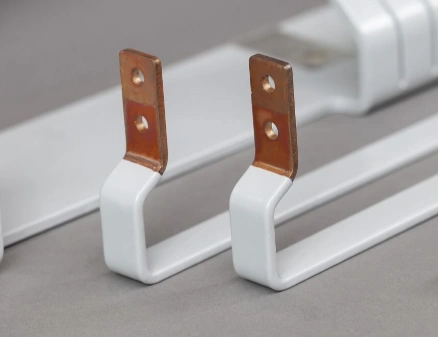
The basic rule is that if the copper part needs to conduct electricity at a contact point, it shouldn't be covered with the insulating coating. Surface conductivity requires direct metal-to-metal contact at the mating surface, and would be interrupted by the presence of any dielectric film at that metal-to-metal boundary. This translates to in-actuality masking you into your surface treatment process. Anywhere there is a terminal, there are grounding pads, bolt-hole contact face, and/or connector interface, they are to be masked prior to the coating process and uncovered after coating is removed.
Control Paint Thickness
The thickness of the paint on copper parts has multiple impacts. Too thick of a coating will thicken up the thermal resistance, which is important in any heat dissipating copper component. Different copper components with protective coating require to have different thickness protection; the thickness of the dry film should be specified in your drawing, usually 25-75 microns for most industrial applications. The target should not be accepted as a process default, but checked against the thermal resistance calculations for copper parts where thermal performance is important.

Can CNC Machining Affect the Coating Quality of Copper Parts?
If the quality of the machining surface is not good, the quality of the coating will be adversely affected. Surface is to be considered by a good CNC machining center. Coatings won't adhere or be long lasting if surface is not prepared properly. To achieve optimal coating performance, it is crucial to have a proper surface treatment at the outset.
Surface Quality Affects Coating Adhesion
Excessively smooth copper surface yields poor adhesion of the coating. If this is too coarse, air bubbles will result and the coating will not cover. When machining copper parts, it is important to avoid the following undesired default:
- Burrs
- Scratches
- Tool marks
- Built-up edge (BUE)
- Coolant residue
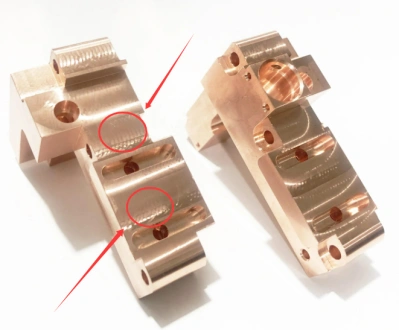
Only keeping good surface quality of copper parts, the paint or coating can be added on the copper parts perfectly, otherwise, the bad painting can have a bad impact on the copper';s conductiveness.
Tuofa Case Study: Balancing Copper Protection and Electrical Conductivity
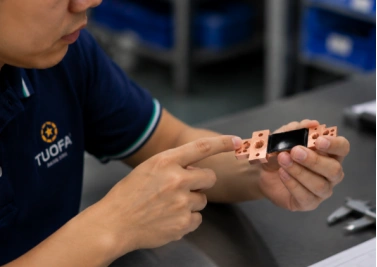
A customer required CNC machined copper components for an electrical application where both surface protection and electrical performance were critical. The copper parts needed a protective coating to prevent oxidation and corrosion during long-term operation, while specific areas had to maintain direct electrical contact.
The main challenge was that conventional paint layers can reduce surface contact conductivity if applied to functional connection areas. The customer needed a manufacturing partner who could not only machine copper parts but also manage the surface treatment process to ensure the right balance between protection and conductivity.
Tuofa provided an integrated CNC machining and surface finishing solution, including surface preparation, masking control, coating application, and final inspection.
Challenges
After reviewing the customer's drawings and application requirements, Tuofa identified two critical challenges:
Protecting Electrical Contact Areas:
The copper components included functional connection areas that required direct metal-to-metal contact. These areas needed to remain bare copper after painting, including:
- Contact pads
- Grounding points
- Bolt connection surfaces
- Threaded holes
- Assembly mating surfaces
Any coating coverage on these areas could increase contact resistance and affect electrical performance.
Maintaining Coating Quality After CNC Machining:
CNC machining could leave surface conditions that affect the final coating performance, including:
- Tool marks on machined surfaces
- Burrs around holes and edges
- Cutting oil and machining residue
Solutions
To achieve the required balance between protection and conductivity, Tuofa implemented a controlled manufacturing process:
Recommended Epoxy Coating
Based on the copper material, operating environment, and electrical requirements, Tuofa recommended epoxy paint coating for the non-contact areas of the copper components.
Controlled Coating Thickness
Tuofa controlled the coating thickness within 20-50 μm (0.8-2 mil) to provide reliable oxidation and corrosion protection without creating unnecessary coating buildup on functional areas.
Quality Inspection
Two full quality inspection before and after surface treatment. Tuofa performed full inspections and surface preparation to remove:
- Machining oil
- Metal particles
- Burrs
- Surface contaminants
Without proper surface preparation, these issues could reduce coating adhesion and create uneven finishes.
Conclusion
Application of coating on copper does not stop the transfer of electricity; however, after the coating, you don't have a good contact surface for electricity. Therefore, if some parts of the copper need to conduct electricity on its surface, you should not cover them. Given the selection of coatings, consider either epoxy or powder coating to shield the copper from damage; if you must be able to conduct electricity, consider conductive paint. Be sure to have the right paint consistency and ensure that the substrate is properly prepared to accept the paint and that the size is correct.
FAQ
What kind of paint sticks to copper?
Epoxy paint adheres easily to copper since it has a strong bonding ability with the metal. Performing these steps correctly will make acrylic paints effective as well.
Do you have to prime copper before painting?
Yes. Copper is very smooth and paint does not adhere well. Make sure to use a special primer for copper to make it adhere to better.
Is copper 100% conductive?
No, Copper is not 100% conductive.One of the best metals for conducting electricity, gold is surpassed by silver. Copper is the standard to compare the electrical conducting properties of different metals.Silver is about 5% superior to Copper though.
 Europe’s Heatwave: High-Temperature CNC Part Design Guide