Tel/WeChat:
  Email:


 Home
HomeWhy Fretting Wear Occurs and How Precision Machining Mitigates It?

 Published:Oct 09,2026
Have you wondered why certain assemblies lose their fit over time? Everything appears to be normal. But fretting slowly and steadily eats away material. The problem is not just that. If it is accompanied by fatigue, then it becomes way more detrimental. All of it can be mitigated by precision machining. Let's discuss this topic in detail.
What Is Fretting Wear?
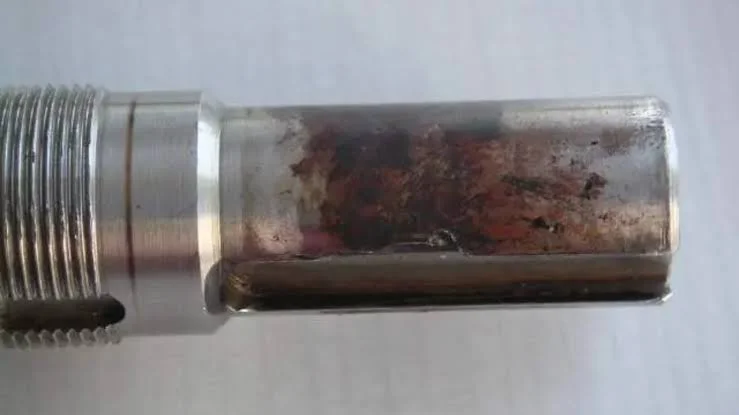
Fretting wear is a form of surface wear. It occurs with a sliding motion of a small amplitude between contacting surfaces. This motion is common in mechanical parts subjected to cyclical loading or vibrations. A relative micro-movement present even in stationary parts can cause fretting.
How Fretting Wear Occurs
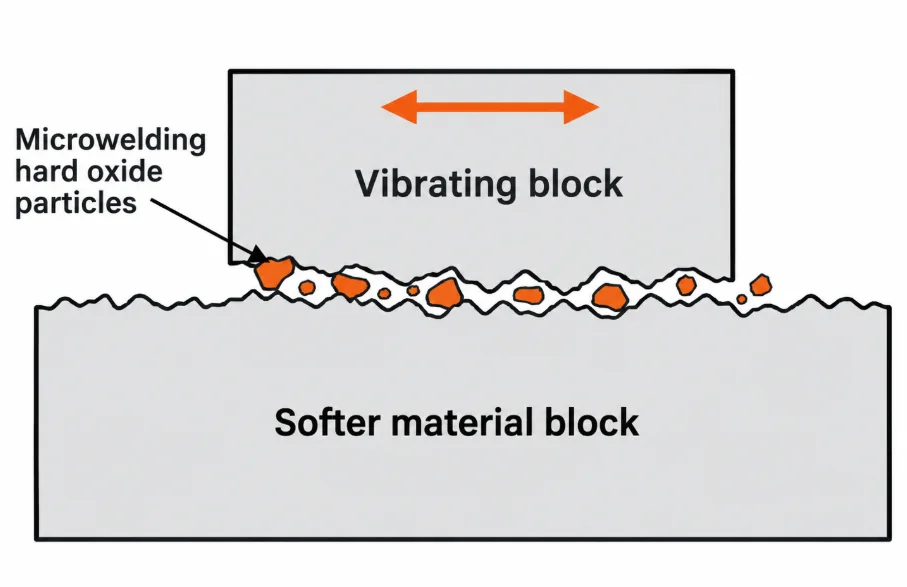
Fretting begins on mating surfaces undergoing a cyclic micro-motion. At contact locations, asperities form due to sticking and tearing action. When they rub against each other, small debris forms. These particles can oxidize giving rise to the term “fretting corrosion”. Surface damage and subsequent movement may alter the original fit of the parts.
Fretting Wear vs. Normal Sliding Wear
In normal sliding wear, the relative movement between surfaces is continuous and large. On the other hand, fretting occurs with a much smaller oscillatory movement. The following table shows the basic differences:
|
Features |
Fretting Wear |
Normal Sliding Wear |
|---|---|---|
|
Movement |
Small amplitude oscillation |
large amplitude sliding |
|
Cause |
Vibration and alternating loads. |
Sliding motion |
|
Contact |
Loaded contact |
Normal sliding contact. |
|
Debris |
Oxidized fine debris
|
Debris in various shapes. |
|
Applications |
Fits, bearings, spline, joints |
sliding guides, seals and bushings |
Fretting Wear vs Fretting Fatigue
In fretting wear, only the surface gets worn out. In contrast to it, in fretting fatigue, crack initiation sites are formed due to fretting. During cyclic loading, these cracks propagate and grow until the part fails by fatigue. Fretting may be responsible for fatigue crack initiation under stresses lower than those in similar stress situations.
How to Identify Fretting Wear
Early identification can optimize contact conditions before fretting causes dimensional changes. Check both the exposed surface and the assembly's operation. These are some common signs that can be seen during failure analysis.
Oxidized Wear Debris
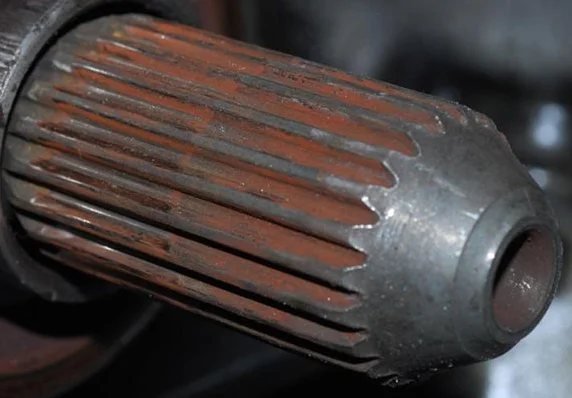
The metallic particles formed due to fretting tend to oxidize in the atmosphere. In steels, red or reddish-brown particles around an interface fit point towards fretting corrosion. Other materials may result in other debris colors and compositions. Another example is aluminum, where debris particles are black in color.
Localized Surface Damage
Fretting generally does not damage the entire contacting areas. It has a localization characteristic. Darkened areas, small pits, grooves, or polished zones indicate fretting-induced damage. It happens due to stress concentration in localized zones.
Loss of Fit and Joint Stability
A fitted shaft, sleeve, hub, or bearing seat may change its initial contact relationship. Looseness, excessive clearance, or loss of positional stability can be consequences of fretting.
Fretting-Induced Fatigue Cracks
Cracks can indicate a more severe condition. Cracks at the fretting location can occur due to fretting fatigue. So, check the fretting-damaged region for evidence of cracks. It is not always just “cosmetic surface damage.”
Where Does Fretting Wear Occur in Machined Assemblies?
Fretting wear doesn't only occur in interference-fit joints. Fretting may happen where two parts are supposed to fit together, and there is some interference when there is vibration or some variation in loading of the components. Below are the most typical mating interfaces in CNC-machined assemblies.
Cylindrical Fitted Interfaces
Cylindrical fitted interfaces are common in shafts, hubs, gears, bushings, sleeves and bearing seats. The components are supposed to rotate relatively in a cyclic manner. Vibration may create local micro-slip along the cylinder contact surface, generating oxide debris. Uneven contact may result in increased localized pressure in certain areas on these interfaces. This gives rise to fretting in these regions.
Torque-Transmitting Interfaces
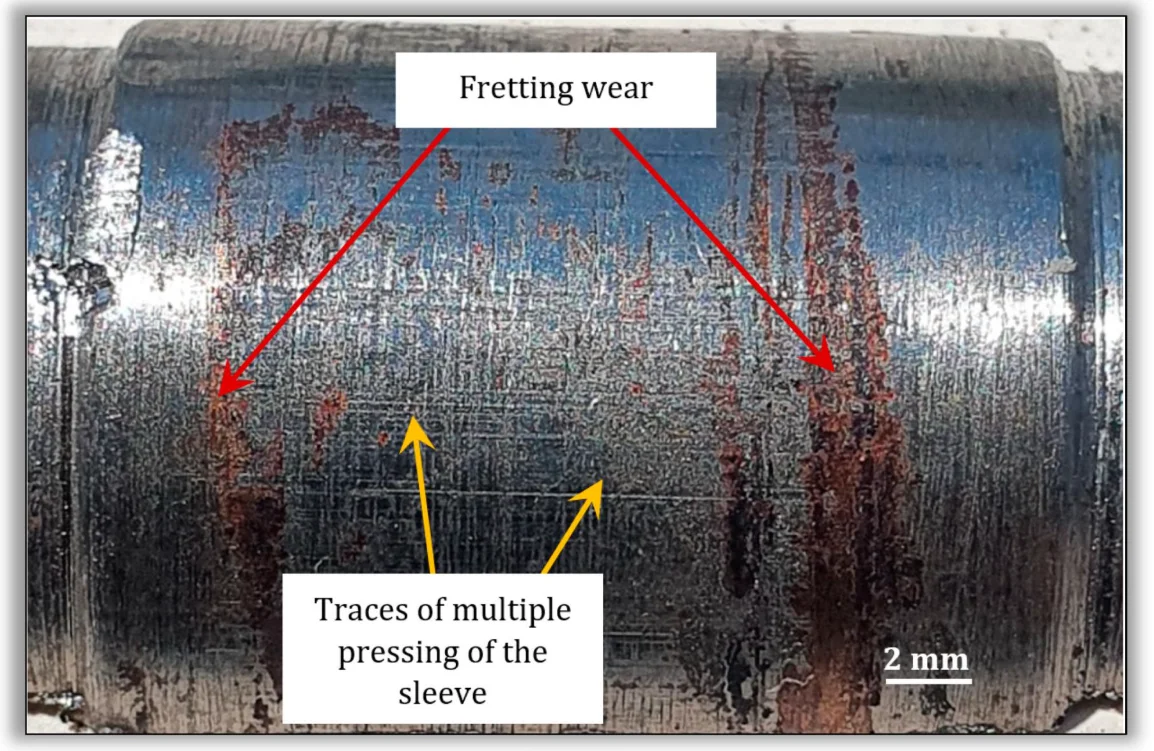
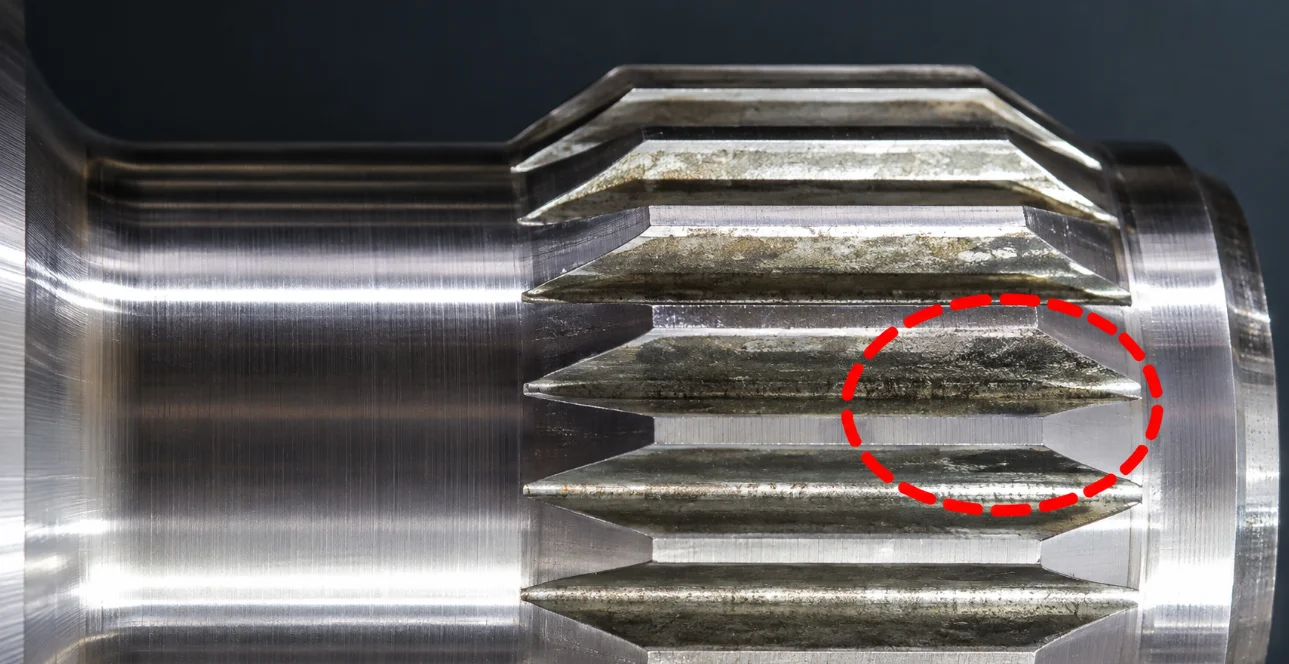
Fretting can be expected on torque-transmitting interfaces. Repeated micro-motion between mating surfaces can be caused by alternating torque. Since these parts are loaded, they fulfil all conditions conducive to fretting. Common torque transfer connections are on splines, keys, couplings, and gear-shaft connections, etc.
Bolted and Clamped Interfaces
In general, bolted and clamped interface are considered to be static. However, the micro slipper can occur between flange faces, washer contact surfaces or clamp plates under vibration, leading to fretting wear. For fretting to occur, the clamping forces are insufficient to inhibit vibration-induced small relative motion. On top of that, contact pressure, joint stiffness, and preload affect the fretting magnitude.
Locating and Support Interfaces
Locating interfaces such as pilots, shoulders, binary face location, and support surfaces can suffer from fretting. These surfaces bear static preload and cyclic dynamic loads. Excessive runout, burrs, machining marks, or poor flatness on a locating surface can prevent the load from being distributed evenly.
What Factors Affect Fretting Wear?
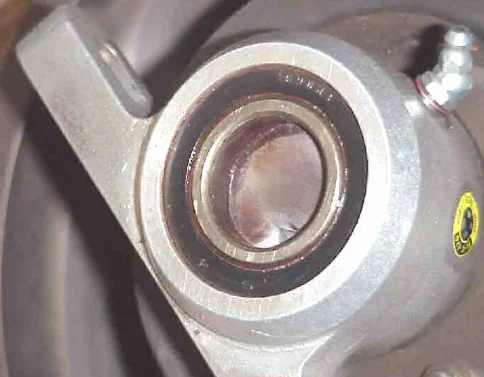
Engineer should not pay attention to materials section or fit selection only. There is not a single parameter that can control fretting. The final behavior is dependent on several factors such as fit, the quality of machined surface and geometry, material, loading, vibration, and environment play a critical role.
Fit Tolerance
If fit is too loose, it can allow relative movements easily, which creates severe fretting wear. If the fit is appropriately tight, the chances of fretting are too few. However, too high interference can lead to higher residual stress, which may cause cracking. Therefore, optimize fit tolerance properly can prevent the mating surfaces from overstressing.
Surface Roughness and Microtexture
Surface roughness is of high importance in the context of fretting. A rough surface might have fewer real points of contact. Surface peaks and troughs may be deformed or broken if repeated micro-motion is carried out many times.
Any defects like machining marks, peaks or valleys on the surface can cause uneven surface. It means that the highest point on the surface will withstand nearly all the contact load. After long-term cyclic micro movement, the top point can deform, break off and form wear debris. Therefore, reduce surface roughness allow the mating interface bear average contact load.
Geometric Tolerances
Geometric tolerance like cylindricity, roundness and flatness are the important factors affecting fretting wear. Once one of them is wrong, even with a correct interference, the fretting wear still happen due to uneven contact load.
Material Pairing
Material pairing can effectively influence fretting performance. In fact, the fretting wear between two hard materials is worse than that between a hard and a soft material. That is because, the brittle oxide debris generated between hard metals can further damage the adjacent surfaces, while the soft and hard metal assembly can suppress fretting by accommodating micro movement.
Load and Vibration Frequency
Vibrations create micro-motion at contacting interfaces. Vibratory motion can become unnoticeable at times, but it's still detrimental. If the magnitude of load is high, it will create high local stresses. Slowly and steadily, it damages parts by fretting or even fretting corrosion. Vibrations tend to spill out any lubricants. So debris is exposed to the atmosphere, leading to fretting corrosion.
Environmental Conditions
Environmental conditions such as humidity, presence of chlorides, exposure to dust, and temperature affect fretting rate. The micro movement metals can cause oxidation of metal surface and then fretting wear happens.
- Dry environments can produce harder abrasive oxide particles.
- High humidity may alter oxide composition and wear rate.
- Dust or particles entering the contact interface will further accelerate abrasive wear.
Can Surface Coatings Prevent Fretting Wear?
Certain surface finishes help minimize fretting damage. The type of surface treatment is dependent upon the type of substrate. The geometry and surface conditions prior to coating are also important. As an example, a poorly cast interface cannot be fixed with a coating. The coating may still show localized stress if the substrate is not well shaped or leads to uneven contact.
Nitriding
Nitriding treatment can harden certain grades of steel. It improves surface hardness and load-bearing ability. Nitriding modifies the surface such that scratching and clinging become difficult. These factors inhibit fretting.
PVD Coatings
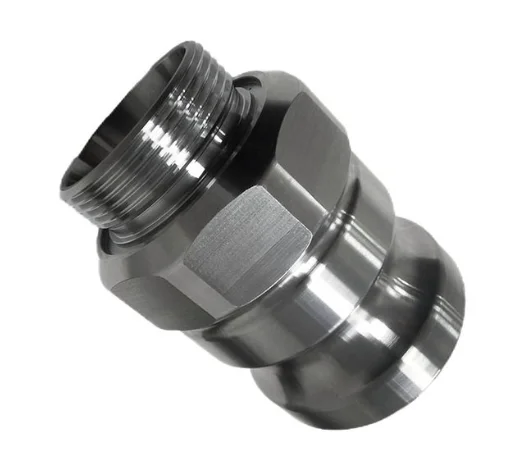
PVD treatment creates a thin and hard coating over the surface. These coatings provide substantial improvements in fretting. The surface becomes very smooth such that surfaces slide smoothly instead of aggressive rubbing. The enhanced hardness resists against scratch. Moreover, PVD coatings are aesthetically superior to other coatings.
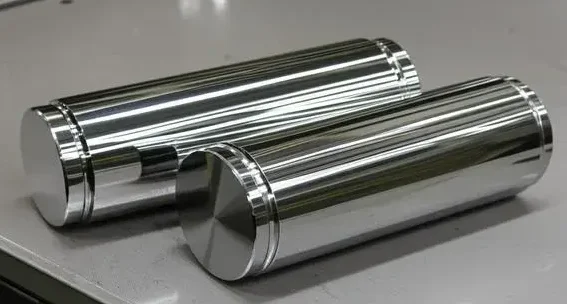
Hard Chrome Plating
Formed parts can be subjected to hard chrome plating. A hard layer of chromium oxide forms over the steel substrate. In addition to improvement in hardness, this plating provides corrosion resistance. However, this plate is brittle and easy to delaminate.
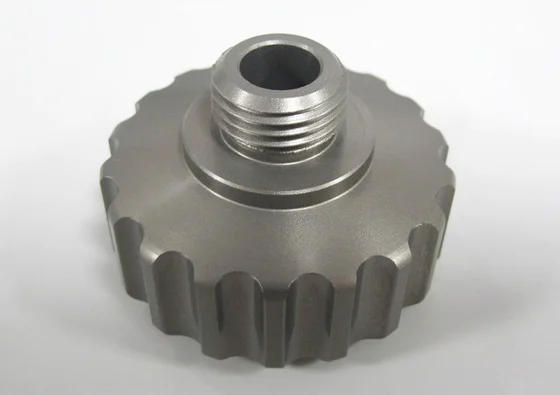
Hard Anodizing
Hard anodizing is mainly done on aluminum parts. This coating is generally thin and hard. However, it hardly withstand concentrated contact stress. That is to say, if the surface of the part is uneven, the coating of the top point can be crushed under vibration and load.
The following table shows a clear difference between these processes:
|
Treatment |
Applications |
Benefit |
|---|---|---|
|
Nitriding |
Shafts, gears and sleeves |
Hardens the surface to prevent sticking and scratching |
|
PVD Coatings |
Wear-resistant surface coating for many common substrates |
Thin but hard surface layer |
|
Hard Chrome Plating |
To improve steel wear resistance |
Wear and corrosion protection |
|
Hard anodizing |
Aluminum components |
hardness enhancement |
How Can CNC Machining Reduce Fretting Wear?
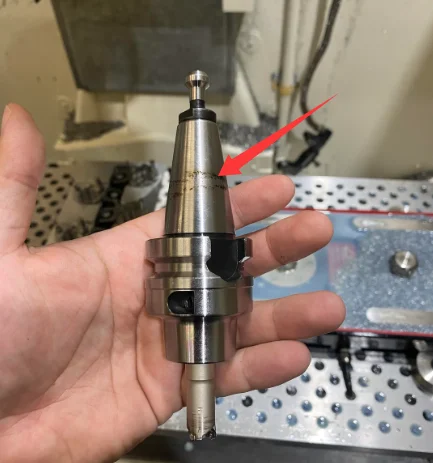
Whether the surface finishes can make effect depends on the machining quality of parts. CNC machining can effectively reduce fretting wear between metal parts by improving machining precision, flatness of surface, accuracy of tolerance.
Customize Fit Tolerances
CNC machining allows fit tolerance customization. It can achieve stable strict control for interference and clearance. The accurate fit can keep the contact surface bear uniform pressure.
Control Surface Roughness
Surface roughness control is good in CNC manufacturing. As per specifications, the desired Ra value can be attained. The tool marks on the surface of metal parts can be removed during check and cleaning process after machining, which can reduce fretting risk.
Control Geometric Tolerances
Cylindricity, roundness and flatness are critical to avoid fretting wear. And they should be controlled simultaneously.
- Cylindricity: Bad cylindricity can create wavy surface, partial line contact and scattered high spots under interference fit.
- Roundness: Poor roundness can lead to discrete peaks, which can accelerate fretting wear.
- Flatness:Bad flatness can cause uneven axial contact and local stress concentration on clamped interfaces.
When machining metal parts, it is important to pay attention to clamp because clamping distortion can create local high spots, which is the starting point of fretting. As for critical mating cylinders, CNC turning and final precision grinding are applied to minimize part deformation.
Improve Surface Quality
Surface quality of CNC-machined parts is better than that of parts manufactured by other processes. It is possible to eliminate features that promote fretting. Surface defects like burrs, sharp edges, etc. can be removed. As the process is fully automated, instances of defects like embedded chips, tool impressions, and scratches are minimal.
Common Misconceptions About Fretting Wear
Common misconceptions about fretting are partly true. They are applicable in some situations but not all.Some of these misconceptions are discussed below.
Harder Materials Always Provide Better Fretting Resistance
Harder materials generally resist fretting. But that is not a universal law. Two metals with high hardness can more easily lead to fretting wear because of the generated abrasive between the two interfaces.
Tighter Fits Always Prevent Fretting
In some assemblies, interference fits might completely eliminate motion. However, fit is not the only factor affecting the fretting performance. Tighter fits can reduce fretting wear, but it doesn't mean that tighter fit is always good. Because tighter fit can lead to higher residual stress, and finally leading to cracking.
Fretting Wear Is Only Minor Surface Damage
Fretting appears to be a small surface damage, but its impact is way more than cosmetic detriment. Fretting alters fit stability and generates wear debris. Fretting creates sites for fatigue cracks. It can drive fatigue cracking under conditions where normal fatigue behavior would not.
Case: Reducing Fretting Wear in a Custom Hub and Sleeve Assembly
The dedicated engineering and machining teams at Tuofa CNC strive to find solutions without unnecessarily bothering clients. Here, we provide a case study to explain it better.
A customer ordered parts for a hub and sleeve assembly. He gave full details pertaining to that order, including the drawing, material, interference fit, and assembly method. Before coming to us, those parts made by some other supplier showed fretting signs like gray-black debris, darkened contact surfaces, and gradually reduced fit stability. The main objective of the customer was to improve fit stability without changing specifications.
Our engineering team noted that low cylindricity exerts uneven stresses in mating regions. We also noticed that excessive surface roughness was promoting fretting wear. We optimized the process parameters as per the table below. The result was a long-term fit stability and greater durability.
|
Parameter |
|
|
||
|---|---|---|---|---|
|
Cylindricity |
0.025 mm |
0.008mm |
||
|
Surface Roughness |
Ra 1.6 µm |
Ra 0.4 µm. |
Fretting prevention doesn't necessarily need material or design change. For some assemblies, the current design may be kept. Only the dimensional accuracy and surface quality may be enhanced.
Conclusion
Fretting wear is caused by small amplitude movements between loaded surfaces. Vibration, slip amplitude, load, and surface quality can affect fretting wear. Optimization of fit tolerance, geometry, surface roughness and material can improve fretting resistance. A lack of accuracy in geometric features such as cylindricity and roundness can result in uneven contact.
FAQ
Can increasing interference fit eliminate fretting?
Not necessarily. A higher interference may lead to a lower relative movement. But it might not eliminate the fretting problem in every situation.
What part designs help reduce fretting?
Parts with stable contact, controlled load distribution, and adequate joint stiffness are expected to reduce fretting.
What is fretting fatigue?
Fretting can create sites for the initiation and growth of fatigue cracks. This fatigue failure can occur at stresses and number of cycles below the normal range.
 CNC G76 Threading Cycle: Programming Guide