Tel/WeChat:
  Email:


 Home
HomeGolf Putters CNC Guide: Why Choose Milled Putters?

 Published:Jan 08,2026
Golf is one of the most expensive games. It is not as common as cricket and football, but it is common in Europe. There are three essential pieces of equipment in golf: golf balls, a golf flag, and multiple types of clubs. Other accessories include tees, ball markers, and gloves. This article focuses on one type of club, i.e., a putter. To be more precise, golf putters are discussed in depth in this article.
What Are Golf Putters?
Golf putters are one of the clubs used in the golf game. To hit the golf ball or direct the ball into the goal port, golf putters are used. In the following figure, it is shown how a putter is used in golf.

Modern Golf Putters Differ from Traditional Designs
The main difference between modern golf putters and traditional golf putters is the materials and machining. Now the focus is on using the best material, which is flexible, lightweight, and shows high strength. Traditional golf putters are heavy and have some machining flaws. The brands, such as Odyssey, Scottycameron, or TaylorMade, now rely on stronger and lighter materials, like Titanium. For machining, they use Computer Controlled Numerical (CNC) operations.
Functions of Golf Putters
The primary function of golf putters is to precisely hit the ball into the goal port. Golf putters are not useful for powerfully stroking the ball. Its functions are strategic, which include:
- Simply roll the ball, not lifting it
- Used for short-distance rolling with precision
- Provides accuracy in directing the ball
Types of Golf Putters
Golf putters are clubs used in golf. These golf putters are of different types, which differ from each other mainly due to the materials, machining methods, and design. The main types include milled, insert, forged, and cast putters.
Milled Putters
Milling is a CNC (Computer Numerical Controlled) operation that is used to manufacture parts with high precision, tight tolerances, and dimensional accuracy. To increase reliability and remove the machining flaws in the golf putters, a milling operation is used. Milled putters are manufactured using the milling operation.
Insert Putters
In these putters, the face material is different than the other material in the putter. It means the insert putters are not one-piece metal but have a different material, like a polymer embedded at the face of the head of the putter.
Cast Putters
Casting is a simple manufacturing method in which parts are produced by melting the metal and pouring it into the molds of the required designs. Cast putters are made through the casting process. These are cheaper putters. The casting process allows the manufacturing of complex shapes.
Forged Putters
Forging is a method of manufacturing components in which a red-hot metal block is placed on the mold of the required design, and a hammer strongly hits the metal. Forging provides a dense and uniform grain structure.
Differences: Milled Putters and Other Types
The previous section was about the general discussion of the golf putter types. This section highlights other main differences among milled, insert, cast, and forged milled putters.
Milled Putters vs Insert Putter
A milled putter is more efficient than an insert putter in terms of feel, consistency, and maintenance. The insert putter is softer and mute compared to a milled putter. Other main differences include:
|
Feature |
Milled Putters |
Insert Putters |
Best For |
|---|---|---|---|
|
Face Construction |
Solid metal face |
Soft insert face |
Preference-based choice |
|
Feel |
Firm, crisp |
Soft, muted |
Feel-sensitive players |
|
Consistency |
Uniform across face |
Insert-dependent |
Distance control seekers |
|
Maintenance |
Very durable |
Insert may wear |
Long-term ownership |
Milled Putters vs Cast Putters
The biggest difference between the milled putters and cast putters is the manufacturing method and its related aspects, such as tolerance, surface finish, and casting. A milled putter is manufactured using a CNC milling operation, while cast putters are made through a casting process.
|
Feature |
Milled Putters |
Cast Putters |
Best For |
|---|---|---|---|
|
Manufacturing |
CNC machined |
Mold-cast |
Precision-focused golfers |
|
Tolerances |
Very tight |
Moderate |
Consistent setup |
|
Finish Quality |
Premium |
Basic |
Visual confidence |
|
Cost |
High |
Lower |
Budget-conscious buyers |
Milled Putters vs Forged Putters
The primary difference between milled and forged putters is the freedom to design with respect to machining. Milling offers more freedom in developing compared to forging.
|
Feature |
Milled Putters |
Forged Putters |
Best For |
|---|---|---|---|
|
Process |
CNC milled |
Compression forged |
Preference in build method |
|
Grain Structure |
Random |
Aligned |
Feel-focused players |
|
Feel |
Firm, precise |
Soft, smooth |
Touch-oriented putting |
|
Design Freedom |
High |
Limited |
Custom head designs |
Advantages of Milled Putters
Milled putters are manufactured through a CNC operation, i.e., milling. CNC operations are automated, which ensures high-quality, flawless machining to enhance the accuracy in directing the golf ball and making it feel better. Milling operations have some advantages, including refined aesthetic appearance and engineered face milling. Below we will explore the unmatched advantages of milled putters.
Excellent Precision
Precision means achieving the level of machining accuracy with respect to tight tolerance. The precision is all about how golf putters are machined without any flaws. Milling operation provides excellent precision for:
- Extremely low swing speed and short distance
- Face angle sensitivityat impact
- Consistent loft for proper roll
Consistent Quality
Consistent quality means how the golf putters are machined flawlessly in batch production. Milling, which is an automated CNC operation, provides flawless machining for a batch production of golf putters.
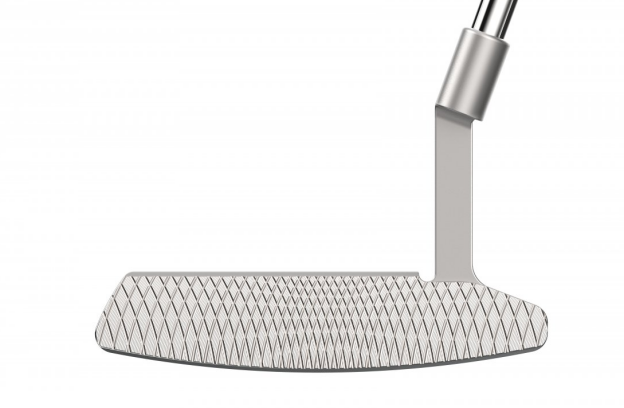
Intricate Surface Milling Patterns
The following figure shows the complexity of the intricate surface of a golf putter. This complex design cannot be machined with traditional machining operations. To make such an intricate surface, the engineered face milling operation stands tall with its machining precision.
Materials for Milled Putters
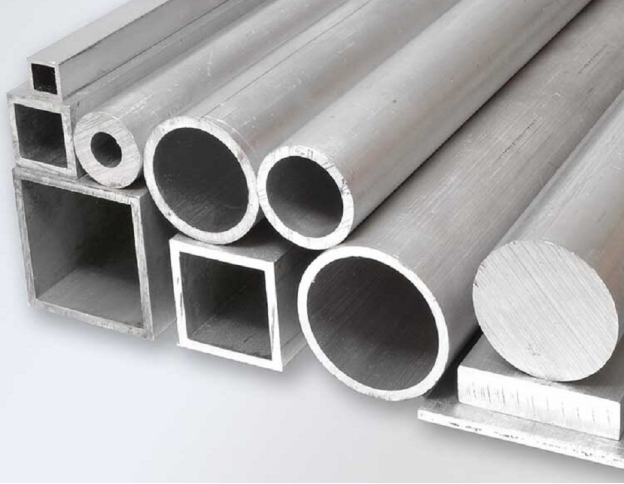
There are too many options of materials for milled putters. These materials are different based on machinability, strength, weight, and stroking impact. This section discusses four important materials, i.e., stainless steel, titanium, aluminum, and carbon steel.
Stainless Steel
Stainless steel milled putters are available in multiple grades, such as 303, 304, 17-4PH, 416, and 420. Stainless steel is an easy-to-machine material with respect to golf putters:
- 416 for firm feel with easy machining
- 17-4 PH stainless steel for high-volume production
- 303 stainless steel for a premium milled feel and precision
Carbon Steel
For carbon steel putters, 1020 and 1045 carbon steel are common. The main difference in these grades is the carbon content in the composition. One has 0.20% C, and the other has 0.45% C, so the strength and hardness are different. For a buttery feel, 1020, and for durability, 1045 carbon steel is used.
Aluminum Alloys
Aluminum material is known for its light weight, corrosion resistance, and decent strength. The Al alloys used in the golf putters include 7075, 6061, and 6082 aluminum.
- For high-strength and crisp-feel components of a golf putter, 7075 is used
- For a stiffer body, 6082 is used
- 6061 is used for a balanced and soft feel
Titanium Alloys
Titanium putters are the premium putters used in golf. Titanium has many alloys, but the most common alloy is Ti-6Al-4V. This alloy provides high strength, a premium feel, and a lighter weight.
Challenge of CNC Milling Putters
The machining of any component or part depends on the type of design and the material's machinability. These challenges can be different, like complex geometry, strict dimensional tolerances, and thermal deformation. For boutique milled putters, these are the challenges:
Complex Geometry
The geometry of the milled putters is complex, as shown in the above figure. For such complex geometries, higher advanced technology is required. CNC multi-axis machining makes it easier and more precise.
Strict Dimensional & Tolerance
The parts of a milled putter, such as lie angle, loft angle, center of gravity location, putter face, etc., require strict control over dimensional tolerance. These parts need higher accuracy in dimensions and surface. CNC machining makes it easier to achieve such a tight tolerance, i.e., 0.01 mm.
Material Challenges
The machinability of all materials is different; Ti alloy is very difficult to machine due to its hardness. This high hardness leads to rapid tool wear and slow machining speed. Traditional cutting tools can't machine such materials, but CNC machining makes it easier.
Thermal Deformation
The materials, such as Ti alloys, have high hardness, which becomes a cause of tool wear. The concept behind this tool wear is thermal deformation. The prolonged cutting generates heat, which further causes minor deformation in tools.
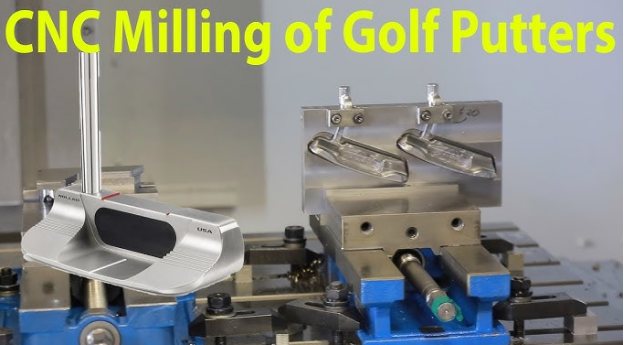
Custom Milled Putters Easily
Some golf putters are customized according to special requirements, like getting a premium feeling while lofting the golf ball. Some need special faces of putter heads, so custom machining is required. For custom machining, CNC machines play a vital role.
When You Need Custom Milled Putters
You may need customization in different milled putters, such as:
- Customization in head shape, MOI for consistent face control
- To resolve speed control problems
- Height, posture, and grip style may require some customization
- You may need a change in sound and impact feel, so the material can be customized here
- Customization may be needed for stroke type mismatch. It adjusts parameters, like toe hang, face balance, and hosel type.
Advantages of Custom Milled Putters
The advantages of custom-milled putters depend on the part that is being customized. For instance:
- By customizing head shape, CG placement, and control over face rotation or stability is improved.
- To resolve the issue of distance inconsistency on long or short putts, face milling and head weight are customized.
- Customization of topline thickness, sight lines, or dots improves alignment.
What Are Soft Milled Putters?
Some players may not like the sound of the stroke or impact sound, so advanced soft-milled putters are introduced. These soft-milled putters are different from simple putters. Soft-milled putters are made of soft metals. The second difference is about CNC machining; face-milling patterns are designed in a way that they produce a muted impact feel and sound. In simple terms, soft-milled putters provide a good feeling and good distance control over durability.
How to Machine Soft Milled Putters?
Soft-milled putters are not made through the ordinary milling process, but it needs special control over impact vibration, contact time, and energy transfer. Only control over the shape is not enough in the case of soft-milled putters. The machining of soft-milled putters includes the following steps:
- Deeper face milling to reduce surface stiffness
- Fine cutter path spacing to damp vibrations
- Lower face thickness for elastic deformation at impact
- Low feed rate and high spindle speed to prevent work-hardening and surface damage
- Sharp and high-quality cutters to reduce residual stresses
Hard vs Soft Milled Putters
When a player switches from hard-milled putters to soft-milled putters, he notices multiple differences, such as impact feel, ball speed, and vibration.
|
Aspect |
Hard Milled Putters |
Soft Milled Putters |
What Players Notice |
|---|---|---|---|
|
Face Milling |
Shallow / minimal |
Deep / aggressive |
Sound and click at impact |
|
Impact Feel |
Firm, sharp |
Soft, muted |
Confidence on short putts |
|
Ball Speed |
Faster off face |
Slightly reduced |
Distance control on fast greens |
|
Vibration |
High-frequency |
Damped |
Hand comfort and feedback |
Tuofa CNC Milling for Golf Putters
In golf, putters are an important part of the game because of their functions, such as directing the ball to the hole, etc. To solve the issues, such as precision and accuracy in achieving the tolerances, CNC machining is very important. Tuofa stands tall with the most advanced CNC machines and expert operators. At the Tuofa, you will get the following things:
Review and Optimize Design
Tuofa assists its customers in reviewing and optimizing the design. This assistance leads to achieving good performance in golf.
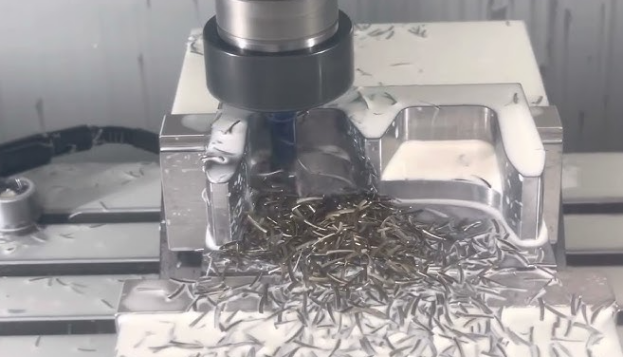
Perform Precision CNC Milling
Each point on the golf putter is very important, and precision is required in machining. Tuofa performs CNC machining with high precision in the production of golf putters.
Conduct Post-Processing
Post-processing of any part plays a key role in its performance. Tuofa conducts post-processing to avoid any type of machining errors. That flawless machining enhances the performance of a golf putter.
Strict Quality Inspection
Tuofa is equipped with the most advanced inspection machines. These machines include:
- Coordinate Measuring Machine for dimensional and geometricinspection
- Digital angle gauge to inspect anglesand alignment inspection
- Surface roughness tester for the inspection of surface finish
- Coating thickness gauge for analyzing coating thickness
- MOI measurement system for mass and balance inspection
Conclusion
Golf putters are an important part of golf, which are used in directing or stroking the ball towards the hole with precision. Milled golf putters are advanced putters that enhance performance by making the feel good and controlled speed while lofting the ball. Soft-milled golf putters are a type of milled putter that are made especially to reduce the sound while hitting and provide impact feedback. A CNC milling operation excels in achieving precision and dimensional accuracy for golf putters.
FAQ
Are milled putters better?
Yes, because milled putters are made through CNC milling operation which means it provides higher precision and accuracy in directing and lofting the ball.
Is face milling important for putters?
Face milling is an important operation for golf putters to produce a flat, smooth, and accurate surface.
What is CNC milling machine?
A CNC milling machine is an automated machine that is used to manufacture complex geometries components with high precision.
 On-Machine Inspection in CNC Machining: A Mechanical Inspection Guide