Tel/WeChat:
  Email:


 Home
HomeWhat Is Ductility of Materials? Important Guide for Manufacturing

 Published:Mar 04,2026
When a material is employed for any application, it is selected based on its chemical composition, physical, and mechanical properties. These properties matter from manufacturing to service life. For instance, a material with a rough surface will fail earlier due to fatigue than a fine surface material. Ductility is one of the core mechanical properties of a material, which is important from machining to service life. This article uncovers each aspect of ductility in detail. So, let's start:
What Is Ductility?
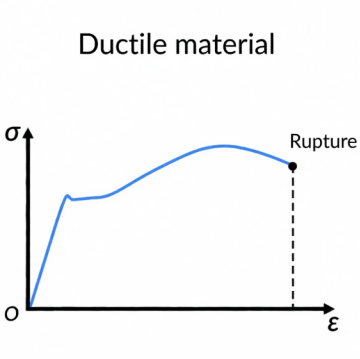
Ductility is a mechanical property of a material. Every material, regardless of metals, polymers, etc., exhibits this property. Basically, it means the plasticity a material can show to its maximum. Its more precise definition is how much a material can stretch to its maximum. It is quantified in elongation% or reduction in area%.
Can Ductility Affect Parts Manufacturing?
Yes, ductility has a significant impact on the manufacturing or machining of the parts. For instance, a rubber is a very ductile material; it shows a lot of plasticization under tensile stress, but can't be manufactured using machines. On the other hand, a mild steel workpiece shows relatively lower ductility than the rubber but is easy to machine.
So, the ductility actually affects the manufacturing with respect to the strength of the material. A highly ductile material will have lower strength, so the difficult to machine.
Is Ductility the Same as Plasticity?
Ductility and plasticity are quite close terms, but not exactly the same.
- Plasticitymeans a permanent deformation of a material under stress before fracture. Load can be tensile or compressive.
- Ductilitymeans the maximum elongation a material shows under tensile stress before fracture.
What Are Important Levels of Ductility?
The levels of ductility depend on the material's nature and the environment. Some materials, such as rubber, show higher ductility, and some exhibit low ductility, such as cast iron. So, let's discuss its levels:
What Is High Ductility?
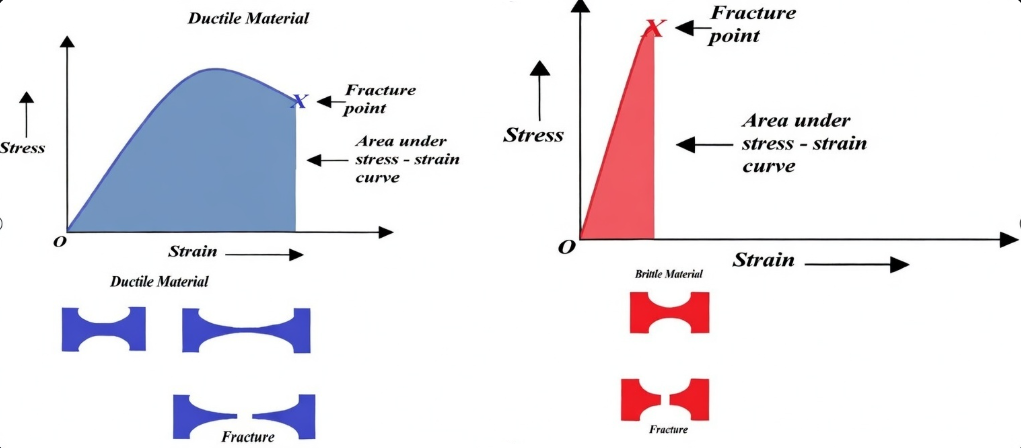
If a material exhibits higher elongation (>20%) or reduction in area, it means high ductility. For instance, annealed copper shows ~40% and mild steel shows 25% ductility, so they are highly ductile materials. Their ductility even more increases when the temperature rises.
What Is Low Ductility?
If a material shows <5% ductility, it is considered a lower ductile material. An example can be a cast iron. It has higher strength but shows little plastic deformation. Its necking is not very clear compared to highly ductile materials.
High Ductility vs Low Ductility
The following table briefly summarizes all the differences between high and low ductility:
|
Parameter |
High Ductility |
Low Ductility |
|---|---|---|
|
Elongation (%) |
High (e.g., >15-20%) |
Low (e.g., <5-10%) |
|
Reduction in Area |
High |
Low |
|
Fracture Type |
Ductile fracture (cup-and-cone, necking present) |
Brittle fracture (flat surface, no necking) |
|
Energy Absorption |
High (tough material) |
Low (brittle material) |
|
Crack Propagation |
Slow, stable |
Fast, unstable |
|
Formability |
Good (bending, drawing possible) |
Poor (cracks easily) |
|
Warning Before Failure |
Yes (visible deformation) |
No sudden failure |
|
Example Materials |
Mild steel, copper, aluminum |
Cast iron, glass, hardened steel |
What is the Difference between Malleability and Ductility?
Both are related and important mechanical properties with respect to manufacturing. In both concepts, material deforms under stress. But there are certain different parameters for both concepts:
Stress Type
For ductility, tensile stress is applied. The material deforms till the fracture under tensile stress.
For malleability, compressive stress is applied, and the material deforms without easy cracking.
Material Behavior
The biggest difference in malleability and ductility is necking. Due to tensile stresses, necking occurs, but in compression, there is no necking. Other differences in the behaviour are:
|
Aspect |
Ductility |
Malleability |
|---|---|---|
|
Shape Change |
Can be drawn into wires |
Can be hammered/rolled into sheets |
|
Stress Condition |
Pulling |
Hammering/rolling |
|
Fracture Behavior |
Resists cracking during stretching |
Resists cracking during flattening |
|
Atomic Behavior |
Atoms slide along slip planes during elongation |
Atoms slide while being compressed and spread |
|
Failure Mode if Low |
Breaks during stretching |
Cracks during hammering/rolling |
|
Example |
Copper wire |
Gold foil |
Testing Method
Ductility is tested by three parameters:
- Tensile test
- Measurement of % elongation
- Measurement of % reduction in area
While malleability is tested by:
- Hammering
- Rolling
- Forging
In all the tests, compressive stresses are applied.
Application Focus
With respect to real-life applications, ductility prevents cracking of the workpiece during the machining process. It is important for wires, structures, and cables.
Malleability is important for the formability of materials. It is required in sheet forming and rolling operations.
Ductility vs Other Properties
A material exhibits different mechanical properties, such as strength, toughness, etc. These properties define the material behaviour under stress and during the applications. In this section, these properties are discussed in depth with respect to the ductility of the materials.
Ductility vs Strength
Strength means how much a material shows resistance to fracture when stress is applied. It varies from material to material and is based on the service environment. A material with high ductility will have lower strength and vice versa. For instance, ceramics have very high strength but are not ductile, which is why they fracture suddenly.
Ductility vs Brittleness
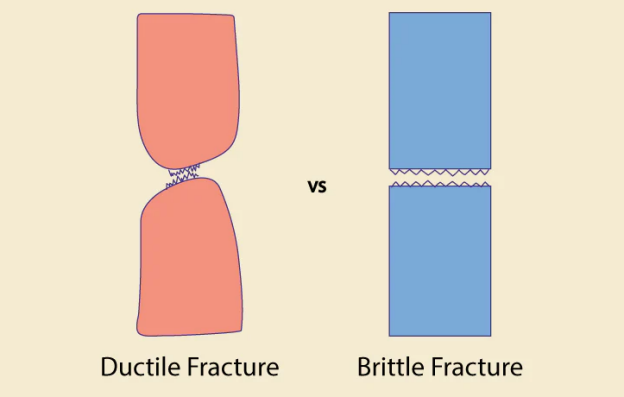
The brittleness property of a material stops it from undergoing plastic deformation. The ductility and brittleness are opposite to each other. For instance, a glass is a brittle material. When the tension force is applied to them, they would not deform but crack suddenly. From the picture, you can easily find the left material breaks with deformation, while the right material breaks without any deformation.
Ductility vs Hardness
Hardness is the resistance to scratch, wear, or penetration. In general, high hardness indicates low ductility, and vice versa. The parts made of hard materials, such as Tungsten metal, show excellent wear resistance during applications but are not ductile. Their %elongation is less than 1% of the total length.
Ductility vs Toughness
The ductility and toughness are relevant properties. Mostly, ductile materials show higher toughness. Toughness is “absorption of energy before the fracture.” It means the parts made of tough metals, such as maraging steel, show high impact strength.
How to Measure Ductility
Ductility of a material can be measured using two parameters, either by % elongation or reduction in area. In both cases, the higher values indicate higher ductility.
Percent Elongation
Ductility Formula:
Ductility (% Elongation) = (Lf−Lo) / Lo×100
Here,
- L o is the original length
- Lf is the final length
Percent Reduction in Area
RA (%) = (A0−Af )/ A0×100
Here,
- RA is the reduction in area
- A0 is the original area
- Afis the final area
What Factors Can Affect Ductility?
Many factors affect the mechanical properties, for instance, material composition, service environment, etc.
Material Composition
The composition of a material is the most important parameter that provides the properties. For instance, in steels, carbon is an interstitial element. It sits on interstitial sites and blocks the dislocation motions, so the plastic deformation reduces, which means lower ductility.
Microstructure
A microstructure of a part means its structure.
- Relation of microstructure with ductility:
Ductility means plastic deformation. Plastic deformation happens when grains move or slide over each other. A part made of annealed steel is ductile because of coarse grains structure. Due to large grains, the number of grain boundaries reduces, so sliding becomes easier, and plastic deformation occurs. In short, a material with large grains has high ductility.
Heat Treatment
Heat treatment affects ductility through the grains.
- Relation of heat treatment to ductility
Different heat treatments, such as annealing, normalizing, or quenching, etc., produce a different grain structure. For instance, in the case of quenching, a very fine and disordered grain structure is produced. In this type of grain structure, the grains can't slide over each other due to a large number of grain boundaries, resulting in little plastic deformation, so ductility is lower.
Temperature
The concept of temperature controls ductility through the grains. At high temperatures, diffusion of atoms and the movement of grains increase, so the ductility of a metal is increased.
Loading Rate
Loading rate affects the ductility through the dislocations. For instance, when the loading rate is high, dislocations do not get enough time to settle down, so they start entangling in the case of a high loading rate. This entanglement of dislocations leads to reduced plastic deformation. In this way, the ductility is reduced.
Ductility of Common Engineer Materials
Since every material is different based on its chemical composition and microstructure, so every material exhibits different levels of ductility. Here we briefly provides information regarding the ductility of some common engineering materials.
What Metals Have High Ductility?
- The FCC metals, such as gold, copper, and Al, have 12 active slip planes, which help easy dislocation movements.
- The metals with lower alloying elements have higher ductility because low alloying elements mean easy dislocation movement.
- The metals, which have non-directional metallic bonding, exhibit high ductility.
Copper (Cu)
Cu is an FCC metal, which is easy to deform or elongate. That's why Cu is commonly used in manufacturing copper wires. This material withstands a large amount of plastic deformation without cracking. Dislocations easily move when a copper rod is passed through the die to make hair-thin wires.
Aluminum and Aluminum Alloys (Al)
Pure Al is a very ductile material (>40% elongation), but in the case of Al alloys, such as 6061 T6 Al, ductility is low. A heat treatment, i.e., precipitation hardening, is done in 6061 T6 alloy to increase its strength. Since these precipitates hinder the dislocation motion, that's why strength increases, but ductility reduces.
Stainless Steels
Austenitic stainless steel, e.g., 316, is a ductile metal because of the FCC structure. 316 steel is easy to machine and bear a large amount of plastic deformation. But ferritic stainless steel, i.e., 430, shows lower elongation due to the BCC structure.
What Metals Have Low Ductility?
Mostly BCC and HCP metals exhibit no or very little ductility and fail in a brittle way. For instance, tungsten is a BCC metal that shows the lowest ductility. Very high stress is required to move dislocations, which results in brittle failure with the lowest plastic deformation. Other metals with lower ductility include:
- Cast Iron
- Quenched High Carbon Steel
Do Engineering Plastics Have Ductility?
Yes, but there is a balance between strength and ductility. These engineering plastics include:
- Nylon (PA6/PA66)
- Polycarbonate (PC)
- ABS
- PEEK
- POM
The strength comes in these materials due to their crystal structure. When stress is applied, polymer chains entangle and stop further chain motion, which causes a reduction in ductility.
How Does Ductility Affect CNC Machining?
Highly ductile materials are easy to deform, but during machining, such materials behave differently with respect to chip formation, tool wear, and surface finish.
Chip Formation
Since ductile materials do not fracture easily, so produce long continuous chips during CNC machining. For instance, when mild steel produces long chips during CNC machining.
Tool Wear
The long chips of the ductile workpieces accumulate at the cutting tips due to pressure and temperature and form a built-up edge. It results in tool wear.
Surface Finish
CNC machining on ductile materials, such as Al, results in a very smooth surface finish if proper tooling, speed, and feed rate are used. Another reason behind the very smooth surface finish is continuous plastic flow.
What Parts Rely Most on High or Low Ductility?
The dependency of parts on ductility depends on the load-bearing, geometry, and structure requirements. For instance, the level of ductility is different for thin and thick parts.
Thin-Walled Parts
The thin-walled parts, such as Al sheets, bear high-stress concentrations during machining, forming, or service. To prevent cracking, thin-walled parts rely on high ductility.
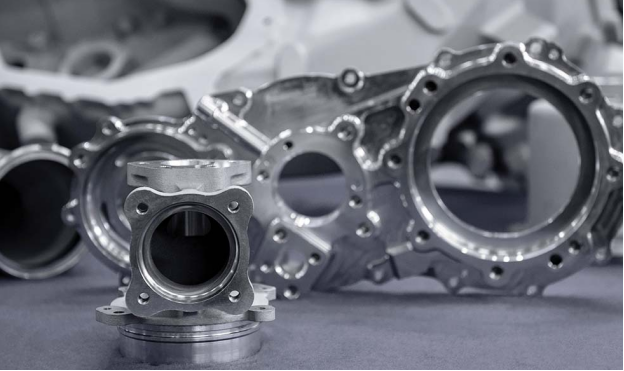
Complex Parts
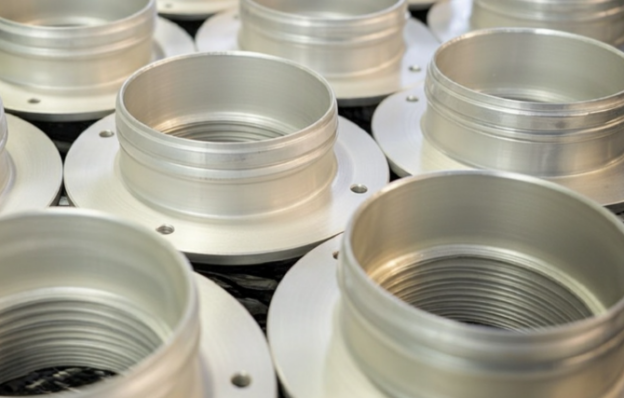
Complex parts, such as Al aerospace parts, have slots and sharp corners. These slots and sharp corners are stress-concentrators during machining and service-life. To avoid cracks and failures, higher ductility is required.
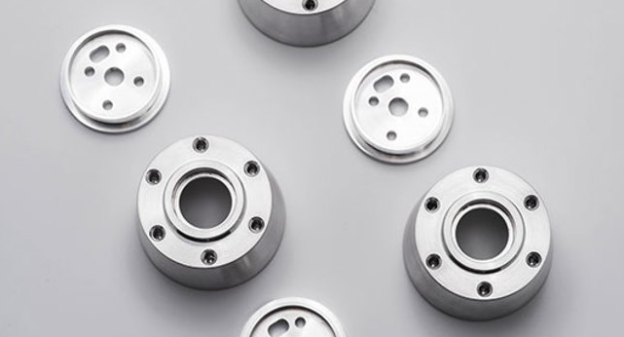
Load-Bearing Parts
Load-bearing parts rely on high ductility when the type of load is tensile, bending, or dynamic. But in the case of thick, compressive, and simple geometry, strength is preferred instead of high ductility.
Conclusion
Ductility is a mechanical property of any material that is measured in % elongation and % reduction in area. To measure this property, mainly the tensile test is used. Ductile materials are easy to deform and machine. Mostly, FCC metals are ductile, which exhibit large plastic deformation. During CNC machining, ductile materials produce long chips but a very smooth surface finish. Thin-walled parts and complex parts rely on high ductility, but load-bearing parts prefer strength instead of ductility.
In practical production, ductility can directly affect the functions of parts, Tuofa can provide CNC solution for custom parts, as well as suggestion for ideal machining or prototyping materials to make your parts perform functions well.
FAQ
Is ductility a mechanical property?
Yes, ductility is a mechanical property. It is important for selecting materials and machining parts.
Why does hot working increase ductility?
Because at high temperatures, the diffusion of atoms increases. Due to this, dislocation movements become very easy, which is why ductility increases.
Does cold work decrease ductility?
Yes, because cold working results in the multiplication of grain boundaries. These GBs hinder the dislocation motion, so the ductility is reduced.
Does work hardening reduce ductility?
Yes, because after work hardening, the entangled GBs restrict the movement of grain boundaries.
 Density of Metals: Chart, Comparison, Effect in CNC Machining