Tel/WeChat:
  Email:


 Home
HomeDensity of Metals: Chart, Comparison, Effect in CNC Machining

 Published:Mar 18,2026
Physical properties of metals are always important, whether it is related to just machining or actual application. Density is a physical property of metals that has great importance when it comes to applications. For instance, with respect to aerospace, the density of metals is extremely crucial because it impacts fuel consumption and speed directly. This article covers the density of different metals in detail and how it affects the machining of respective metals.
What Is the Density of Metals?
In scientific terms, density is mass per unit volume. It is described as: In simple words, density means how tightly atoms are packed in the structure. Metals in which a large number of atoms are tightly packed, they feel heavier. For instance, the same size of copper and Al cubes weigh differently. Cu is heavy compared to Al because its density is higher due to the large, closely packed atoms.
Is Density An Intrinsic or Extrinsic Physical Property?
Density is an intrinsic property of metals. It means it is the fundamental characteristic of the material that does not depend on the amount of the material. For instance, a small cube of Al or a large block of Al will have the same density.
Units Used to Measure Metal Density
The common units used to mention density are g/cm3 or Kg/m3. Mostly, density is measured in g/cm3.
How to Calculate the Density of A Metal?
It is very easy to calculate the density of metals. Two required things to calculate the density are mass and volume.
Density Calculating Formula
Formula:
Density = Mass/Volume
- Mass is the amount of matter present in the metal
It can be in grams (g) or kilograms (Kg).
- Volumeis the space occupied by that metal
Can be in cm3 or m3
Density Chart of Common Metals
The following chart mentions density of different metals. Metals with 1 - 5 g/cm3 density are considered lightweight metals and are commonly used in the aerospace sector. As the density increases, the metals become heavier. Importantly, titanium density is highly discussed because it is widely used in some high-end industries as precision parts.
|
Rank |
Metal |
Density (g/cm³) |
Easy Comparison |
|---|---|---|---|
|
1 |
Magnesium |
1.74 |
Very light metal |
|
2 |
Aluminum |
2.70 |
Lightweight, used in aircraft |
|
3 |
Titanium |
4.51 |
Strong but relatively light |
|
4 |
Zinc |
7.14 |
Medium-density industrial metal |
|
5 |
Iron |
7.87 |
Common structural metal |
|
6 |
Steel (typical) |
~7.85 |
Similar to iron |
|
7 |
Nickel |
8.90 |
Dense engineering metal |
|
8 |
Copper |
8.96 |
Heavy conductor metal |
|
9 |
Brass |
~8.4-8.7 |
Copper alloy used in fittings |
|
10 |
Silver |
10.49 |
Precious conductive metal |
|
11 |
Lead |
11.34 |
Very heavy and soft metal |
|
12 |
Gold |
19.32 |
Extremely dense precious metal |
|
13 |
Tungsten |
19.25 |
One of the densest engineering metals |
What Are Common Metals by Density?
Based on density, metals are categorized into three categories: low-density, medium-density, and high-density metals. These metals are then machined and employed in different applications accordingly.
Low-Density Metals
Metals with 1 - 5 g/cm3 are low-density metals. It means these metals are very lightweight. In this range, Al, Zn, Mg, Ti, and Fe come. The crystal structure of these metals is different but still exhibits lower density. Al (6061 & 7075 grades) and Ti (Ti-6Al-4V & Ti-5Al-2.5Sn grades) are the most common metals with respect to the aerospace sector. These metals are used in major components of a craft to increase the fuel efficiency.
With respect to CNC machining, density does not control the machining itself. However, it can affect the machinability of materials indirectly. Low-density materials like AI, may be easy to cut because of less cutting force.
Medium-Density Metals
Metals like Steel, Cu, Ni, and Brass are medium-density metals that come in the range of 7 - 9 g/cm3. Medium-density steel, such as AISI 1045 steel, is mostly used in pressure vessels and structural parts. Inconel 718 is used in turbine blades and aerospace engine components. C36000 Brass is used in heat exchangers and electrical connectors.
These metals are important but exhibit different CNC machining behavior. Brass and steel are easy to machine, while Nickel is very difficult. So, cutting parameters vary a lot when a metal is changed.
High-Density Metals
Mostly, heave engineering metals and superalloys fall in this category. These metals are employed in severe conditions, such as radiation shielding, high-temperature performance, etc. For instance, W-Cu alloy is used in aerospace counterweights. It is a very hard and brittle metal, so its machining is extremely difficult. Another example is that Pb-Sb alloy is used in radiation shielding, but it is very soft and ductile, so high machinability.
Density of Pure Metals vs Metal Alloys
Density is an intrinsic property of metals. It is the fundamental characteristic property; it means it remains the same regardless of the amount of material, but it changes from material to material. Pure metals and metal alloys exhibit different densities because pure metals are only one material, while in alloys, there are more than one material, so the density is different for pure metals and metal alloys.
Density of Pure Metals
In pure metals, like pure iron or Al, there is only one type of atom and crystal structure. Density is calculated based on the atomic mass and how closely they are packed in a crystal structure (BCC, FCC, or HCP, etc.). So, the density in pure metals is fixed and predictable, like the density of pure Al is 2.70 g/cm3. Here provide a table of density of common pure metals:
|
Metal |
Symbol |
Density(g/cm3) |
|---|---|---|
|
Magnesium |
Mg |
1.738 |
|
Aluminum |
AI |
2.7 |
|
Titanium |
Ti |
4.507 |
|
Zinc |
Zn |
7.14 |
|
Chromium |
Cr |
7.19 |
|
Iron |
Fe |
7.874 |
|
Nickel |
Ni |
8.908 |
|
Copper |
Cu |
8.96 |
|
Silver |
Ag |
10.49 |
|
Mercury |
Hg |
13.534 |
|
Tungsten |
W |
19.25 |
Density of Metal Alloys
Metal alloys are made of more than one type of element. For instance, in W-Cu, there are two major constituents. Since the atomic mass of different elements is different, this directly affects the density overall. That's why the metal density alloys keeps changing as the type of alloying elements changes. Another reason is that each element results in a change in the packing factor of atoms. Below is the density of common metal alloy.
|
Alloy Type |
Common Grades |
Density(g/cm3) |
|---|---|---|
|
Magnesium Alloys |
AZ31,AZ91 |
1.74-1.85 |
|
Aluminum Alloys |
6061,7075,2024,1100 |
2.70-2.80 |
|
Titanium Alloys |
Ti-6AI-4V(grade 5) |
4.40-4.51 |
|
Carbon Steel/ Low Alloy Steel |
AISI 1081, 4140 |
7.85-7.87 |
|
Stainless Steel |
304, 304L,316,410 |
7.85-8.00 |
|
Brass |
C260, C360 |
8.4-8.53 |
|
Bronze |
phosphor bronze, aluminum bronze |
8.7-8.9 |
|
Copper Alloys |
C110 |
8.8-8.96 |
Key Difference: Predictable & Variable Density
The key difference with respect to density between pure metals and metal alloys is the prediction and variation of density.
|
Aspect |
Pure Metals |
Metal Alloys |
|---|---|---|
|
Density Behavior |
Fixed and consistent because only one type of atom is present |
Changes depending on alloy composition |
|
Atomic Structure |
Uniform crystal structure with identical atoms |
Mixed atoms of different sizes distort the lattice |
|
Composition Effect |
Density does not vary since composition is constant |
Density varies with percentage of alloying elements |
|
Example |
Aluminum ≈ 2.70 g/cm³, Copper ≈ 8.96 g/cm³ |
Brass density varies (~8.4-8.7 g/cm³) depending on Zn content |
|
Predictability |
Easy to calculate and predict |
Requires calculation based on composition |
Density of Metals vs Non-Metals
Generally, metals have higher density compared to non-metals because of atomic packing factors. For instance, metals have a density range of 0.5 - 22 g/cm3, and ceramics exhibit <3 g/cm3.
Strength-to-Weight Ratio
Strength-to-weight ratio is different with respect to density for metals and non-metals. Metals, like Ti, exhibit a higher strength-to-weight ratio. But in non-metals, such as in plastics, strength-to-weight ratio. Plastics show a very low strength-to-weight ratio, but carbon composites show a very high strength-to-weight ratio.
Stiffness-to-Weight Ratio
Generally, non-metals exhibit a higher stiffness-to-weight ratio compared to metals. Ultimately, it depends on the type of material. For instance, polymers show low but composites show a very high stiffness-to-weight ratio.
Weight-Critical Applications
In weight-critical applications, generally metals are preferred because of their higher strength-to-weight ratio. Mostly, non-metals exhibit a poor strength-to-weight ratio, so not preferred in weight-critical applications.
Machinability Comparison
Materials density can affect the machinability, but it isn't the direct factor for CNC machining. In general, the density of metals is higher than non-metals. And this can affect the cutting force, and tool wear.
Besides the density, the following table presents differences based on machinability between metals and non-metals.
|
Property |
Metals |
Non-Metals |
|---|---|---|
|
General Machinability |
Usually good and predictable |
Varies widely depending on type |
|
Cutting Forces |
Moderate to high |
Usually low |
|
Tool Wear |
Can be significant (especially hard alloys) |
Usually low, but abrasives like composites can cause high wear |
|
Surface Finish |
Typically good and consistent |
Can vary; polymers smooth, composites rough |
|
Chip Formation |
Continuous or segmented chips |
Brittle fracture or powder-like debris |
|
Typical Challenges |
Work hardening, tool wear |
Melting (polymers), brittleness (ceramics), fiber pull-out (composites) |
|
Examples |
Aluminum - easy, Titanium - difficult, Steel - moderate |
Plastics - easy, Ceramics - difficult, Carbon fiber - abrasive |
Factor that Affect Metal Density
These are some factors that directly and indirectly affect the metal density:
Atomic Mass
Atomic mass is the weight of an element. Its most common unit is gram per mole (g/mol). The atomic mass of every element is different. For instance, the atomic mass of C is 12 g/mol, and for Fe it is 56 g/mol. It is actually the weight of an element. As atomic mass changes, the density of metals changes directly.
Atomic Arrangement
There are many crystal structures, for instance, body-centred cubic (BCC), face-centred cubic (FCC), and hexagonal close-packed (HCP). The atomic arrangement in each crystal structure is different. For instance, in BCC metals, the atoms are closely packed, so the density of BCC metals is higher compared to FCC metals, in which atoms are less closely packed.
Alloy Composition
Alloy composition means the elements present in the alloy. Steel, an alloy of simple Fe and C elements, has a different crystal structure, hence the atomic packing factor is different than pure Fe. So, the density varies based on the elements present in the alloy.
Temperature
At high temperatures, metals become soft because, with the rising temperature, atoms get excited. To stabilize themselves, atoms move rapidly, so the vacancies are generated. When vacancies are generated, the density of metals decreases. For instance, in steels, in the austenitic stage (912°C), density decreases from 7.86 g/cm3 to 7.7 g/cm3.
During CNC machining, the temperature does not go to that range where vacancies are generated and reduce the density. So, the CNC machining does not affect density.
Pressure
The role of pressure is opposite to that of temperature in terms of density. As pressure increases, the density of metals increases. When pressure is employed, the lattice compresses, the atomic spacing reduces, so the density increases. For instance, when 500 - 800 MPa pressure is employed, the density increases 7.87 - 7.9 g/cm3. But in the case of CNC machining, pressure is not up to that value, so the metal density does not change.
So, the conclusion is that CNC machining does not affect the density of metals at all.
Benefits of CNC Machining Not Affecting Metal Density
CNC machining is known for its precision in machining parts. Due to automated machining, the chances of errors are lower compared to manual machining. But with respect to density, CNC machining provides the following benefits.
Predictable Weight of Parts
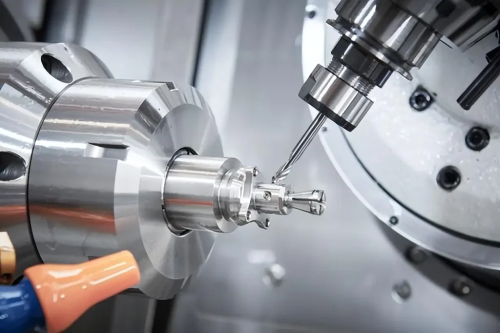
During CNC machining, temperatures and pressures do not reach that value where density decreases or increases, so the density remains the same throughout the machining. That's why the weight of parts remains predictable.
Support Lightweight Design
The lightweight metals, like Mg, can easily be machined on CNC machines. So, density has no impact on the machining of lightweight metals.
Better Quality Control
To achieve the top quality in the products, it is better to test the density of metals before employing them in respective applications. Quality control results in achieving higher precision in machining and more efficient performance.
How Density Affects CNC Machining
CNC machining does not affect the density of metals, meaning the density remains the same after the machining processes. Let's check how density affects the parameters of CNC machining.
Cutting Force
Since density depends on the atomic packing factor of atoms. For instance, in Al, there is an FCC crystal structure. The atoms are less closely packed, so their density is low, i.e., 2.70 g/cm3, compared to Ti, which has an HCP and a density of 4.50 g/cm3. A Higher packing factor leads to higher strength, so higher cutting forces are required to machine Ti compared to Al.
Tool Wear
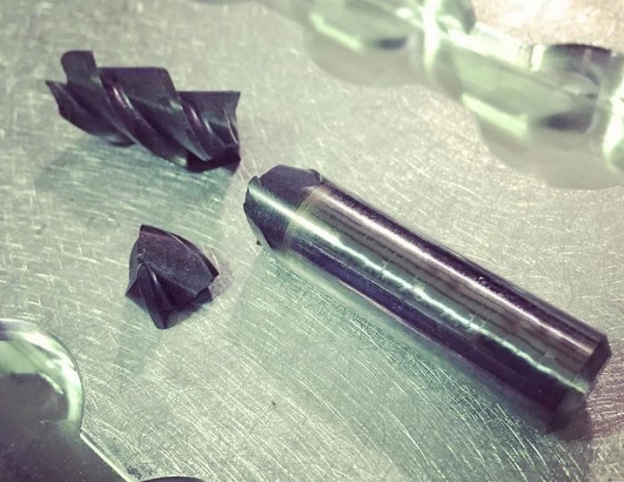
High density of a metal means high strength and high hardness due to the atomic packing factor. So, tool wear is higher in the case of high-density metals, like Tungsten.
Material Removal Rate
The material removal rate (MRR) is also linked with the strength and the hardness of metals, which are directly affected by density. In the same situation, due to lower density, the material removal rate is higher in the case of Al compared to W, which has a higher density.
Tips for Optimizing Parts Based on Metal Density
Some factors can be adjusted to optimize the parts based on metal density. This optimization is sometimes necessary to avoid material, time, and money loss.
Choose the Right Metals
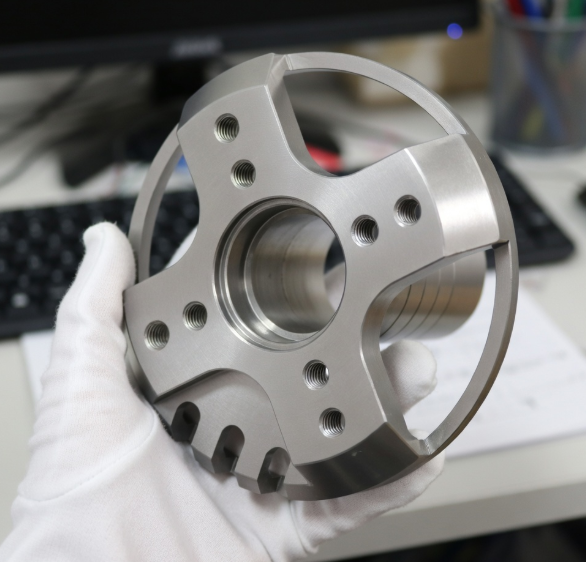
The metals should be selected based on the requirements of applications. For instance, if the requirement is strength-to-weight ratio, then metals with lower density are selected. This is why Ti is used commonly in the aerospace industry.
Optimize Geometry of Parts
Parts can be optimized through geometry. For instance, making pockets in the parts reduces weight significantly.
Balance Weight Distribution
When metals with different densities are combined, for instance, in the structure of an aircraft, the balance in weight distribution is very critical. It directly controls turbulence and vibration. So, the metals should be selected wisely with respect to their densities and locations in that structure.
Conclusion
The density of metals is an intrinsic property and is defined as mass per unit volume. The metals up to 4 g/cm3 are considered low-density metals, those with a density of up to 8 g/cm3 are moderate-density metals, and those with a density of more than 8 g/cm3 are heavy metals. CNC machining does not affect the density of metals because temperature and pressure do not go up to that range where vacancies are generated, and density is reduced. But the density of metals affects CNC machining parameters indirectly because it controls mechanical properties, such as strength and hardness. Understanding metal density can optimize parts with high precision and high quality.
In practical applications, metal density can influence the weight of parts and the setting of cutting parameters. Tuofa specializes custom precision metal parts, if you need custom CNC machining service, contact Tuofa for quick quotation.
FAQ
What metal has the highest density?
Osmium metal has the highest density of metals. It is about 22.58 g/cm3.
Which metal has the lowest density?
Lithium metal has the lowest density of metals. It is about 0.53 g/cm3.
Which is heavier, steel or copper?
Copper is a heavy metal because its density is higher than that of steel, i.e., 8.96 > 7.87 g/cm3.
 Inconel 625: Properties, Machinability, and Design Guide