Tel/WeChat:
 Email:



 Home
Is Nickel Magnetic? Material Guide for CNC Machined Components

 Published:Nov 14,2026

Sometimes, our customers ask for demagnetization of nickel parts after CNC machining because the nickel parts are used in magnetically sensitive equipment like MRI machine, optical devices, and semiconductor devices. However, why does Nickel need demagnetization? Is the reason its magnetism? Does demagnetization remove the inherent magnetism of nickel. What should you do to demagnetize nickel parts? Stay with us as we are to deep dive into magnetic nature of nickel and what about its relative alloys and a lot more.
Is Pure Nickel Magnetic?
Yes, pure nickel is magnetic because it shows strong attraction towards magnets and retains magnetism when a magnetic field is applied at room temperature, so its magnetic. All this magnetic nature arose from electronic level of nickel. Since it's a transition metal, has partially filled d orbital and has electronic configuration of 4s²3d⁸, enabling it to have tiny magnets in form of unpaired electrons.
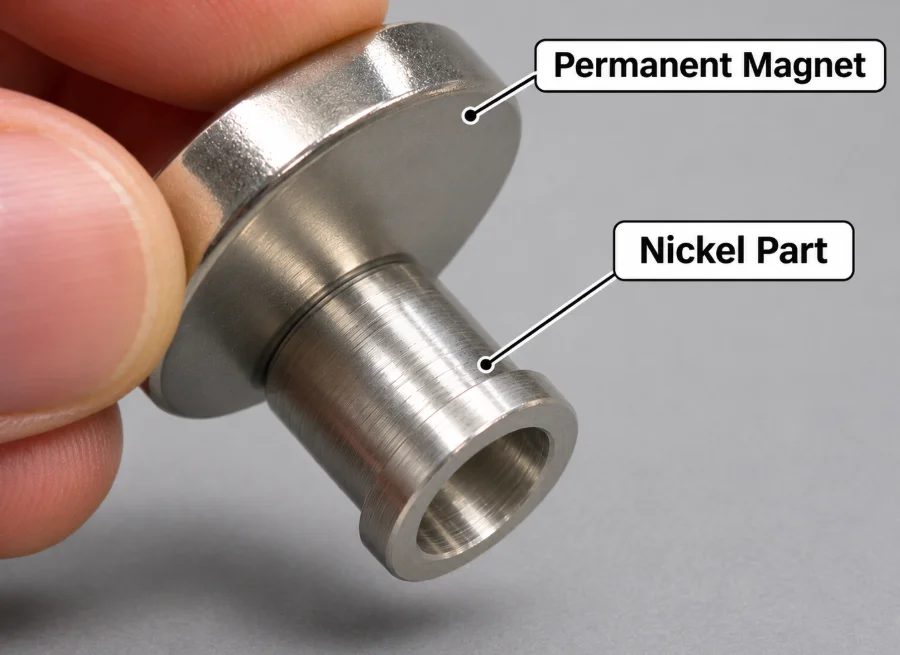
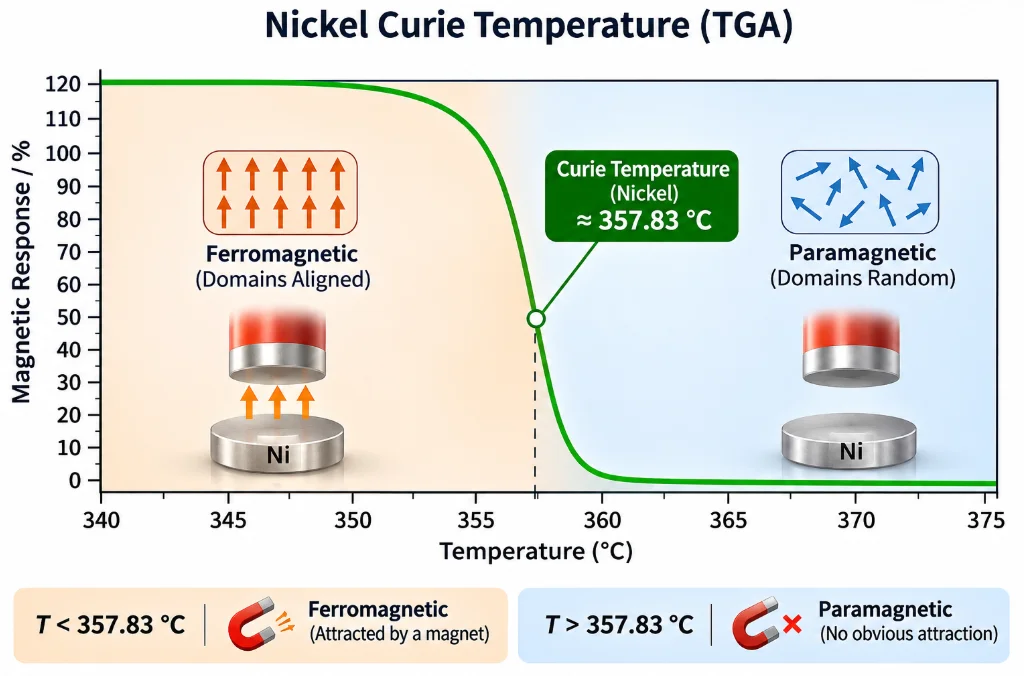
However, this magnetic behavior shows remarkabe shift when temperature rises above its Curie temperature. Curie temperature of nickel is 358°C. What happens here is basically losting magnetic domains. Kinetic energy overcomes magnetic alignment. Compared to room temperature, at this temperature nickel shifts from ferro to paramagnetic. But yeah, it shows weak diamagnetic behaviour when a very strong magnetic field is applied. This whole magnetic behavior is caused by atomic level electron arrangement in Ni.
Chemical Composition of Pure Nickel
The magnetism of nickel is also influenced by its chemical composition. We have gathered chemical composition of pure nickel in following tables:
Commercially Pure Nickel Alloys
|
Alloy |
UNS No. |
Ni (%) |
Fe (%) |
Cu (%) |
C (Max %) |
Other Elements (%) |
|---|---|---|---|---|---|---|
|
Nickel 200 |
N02200 |
99.0 min |
0.40 max |
0.25 max |
0.15 |
Mn: 0.35 max; Si: 0.35 max |
|
Nickel 201 |
N02201 |
99.0 min |
0.40 max |
0.25 max |
0.02 |
Mn: 0.35 max; Si: 0.35 max |
|
Nickel 270 |
N02270 |
99.97 min |
0.05 max |
0.01 max |
0.02 |
Mn: 0.005 max; Si: 0.005 max; S:0.003 max; Ti, Mg:0.005 max each |
As you can see from the table, each chemical element has a specified acceptable range. Within these limits, different actual content levels of these impurities will lead to different magnetic behaviour of pure nickel.
Magnetic Properties of Pure Nickel
Strong paramagnetism makes it to show Magnetostriction, where it changes its shape slightly when magnetic field is applied. Paramagnetism of pure nickel gets disturbed once its purity is disturbed by introducing external elements like iron, molybdenum or chromium.
Are Nickel-Containing Alloys Magnetic?
Although pure nickel is magnetic, nickel alloys can be magnetic or non-magnetic, which depends on the added alloying elements by human. Let us discuss the impact of alloying elements on the magnetism first.
- Adding Fe can promote ferromagnetism in nickel alloys.
- Adding Co can help keep the ferromagnetism of nickel alloys and raise the Curie temperature.
- Adding Cr can lower the Curie temperature of nickel alloys, which can reduce the magnetism of nickel alloys.
- Adding Mo or Cu can generally reduce nickel alloys'magnetism as well.
In real engineering practice, Tuofa also adds some alloying elements in the nickel alloys to make its magnetism weak before machining, which can reduce the risk of developing residual magnetism during machining.
Of course, the content of these alloying elements in nickel alloys is very essential. Nickel-based nickel alloys and iron-based nickel alloys are two main types, how about their magnetism? Let us explore them.
Magnetism of Nickel Alloys (Nickel-based)
Common nickel-based alloys include Inconel alloys, Monel alloys, and Hastelloy alloys. The below table shows the magnetism of some specific grades of nickel-based alloys and their typical applications because of their magnetism.
|
Alloy |
Magnetic Status |
Curie Temperature |
Key Chemical Composition (wt%) |
Primary Applications |
|---|---|---|---|---|
|
Inconel 625 |
Non-magnetic |
< -196 |
Ni: 58.0% Cr: 20.0-23.0% Mo: 8.0-10.0% Nb+Ta: 3.15-4.15% Fe: 5.0% |
Marine components, propeller blades, aerospace exhaust ducts, heat exchangers, and chemical scrubbers |
|
Inconel 718 |
Non-magnetic |
< -196 |
Ni: 50.0-55.0% Cr: 17.0-21.0% Fe: ~18.5% (Bal.) Nb+Ta: 4.75-5.5% Mo: 2.8-3.3% |
Jet engine turbine discs, rocket motors, high-strength downhole oilfield tools, and nuclear reactors. |
|
Hastelloy C-276 |
Non-magnetic (paramagnetic) |
None / spin glass below -270°C |
Ni: ~57.0% (Bal.) Mo is 5.0 to 17.0% Cr max 16.5% Fe min 4% W: 3.0-4.5% |
Extreme chemical processing for example flue-gas scrubbers, and sour gas piping |
Iron-Based Nickel Alloys
Introducing iron to nickel gives out nickel alloys which are both magnetic and no magnetic but why is thats so? Well magnetism here basically depends on crystal structure of material. StainlessSteel 304 and 316 both turns out to be non magnetic in there annealed form and invar 36 is magnetic.
Why SS 304 and 316 non magnetic?
If we talk about composition both Alloys mostly contain nickel; when iron is added in them they form a face-centred cubic structure (FCC), where small magnetic domain points out in opposite directions cancel each other's effect, making them non magnetic.
However, cold forming changes manetism here: physical stress twists the crystal structure into a slightly different shape, martensite. This makes bent areas of 304 slightly magnetic. Stainless steel 316 has even more nickel and molybdenum, so it stays much more stable and remains non-magnetic even when bent.
What makes Invar 36 magnetic even with FCC structure?
Unlike 304 and 316 stainless steel, Invar does not contain chromium. Without chromium changing mix, iron and nickel atoms arrange themselves into a structure where their tiny magnetic fields easily line up in the exact same direction.
What Makes Nickel and Nickel Alloys Magnetic?
Base cause behind magnetic behavior is based on magnetic domains, crystal structure and Curie temperature.
Magnetic Domains
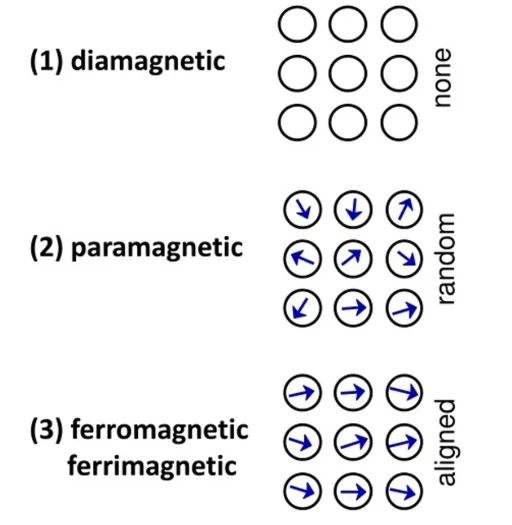
One main cause behind magnetic nature of Ni is formation of magnetic regions within material. Unpair electrons in nickel have specific spins when these spins align in same direction, that region develops strong response to magnetic field. Such regions are magnetic domains. Magnetic domains are disrupted at temperature above its Curie temperature, making nickel paramagnetic.
But wait, magnetic domains are not only cause making nickel magnetic crystal structures of nickel and its corresponding alloys, which also have a remarkable impact on magnetism.
Influence of Crystal Structure
Naturally nickel has face centered cubic structure, which also plays a huge role in its magnetic behavor. Face centered cubic structure allows unpaired electrons to interact with magnetic fields efficiently. Such interaction allows electronic spins to align with magnetic field. In case FCC structure is disturbed at high temperature, cold working or machining, magnetic properties alters.
Curie Temperature
Curie temperature is where material loses its magnetic nature. At room temperature nickel has magnetic momentum that aligns with each other. These respond to magnetic fields, making magnetic domains. As temperature reaches 358°C, these momenta do not align parallel, imparting paramagnetism.
How Does CNC Machining Affect the Magnetism of Nickel Parts?
Definitely, CNC machining can change the magnetic response of nickel parts. This happens due to mechanical deformation and localized temperature increases. Up to which extent you can expect change depends on:
- Alloy composition
- Initial metallurgical condition
- Machining parameters
- subsequent heat treatment
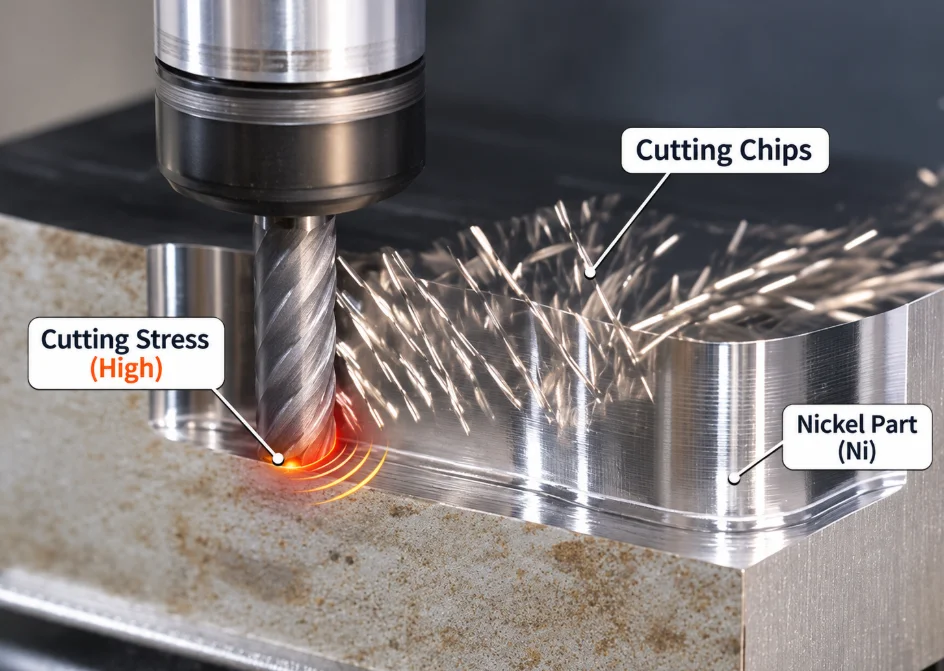
Cutting Stress
When nickel components are subjected to cutting applied stress influence magnetic domain-wall movement. Such influence directly changes nickel's magnetic permeability and induction. Cold-worked nickel, for example, exhibits a different magnetic induction response from annealed material.
How Tuofa minimizes these effects:
- Avoid excessive cutting forces and tool pressure during CNC
- Preferably use sharp cutting tools to reduce friction and deformation.
- Consider stress-relief treatment when dimensional stability and magnetic consistency are critical.
Magnetic Workholding
Since Ni is magnetic so in CNC machining engineers preferably use magnetic chucks to hold it. During this process nickel gets interacted with magnetic field of these chunks for a long time. There are changes to develop residual magnetism. Toufa our engineers prefer to demagnetise components first to avoid unnecessary magnetic interference at the next stage, but it doesn’t mean that the residual magnetism won’t form again during subsequent machining processes. But it is not always. Nickel alloys are demagnetized before machining because the nickel material already has residual magnetism prior to machining.
Cutting Heat
Now you know that nickel is magnetic, but its has low thermal conductivity. This low thermal conductance also becomes a factor to disrupt its magnetism due to CNC. When friction arises between cutting tool and nickel and haigh force is applied localized heat generates, if reaches above curie temperature, temporality makes Ni paramagnetic, instant cooling causes disturbance in magnetic permeability.
Why Do CNC-Machined Nickel Parts Need Demagnetization?
Is it necessary to demagnetize CNC-machined nickel parts? The answer is yes if your nickel parts are used for magnetically sensitive equipment. As we have mentioned before, nickel alloy materials may have residual magnetism before CNC machining, which can interfere with processing. Demagnetization is not only important for machining, but also for the final performance of nickel parts.
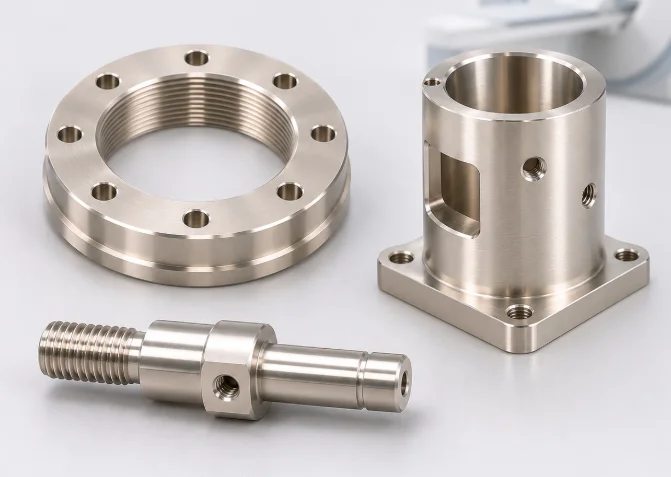
Prevent Chip Adhesion
Engineers use magnetic chuckes to hold nickel components, nickel being magnetic. These chucks introduce residual magnetism in nickel, so nickel can attach residual chips to it strongly, disturbing its blind holes and threads. After machining, the nickel parts should be demagnetized to prevent them from picking up iron chips when cleaning, inspection or delivery.
Prevent Surface Contamination
Magnetized nickel parts act like small magnets on shop floor. During storing, shipping or being moved, nickel components pull fine metal shavings and grits. Such contamination causes flaws when the part goes on to plating, coating, or welding.
Improve Assembly Reliability
If nickel components have magnetic effect in them during assembly, they get stuck with other magnetic parts. This leads to assembling misalignment and jamming robotic pick and place equipment.
Avoid Magnetic Interference
Nickel and its alloys find their applications in electronic assemblies, sensors, aerospace instrumentation, and medical devices. Here magnetic behavior is what directly affects component performance. For instance:
- Sensor accuracy:Residual magnetism distort readings in sensitive magnetic sensors and measurement instruments.
- Electromagnetic compatibility: Unwanted magnetic fields interfere with nearby electromagnetic components.
- Magnetic permeability:Applications requiring controlled permeability may be affected by changes in the component's magnetic condition.
Demagnetization Methods for CNC Machined Nickel Components
How to avoid unnecessary contamination due to induced magnetism in nickel, its components are demagnetised. Two major methods used for this purpose are AC demagnetization and thermal demagnetization.
AC Demagnetization
If you want a cheaper effective and method which does not alter mechanical properties of your nickel components, opt for AC demagnetization.
Engineers pass component through an alternating magnetic field that continuously reverses polarity while gradually decreasing in amplitude to zero.
Thermal Demagnetization
Thermal demagnatization is where you heat your components at curie temperature of nickel. Remember that components should be heated uniformly so it behave as peramangentic, and all metallic residues left unmagneised surface of component.
Application of Magnetic Nickel Parts
Nickel's compatibility with showing ferromagnetic behavior, relatively high magnetic permeability, and corrosion resistance makes it capable of being used in industrial applications.
Automation Industry
In industrial automation, manufacturers use magnetic Nickel parts in order to support electromagnetic actuation and precision positioning. And its not end here Ni's ferromagnetic response allows it to interact with magnetic fields generated by solenoids and actuators.
Electronic & Electromagnetic Shielding Industry
Nickel find its application in electronic and electromagnetic shielding industry for instance in:
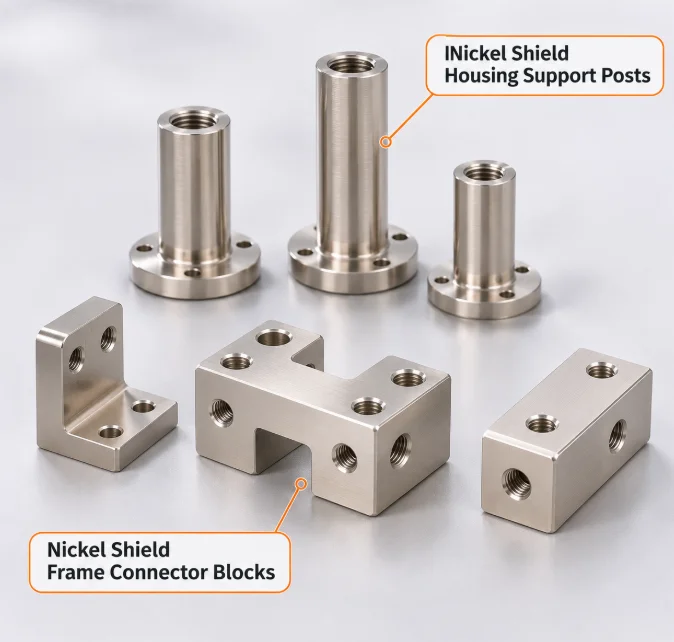
- Nickel Shield housing support posts:These posts hold shielding enclosures firmly in place and keep housing a set distance from the electronics inside it.
- Nickel Shield frame connector blocks:These blocks tie sections of a shielding frame together and give assembly solid, stable points of attachment.
Medical Electromagnetic Device
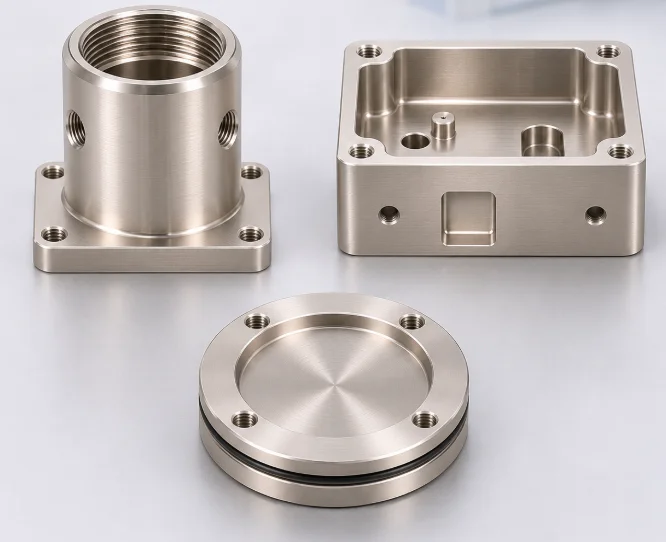
Medical equipment uses nickel-containing components in certain electromagnetic assemblies. For example sensor housings are manufactured by using nickel.
It's because of nickel's magnetic response support interaction with electromagnetic components and its machinability allows production of close-tolerance coupling features as well.
Magnetic Component Industry
Engineers find nickel a suitable option to be used in magnetic assemblies, as it possesses ferromagnetic nature. In such assemblies parts must respond to an applied field, like in case mounting tabs. Permeability and easy workability of nickel is what make it practical for clamping hardware.
When Needs Non-Magnetic Nickel Parts?
Nickel is not just used out of its magnetic nature; there are number of applications where engineers make it nonmagnetic or use its nonmagnetic properties out of its high corrosion resistance, tensile strength and other remarkable properties.
High-Precision Optical Instruments
Nickel alloys are adopted by engineers for manufacturing high precision optical instruments. We have combined there use in a table here for you:
|
Component |
Alloy |
Yield Strength |
CTE (20-100°C) |
Primary Function |
Key Advantage |
|---|---|---|---|---|---|
|
Standoffs |
Monel 400
|
172 to 590 MPa |
13.9 µm/m·°C |
Board and bench spacing |
Non-magnetic near sensors along with good corrosion-resistant |
|
Shoulder Screws |
Monel 400 (N04400) |
172-590 MPa |
13.9 µm/m·°C |
Pivot axles |
Smooth wear resistance and prevents thread galling |
|
Spacer Blocks |
Inconel 718 |
Min 1,030-1,330 MPa |
13.0 µm/m·°C |
Focal height & datum alignment |
Zero creep/compression under heavy bolt preload |
Medical Device Industry (MRI Compatible)
Number of medical equipments are sensitive to magnetic fields, and in case they get interacted with some magnetic part, there are high chances of false results.
For example, in case of MRI if any bushing is made of stainless steel, it will interact with frequencies, causing a visual anomaly in scan. So non magnetic alloys of nickel are used in such scenarios for example:
- Nickel alloy bushings made with Hastelloy C276
- Monel 400for mounting lugs
- Nickel locating pins made with Inconel 625
Electronic and RF Communication Assemblies
Manufacturers use nickel based super alloys for Electronic and Radio Frequency communication assemblies. Such components work in harsh conditions, like in seawater or aerospace, so they need to be strong, resist galvanic corrosion and deliver reliable electromagnetic interference (EMI) shielding. Ni alloys show all such properties.
Monel400 is preferably used for making Nickel shield frame connector blocks. It's not monel only but other alloys like Inconel 625 and hastelloys which are used for manufacturing of Ni sleeve spacer and nickel base shims respectively.
Assemblies Near Permanent Magnets
When assemblies sit close to permanent magnets, non-magnetic nickel alloys are a go-to choice of manufacturers and engineers. You'll find Monel 400 is being used for shoulder screws, Hastelloy C276 in connector blocks, and Inconel 625 in mounting tabs, each picked by engineers so can operate effectively in tough conditions.
Conclusion
Nickel is magnetic, but how much? basically depends on grade. Pure nickel is ferromagnetic, while alloys like Monel 400, Inconel 625, and Hastelloy C276 respond very differently. Some are nearly non-magnetic in practice. So by noticing Ni don't just assume material is magnetic. Check permeability of your specific alloy, account for residual magnetism after machining, and confirm grade and magnetic requirement on drawing before release.
If you are wondering how to customize nickel parts, feel free to contact Tuofa custom CNC machining service. We will help you determine whether demagnetization is required based on your part's actual application.
FAQ
Can nickel parts be demagnetized after machining?
Yes, definitely; nickel parts can be demagnetised after CNC machining by using either a thermal or AC demagnetisation method.
Can demagnetization permanently remove nickel alloy magnetism?
Demagnetization only removes residual magnetism and cant change feromagnetic nature of pure nickel.
Can nickel be a magnet?
Pure nickel is a soft magnetic material which you can magnetizes easily but loses most of that magnetism once the field is removed, so it doesn't work well as a permanent nickel magnet on its own.
 Comparison of Brass Nuts and Steel Nuts: Materials, CNC Machining & Applications