Tel/WeChat:
 Email:



 Home
How to Prevent Galvanic Corrosion? Material, Surface Finishes, Design & CNC Machining Features

 Published:Nov 06,2026

Galvanic corrosion is one of the most common failure molds caused by the assembly of dissimilar metals. It always occurs covertly in many CNC machined metal parts in aerospace, medical, renewable, or automation parts due to moisture, saline media, and electrolytes.
Is there nothing we can do about it? No, actually, galvanic corrosion can be avoided or prevented from the part designs. Effectively preventing it can make your parts serve for a longer life. But how to do that? In this article, we explain what galvanic corrosion is and then provide effective solutions for you.
What Is Galvanic Corrosion?
Galvanic corrosion is a form of corrosion that occurs when two metals having different natures come into contact in the presence of a liquid environment, such as seawater. One metal corrodes faster while the other metal corrodes slower. Galvanic corrosion is also known as bimetallic corrosion or dissimilar metal corrosion.
How to identify galvanic corrosion?
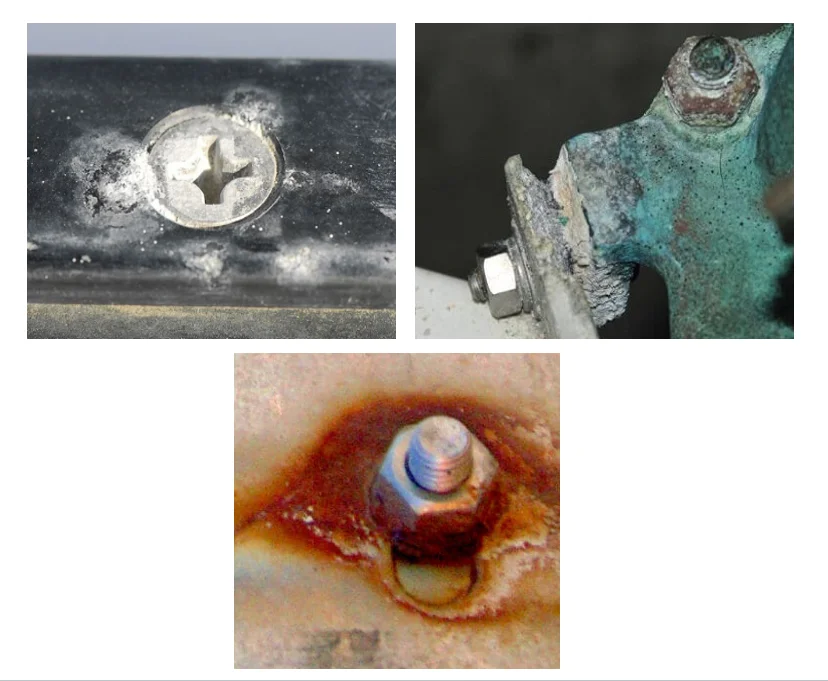
Galvanic corrosion phenomenon is easy to identify through the appearance of metal parts. If there is galvanic corrosion, white fluffy or powdery corrosion deposits, reddish-brown rust or greenish-blue patina can be seen on the mating surface between two metal parts.
How Does Galvanic Corrosion Occur?
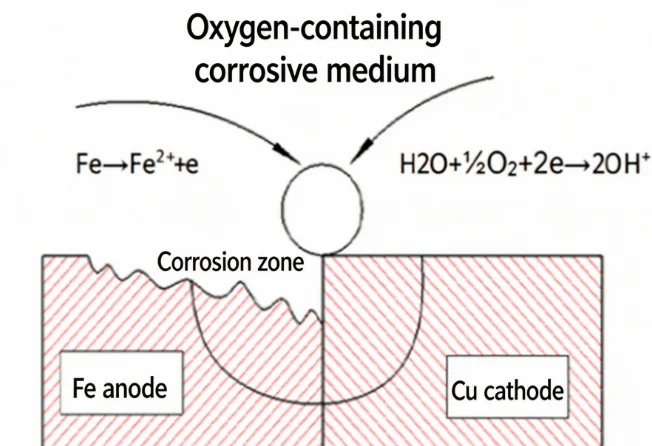
Galvanic corrosion occurs when the following three elements are present together at once.
- First, there must be two metals that differ in their electrical potential value. In galvanic corrosion, when two metals are electrically connected, the anode is the more electroactive one, while the cathode is the more noble one.
- Second, there must be a connection between the two metals via some sort of conductor.
- Third, these two metals must be linked with an electrolyte. There are several electrolytes available, such as condensation, rainwater, salts in roads or in washers.
Without any of these three elements, the whole process would stop.
Let us learn in details the steps of galvanic corrosion:
Step 1: Oxidation at the Anode
The more electroactive (less noble) metal releases electrons and dissolves into the electrolyte as metal ions.
Step 2: Electron Flow through Metal Contact
Free electrons travel from the anode through the electrical connection to the cathode.
Step 3: Reduction at the Cathode
Dissolved oxygen undergoes reduction on the cathode surface to form hydroxide ions.
And finally the metal ions combine with hydroxide ions to form visible corrosion products.
Galvanic Corrosion vs Pitting vs Crevice Corrosion
Even though the three forms of corrosion seem to be similar as regards the failure of the component, the truth is that the cause is different for all three of them.
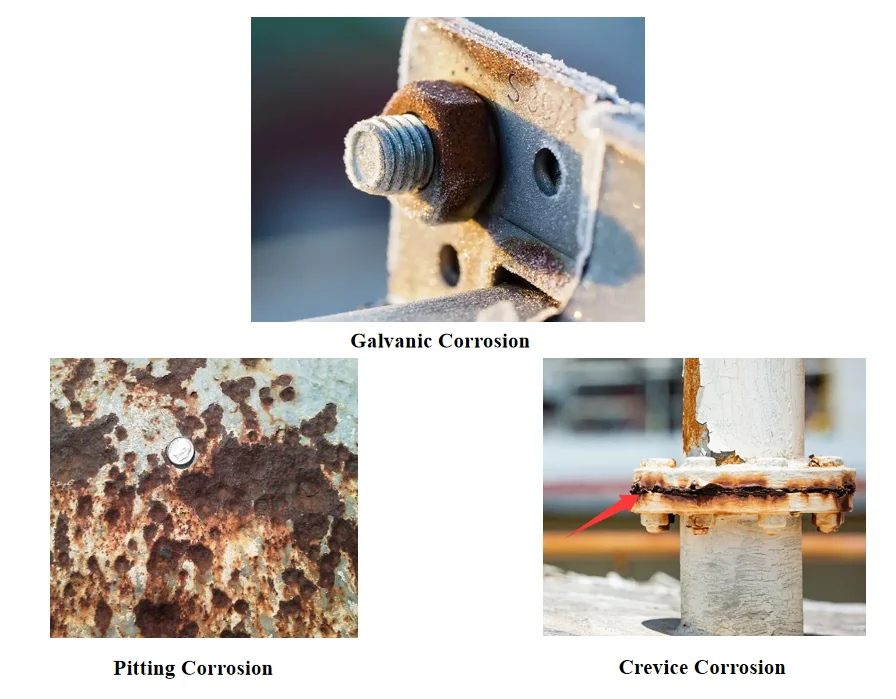
- Galvanic corrosion is made up of at least two different metals.
- Pitting and crevice corrosion can happen with just one metal. They act together whenever they happen in the actual structure.
|
Type |
Main cause |
Where it shows up |
Best first fix |
|---|---|---|---|
|
Galvanic |
At least two metals with a difference in potential and electrolyte |
At the junction |
Using same metals or by providing insulation |
|
Pitting |
Localized failure of the passive film |
Small deep holes |
Better alloy selection or passivation |
|
Crevice |
Oxygen-deprived crevices |
Under washers, gaskets, and tight joints |
Change in gap size or sealing |
Prevent Galvanic Corrosion via Material Selection
Choosing the right material for use in an application can be described as the most economical and effective way of dealing with corrosion. This should be done at the beginning stage of the design process. If this is not done, it means that a lot of money will be used in coating, gaskets, and testing in the future.
Understand the Galvanic Series for Metal Matching
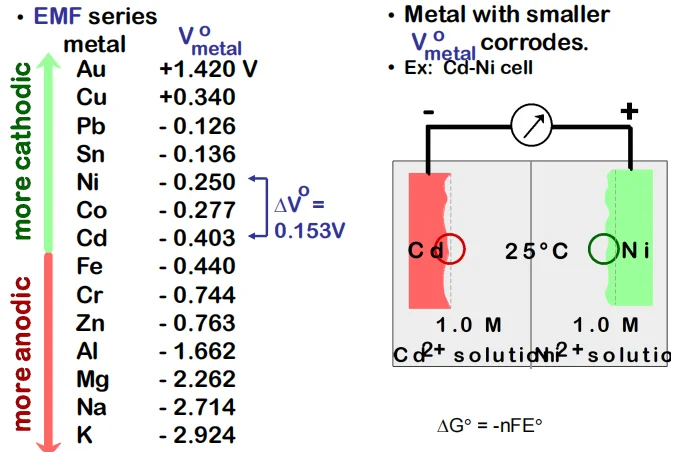
Galvanic Corrosion Series is a technique where ranking of metals according to their position in a selected electrolyte is done using a scale. Active metals include those that have high ranks on the scale, whereas the noble metals include those that have low ranks and are therefore resistant to corrosion, according to ASTM G82 standards.
Use of the above chart along with a basic voltage guideline. This is the MIL-STD-889 approach that is widely recognized. In order to ensure that there are no significant differences between the two metals being paired, follow the guideline. In case of severe environments, including outdoor and marine environment, it is important to ensure that you do not exceed 0.15 V.
Avoid High-Risk Metal Combinations for CNC Assemblies
There exist certain combinations that definitely cannot match at all and will always repeat themselves. Do not use such combinations if possible. If you must use such combinations in your design, make sure that this is taken into account during the design process.
|
Metal pair |
Metal that corrodes |
Risk level |
Safer option |
|---|---|---|---|
|
Aluminum + stainless steel |
Aluminum |
High |
Add insulating washers |
|
Aluminum + copper or brass |
Aluminum |
High |
Use plated or coated copper, or switch to aluminum |
|
Magnesium + steel |
Magnesium |
Very high |
Use coated steel with full sealing |
|
Carbon steel + stainless steel |
Carbon steel |
Medium |
Use zinc-nickel plated steel fasteners |
|
Aluminum + carbon fiber (CFRP) |
Aluminum |
High |
Add a glass-fiber ply or sealant barrier |
Evaluate Galvanic Compatibility in the Service Environment
In this case, the same combination will display totally different characteristics in both places. Combining materials which will suit in case of dryness will not suit in the case of deck of the boat. There are three main questions that need answers: How much wet would the joint be? What are the properties of conductivity of the liquid; and how frequent would the liquid be drying and wetting?
Sea water and road salt water are conductive liquids and hence facilitate electrical current in the joint. Fresh water is not a conductive liquid. Temperature increases the speed of the reaction. Wetting and drying increases the concentration of salts.
Optimize CNC Part Geometry to Remove Electrolyte Traps
Corrosion occurs due to the presence of liquids. There is a possibility of making a design where the liquid cannot remain on the component. This means that the electrolyte will not be present. When it comes to CNC machining, it will be easier to design the drainage channels.
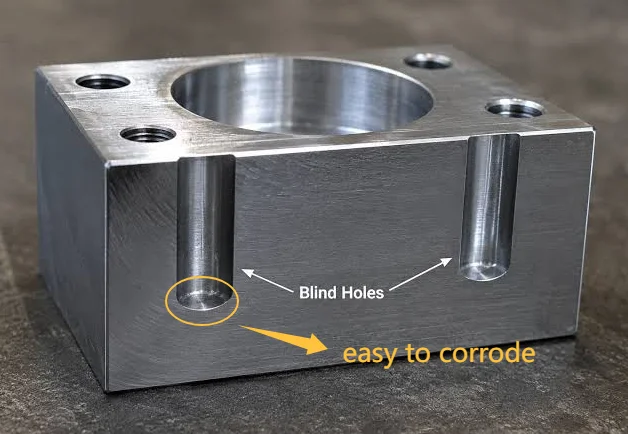
Eliminate Undrained Internal Cavities and Blind Holes
Blind holes work like cups. The water enters the hole but does not escape from it. Blind holes should be redesigned as through holes wherever possible, but in the case that they cannot be changed, cross holes or drain holes are created at the lowest point.
Redesign Deep Grooves and Recesses that Hold Liquid Films
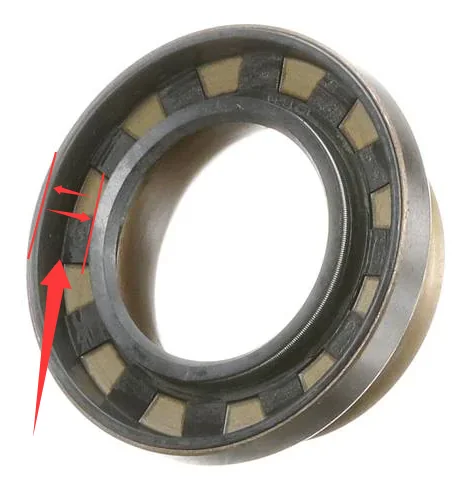
Capillary forces keep the thin film of liquid in the grooves for days. For the removal of the liquid, it is necessary to increase the width of the grooves, increase the radius of the inner corners and have a slope on the floor to the exit. Inner sharp corners also tend to trap dust particles.
Design External Surfaces for Drainage
Wherever possible, make provision for draining the ledges and the surfaces in such a manner that water does not get collected on the surface. It must be made sure that no upward recess or overlap lip occurs as this results in capillary gaps. Obviously, the angle varies depending on the fluid as well as the installation. If the part could be drained in one specific orientation, it will certainly contain some fluid in another orientation.
Isolate Dissimilar Metals to Prevent Galvanic Corrosion
As we have introduced before, galvanic corrosion especially occurs between two metals that have different chemical compositions. There are many situations where dissimilar metal parts are used for connecting, which means that choosing the same metals for assembly to avoid galvanic corrosion is impractical. Therefore, here we provide some solutions for isolating two dissimilar metal parts.
Use Non-Conductive Insulating Gaskets and Sleeves
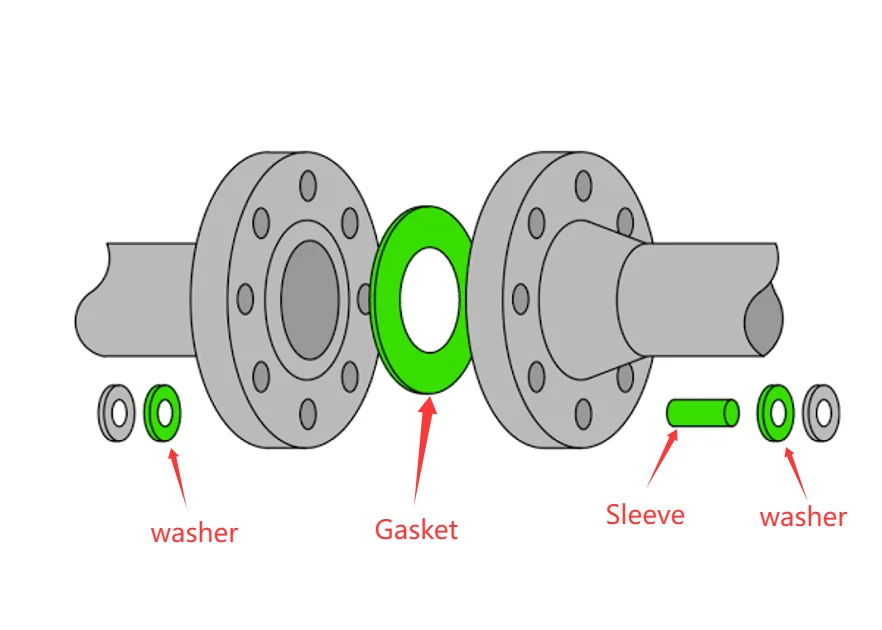
Use a gasket between the surfaces of the two metal parts. From the definition of galvanic corrosion, we can easily know that it doesn't occur between two plastics or plastic and metal parts. Therefore, plastic parts like PTFE, nylon, neoprene, and EPDM can be used as gaskets between dissimilar metal parts.
In addition, plastic sleeves are used to cover the bolt shank to separate the metal bolt from the hole wall. Therefore, when you are designing parts, the connecting structures should be considered and device what insulating isolators to use.
Non-Conductive Fasteners for Electrical Isolation
Non-conductive plastic fasteners like Nylon, PEEK, and composite fasteners reinforced with glass also can be used to separate two dissimilar metal parts especially two plates. Such fasteners are ideal for use in light load applications, covers, and panels. They are not as strong as steel and therefore not recommended for use in high load bearing applications. In such cases, coated metal fasteners are recommended.
Apply Surface Finishes for Parts to Prevent Galvanic Corrosion
Coating of the metal is used as a barrier to isolate the metal from its mate in the galvanic series. Both are equally effective in the process of corrosion protection. However, which coating would be suitable will be based on several factors.
Match Finishes to Service Conditions
First, one should identify the function of the joint. In this case, the fact that the joint should be conductive with regard to the ground makes it necessary to use a conductive coating. For the structural joint in the salt spray environment, a heavy coating would be required. The sliding surface requires a hard coating.
|
Finish |
Best use |
|---|---|
|
Chromate conversion coat (MIL-DTL-5541) |
Aluminum grounding points and enclosures |
|
Zinc-nickel plating |
Steel fasteners in harsh outdoor use |
|
Electroless nickel |
Aluminum or steel parts for wear and corrosion control |
|
Passivation (stainless) |
Stainless parts, to restore the oxide film |
|
Anodize Type II |
Aluminum housings and cosmetic parts |
|
Hard anodize Type III |
Aluminum parts with wear and corrosion needs |
|
Powder coat |
Large, exposed parts and outdoor frames |
Conductive Metallic Surface Finishes
Anodizing is a process of coating which protects the aluminum surface but at the same time keeps the surface electrically conductive. The zinc-nickel coating is used to protect the steel from any form of corrosion. The electroless nickel coating is even but pores can form causing corrosion of the surface of the metal.
Non-Conductive Protective Coatings
Non-conductive coating acts as the insulator of the surface. Anodizing produces the layer of aluminum oxide on the surface. Al2O3 is resistant and non-conductive. One must remember that the process of anodizing increases the thickness of the coating by half.
The powder coating and electrocoating form the thick barrier of the coating. But it should be noted that there is the main drawback of the powder coating and electrocoating, i.e. they can chip off. An important point you should know is that a small exposed anodic area and a large cathodic area can accelerate localized anodic corrosion due to ratio effect.
Galvanic Corrosion Prevention by Industry
Preventing galvanic corrosion varies with industries. Let us learn the specific solutions for preventing galvanic corrosion of mating parts in different industries. This can guide you avoid galvanic corrosion when designing your parts for different operating environments.
Automotive and Transportation
Galvanic corrosion occurs due to the effect of road salt and water accumulation. Galvanic couple can consist of the aluminum components, steel frame, and stainless-steel fasteners. Fasteners must have a zinc-flake or zinc-nickel coating. Steel must be covered by the e-coat finish and joints must be sealed. There should be drain holes in places where water can accumulate.
Aerospace and Defense
In order to prevent galvanic corrosion in the aerospace industry, it is important to consider that aluminum can corrode with titanium and carbon fibre in contact with moisture. It is necessary to isolate these materials with the layer of glass fibres or barrier film. Sealing of the fasteners will also reduce the risk of moisture. It is suggested to apply chromate or its equivalent to aluminum.
Marine & Offshore
The process of galvanic corrosion is accelerated in the presence of seawater in the marine/offshore parts. If it is possible to use those metals whose corrosion potential is about the same. High-corrosion-resistance materials like 316L and duplex steel are premium choices for marine parts. One can use coating, gaskets, and sleeves for separation of various metals. Major metals can be protected with zinc or aluminum anodes installation. Regular inspection is required as coating can be worn by waves and saltwater spray.
Industrial Equipment
The dirt and cleaning chemicals cause the galvanic corrosion of industry equipment like food processing equipment and automated production instruments. The water and cleaning chemicals seep into the joints and gather in the cracks. Use stainless steel or coating on the components and avoid areas where the water can accumulate. Make sure that the cleaning chemicals will not damage the coating.
Medical Devices
Corrosion in medical devices could be caused by steam, saline solutions, and cleaning solutions. In order to avoid it, use the passivated 316L stainless steel or titanium. Try not to use different types of metals if it is possible. Make sure that the joints are easy to clean and dry.
Frequent Design Mistakes That Cause Galvanic Corrosion
At the stage of designing, some unreasonable designs can also cause galvanic corrosion.
Overlook Galvanic Risk from Embedded Threaded Inserts
Embedded metal thread inserts can easily cause internal galvanic corrosion between interface of inserts and the base substrate. Therefore, at the stage of design, you should evaluate the material of inserts and the base parts.
What's worse, when the inserts are pressed into the metal substrates, there is a narrow crevice between their interfaces, which can easily trap moisture, cutting fluid and electrolytes.The solution is selecting insulated threaded inserts or seal the press-fit boundary.
Underestimate Coating Wear on Sliding Contact Surfaces
The coating on the surfaces of parts is going to be removed. For example, sliding friction surfaces of guide pins quickly wear away coatings. And the exposed substrate easily undergo galvanic corrosion for its direct contact with dissimilar metals.
To avoid this risk, you should evaluate the wear life of parts before applying coatings on them. Normally, it is done on those areas which have some sort of movement, like hinge, clamps, or bolts, etc.
Check Material Compatibility but Ignore the Area Ratio
The surface area is important as well. When anode is smaller than cathode, the corrosion process proceeds fast because all currents get focused in one spot. In turn, the larger anode lasts longer.
For example, a small steel screw fastened to a large aluminum housing — aluminum acts as the anode and corrodes rapidly. Conversely, a small aluminum rivet on a large stainless steel plate will fail quickly.
Therefore, the recommended design solution is to use a larger anode and a smaller cathode to distribute corrosion current and slow down the corrosion rate.
Tuofa DFM Advice for Avoiding Galvanic Corrosion Risk
Upon using the machining manufacturing services provided by Tuofa, we will examine your design to ensure that it is not susceptible to any corrosion before cutting. We will use your drawings if you use our service as a CNC service provider. If there is something that is not easily machinable, we will give some suggestions.
Evaluate Features Prone to Fluid and Debris Retention
We will find out the blind cavities, pockets, and deep grooves that are containing the fluid. Some suggestions would be drilling holes, opening holes, or increasing the radiuses that can be accessed by the machines. Such modifications are quite inexpensive.
Edge and Burr Control Review for Corrosion-Prone Zones
Burrs and sharp edges decrease the coating thickness and even perforate the gasket. Sharp edge makes the coating less effective. Our recommendations would be to create an edge break which is 0.1 mm to 0.3 mm on joint surfaces and hole exits.
Tolerance Specification Review for Assembly-Induced Corrosion Risk
The importance of tolerances in corrosion problems goes underappreciated. Poor fits make gaps, while pressed fits remove coatings. Coating itself may create a gap where you want the part to have one. Tuofa performs fitting analysis and takes into account coating tolerances to make sure that the part fits well and has good drainage.
In case you process your parts at Tuofa, you may send us your drawings for DFM analysis, and we'll find any galvanic issues in advance.
Conclusion
Galvanic corrosion can be minimized through proper selection of materials and design. You need to select proper materials and coating of parts as well as avoiding entry of water in the joint. This will prove useful for parts produced using CNC technology. It will enable you to prevent any damage, save money on repair costs, and prolong the lifespan of parts.
FAQ
Can plastic parts cause galvanic corrosion?
Plastic is not a conductor of electricity; therefore, it is impossible to form a galvanic cell using plastic. It is an excellent insulator. Carbon-based plastics and carbon fiber composite materials are exceptions to this case. They conduct electricity and serve as noble cathodes to aluminum.
Does paint prevent galvanic corrosion?
Paint is a good way to protect but does not guarantee that your metal will be protected. Painting results in coating and scratching in any way would lead to exposure of the metal. If you have to paint only one metal surface, paint the noble metal surface.
How to prevent galvanic corrosion between aluminum and stainless steel?
Disassembly of cell is recommended. Insulation washers and sleeves should be used at the joint. Application of sealant is needed to avoid any kind of leakages of fluids. Aluminum must be anodized whereas stainless steel must be passivated. Size of aluminum surface must be bigger than that of stainless-steel surface.
 Is Bronze Magnetic? Choose the Right Bronze for Your Parts