Tel/WeChat:
 Email:



 Home
Comparison of Brass Nuts and Steel Nuts: Materials, CNC Machining & Applications

 Published:Nov 19,2026

In engineering applications, there is a wide choice of materials to be chosen for nuts. Two of the most common materials are steel and brass. Even with similar geometries, steel nuts and brass nuts perform quite differently. Both of them have their own set of properties and applications. Here we'll be giving deep insight into this topic. A lot of myths will also be busted. Stay tuned!
Overall Comparison: Brass Nuts vs Steel Nuts Material Properties
Brass nuts have useful properties such as nonmagnetic behavior, anti-galling, high machinability, precise thread formation, high throughput, etc. Steel is favored due to it high strength, structural integrity, high toughness, and endurance to fatigue. There are many grades and classes of brass and steel nuts. As per application requirements suitable grades of nuts are chosen. The table below briefly provides a comparison of brass nuts and steel nuts material properties.
|
Material Property |
Brass Nuts |
Steel Nuts |
|---|---|---|
|
Tensile Strength |
Generally lower |
Much higher than common brasses |
|
Thread shear resistance |
Lower |
Higher |
|
Hardness |
Relatively soft |
Harder than common brasses |
|
Anti - seizing resistance |
Very good |
Susceptibility to seize |
|
Corrosion resistance |
Excellent |
Carbon steel corrode over time. Stainless steel is corrosion resistant |
|
Galvanic corrosion |
Brass is not likely to be an anode in common galvanic pars |
corrosion on steel might speed up |
|
Thermal expansion |
High: 20 × 10⁻⁶/K |
Lower than brass: 12 × 10⁻⁶/K |
|
Thermal Conductivity |
High |
much lower than brass |
|
Electrical conductivity |
Good |
Relatively poor |
|
Creep |
Susceptible to creep at elevated temperatures |
resists creep |
|
Machinability |
excellent |
lower |
|
Density |
8.6 g/cm³ |
7.8 g/cm³ |
|
Magnetic properties |
Non - magnetic |
Common grades are ferromagnetic |
|
High - temperature strength |
Lower |
Higher |
|
Impact resistance |
Lower |
higher |
Brass Nuts Explained
The term “brass nuts” should not be taken as a generic term. Rather, brass nuts are of numerous types, classes, and materials. One material differs from another. Each material serves its own set of applications. A few of the brass nut materials are explained here.
|
Material |
Grade |
Standard |
Characteristics |
|---|---|---|---|
|
Free - Cutting Brass |
C36000, C36010 |
ASTM B16 /B16M |
Excellent machinability |
|
Lead- Free Brass |
C69300, C49250 |
ASTM B124/B124M; ASTM B283/B283M |
Lead-free option |
|
Silicon brass |
C69300 |
ASTM B124/B124M, B283 /B283M |
Good strength, corrosion resistance and machinability |
|
Naval Brass |
C46400 |
ASTM B124/ B124M, B283/B283M |
seawater corrosion resistance |
|
DZR Brass |
C48640 |
ASTM B124 /B124M, B283/B283M |
resistance to dezincification in water |
|
Forging Brass |
C37700 |
ASTM B124/B124M, B283/B283M |
Hot-Forging characteristics |
|
High - Strength Brass |
C69300 |
ASTM B124/ B124M, B283/B283M |
Higher strength than conventional brass |
Common Types of Brass Nuts
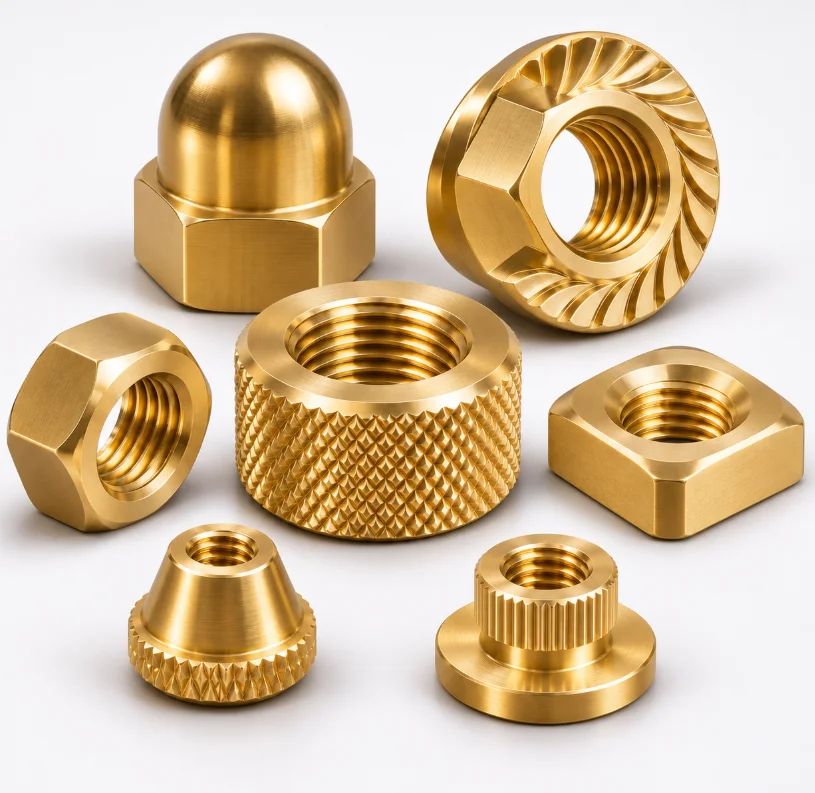
Free-Cutting Brass Nuts
Free-cutting brass is widely used in machining applications. It offers excellent machinability. A small addition of lead in free-cutting brass nuts enhances chip-breaking. As chips break easily, lower cutting force is needed. Heat also dissipates quickly. As a result, you can expect high dimensional accuracy, high throughput, and better surface finish. Free-cutting brasses are well suited for bulk production and small-sized brass nuts.
Naval Brass Nuts
Naval brass nuts are particularly found in marine applications. A small addition of tin in the copper-zinc alloy enhances corrosion resistance. While normal brass nuts tarnish quickly in marine environments, naval brass nuts can withstand these harsh conditions. Their mechanical strength is also better than ordinary brass grades. However, when dissimilar metals are connected, e.g. a brass-or-steel combination, galvanic compatibility should be checked.
Lead-free Brass Nuts
As lead acts as a slow poison, the use of lead can be restricted. For instance, environmental or municipal regulations would restrict its use in water utilities. Lead may be compensated by Si, Se, or Bi.
Steel Nuts Explained
Steel nuts come in a variety of types, classes, and grades. This variation caters to aspects like joint load, preload, operating environment, temperature, corrosion exposure, and compatibility. Broadly, steel nut categories include carbon steel nuts, stainless steel nuts, and alloy steel nuts.
|
Steel Material |
Common Grade |
Relevant Standard |
Key Characteristics |
|---|---|---|---|
|
Low - Carbon Steel |
1006 |
SAE |
Low cost, weldability |
|
Medium - Carbon Steel |
S275 |
EN 10025 |
Moderate strength |
|
High - Strength Carbon Steel |
1045 |
SAE |
High strength and hardness |
|
Alloy steel |
4041 |
SAE |
Heat - treatable for strength enhancement |
|
Austenitic stainless steel |
304 / 316 |
ASTM F594 |
Excellent corrosion resistance |
|
Martensitic Stainless Steel |
410 |
ASTM F594 |
Corrosion resistance and high hardness |
|
Precipitation - Hardening Stainless Steel |
17 - 4 PH |
ASTM F594 |
Very high strength with good corrosion resistance |
Common Types of Steel Nuts
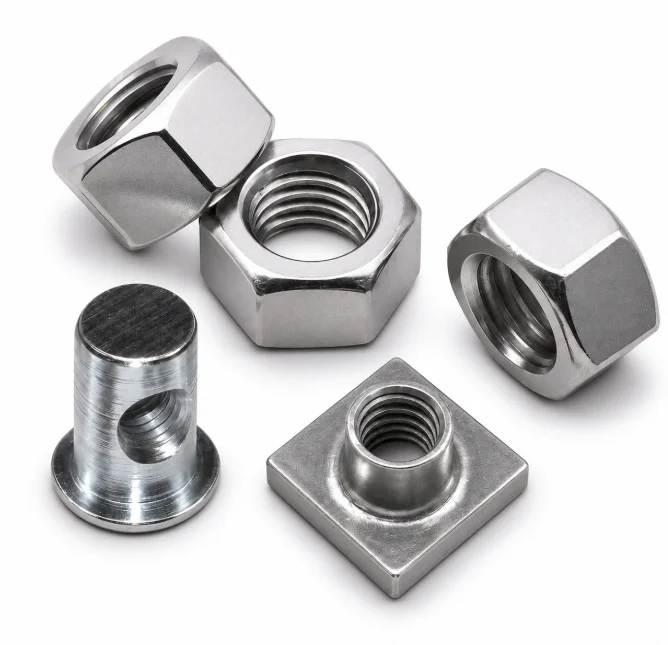
Carbon Steel Nuts
Carbon steel nuts are the most commonly used type of steel nuts. They are widely available and cost-effective. Their mechanical performance varies depending on carbon content and heat treatment. Depending on the application, suitable grades and classes of steel nuts can be chosen. The biggest limitation of plain carbon steel nuts is their susceptibility to corrosion. So, galvanization or phosphate coating might be needed.
Stainless Steel Nuts
Stainless steel nuts have corrosion resistance as their biggest advantage. Different corrosive environments need different stainless steel nut grades. For example, 316/316L stainless steel nuts are specified for marine environments. Food factories might specify 304 stainless steel nuts due to them being food grade. But stainless-steel nuts might be prone to thread galling or seizing. So anti-galling strategies should be employed.
Alloy Steel Nuts
Alloy steel nuts contain chromium, molybdenum, nickel, or manganese to enhance mechanical performance. Certain alloy grades are known for increasing hardenability, toughness, or fatigue performance. So they are used in conditions like high preload, high tensile loading, or repeated loading. Out of other steel nut categories, alloy steel nuts have higher resistance to thread stripping and deformation.
Properties Comparison: Brass vs Steel
From a material selection perspective, a comparison of brass nuts and steel nuts material properties should be made. The properties directly affect thread loading capacity, tightening torque, clamping force, weight, and EMI.

Mechanical Properties
In a comparison of brass nuts and steel nuts material properties, steel nuts outperform brass nuts in almost all metrics.
Yield Strength
Brass has a wide variation in yield strength values. But generally, they yield at stresses much lower than what steel nuts can endure. This means that steel can handle high tightening loads with high clamping force.
Hardness
Steel nuts are harder to indent than brass nuts. This property becomes useful when anti-seizing behavior is harnessed from a brass and steel nuts combination.
Shear Strength
The shear strength of brass is around 150-500 MPa. For steel, this number is 300-900 MPa. During tightening, the axial load is transferred to the threads. It generates shear stresses in the threads. So, steel threads can be expected to endure higher shear stress than brass threads.
Compressive Strength
The compressive strength of steel is better than that of brass. It is easy for thread profile deformation or thread flank collapse on the brass when exceeds the bearing limit. Instead, steel keeps stability under high pressure.
Elongation
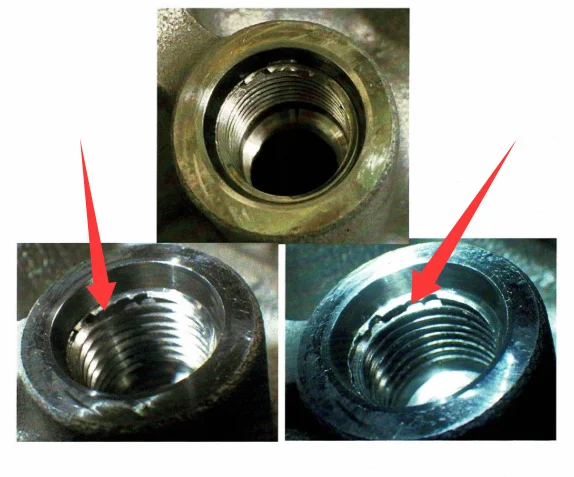
Brass elongates more than steel. What's more, brass has good ductility. It doesn't easily fracture suddenly because of its plastic deformation. However, the elongation can be very different in steel grades. The annealed low-carbon steel has high elongation while untempered quenched alloy steel has extremely low elongation. The latter can fracture suddenly without any warning compared with brass.
Physical Properties
Density
Brass, with a density of around 8.5 g/cm3, is denser than steel, which has a density of 7.8 g/cm3. This means that brass nuts with the same dimensions would weigh more than steel nuts.
Linear Thermal Expansion Coefficient
Brass has a thermal expansion coefficient of around 20 x 10^-6 / K. It expands/ contracts more than steel, which has an expansion coefficient of 12 x 10^-6. Consider this factor in areas where dissimilar metals are used in temperature-varying environments. Otherwise, thermal stresses might damage the fasteners.
In detail, when a brass nut is connected with a carbon steel nut, the expansion of brass is more than that of the other one as the temperature raises, which leads to increased thread preload. If the temperature decreases, the reverse applies.
Thermal Conductivity
Brass is more thermally conductive than steel. So, heat dissipation from brass nuts would be quicker than from steel nuts. This makes brass nuts widely used for power devices or water-cooled devices. However, if a steel nut is mistakenly used for thermal devices, heat accumulates at the contact interface, creating hot spots. The hot spots can raise the temperature and accelerate component aging and reduce the power rating. This is also the reason why Tuofa confirms the application of parts before machining. Confirming the use of parts allows us to provide professional material recommendations.
What Are the Pros and Cons of Brass Nuts and Steel Nuts?
The material properties of brass nuts and steel nuts translate into their pros and cons. They both find their use in applications that suit their material properties. Brief lists of their pros and cons are listed below.
Pros and Cons of Brass Nuts
Advantages of Brass Nuts
- Brass nuts are resistant to rust.
- Brass nuts are resistant to galling in parts assembly.
- Brass nuts can reduce vibration noise due to their damping properties.
- Brass nuts offer good electrical and thermal conductivity, eliminating the requirements for additional conductive media.
Disadvantages of Brass Nuts
- Brass nuts have lower strength, making them not suitable for load-bearing parts.
- Brass nuts can't bear high temperatures. Their strength continuously decreases when the temperature is over 120℃.
- Higher material costs.
- Brass nuts made of some typical grades have the risk of dezincification and seasonal cracking.
Pros and Cons of Steel Nuts
Advantages of Steel Nuts
- Steel nuts have good impact resistance, suitable for structural load-bearing applications.
- Steel nuts have stable preload, making them not easy to loosen.
Disadvantages of Steel Nuts
- Steel nuts are easy to rust because of the iron content of steel.
- Steel nuts have no self-lubrication. The tightness will differ even with the same turning force, which is hard to control.
- Galling is easy to happen between a steel nut and a steel bolt.
- The hardness of some grades of steel like stainless steel can result in an increase in tool cost.
When to Choose Brass Nuts or Steel Nuts?
In our practical machining experience, choosing brass or steel nuts is a common question from our clients. The selection depends on the operating scenarios and functional requirements of parts.
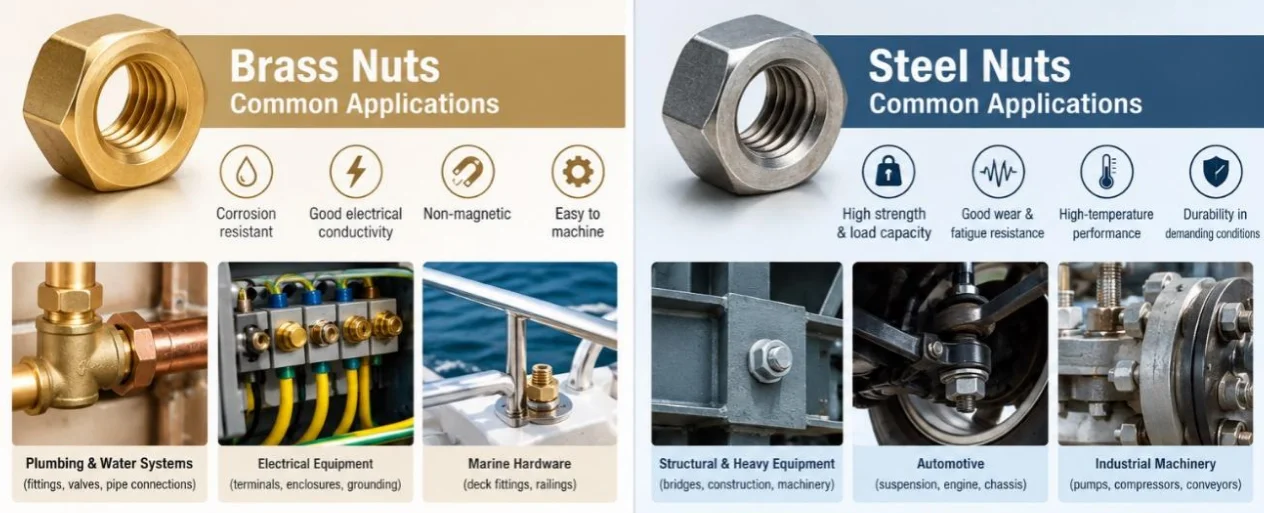
What Are Brass Nuts Used for?:
Humid or Moderately Corrosive Environments
Brass nuts exposed to a humid environment do not need any protective coating to combat rust. They can endure mildly corrosive environments without the risk of corrosive degradation. So, brass nuts are often used in plumbing equipment, ship hardware, and other outdoor equipment.
However, if your CNC-machined nuts are used in continuous hot water or chlorine immersion, we advise you to choose bronze or 316 stainless steel nuts instead of brass because it will suffer from dezincification.
Anti-Galling Threaded Assemblies
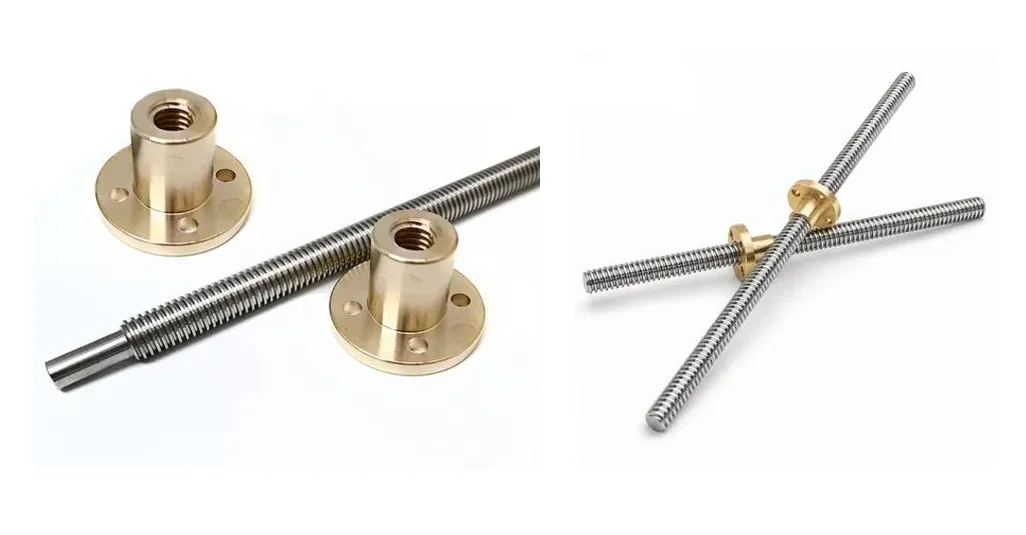
Brass has a lower hardness than steel. As we know, galling is an adhesive wear phenomenon and easily happens when two dissimilar metal parts are connected with each other and become scratched or seized. Based on our machining experience, a brass nut is preferred to avoid galling when the other material is steel. For example, brass nuts are usually used together with steel lead screws, which aren't static connections.
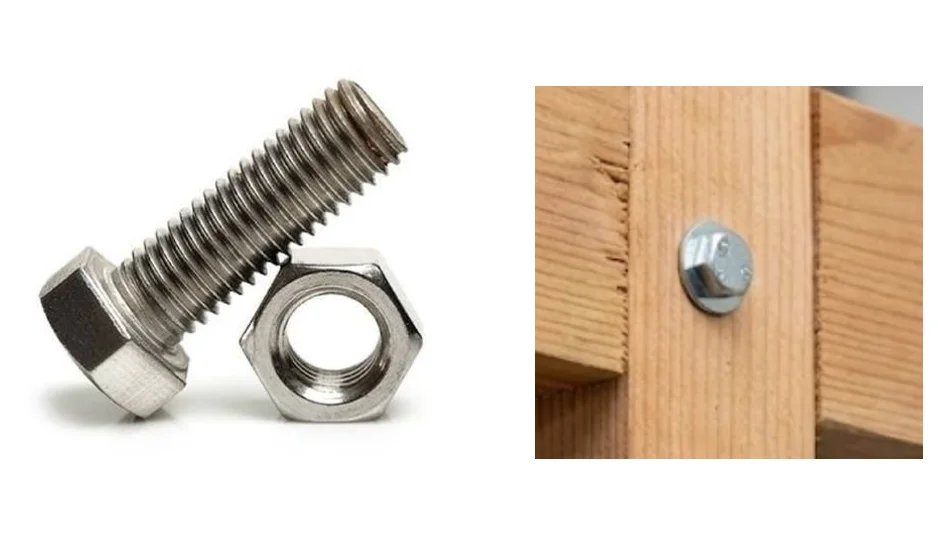
However, if you have a steel bolt, brass nut or steel nut should you choose? You can easily find that steel nuts are always used together with steel bolts in many industrial applications because their connections are static, and steel bolts and nuts are seldom threaded out. To prevent galling, we use anti-seize lubricants, reducing the thread friction coefficient, or controlling the tightening speed.
Non-Magnetic Precision Assemblies
Brass nuts can be safely employed in places where ferromagnetic materials cannot be used. Brass being non-magnetic does not interfere with electric and/or magnetic signals. Brass nuts are thus suitable for instrumentation, sensors, electrical equipment, and laboratory equipment.
Compared with brass, steel is magnetic and has weak residual magnetism after CNC machining, which makes it not suitable for these magnetically sensitive applications. Even after demagnetization, a steel nut is still not a good choice because it has the risk of generating residual magnetism during thread tightening.
What Are Steel Nuts Used for
Heavy-Load Structural Joints
Steel, having an impressive mechanical strength, has the ability to withstand heavy loads that brass nuts cannot. Steel nuts are widely used in machinery, structural connections, construction, mining, and heavy equipment. But fastener grade and class should be checked for compatibility.
Vibration and Cyclic-Load Equipment
Steel nuts offer good thread integrity under cyclic loading. Since steel nuts have high shear strength, the risk of damage due to vibrations is small. But, steel nuts may loosen during high vibrations. So, a locking method may be introduced to keep the nuts in place. On the contrary, brass nuts aren't suitable for this kind of equipment because it has poor fatigue resistance which can result in thread creep and loosening.
Impact-Loaded Assemblies
Steel nuts are commonly used for impact-loaded assemblies such as mining equipment, off-road vehicles, and construction machinery and so on. The response of steel nuts upon impacts is excellent. Many grades of steel nuts have very high toughness values. This means that they can absorb high impact energy without breaking. Nevertheless, brass nuts easily deform under instantaneous impact.
Machinability: Brass vs Steel
Apart from some hard-to-machine brass grades, brass has a higher machinability than steel. High machinability offsets the high material cost of brass. Although steel is comparatively more difficult to machine than brass, optimum settings and proper tooling help to achieve great results.
Brass: Easy to Machine
In the comparison of brass nuts and steel nuts' machinability, brass nuts visibly stand out. Free-cutting brass grades like C3600 require low cutting forces. So high throughput and good finish can be achieved with relatively low effort. However, lead-free brass is a bit difficult to machine.
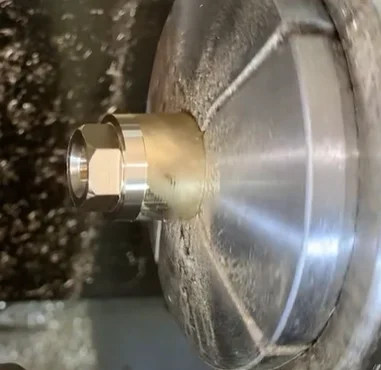
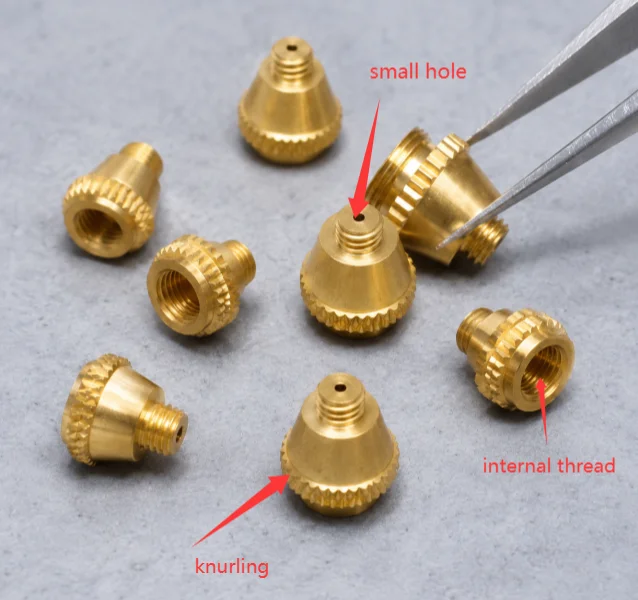
The high machinability allows CNC machining of precision brass nuts with stably controlled pitch diameter, thread angle and concentricity, and a good-quality surface with minimal burrs. In addition, some brass nuts undergo diamond knurling to improve grip and make manual tightening easier. Therefore, the benefits of CNC machining brass nuts include:
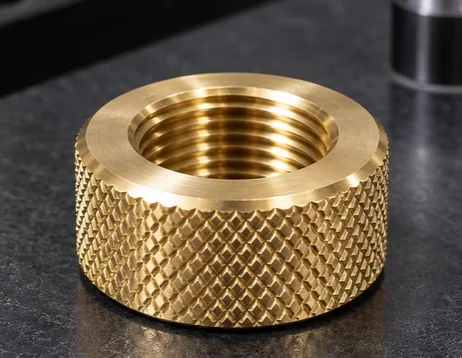
- No material adhesion to the cutting tool
- well-defined threads
- Durable knurling
Why Is Steel Harder to Machine than Brass?
Steel being harder and stronger requires high cutting forces for machining. It also generates more heat at the tool-substrate interface. But this does not mean that dimensional accuracy and good surface finish cannot be achieved.
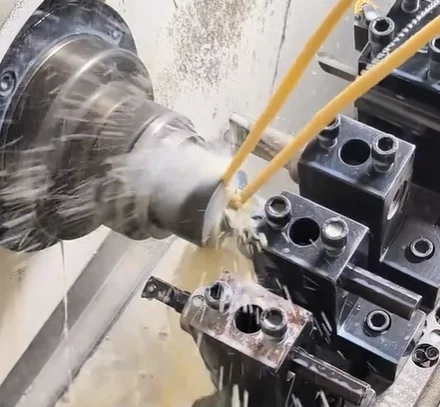
- Carbon steel has high strength and can easily generate long continuous chips that may scratch finished threads.
- Stainless steel is prone to work hardening, leading to accumulated cutting heat and damage to cutting tools.
- Alloy steel is very hard, making it difficult to machine unless ceramic tools are used, which can increase the machining costs.
In general, CNC machining custom irregular steel nuts is more difficult than brass nuts.
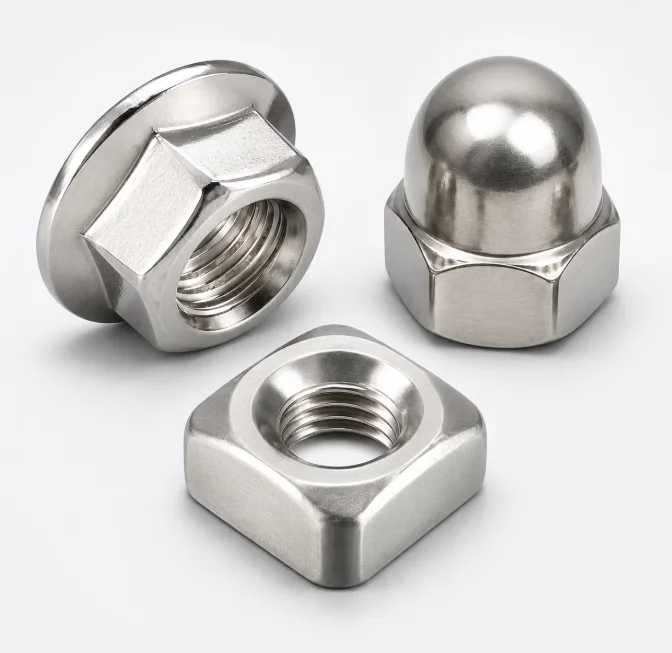
Machining Cost Comparison: Brass vs Steel Nuts
While brass is way more expensive than steel, it has major advantages in machining costs. With good machinability, brass nuts can be produced at high speeds with low tool wear and low scrap generation. Steel may require expensive carbide or coated tools, but tooling for brass incurs low cost. Even after machining, steel nuts might require finishing operations like galvanization. But brass nuts can function properly without any coatings.
Why Choose Tuofa CNC Machining for Custom Brass and Steel Nuts?
Tuofa is a CNC machining company in China. We handle all sorts of machining tasks. Over the years, we have earned a specialty in machining difficult materials and intricate shapes. In addition to CNC machining services, we also provide recommendations for selecting steel and brass, and compatible surface finishing services. Here are some custom brass nuts with irregular geometry.
Material Selection Supporting
Tuofa engineering team is familiar with almost all classes of materials. It can effectively handle specialty grades. Our dedicated engineers can evaluate the risk and recommend cost-effective materials for you.
For example, we will help you prevent risks such as dezincification risk, seasonal cracking risk, and hydrogen embrittlement risk and so on before starting machining.
Support Low-Volume Production for Small Precision Parts
Tuofa is equipped with Swiss lathes and other small advanced CNC mills and lathes, supporting our manufacturing capability of small brass nuts and steel nuts with precision threads. Our machines are adaptable to design iterations and customization. We can even manufacture small-sized parts with a low MOQ. Our QA/QC team vigilantly monitors dimensions, tolerances, and surface finish.
One-Stop Solution from Machining to Surface Finish
We also perform finishing operations like grinding, polishing, plating, painting, and galvanization in-house. The compatibility between surface coatings and brass or steel must be considered. Finally, our QA/QC team validates quality to exceed customers' expectations.
Conclusion
Two of the most common material categories used in nuts are steel and brass. They have different material properties. So, they find their suitability is determined in different applications based on their material properties. Brass has advantages like anti-galling, low EMI interference, high machinability, and no rusting in mildly corrosive environments. Steel is beneficial in applications that require high strength, high toughness, etc. Different grades of steel or brass are used to complement specialized applications.
FAQ
Does stainless steel react with brass?
A dissimilar metal couple might initiate a galvanic reaction. For a steel-brass pair, steel might start to corrode more quickly than in the unpaired form.
Is brass softer than steel?
Generally, most grades of brasses are softer than steels
Is zinc plating suitable for brass nuts?
Brass usually does not need any protective coatings in a mildly corrosive environment.
Is brass stronger than steel?
Steels are usually stronger than brasses.
 Thermal Conductivity of Aluminium: Guide for Material and CNC Machining