Tel/WeChat:
 Email:



 Home
Custom Aftermarket Performance Parts CNC Machining: A Complete Guide

 Published:Nov 24,2026

Generally, vehicles perform reliably with factory-fitted standard parts. But in demanding applications, like racing or off-roading, standard OEM parts have performance limitations. In these scenarios, people often resort to higher-performance parts. Depending on the operating requirement, customization of these parts can be undertaken. CNC machining plays a fundamental role in the manufacturing of aftermarket performance parts. Better quality materials and design modifications can be incorporated in the new parts. Here is a complete guide to customization and CNC machining of these parts.
What Are Aftermarket Performance Parts?
Aftermarket performance parts are upgraded components for cars, motorcycles, and other powersports vehicles built to exceed original factory stock specifications. In contrast to standard OEM parts, these are often designed and provided by third-party companies like Tuofa who provides CNC machining services. These performance components incorporate modifications in design and materials. So that vehicles optimize performance parameters like engine power, acceleration, handling, braking, suspension, fuel efficiency, or aesthetics.
Performance Parts vs OEM Replacement Parts
|
Feature |
Aftermarket performance parts |
OEM replacement parts |
|---|---|---|
|
Purpose |
Improve performance |
Restore original factory making |
|
Manufacturer |
Third- party manufacturers |
OEM |
|
Performance |
Improves power, handling, braking, etc. |
maintains original performance |
|
Materials |
Premium materials |
Standard OEM materials |
|
fitment |
May require modifications |
Factory- fit replacement |
|
Customization |
High |
Limited |
|
Applications |
Racing, off-road, towing. |
Maintenance and repairs |
Common Applications of Aftermarket Performance Parts
Aftermarket performance parts are used in a range of vehicle types. From commercial trucks to racing to off-roading vehicles to towing, aftermarket performance parts find their place. Wherever standard OEM parts struggle to perform, aftermarket performance parts come into play. So, automotive parts are customized to optimize performance.
Main Categories of Aftermarket Performance Parts
Aftermarket performance parts are usually used in engines, suspension, chassis, brakes, and drivetrain. Depending on the intended usage, standard parts may be replaced with aftermarket performance parts.
Engine Performance Components
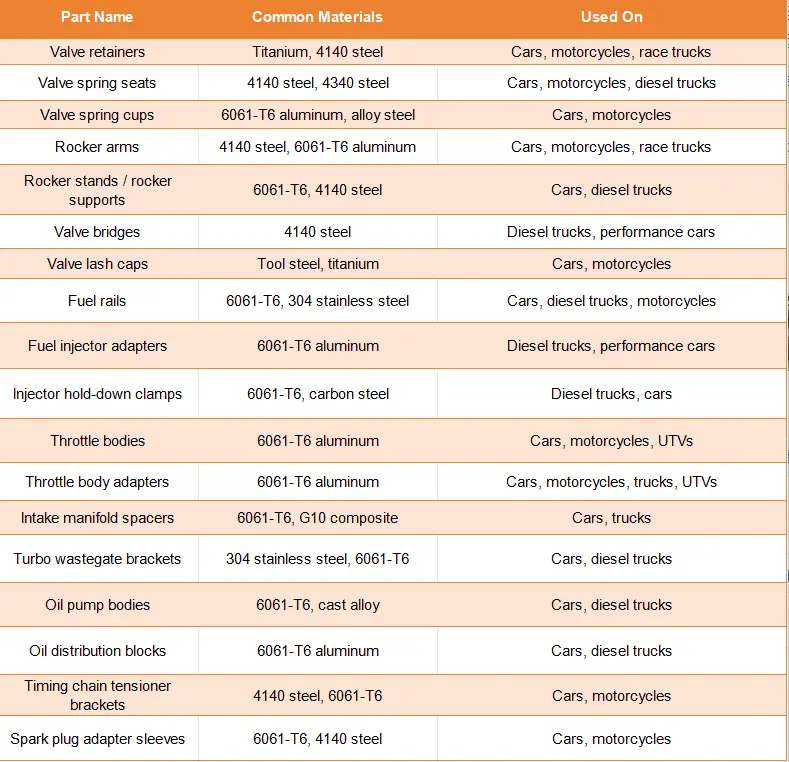
At times, engine output parameters like power, torque, throttle response, or fuel efficiency need enhancement. Generally, an engine's performance depends on the air intake system, exhaust systems, turbochargers, intercoolers, camshafts, fuel injectors, etc. So, modification of these auto parts can optimize engine response. The customization can be in both design and materials. Design can improve combustion, whereas materials improve durability. For example, forged pistons are used to accommodate higher cylinder pressure and engine speeds.
Suspension and Chassis Components
Suspension and chassis components provide stability to vehicles. Stability is especially important in rough terrain and for loaded vehicles. In this scenario, aftermarket performance parts improve handling, ride control, cornering ability, and structural rigidity in comparison to OEM parts.
Common aftermarket performance parts include lower springs, coilovers, shock absorbers, sway bars, control arms, bushings, chassis braces, and adjustable suspension. In achieving these goals, the damping, body roll, position of center of gravity, or structural rigidity are improved.
|
Part Name |
Common Materials |
Used On |
|---|---|---|
|
Upper control arms (UCAs) |
6061-T6 aluminum |
Trucks, cars, UTVs, ATVs |
|
Differential covers |
6061-T6 aluminum |
Trucks, cars, UTVs |
|
Turbo flanges and turbo adapters |
6061-T6, 304 stainless steel |
Cars, diesel trucks |
|
Fuel distribution blocks |
6061-T6 aluminum |
Trucks, performance cars |
|
Throttle body adapters |
6061-T6 aluminum |
Cars, motorcycles, trucks, UTVs |
|
Brake caliper brackets |
6061-T6, 4130 chromoly steel |
Cars, trucks, UTVs |
|
Transfer case adapters |
6061-T6, 4140 steel |
Trucks, off-road vehicles |
|
Sway bar mounts |
6061-T6 aluminum |
Cars, trucks, UTVs |
|
Track bar brackets |
6061-T6, 4140 steel |
Trucks, off-road cars |
Brake and Drivetrain Components
Brakes serve the purpose of stopping automobiles. The drivetrain is used in power transmission. Factory-fitted components usually meet standard requirements. But for extraordinary requirements, custom performance parts are needed. For braking,
larger brake rotors, multi-piston calipers, or high-friction brake pads may be used. Customized drivetrain components include clutches, limited-slip differentials, modified driveshafts, stronger axles, etc.
|
Part Name |
Common Materials |
Used On |
|---|---|---|
|
Brake caliper adapters |
6061-T6 aluminum, 4130 chromoly |
Cars, trucks, UTVs, ATVs |
|
Brake rotor hats |
6061-T6 aluminum |
Cars, motorcycles, race vehicles |
|
Axle flange adapters |
4140 steel, 6061-T6 |
Trucks, off-road cars |
|
Locking differential internals |
4340 steel |
Trucks, performance cars |
|
Drive shaft flanges |
4140 steel |
Cars, trucks |
|
Shift linkage brackets |
6061-T6, 4130 chromoly |
Cars, motorcycles, trucks |
|
Shift knobs |
6061-T6 aluminum, titanium |
Cars, motorcycles, UTVs |
|
Wheel hub adapters |
6061-T6 aluminum |
Cars, trucks, UTVs |
|
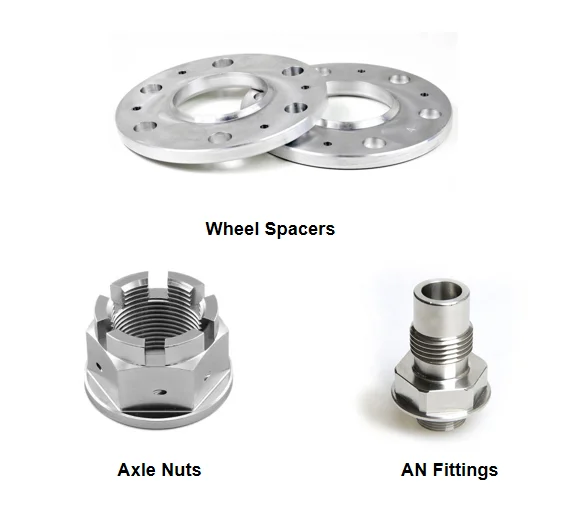
Wheel spacers |
6061-T6 aluminum |
Cars, motorcycles, trucks, ATVs |
|
Transmission adapter plates |
6061-T6, 4140 steel |
Trucks, classic performance cars |
Why Is CNC Machining Used for Aftermarket Performance Parts?
CNC machining can achieve ultra high precision and good surface because of its auto-controlled processing, which makes it an ideal manufacturing methods for high-performance aftermarket components.
Low-Volume Production without Expensive Tooling
Manufacturing processes other than CNC machining need tooling and fixtures that do not accommodate low-volume production. On the contrary, CNC machining only needs computer programming for modifying designs. So, practically, it can accommodate even a single-piece production. As aftermarket performance parts usually need a high level of customization, so this quality of CNC machining is advantageous.
Complex Geometry and Custom Designs
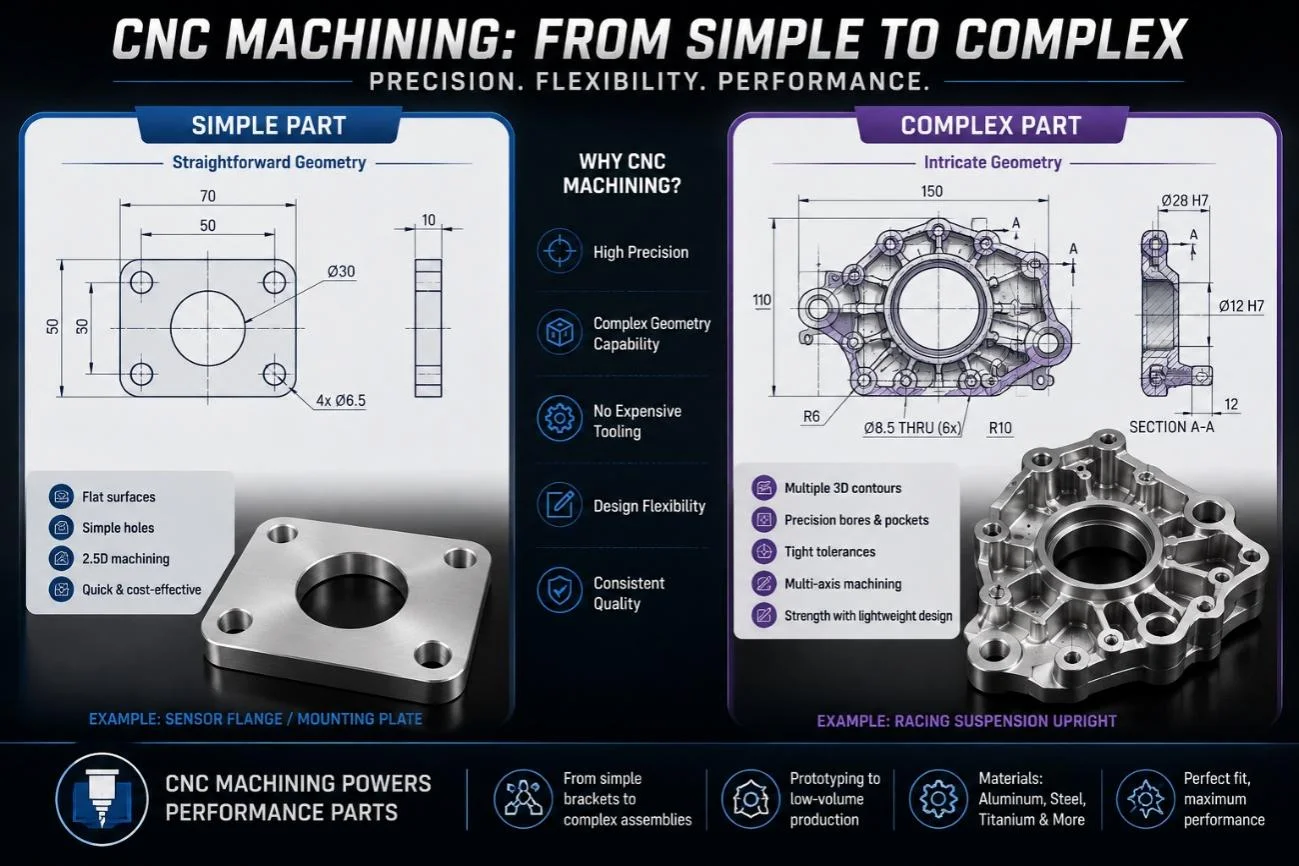
A lot of aftermarket performance parts contain features that are too complex for ordinary manufacturing processes. As an example, the drawing shown on the left side is quite straightforward. This part can be produced by simple cutting, grinding, and drilling operations. However, the part shown on the right side invokes the deployment of CNC machines. Modern CNCs like 5-axis machines can produce complex-shaped aftermarket performance parts in a single setup. It therefore promotes accuracy and quickness in lead time. Complex features like multiple curved surfaces, intersecting bores, pockets, ribs, and angled holes can be created with ease.
High Precision for Bolt-On Fitment
Aftermarket performance parts require high precision for bolt-on fitment. If modifications are desired to be kept to a minimum, then aftermarket performance parts need to fit directly onto existing slots. They need to simultaneously align with several mounting holes, dowel locations, shafts, bearings, pipes, or mating surfaces. Even a minute deviation will fail fitting. Here, the role of CNC machines gains traction. These machines can create parts with very high precision.
CNC Machining vs Casting and Forging for Performance Parts
Although CNC machining covers a large portion of aftermarket performance parts manufacturing, forging or casting may sometimes be more preferable. Usually, aftermarket performance parts are not mass produced. They need a high level of customization. So, the CNC machining process is often adopted. But for special cases like fatigue-proof components or ultra-high-complexity parts, sometimes forging or casting processes are adopted.
Advantages of CNC Machining
|
Advantage |
Performance Benefit |
Examples |
|---|---|---|
|
Low tooling cost |
Lower startup cost |
Brackets |
|
Low -Volume Production |
Cost- effective customization |
racing parts |
|
High Precision |
Proper fitting |
mounts |
|
Design flexibility |
Vehicle - specific designs |
Intake adapters |
|
Complex Geometry |
Advanced designs |
Suspension uprights |
|
Fast prototyping |
Faster development |
Engine components |
|
Repeatability |
reliable performance |
Brake adapters |
|
Weight reduction |
Lower component weight |
Racing brackets |
|
Material Flexibility |
Optimized strength - to - weight ratio |
Billet components |
|
Bolt-on Fitment |
Easier installation |
Brake adapters |
When Forging Is Preferred
Forging is preferred for aftermarket performance parts that would be subjected to high stresses and cyclic loading. But the cost of dies and tooling can only be justified if a sizeable quantity of identical parts is needed. Otherwise, the cost would be very high. Forging refines the microstructure, enabling these parts to withstand high loads over long periods. Common examples of forged aftermarket performance parts include connecting rods, crankshafts, gears, axles, steering components, and certain suspension components. But machining would still be required to fine-tune the dimensions.
When Casting Is More Suitable
Casting is suitable in cases where access for the tool would be difficult if machining is used. Features like internal passages, cavities, ribs, bosses, and irregular external shapes may at times be too complex for machining. Casting can accommodate high complexity. But low volume would increase the cost of the mold. Machining would still be required to adjust dimensions and to smooth the rough features.
Common Materials Used for CNC Machined Aftermarket Performance Parts
Steels often top the list of materials used in standard OEM components. While the importance of steel can never be neglected. Some other materials often surpass the performance parameters for some aftermarket performance parts. Here, a few of such materials are discussed.
Aluminum Alloys
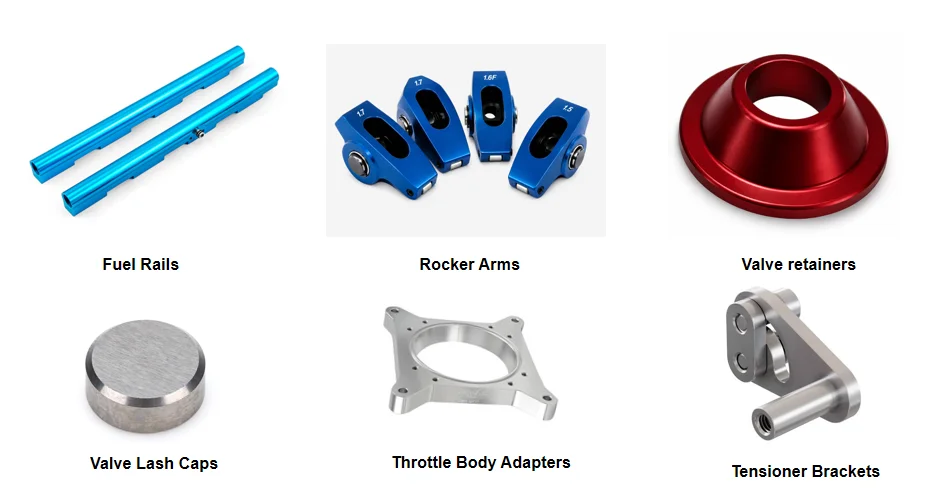
Aluminum alloys are generally used in aftermarket performance parts that do not bear high mechanical loads. Usually, the low-density benefit of aluminum is sought. Besides that, it is corrosion-resistant, machinable, and offers quite a few surface finishes. As an example, if intake components are made up of aluminum instead of steel, the mass can be reduced to one-third. The most common grade of aluminum is 6063. But for high-performance applications like racing cars, 7075 alloy may be used. Its strength is comparable to steel at a fraction of the weight. Therefore, even load-bearing parts can be made out of it.
Alloy Steel
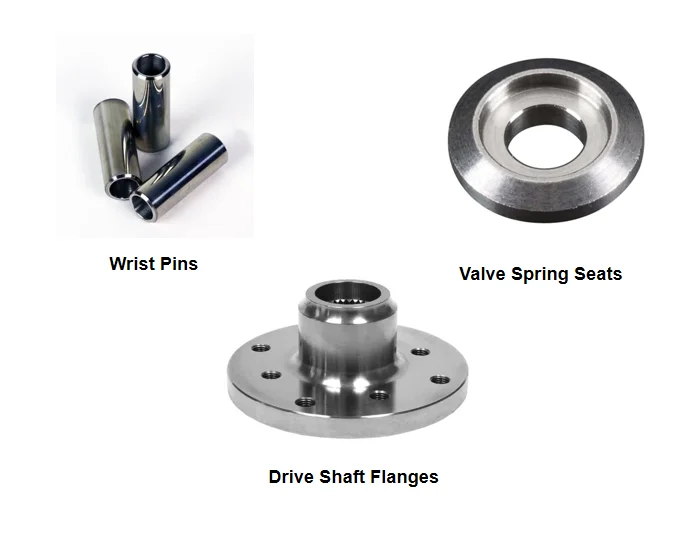
Alloy steels generally offer better toughness and fatigue resistance than plain carbon steels. Wherever high mechanical loads and impacts are expected, alloy steels can provide better durability. Moreover, due to higher yield strengths, designers can reduce thickness of some parts comparatively. This brings savings in weight. 4140 alloy steel and 4340 alloy steel are thus commonly used in aftermarket performance parts such as shafts, axles, gears, suspension components, and brackets.
Stainless Steel
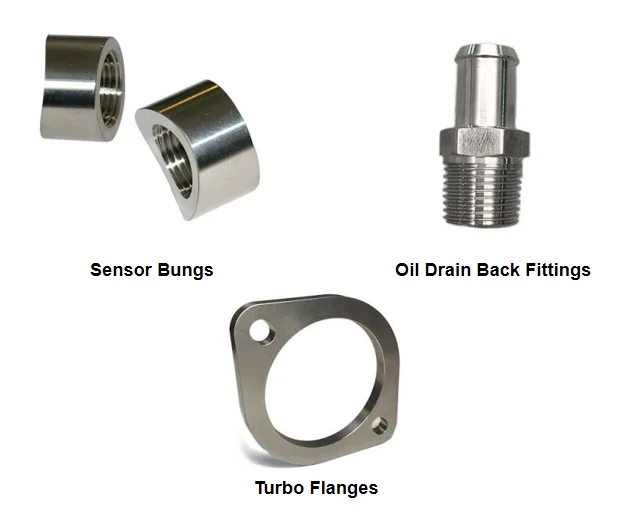
Aftermarket performance parts made up of stainless steel are ideal to be used in environments containing moisture, chemicals, and exhaust gases. These parts endure these aggressive chemicals without withering away. Exhaust parts, rims, lower parts of chassis, and fuel tanks are some areas where stainless steel can be used.
Titanium Alloys
Titanium is a truly high-performance material for automotive parts. As compared to steel, titanium reduces weight to half while providing the same mechanical strength. The weight of automobiles directly influences engine performance and fuel efficiency. While titanium can dramatically lower weight, a boost in performance can be expected. But the high price of titanium practically forbids its use in many applications.
Surface Finishing for CNC Performance Parts
Surface finishing of aftermarket performance parts is like adding sugar to a dessert. In certain conditions, it boosts performance drastically. Even if the cost increases, the durability of parts pays off in the long term.
Do Aftermarket Performance Parts Need Surface Treatment?
Aftermarket performance parts do not necessarily need surface treatment. However, the performance of certain parts and materials can be enhanced this way. It can top up functionality as well as aesthetics. On one hand, properties like frictional coefficient, heat resistance, wear resistance, and corrosion resistance can be enhanced. On the other hand, a variety of colors and hues beautify the visible component.
Anodizing for Aluminum Performance Parts
Commonly, anodizing is done to bring about different textures, glosses, colors, and hues in aftermarket performance parts. But hard anodizing is particularly done over parts to increase resistance against wear and corrosion. Common examples of anodized aftermarket performance parts include suspension brackets, engine mounts, intake components, sensor adapters, housings, and clamps.
Powder Coating for Exterior Parts
Powder coating imparts great looks on exterior parts. A variety of colors are available to select from. Besides beautification, it creates a thick, non-reactive layer that protects against corrosion due to water, dirt, or chemicals. The most common areas of application of powder coating are chassis and suspension parts. Some aftermarket performance parts in this scenario include engine cover, control arms, brackets, subframes, chassis components, and wheel rims.
Ceramic Coating for High-Temperature Performance Parts
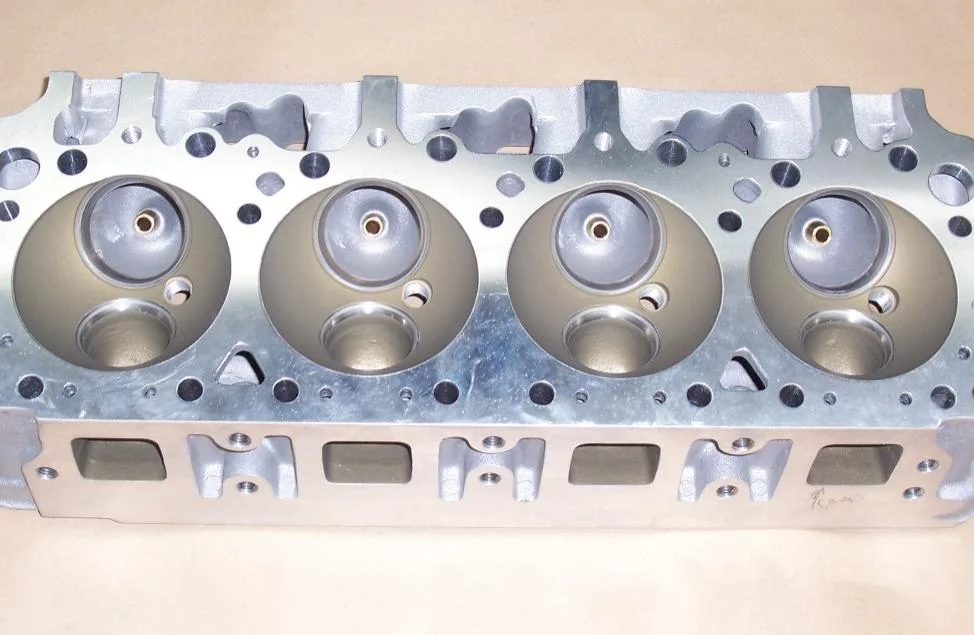
Due to the excellent response of ceramics, they are often preferred in high-temperature conditions. Commonly, they are used in engine and exhaust systems. While ceramic coating protects against abrasion, it acts like a thermal barrier. As an example, if pistons and cylinder heads are coated with ceramics, the need for lubrication will drastically reduce. Heat-related problems like thermal expansion would be reduced. Abrasion and wear damage would also be reduced.
Design Considerations for CNC Aftermarket Performance Parts
While designing aftermarket performance parts, the capabilities of CNC machining must be considered. Parts with tight tolerance control can be made. CNC machining assists well in optimizing weight while incorporating assembly features.
Tolerance Control
Meeting the dimensional tolerances of aftermarket performance parts is critical for proper fitting. Mating features such as holes, bores, shafts, and dowel locations would not align if dimensions are not within allowable tolerances. Even small deviations can lead to premature failure, vibration, and misalignment.
Lightweight Design
A key goal in designing automotive performance components is to reduce the weight. CNC machining can help in achieving this goal. Lightweight parts can be made by using specialized materials like aluminum or titanium. The other way is to remove material from low-stress regions. Then load-bearing regions can be strengthened by ribs or gussets. CNC machining aligns well with manufacturing while incorporating such features.
Assembly Features Design
Features that support assembly can be incorporated directly using CNC machining. Further, these features are very precise, that give seamless integration. Mounting holes, threaded holes, counterbores, countersinks, dowel holes, locating shoulders, grooves, and keyways can be CNC machined.
Key Factors Affecting the CNC Machining Cost of Aftermarket Performance Parts
The cost of CNC machined parts varies a lot. Even seemingly identical parts have different prices. Design complexity, material selection, and tolerance requirement differ the cost of CNC machined parts. Here this aspect is discussed.
Part Design Complexity
The complexity of design directly affects the machining cost. Parts with high complexity may need multiple setups. They might even need multi-axis machines. In comparison, 3-axis machining for simple designs is cheaper than for complex designs. Using 5-axis machines is an altogether different story.
Material Selection
Material cost is a major component of the price of aftermarket parts. In this regard, mild steel is usually a low-cost solution. Exotic materials like titanium cost much more than that. Other materials like aluminum or alloy steel come in between.
Tolerance Requirements
Usually, loose tolerances require fewer finishing operations. Parts rejection is also less. But tight tolerances require stringent quality control. Even small deviations render the parts useless. To maintain dimensions, finishing operations like grinding and polishing are required. All these factors increase the cost for parts with tight tolerances.
Tuofa's Experience in Manufacturing Custom Aftermarket Performance Parts
Choosing the right supplier is the first step to success. While sourcing aftermarket performance parts, the ideal supplier should be quick to respond to design iterations, support machining of different materials, and show flexibility in the volume of parts. In this regard, Tuofa has proved to be worthy to be considered for CNC machining.
Supporting Rapid Design Iterations
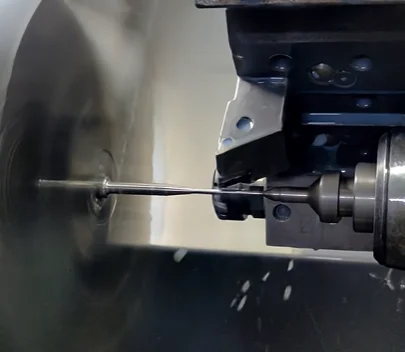
Tuofa has a professional team of engineers that give real-time DFM feedback. As per recommendations, clients can iterate designs. Here at Tuofa, we can rapidly adjust CAM and CNC programming for such changes.
Multi-Material Manufacturing for Different Performance Requirements
Our CNC machining facility supports different materials. Even a single CAD file can be used to manufacture identical parts, say with mild steel and then with alloyed steels. Tuofa welcomes easy-to-machine materials and difficult-to-machine materials with advanced CNC machines.
Flexible CNC Production for High-Mix Low-Volume Performance Parts
Aftermarket performance parts always require low volume and diverse materials for one project. It is important to keep stable performance of parts made of different materials, which places very high demands on the machining capabilities and series management capability of suppliers. Tuofa CNC manufacturer can achieve that with experience team.
Conclusion
Aftermarket parts are generally used to improve a vehicle's performance in the desired aspect. These parts can be produced for engines, suspension, brakes, chassis, wheels, and structural components. CNC machining is well suited to cater to its manufacturing demands. High precision, accuracy, good surface finish, customization, and low-volume production are some of the benefits of CNC that suit to aftermarket parts. Depending on the design and materials, these parts can be easily produced by good CNC machining centers, like TuofaCNC machining center.
FAQ
Why billet aluminum is popular for performance parts?
Billet is considered a raw feedstock. CCM billet develops a rolled microstructure that gives superior mechanical properties.
What are the best options for aftermarket performance parts?
Generally, 6063 aluminum, 7075 aluminum, 17-4PH stainless steel, and 4140 alloy steel are considered the best material options
What are the best aftermarket parts for improving car performance?
Cold-air intakes, exhausts, turbochargers, suspension components, high-performance brakes, and lightweight wheels are some hot options for improving car performance.
What are the best aftermarket parts for improving truck performance?
There are many improved aftermarket components for trucks, while here are the typical CNC-machined ones for remarkable performance including UCAs, differential covers, turbo flanges, fuel distribution blocks, throttle body adapters, rocker supports, sensor adapter blocks, sway bar mounts and track bar brackets.
 Ceramic Cutting Tools: Advantages & Impact on Machining Results