Tel/WeChat:
 Email:



 Home
How Does the Shore Hardness Scale Affect Material Selection, Design, and Machining?

 Published:Oct 21,2026

Shore Hardness can directly influence material selection, part design and the selection of manufacturing methods such as CNC machining and injection moulding. This guide is written to tell you how shore hardness help you choose suitable material, what part design is available and what CNC machining risks are.
What Is the Shore Hardness Scale?
Shore hardness scale is an internationally accepted standard system for measuring resistance of rubbers, elastomers, and plastics to permanent indentation. It is a method of determining hardness or flexibility of materials.
Shore scale uses a device called a durometer. Operates within a numeric range of 00 to 100. Mastering this scale helps engineers optimize functionality. It avoids catastrophic material failure during production and field use.
What Materials Use the Shore Hardness Scale?
Shore scale is generally not used for metals, glass, ceramics, stone, or wood. They are tested using other hardness methods such as Rockwell, Brinell, or Vickers. Manufacturing team uses the Shore scale for Non-metallic materials: elastomers, rubbers, thermosets, gels, and thermoplastics.
Shore Hardness vs. Durometer
Shore hardness and durometer are interrelated terms. You can say Shore hardness is actually hardness value obtained using a particular Shore scale. In comparison, a durometer is instrument you use to measure that hardness.
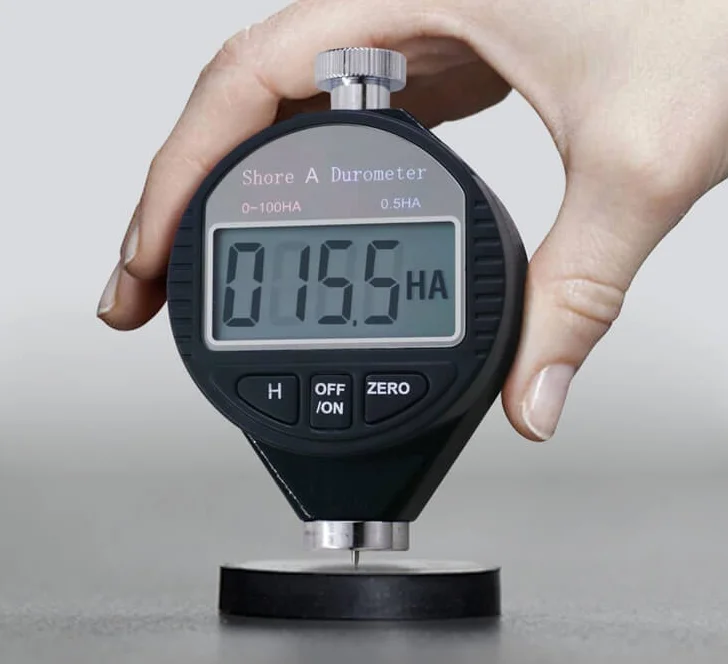
For example, if a silicone rubber has a hardness of 60 Shore A, 60 is hardness value, and Shore A is the scale. In industry speech, engineers ask, "What is durometer of this rubber?" They mean, "What is the Shore hardness?"
How to Measure Shore Hardness of Materials?
A stand-mounted durometer is used to measure Shore hardness. Using an indentation test, select the Correct Scale Device. After selecting right device, prepared material specimen must be flat and at least 6.0 mm (0.25 inches) thick. If you have a very thin sample, indentor will read hard workbench underneath. It'll skew the result.
Now you need to press durometer firmly and perpendicularly against material until the flat presser foot is completely flush with sample surface. Allow reading to stabilize according to applicable test method. Note down hardness value, normally from 0 to 100 Shore units. For reliable results, take several measurements at different locations.
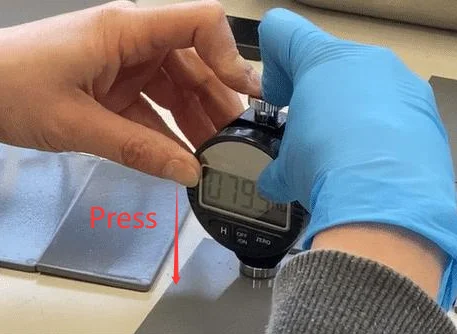
Focus on:
- Specimen thickness affects readings(ASTM D2240)
- Temperature impacts elastomer hardness
- Do not test near the edge of a part.
What Are the Different Shore Hardness Scales?
You must know there are 12 different Shore Scales. But engineers commonly use Shore OO, Shore A, and Shore D in manufacturing and engineering. Each scale ranges from 0 (softest) to 100 (hardest). Most common durometer types used in polymer manufacturing are Shore A and Shore D. Let's see difference between these scales and their specifications.
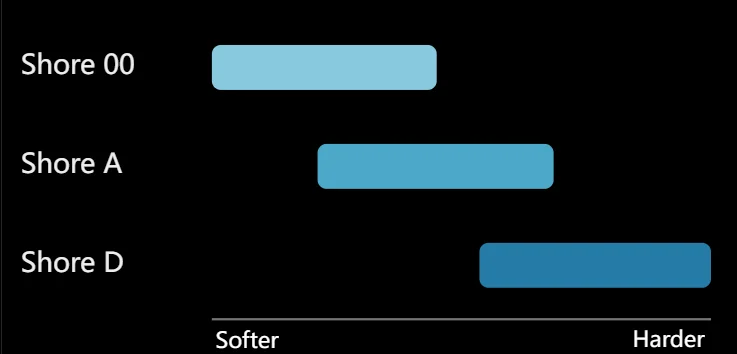
Shore OO
It measures extremely soft materials, ultra-soft rubbers, gels, and low-density foams. As the softest of shore OO, shore A and shore D, shore oo is an ideal option for low-pressure seals and gaskets. However, shore 00 is hardly suitable for CNC machining, injection molding will be better.
Shore A
You can use this scale for rubber bands, pencil erasers, and tire treads. As, a Shore A scale can handle soft to extra-hard materials(Shore A 10~90) , it is most commonly used of mentioned 3 scales. Rubber bands with 20A and rubber shoe soles with 70A are common examples. Engineers use a truncated cone point with a moderate spring force of 8 N for this scale. It also evaluates non-rubber plastic that is semi-rigid and flexible.
In general, materials with a hardness of shore A 40 or higher are more suitable for CNC machining. If lower than shore A 40, the materials are prone to deform or stick to the cutting tools.
Shore D
Deals with hard rubbers, semi-rigid plastics, and rigid engineering plastics using a sharp pointed cone with a high spring force of 44.5 N. Shore D allows easier CNC machining with little deformation. Importantly, higher hardness can cause higher brittlement. Engineering plastics use shore D include POM, PEEK, Nylon, PPS.
|
Hardness Scale |
Range |
Typical Reading |
Typical Materials |
|---|---|---|---|
|
Shore OO |
0-100 |
20-80 OO |
Gels, ultra-soft silicone, soft foams |
|
Shore A |
0-100 |
20-90 A |
Rubber, silicone rubber, soft TPU, cast polyurethane (CPU) |
|
Shore D |
0-100 |
30-85 D |
Hard urethane/hard TPU,POM,PEEK,Nylon,PPS, G10/FR4 epoxy laminate |
Materials That Use the Shore Hardness Scale
Shore hardness is commonly used to measure the hardness of soft, flexible materials such as rubber and elastomers, as well as rigid engineering plastics. These materials include polyurethane, rubber, silicone, TPE, TPU, POM, PEEK, Nylon, PPS. They can be tested by indentation.
During cutting, flexibility and elasticity may cause deformation, vibration, or dimensional variation. We are gonna shed light on relationship between Shore hardness and CNC machining for these materials.
Rigid Engineering Plastics
POM, PEEK, Nylon and PPS are common engineering plastics used for manufacturing CNC machined parts because of their high hardness. Engineering plastics such as POM, PEEK, Nylon, and PPS can all be tested for Shore hardness, typically using the Shore D scale.
High-rigidity plastics such as PEEK and PPS are generally well-suited for precision CNC machining, whereas Nylon is more prone to developing burrs and warping.
Polyurethane
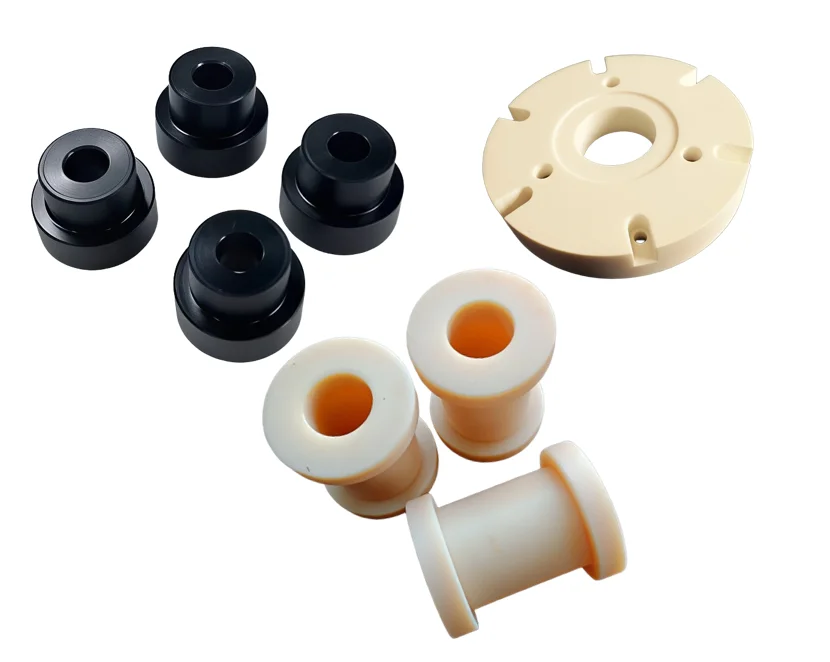
Has a wide range of hardness values (30A-85D). PU is considered the ideal plastic for CNC machining among elastomers. Rigid PU (>70A to 85D), on higher end of scale, has low grip. They are frequently CNC machined for custom industrial bushings, gears, and wear plates. Due to structural rigidity, it has ability to resist clamping forces without warping and shears beautifully into distinct chips.
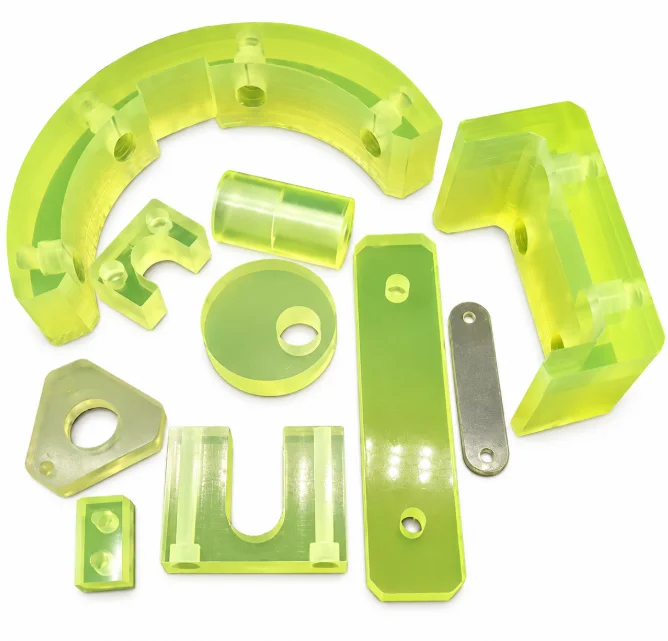
On the other hand, soft PU (<70A) is difficult to CNC machine, as it may deform under cutting forces. Leads to friction and intense heat buildup. Instead of chipping, it deflects away from the cutting edge. But wait, along with its drawbacks, you can enjoy following properties of low-grade PU.
- High grip (high coefficient of friction)
- High flexibility
- Low impact resistance
Rubber and Elastomers
Rubber with a hardness of shore A 40 or lower is difficult to machine. Harder rubber (shore A 70+) like CPU can be CNC machined.
Silicone
Silicone is soft instead of hard. The typical shore hardness of silicone is shore A 20~A80. Low-hardness silicone is very soft and easy to stretching or tearing if using CNC machining. Therefore, it is commonly processed by compression moulding or liquid silicone injection moulding instead of CNC machining.
TPE and TPU
TPE and TPU are usually soft and are not standard materials for CNC machining. They are most often manufactured via injection moulding.
How Does Shore Hardness Affect CNC Machining?
Shore hardness of materials can definitely affect the CNC machining and finally affect the quality of the final parts. Let us learn how material with different shore hardness behaves during cutting.
Deformation
Materials with lower Shore hardness are flexible. They can deform under clamping or cutting forces. This may lead to inaccurate dimensions. In comparison, higher-hardness grades are easy to machine. Top benefit is that they generally hold their shape better.
For example, when machining the Silicone Rubber with a hardness of Shore A 30 into part, the final dimension of the part may be larger than the preset dimension.
Cutting Resistance
Cutting resistance is greater when machining medium-to-high hard materials. Especially, machining materials with Shore D hardness can easily lead to edge chipping. However, it doesn't mean that hard materials can't be CNC machined. Pay attention to select suitable cutters and setting ideal cutting parameters to remove materials from the workpieces smoothly.
Tearing
If the material has low hardness of shore A, the cutter may tear the material instead of cutting off the material to produce a clean machined edge. The lower hardness of material, the risk of tearing is higher. Engineers face this issue for reasons including:
- Using a dull tool
- Unsuitable feed rate
- Excessive cutting pressure
You must use a sharp cutting tool. Also select suitable machining parameters. Help you cut material easily rather than pulling and stretching it.
Heating
Friction between tool and workpiece generates heat. Some elastomers do not dissipate that heat. So, Heat is a hidden problem for flexible materials. Too much heat can make your material softer and more difficult to control, leading deformation, poor surface finish, or dimensional changes.
How to Optimize CNC Machining Strategy with Shore Hardness?
As you know, machinability depends on elasticity, grade, thickness, geometry, clamping, tooling, and heat generation. Shore hardness itself is an indentation measurement. Engineers should not treat it as a direct measure of machinability. Shore hardness can provide a useful starting point for selecting a machining strategy.
Workholding
Workholding is an important step during CNC machining. Low shore A soft materials can't be clamped rigidly because it can easily deform. When holding this soft materials, we suggest using vacuum fixtures, soft jaws, custom supports, or sacrificial backing to maintain geometry. As for the materials with shore D hardness, conventional fixtures can be selected.
Cutting Tool Selection
Select a sharp or high-polished cutting tool for soft elastomers. A dull tool can push, stretch, or tear material. For harder materials, you can choose standard cutting tools designed for machining standard engineering plastics.
Cutting Speed and Feed
Material's Shore hardness and elasticity are two important factors that must be considered for cutting speed and feed. With aggressive feed, soft materials deform. Excessive rubbing at an unsuitable speed generates heat and makes material soft. For TPU in particular, excessive heat and rubbing can cause smearing and tool loading. Here are some tips.
- Use high cutting speeds, low feed rates, and shallow depths of cut when cutting soft elastomers
- Use a greater depth of cut when machining hard materials like POM, PEEK, PPS and Nylon with Shore D hardness
Heat Control
Heat control is especially important for soft polymers and elastomers. It can cause softening, deformation, smearing, or dimensional changes. To control heat, you need to follow steps.
- Use a sharp tool
- Avoid unnecessary rubbing
- Maintain appropriate chip evacuation
- Select suitable cutting parameters.
- Depending on the material and machining operation, you can also go for air cooling.
Following table provides you with quick information.
|
Shore hardness |
CNC machining Approach |
|---|---|
|
below 40A |
Extremely difficult to CNC machine Molding, casting, or other forming processes are used |
|
40A-60D |
CNC machining is possible for selected geometries, but workholding and deformation become important |
|
Above 70D |
Materials become brittle and prone to edge chipping |
How Does Shore Hardness Affect Part Design?
Traditional engineering design rules for rigid plastics do not apply to soft materials. You know soft elastomers deform easily under stress. Although Shore hardness alone can't determine design value in practical manufacturing, it can affect the design of parts.
Wall Thickness
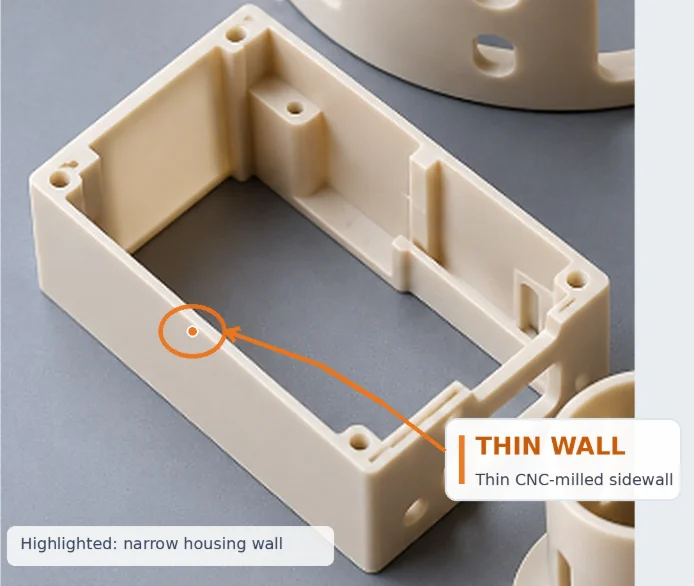
For soft materials, thicker walls are mandatory, a minimum of 2.5mm to 3.0mm. If walls are too thin, material will buckle and sag under its own weight. It may distort under minor operational pressures.
However, excessively thick sections may increase material cost and machining time. The lower the hardness of materials, the larger the recommended wall thickness. Thinner walls are highly permissible down to 1.0 mm-1.5 mm for hard materials. These rigid formulations can easily support structural loads without flexing.
Sealing Lips
Materials with low shore hardness have good sealing performance while they are easy to tear during CNC machining. In addition, the sealing lips can't be machined too thin and too long because a lower Shore hardness leads to greater deformation.
On the contrary, the hard materials are easy to machine while the sealing performance is not better than the soft materials. That is to say, sealing lips are hardly created through CNC machining. This feature should be avoided when you design your CNC parts.
Grooves
Grooves are common features on CNC parts, while the manufacturing of them can be affected by the hardness of materials. Therefore, when design grooves for your parts, you should consider the selection of materials.
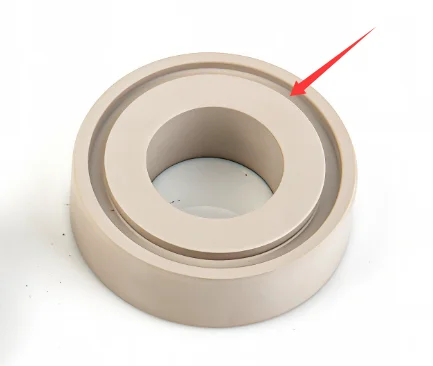
Low Shore A elastomer like shore 40A~70 A silicone is nearly incompressible, tend to deform and displace under pressure, and exhibit elastic recovery.These means that when designing grooves on soft elastomer, the grooves should not excessively tight, and should provide enough spaces for filled things, which can prevent the grooves from deformation. Additionally, use rounded corners instead of sharp internal corners.
Generally, high shore A or Shore D rigid polymer is suitable for creating grooves without deformation under pressure. This kind of grooves can be used to position or clamp components. Different from soft materials, there is no need to leave space. The accurate dimension and precision tolerance can be easier to achieve.
Interference Fits
A soft elastomer can tolerate greater deformation during installation. Harder elastomer will resist deformation. Requires a smaller interference or greater assembly force. Engineers must know that excessive interference can permanently deform softer materials or create excessive stress in harder materials.
Clearances
PEEK, POM and Nylon are easy to expand when the temperature becomes higher because the coefficients of thermal expansion of plastic is higher than that of metals. The clearances are required to avoid tolerance accumulation. This is critical for successful part assembly. Insufficient clearance can cause parts to bind or seize.
Shore Hardness vs Rockwell vs Brinell Hardness: What Is the Difference?
All are hardness scales and are used to measure a material's resistance to indentation. Elasticity and density differentiate them from one another. Albert Ferdinand Shore designed Shore for flexible materials like rubbers and plastics. Rockwell hardness can be used for plastics or metals, while Brinell hardness is mainly used for metals and alloys.
Shore Hardness vs Rockwell Hardness
Rockwell measures permanent plastic deformation. Shore hardness durometer measures indentation depth under applied load, dominated by elastic deformation for elastomers. Lower Rockwell scales are designed specifically for plastics (Rockwell R, M, or L). Very hard polymers are measured on highest Shore scale (Shore D).
|
Parameter |
Shore |
Rockwell |
|---|---|---|
|
Main use |
elastomers and plastics |
metals and selected plastics |
|
Materials |
rubber, Si, TPU, TPE, polyurethane |
steel, aluminium, copper, engineering plastics |
|
Indenter |
calibrated indenter (blunt tip for Shore A/OO, sharp cone for Shore D) |
diamond cone (HRC) or hardened steel ball (HRB, R, M, L) |
|
Scales |
Shore A, D, OO |
HRC, HRB, HRA; plastic scales |
|
Applications |
seals, gaskets, and flexible polymer parts |
Machined and heat-treated metal parts |
|
Example |
silicone: 60 Shore A |
steel: 60 HRC |
Shore Hardness vs Brinell Hardness
Brinell test is one of the oldest hardness testing methods. Used for materials with coarse or uneven structures. Brinell tests apply heavy force up to 3,000 kgf using a large 10mm tungsten carbide ball forced into the material. Instead of measuring depth, an operator uses a microscope to measure diameter of circular crater.
Shore hardness is commonly used when material can undergo significant elastic deformation. For example, a silicone might be specified as 60 Shore A, whereas an aluminium component might be specified as 80 HBW. These two numbers use different indenters, loads, and measurement methods.
|
Parameter |
Shore |
Brinell |
|---|---|---|
|
Main use |
elastomers and plastics |
metals and alloys |
|
Materials |
rubber, silicone, TPU, TPE, polyurethane |
Steel, cast iron, Al, Cu |
|
Indenter |
calibrated indenter (blunt tip for Shore A/OO, sharp cone for Shore D) |
tungsten-carbide ball |
|
Scales |
Shore A, D, OO |
HBW |
|
Applications |
seals, gaskets, and flexible polymer parts |
Casting and bulk metal components |
|
Example |
silicone: 60 Shore A |
Aluminium: 80 HBW |
Why Are Metals Not Normally Measured With Shore Hardness?
We can't measure metals with Shore hardness. There are two main reasons.
- Extreme rigidity
- Lack of elastic recovery
How Does Shore Hardness Affect CNC-Machined Parts?
In an engineering assembly, Shore hardness of a CNC-machined polymer determines how finished component behaves under physical loads. Let's see following three core operational performance characteristics that affect cnc-machined parts.
Deformation
We have discussed in detail that Lower-Shore materials are soft and flexible. They deform more easily under applied loads. In comparison, higher-Shore materials resist indentation, maintaining their geometry. Engineers select hardness matching expected operating load and allowable deformation.
Compression Resistance
Higher-hardness grades offer greater resistance when they are compressed. ;On the contrary, softer materials deform easily under pressure and may happen permanent deformation. For example, sealing components may fail due to prolonged compression.
Support
Hardness affects how well a component supports an applied load. Engineers get greater load support from harder grades. Softer elastomers provide engineers with elasticity and cushioning. Shore hardness depends on whether CNC-machined part needs cushioning or structural support.
Conclusion
More than a number, Shore Hardness helps you to know how a polymer or plastic will behave during machining. You can differentiate a difficult machining process from a reliable finished part using right Shore scale and material grade. Material properties, part geometry, tooling, and manufacturing requirements are also important.
Share your material and part requirements with Tuofa Custom Plastic Machining. We confirm required Shore scale and hardness before machining begins. Does it need to flex, seal, or support a load? Defining these requirements avoids selecting wrong material.
FAQ
What is Shore hardness of rubber?
Using Shore A hardness scale, softer rubber has a lower value of 40 Shore A, and harder rubber has a higher value of 80 Shore A.
What is the unit of Shore hardness?
Shore hardness doesn't have a physical unit. The value is always given with its scale, such as 60 Shore A, 70 Shore D, or 45 Shore OO
Is a 70 durometer harder than 90?
No. If both values are measured on same Shore scale, 90 Shore A is harder than 70 Shore A.
 Corrosion-Resistant Alloys: Factors, Typical Metals & CNC Machining