Tel/WeChat:
  Email:


 Home
HomeThe Most Common Titanium Alloy: Ti-6Al-4V (Grade 5/TC4) CNC Tips

 Published:Feb 22,2026
In Titanium alloys, Ti-6Al-4V is the most commonly used alloy as a custom CNC machining part material. This alloy is common for critical applications for aerospace and medical implants. A complete guide is provided in this article, which covers each aspect of this alloy.
What Is The Most Common Titanium Alloy?
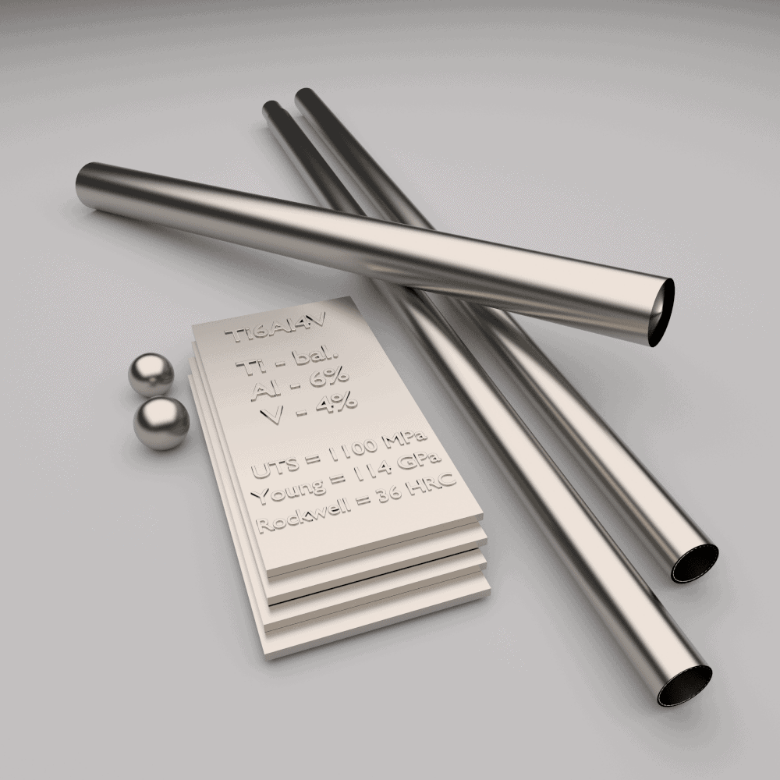
There are total of 20-30 Ti alloys, but Ti-6Al-4V is the most common alloy in industries and CNC machining. It alone covers 50% of Ti alloys usage, which shows its dominance in Ti alloys. The main reason behind its dominance is its mechanical properties and machinability. Ti-6Al-4V is the generic name of this alloy, followed by other names, for instance, TC4 in Chinese standards and grade 5 in ASTM standards.
What Is Ti-6Al-4V
It is an α-β Ti alloy that has 6% Aluminum and 4% Vanadium in its composition. Al is responsible for α-phase stabilisation, and V stabilises the β-phase. It means it is a dual-phase Ti alloy. Its other names include grade 5, Ti64, and TC4.
Why Ti-6Al-4V Is So Common
It is a safe, proven alloy and widely used in aerospace and medical implant applications. The reason behind its wide use is its near-perfect balance of properties in:
- High strength-to-weight ratio
- Excellent corrosion resistance
- Usable up to 400°C
- Easy to process by CNC machining, forging, etc.
Common Conditions for Ti-6Al-4V
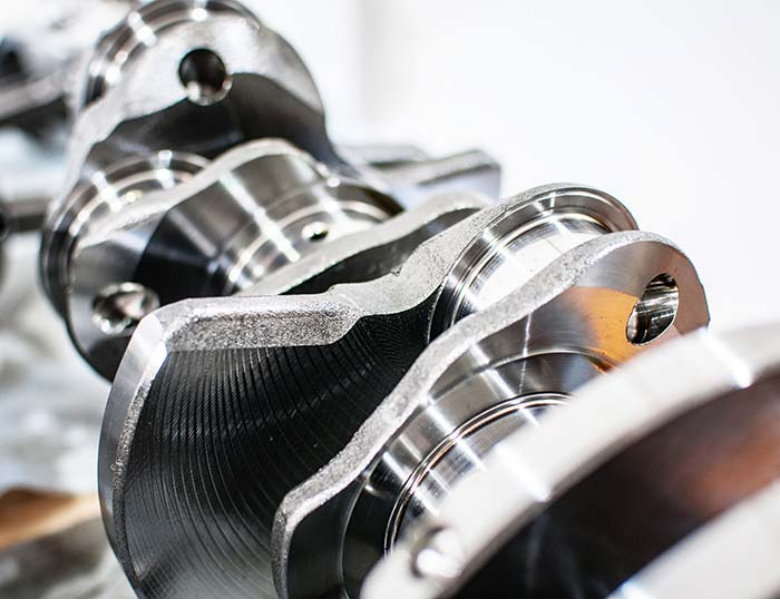
It is supplied in annealed, stress-relieved, STA conditions, but the required condition is selected based on the application. For instance, for airframe parts, the annealed condition is selected, and for load-bearing applications in aerospace, solution treatment and ageing (STA) is selected.
Ti-6Al-4V Names, Grades, and Equivalents
This alloy of Ti has multiple names and grades based on different standards. For instance,
Grade 5 vs Ti-6Al-4V
Ti-6Al-4V and grade 5 are the same in terms of chemical composition, mechanical properties, and applications, etc. Grade 5 is just a commercial grade designation in ASTM standards.
Grade 5 is used when materials standards are discussed or compared with other grades.
Ti-6Al-4V is used when it is related to engineering designs, chemical composition, or its mechanical properties.
TC4, Ti64, and UNS Numbers
TC4 and Ti64 are the names of Ti-6Al-4V, but they are used in different origins or industries. For instance, TC4 is the name of Ti-6Al-4V in China. In aerospace or engineering shorthand, it is called Ti64. UNS R56400 is the standardised designation of annealed Ti-6Al-4V.
Grade 23 (ELI) vs Grade 5
ELI means Extra Low Interstitials, like oxygen, in Ti-6Al-4V. So, both are the same but different based on the percentage of interstitials in the composition. Due to lower interstitials in grade 23, it has relatively lower mechanical properties, like strength and good machinability. Grade 23 is used in medical implants and cryogenic environments.
Ti-6Al-4V Chemical Composition
The chemical composition plays an extremely important role in the properties and applications of the respective material. Ti-6Al-4V is an alloy of Titanium with the main alloying elements, i.e., Al and V. Please check the following table for the chemical composition of this alloy:
|
Element |
Composition (wt%) |
Role / Purpose |
|
Titanium (Ti) |
Balance |
Base metal |
|
Aluminum (Al) |
5.5–6.75 |
α-phase stabilizer, increases strength |
|
Vanadium (V) |
3.5–4.5 |
β-phase stabilizer, improves toughness |
|
Iron (Fe) |
≤ 0.3 |
Impurity, minor strength effect |
|
Oxygen (O) |
≤ 0.2 |
Interstitial, increases strength but reduces ductility |
|
Carbon (C) |
≤ 0.08 |
Impurity, minor hardening effect |
|
Nitrogen (N) |
≤ 0.05 |
Interstitial, increases strength |
|
Hydrogen (H) |
≤ 0.015 |
Impurity, avoid embrittlement |
|
Other elements |
≤ 0.4 |
Impurities |
Aluminium’s Role in the Alloy
Al is an FCC metal. It is responsible for stabilizing the Alpha-phase of Ti metal. It increases the transformation temperature from the alpha to beta transition. Further, it increases the mechanical properties (yield strength and tensile strength) by the solid-solution strengthening mechanism.
Vanadium’s Role in the Alloy
Vanadium is a beta-phase stabilizer element. It stabilizes the beta-phase of Ti metal at lower temperatures. Further, it provides ductility and toughness.
Oxygen’s Role in the Alloy
It is added in very low wt%, i.e., 0.2% max. It provides strength through an interstitial solid-solution strengthening mechanism.
Alpha-Beta Structure Explained
α-phase has an HCP crystal structure and is stable from room temperature to 882°C in pure Ti.
While the β-phase has a BCC crystal structure and is stable above 882°C in pure Ti.
α+β microstructure looks like α-grains are embedded in the β-matrix.
This microstructure (α-β) is responsible for extremely good mechanical properties, i.e., strength, corrosion resistance, and fracture toughness.
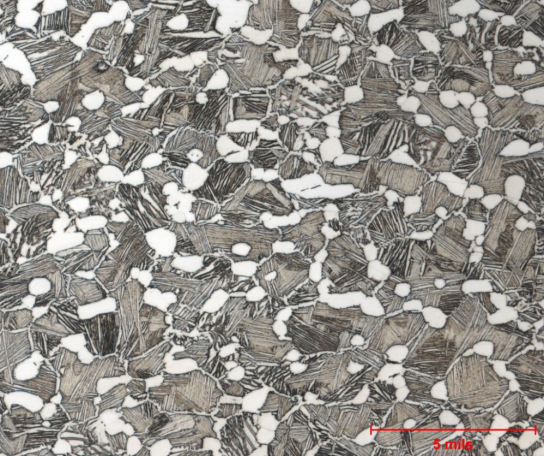
Here, the lighter color grains are the beta-phase, while the needle-like structure and darker phase are the alpha-phase.
Mechanical Properties of Ti-6Al-4V
Why Ti-6Al-4V or grade is very common in crucial industries, such as aerospace, is because of its mechanical properties. Let’s discuss these properties one-by-one:
Tensile and Yield Strength
All the mechanical properties greatly depend on the heat treatment of the alloy. Generally:
- Tensile (Ultimate) strength: 910 – 960 MPa
- Yield strength: 840 – 910 MPa
While it provides a little elongation till fracture, i.e., 10 – 15%
Fatigue Strength Drivers
The key fatigue strength drivers are:
- Microstructure (grain structure of α-β phase)
- Surface condition
- Environment
- Heat treatment (fine precipitates enhance fatigue strength)
- Defects and inclusions
This alloy does not show the endurance limit like steels, while its fatigue strength is 550 – 700 MPa at 107 cycles.
Ti-6Al-4V Hardness
Its hardness mainly depends on the heat treatment. For instance, after annealing, its hardness is 340 - 350 HV, and after Solution Treatment and Ageing, its hardness is 370 - 390 HV.
Physical and Thermal Properties
|
Property |
Value |
Unit |
|
Density |
4.43 |
g/cm³ |
|
Melting range |
1604 – 1660 |
°C |
|
Thermal conductivity (20–25 °C) |
6.7 |
W/m·K |
|
Specific heat capacity (at 20 °C) |
560 |
J/kg·K |
|
Coefficient of thermal expansion (20–100 °C) |
8.6 × 10⁻⁶ |
/K |
|
Electrical resistivity (20 °C) |
1.7 × 10⁻⁶ |
Ω·m |
|
Maximum service temperature (approx.) |
~400 |
°C |
When Ti-6Al-4V Is Not the Best Choice?
There are many conditions when Ti-6Al-4V cannot be used, even though it shows exceptional mechanical properties. For instance, if the service temperature is more than 500°C, it is not the best choice because of rapid oxidation, poor creep strength, and reduction in strength with rising temperature. Other situations include:
- When higher thermal conductivity is required
- When severe wear, galling, or sliding conditions
- Cost-effectiveness matters
- When high-stiffness is required
Common Titanium Alloy Grades
Ti has many alloys other than Ti-6Al-4V. It is an aerospace-grade alloy, while other grades, such as grades 1 and 2, are commercial grades. These alloys are different in terms of mechanical properties and CNC machining.
Titanium Grade 1
A commercial-grade alloy of Ti with a very low percentage of alloying elements. It is highly ductile and easy to machine on CNC machines. It is used where flexibility is required, such as in plates or screws in biomedical applications.
Titanium Grade 2
Grade 2 is stronger than grade 1, but with a balance among strength, ductility, and machinability. It is the most commonly used commercial grade.
Grade 5 vs. Grade 1, 2
|
Property |
Grade 5 (Ti-6Al-4V) |
Grade 1 |
Grade 2 |
|
Machinability |
Poor (requires sharp tools, slower feed) |
Excellent (easy to machine) |
Good (better than Grade 5, slower than Grade 1) |
|
Strength Level |
~950 MPa UTS, 830 MPa YS |
~240 MPa UTS, 170 MPa YS |
~345 MPa UTS, 275 MPa YS |
|
Cost |
High (alloying + processing) |
Low (commercially pure) |
Moderate |
|
When NOT to use |
For simple low-load applications or when machinability/cost is priority |
When high strength is needed |
When very high strength or aerospace-grade performance is needed |
CNC Machining Ti-6Al-4V for Custom Parts
The machinability of the Ti-6Al-4V is very important with respect to custom parts, because in custom machining, the parts are not manufactured according to the standards. So, different parameters are used for the custom machining process.
Why Ti-6Al-4V Is Hard to Machine
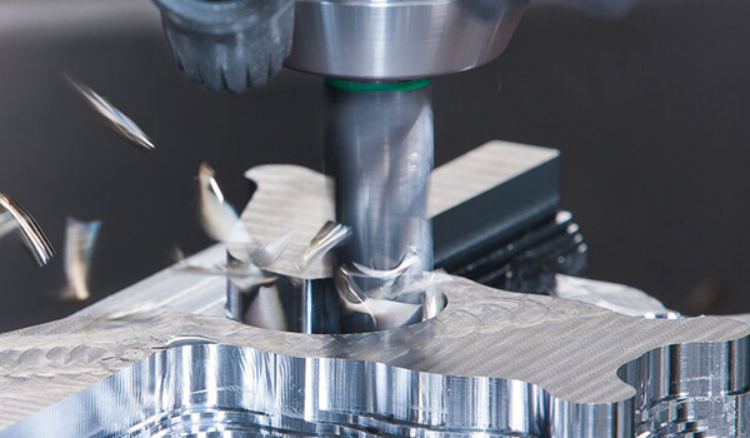
During CNC machining, the biggest problem that comes is the lower thermal conductivity of the workpiece. Ti-6Al-4V has a lower thermal conductivity, which leads to head accumulation at the cutting edges of the cutting tools. This heat results in the tool wear.
If you are looking for the best one-stop CNC machining solutions for your projects of Ti-6Al-4V parts, then come to TUOFA CNC Machining Solutions. We are equipped with the most advanced CNC machines and their expert operators, which enable us to deliver the best machining solutions to our customers at the best prices and shortest delivery times.
Design for Machining (DFM) Rules
Design for machining means optimizations in the designs to increase the efficiency of the part and reduce the machining cost. It is mainly done for fillets, thin walls, deep pockets, hole depth, and thread choices.
For these parts, avoid sharp corners, long, narrow pockets, undercuts, and rough surface finishes. To avoid tool wear and parts deflection, a coolant should be continuously used.
Surface Finish and Post-Processing Selection
After machining, the surface of the Ti-6Al-4V is often treated with some operations to enhance surface-related properties, such as fatigue strength, corrosion resistance, etc.
|
Surface Finish |
Typical Method |
Use |
|
Polished |
Grinding, Buffing |
Smooth surface, reduce friction, aesthetic |
|
Anodized |
Electrochemical treatment |
Corrosion resistance, surface hardness, color |
|
Shot-Peened |
Blasting with steel/ceramic shots |
Improve fatigue strength, relieve residual stress |
|
Plated / Coated |
Electroplating, PVD, CVD |
Wear resistance, corrosion protection, decorative |
|
Passivated |
Acid treatment (stainless/titanium) |
Remove surface contaminants, improve corrosion resistance |
|
Electropolished |
Electrochemical smoothing |
Ultra-smooth, reduce micro-crevices, corrosion resistance |
Any Tips on Machining Titanium Grade 5?
Grade 5 or Ti-6Al-4V is a tough material to machine, but these tips can help you make it easy for your projects.
Milling and Turning Titanium
Milling: A subtractive manufacturing process in which the cutting tool operates, but the workpiece remains stationary. Any complex shape can be manufactured.
- Use a low cutting speed and a high feed rate
- Use sharp and rigid tools
- Prefer climb milling
Turning: A subtractive manufacturing process in which the cutting tools remain stationary but the workpiece rotates. It is specialized precision CNC operation for cylindrical shapes.
- Use carbide inserts
- Use a rigid machining setup
- Use coolant to avoid workpiece deflection and tool wear
- Use high helix or special chip breakers
How to Cut Titanium
The real problem in cutting Ti is heat accumulation at the cutting edges of cutting tools. This accumulated heat results in tool wear. So, the best way to cut the Ti is to use sharp tools only, low cutting speed, high feed rate, coolant and a rigid machining setup. The best machining operation is milling, turning, or waterjet cutting.
What to Consider?
These are the important things to consider before cutting Ti:
- Material properties
- Selection of cutting tools
- Optimisation of cutting parameters
- Heat management
- Rigidity of the machining setup
Quick Ways to Cut Titanium
These are the fast-cutting operations to cut Ti quickly.
- Waterjet cutting
- Band saw
- Abrasive cut-off wheel
- Laser cutting
Ti-6Al-4V Used in Various Industries
Ti-6Al-4V is used in a lot of industries. Some of them are discussed below:
Titanium Medical Applications
In medical applications, the most important properties include biocompatibility, corrosion resistance, and strength. That’s why Ti-6Al-4V is used in many parts of medical applications. For instance:
- Bone plates
- Bone screws
- Hip and dental implants
Titanium in Automotive and Motorsport
In this industry, Ti-6Al-4V is used in the manufacturing of many important parts, such as exhaust components, titanium rocker arms, suspension components, connecting rods, and valves, due to:
- High-strength-to-weight ratio
- Good fatigue resistance
- High temperature capability
- Excellent corrosion resistance
Titanium in Robotics
The robotics industry relies on mechanical properties, such as lightweight but strong, durability, precision machining, and corrosion resistance. Ti-6Al-4V qualifies these properties and is used in the manufacturing of grippers, joints, and pivots, robotic arm links, etc.
Custom Titanium Parts
Almost every industry uses custom Titanium parts to take maximum advantage of its properties. For instance, orthopaedic implants are the biggest example of customising the parts. Other examples include turbine blades and discs, connecting rods, etc.
Conclusion
Ti-6Al-4V is an important Ti alloy because of its exceptional mechanical properties. It has many names, such as TC4, Ti64, or grade 5. It is used in various industries, including aerospace, biomedical, and automotive. It is very hard to machine material because of its lower thermal conductivity. To prevent tool wear, use sharp tools and a slow cutting speed and a fast feed rate.
FAQs About Ti-6Al-4V (Grade 5/TC4)
What is the Ti-6Al-4V equivalent name in different countries
- In the USA, Grade 5
- In China, TC4
- In Russia, VT6
- In Japan, Ti-6Al-4V
How much does Ti-6Al-4V cost per kg?
Its price varies based on the condition, but generally its price is 30$ - 40$/kg.
How much is 1 lb of titanium worth?
1 lb of Ti is worth of 15$ - 25$.
Is Ti-6Al-4V magnetic?
It is a paramagnetic material, which means it shows very negligible or very little attraction in a strong magnetic field.
 What Are Transition Metals? Definition, Properties, and Uses