Tel/WeChat:
  Email:


 Home
HomeWhat Is Black Chrome and Is It Suitable for Your Parts?

 Published:Sep 23,2026
Black Chrome provides CNC-machined parts with a dark metallic coating that has excellent wear and corrosion resistance properties. It also provides a unique finish appearance to the industrial and precise parts.In this guide, you will learn whether black chrome is right for your parts, how much it costs, and how to choose the right manufacturer.
Key takeaway
- Black chrome is a thin black electroplated coating with a metallic appearance. It also has special optical and thermal properties.
- Black chrome offers good durability, thermal stability, and a premium black metallic appearance.
- Carbon steel, alloy steel, stainless steel, brass, copper, bronze, and nickel alloys can be black chrome plated. Aluminum and stainless steel usually require a nickel underlayer before black chrome plating.
- The part surface must be properly activated before black chrome plating. Poor surface activation can cause the coating to peel or blister.
- Black chrome is commonly used on automotive parts, camera components such as lens barrels and retaining rings, photothermal components such as absorber plates, and optical components used in medical equipment.
What is Black Chrome?
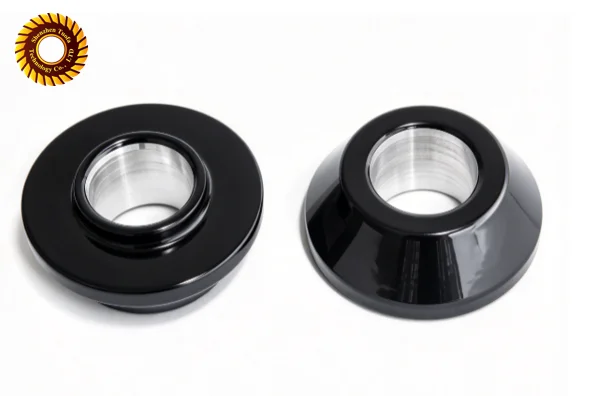
Black chrome is a thin metallic coating comprised primarily of chromium and chromium oxide (Cr₂O₃). It offers a dark gray/black color without the use of any pigments. The dark color comes about owing to the microscopic nature of the coating whereby instead of reflecting light, the light is either absorbed or scattered. As such, owing to its thinness, it will take on the same texture as that of the underlying substrate.
How to Identify Black Chrome?
Black chrome is a black metallic finish with a mirror-like surface. The color of black chrome varies between grey and blueish grey, but black nickel has a more warm tone. In most cases, black chrome tends to have greater wear resistance as compared to black nickel. This means that wear marks will be the first step in distinguishing between the two finishes.
Does Black Chrome Have Different Colors?
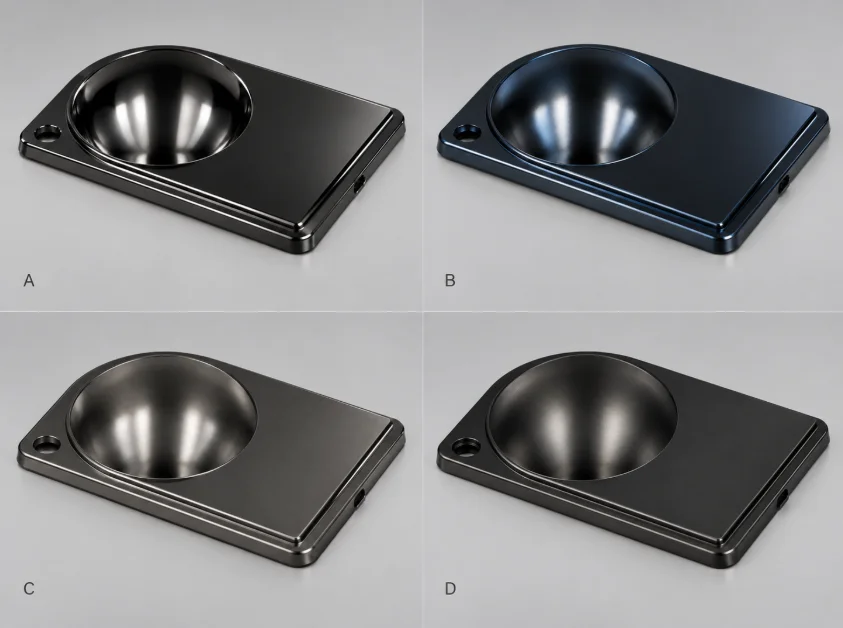
The color of black chrome may vary from dark gray to charcoal or even black, depending on whether the finish is matte, semi-gloss or glossy. The variation of the color of black chrome will not affect the functionality of the coating. The decorative components must be of an approved color and gloss, while the functional components must have the required coating characteristics. According to MIL-DTL-14538, black chrome is described as a dark gray that approaches black. Consequently, the difference in shades is permissible as long as it falls within the approved range.
Advantages of Black Chrome
Black chrome does not only have the advantage of being a dark metal. It is also wear-resistant, corrosion-resistant, and resistant to heat and light. Also, it retains its metallic property for quite some time. These advantages are discussed below:
Wear Resistance
Black chrome offers good wear resistance and is generally more durable than ordinary paint under frequent handling and light abrasion. However, the wear resistance depends on the thickness of the coating, the condition of the surface, and how the black chrome is applied. Otherwise, the black chrome can easily peel off and wear because of friction, impact, or abrasion.
Corrosion Resistance
Black chrome enhances the ability to provide protection against corrosion if employed in the right coating system. It usually acts on a layer of nickel, and nickel plays the role of protecting the metal from corrosion and moisture. The effectiveness of such a coating process is determined by the coating system, coating thickness, and coating quality. Black chrome outperforms black oxide in corrosion resistance.
Visible Metallic Black Appearance
Black Chrome Plating will give the parts a metallic black appearance. The glossy and reflective nature of the black chrome plating gives the parts a metallic look. This kind of plating is more recommended when the design depends on the black color look of the product. There are times that the only requirement for the part is the black color and not the metallic look.
Offer Flexible Black Chrome Colors
The black chrome may not be just one single shade. The color may vary from a darker black to even a dark gray. The finish can also either be in a satin or glossy finish. Appearance will depend not only on the type of material used for plating but also the process of plating used. This way, manufacturers will be able to control both the color and the finish.
Good Thermal Stability
Black chromium is capable of offering good heat stability and absorption of solar energy due to its dark coloration. This makes it suitable for use in solar thermal systems. Heat stability of black chromium is based on the coating process and the operational conditions. Black chromium can also aid in maintaining optical characteristics when exposed to UV radiation.
How Does the Undercoat Affect Black Chrome Appearance?
The appearance of black chrome coating strongly depends on the surface of the undercoat. The smooth surface of the substrate results in glossy coating, while the textured surface leads to matte coating. The thin layer of black chrome coating takes its shape from the surface underneath.
Polished Undercoat for Glossy Black Chrome
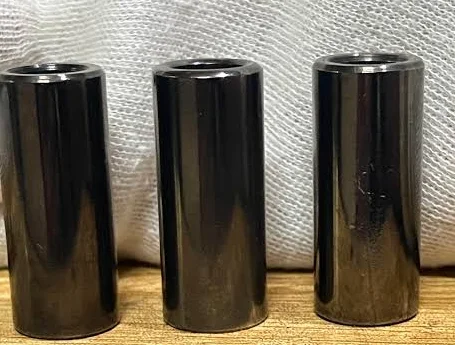
Polished surface or bright nickel undercoat is used to produce glossy black chrome coating. It means that the surface underneath will be followed by black chrome coating that will form deep black coating with metallic gloss. The glossy black chrome coating is used for car trim, quality hardware and other decorative purposes.
Satin or Textured Undercoat for Matte Black Chrome
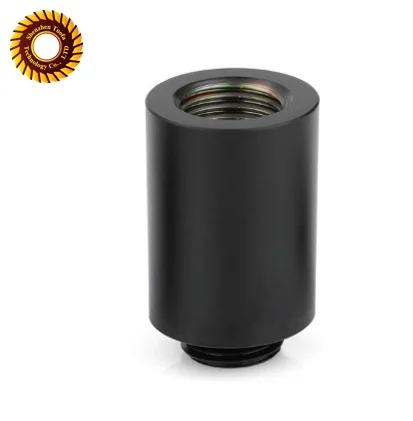
Satin or textured coating decreases light reflection and gives a softer and matte appearance to black chrome plating. The application of such a coating is appropriate when dealing with components of cameras and instruments which require low levels of reflection. The surface must be textured prior to plating.
Which CNC Materials Can Be Black Chrome Plated?
|
Material |
Why It Accepts Black Chrome |
Typical Stacking & its Behavior |
|---|---|---|
|
Carbon Steel |
Conductive, no passive film; nickel bonds readily |
Easy, Nickel only |
|
Alloy Steel |
Similar to C- steel, hardened grades need a post-bake |
Easy, Nickel, then bake |
|
Stainless Steel |
Conductive, but a passive oxide film blocks adhesion |
Difficult, Acid activation, Wood's nickel strike |
|
Aluminum and Alloys |
Reactive; forms oxide instantly and attacks plating baths |
Difficult, Zincate, copper or electroless nickel, nickel |
|
Brass |
Excellent conductivity and smooth surface |
Easy, Nickel only |
|
Copper |
Plates beautifully but diffuses into chrome over time |
Moderate, Nickel barrier, then chrome |
|
Bronze |
Like brass and alloying elements need stronger cleaning |
Moderate, Extended cleaning, nickel |
|
Nickel and Nickel Alloys |
Ideal undercoat metal & needs only activation |
Easy, Activation, chrome direct |
Why Can't Aluminum Be Black Chrome Plated Directly?
Aluminum corrodes when exposed to air and this makes it very hard for the black chromium plating to bond with it. This is why aluminum needs some further treatment before applying black chromium plating. Aluminum alloys are one of the most common materials for custom CNC parts. Tuofa has handled many custom aluminum projects, so we have a lot of experience with aluminum surface finishing. When a customer asks for black chrome, we always advise against plating it directly on aluminum. The coating will almost certainly fail for it will peel or blister.
Why Is Stainless Steel Difficult to Black Chrome Plated?
The oxide film formed by stainless steel prevents the metal from corrosion, but it may also prevent the adhesion of plating. Before plating, the stainless-steel surface needs to be treated through cleaning and activation. A nickel strike can be done to ensure adhesion of chrome film to the surface. Without activation and a nickel strike, the black chrome coating will definitely peel.
Can Copper Be Black Chrome Plated Directly?
Yes, it is possible to black chrome plate copper, but after preparing the surface properly. It is common practice to plate a nickel layer between the copper and chrome layers. That will increase the adherence and corrosion resistance of the coating. In some cases, it might be necessary to plate a nickel layer in brass or bronze to get a stable coating.
What Affects Quality and Cost in Black Chrome Plating of CNC Parts?
The design of parts and CNC machining can affect the quality and cost of electroplating black chrome. For design features that may affect coating quality or increase cost, CNC manufacturers like Tuofa CNC usually evaluate them through a DFM review. They then suggest practical design improvements. This can improve coating quality and reduce production costs.
Consider the Surface Roughness
Black chrome coating is very thin, usually about 0.25-0.5 μm. CNC tool marks and other surface details may still be visible after plating. Therefore, the required final appearance should be considered during machining according to customer's requirement.
- For a glossy mirror-black finish, polish the part after CNC machining to Ra ≤ 1 μm.
- For a matte black finish, bead blast the part before black chrome plating.
Consider Coating Thickness in Part Dimensions
Black chrome itself is usually very thin. However, it is rarely plated directly onto the base metal. An undercoat is usually applied first. This makes the total coating thickness higher, often around 1-3 μm. For most CNC parts, this small thickness has little effect. For precision parts, however, it can affect final dimensions and assembly. Therefore, plating allowance should be considered during CNC machining.
Round Corners and Other Complex Features
Sharp corners can cause current to concentrate during electroplating black chrome, which means the coating will be too thick and easily brittle. Therefore, to make black chrome electroplated on the parts better, CNC manufacturer always recommend change sharp corners into round corners. The commonly-recommended radius of the round corner is about 0.88mm. This can help black chrome plate more evenly. The deep pocket, small slot, blind hole, and sharp corner can also cause problems during plating. Simplify these features can reduce the cost for plating black chrome.
Applications of Black Chrome Plating
Black chrome is widely used in various industries where a dark metal surface and high durability of the surface are required. Typical uses of black chrome include automotive parts, instrumentation, trimmings, and solar thermal parts.
Automotive Wheels and Trim
Black chrome plating is applied on wheels, grilles, badges, emblems, and trims. This gives a black metal look that is wear and moisture resistant. The final look will depend on the surface of the substrate and the plating method.
Camera and Precision Instrument Parts
Black chrome plating is used on wheels, grille, badge, emblem, and many other trim parts. This type of coating gives the mentioned items dark metal color and good wear-resistance during handling and normal use. In addition, black chrome coating is appropriate for selected exterior parts that have contact with water and roads. Final coating appearance will depend on the base material and plating procedure.
Decorative Metal Parts and Hardware
Black chrome is applied to handles, knobs, and various metal fittings and fixtures. This results in a black metal look with a certain level of durability from regular usage. There are various methods of preparing black chrome such as matte, satin or gloss according to the application.
Solar Thermal Components
Selected components like absorber plate for solar thermal systems have black chrome coating due to its optical characteristics. Black chrome coating can absorb large amounts of solar radiation while having low emittance of thermal radiation. It helps absorb heat efficiently while reducing heat losses through radiation. The most common areas of application are solar collector plates and tubes.
Black Chrome vs Other Black Finishes: Which Is Suitable for Your Parts?
Various black finishes have different features when it comes to appearances, longevity, price, and surface treatment. The following paragraphs compare black chrome finish to various other finishes in order to show their differences.
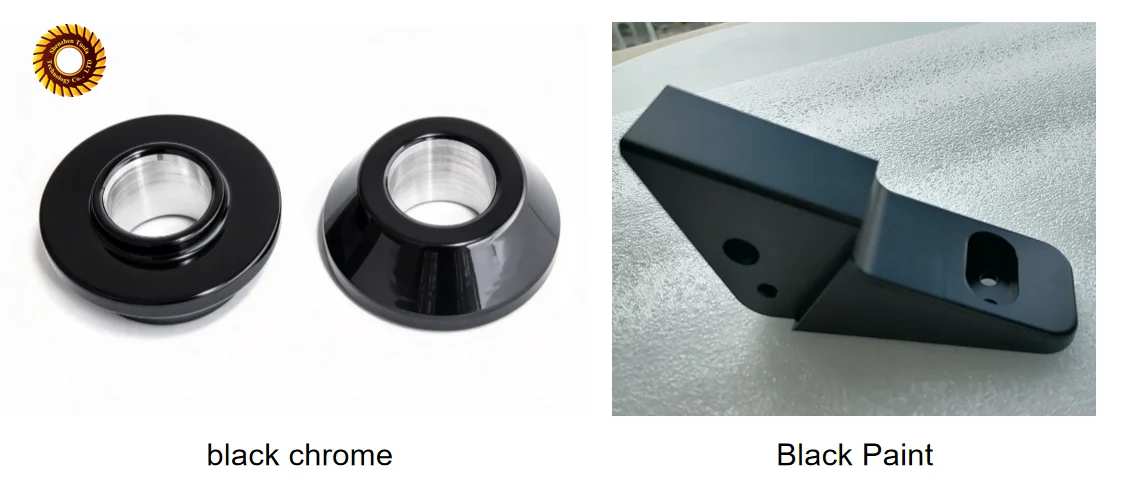
Black Chrome vs Black Paint
Black paint looks flatter and more like a colored coating, while black chrome retains a stronger metallic depth and plated appearance. Paint is less expensive and does not require the material to be metal. The process is simple to carry out and best suited for big parts, but it is susceptible to flaking, scratching, and masking of intricate machining marks. The black chrome is more costly, but it gives a hard and thin layer. It is more suitable for parts that are frequently handled.
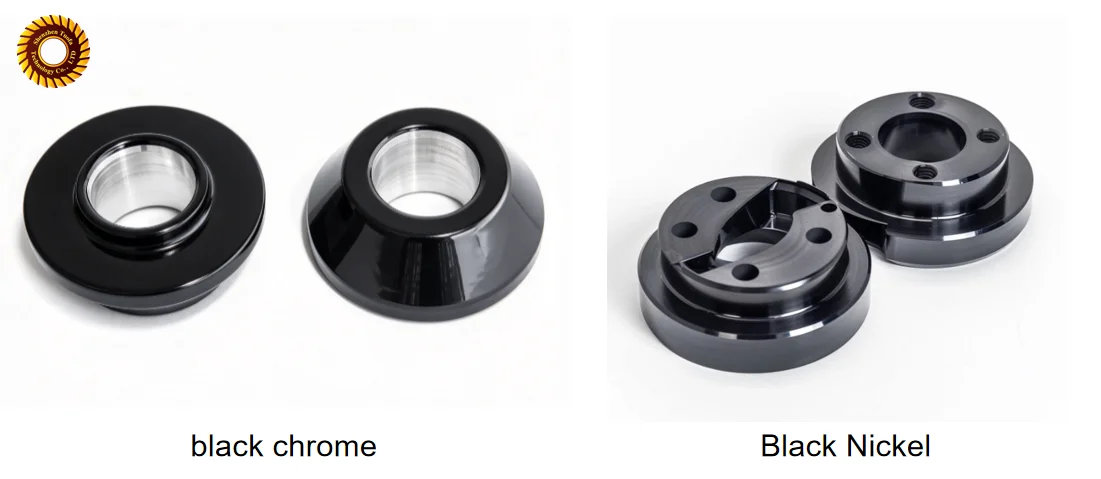
Black Chrome vs Black Nickel
Black nickel is usually lighter and more gunmetal-gray, while black chrome is generally deeper black with a colder, more chrome-like metallic finish. Black nickel is used to get a smooth black metallic coating.On the other hand, black chrome is capable of giving a metallic dark finish and its coating is more robust than that of black nickel. Black nickel works best on parts which will only be used for aesthetic purposes. Black chrome works better on parts which are handled frequently.
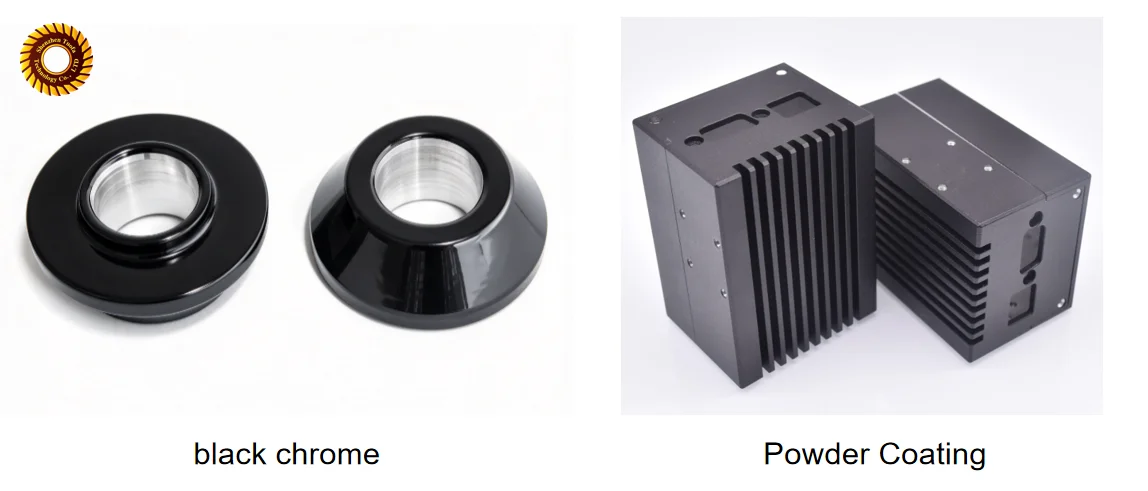
Black Chrome vs Powder Coating
Powder coating has a thicker, softer, sometimes textured appearance, while black chrome looks thinner, harder, and more reflective. Powder coating results in a thicker coating and offers great corrosion resistance properties. It also works effectively on larger pieces and gives many options in terms of color. The thickness of powder coating, however, can cover up the fine machined surfaces and dimensions. Black chrome forms a thin metallic coating that helps preserve the fine machined surface. The powder coating process is most suitable for larger pieces, whereas black chrome is most appropriate for precise components.
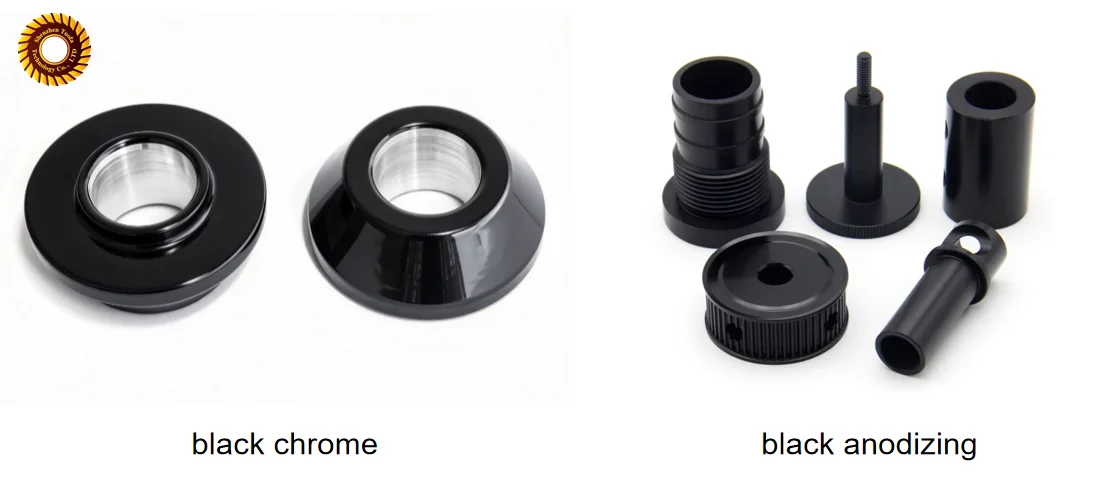
Black Chrome vs Black Anodizing
Black anodizing looks thinner and more natural on aluminum, while black chrome appears darker, smoother, and more metallic. Black anodizing is primarily used for aluminum and its alloys. It produces a tough layer of oxide that can increase resistance to wear and corrosion by providing very little additional coating. On the other hand, black chrome is a plating process for metal. It works well for steel, stainless steel, copper, and several other metals. It may also work on aluminum after additional preparation. Another important difference is the difference in appearance. While black anodizing produces a consistent and dull look, black chrome produces a more metallic dark surface.
Tuofa One-Stop CNC Machining and Black Chrome Plating Solution
Utilizing a single vendor for machining and black chrome plating can make things simpler. Tuofa is capable of doing everything from machining to preparation and plating and final inspection. You will not have to deal with multiple vendors for the same parts. This way, you will minimize chances of any miscommunication or delay due to communication with multiple vendors.
Fast Turnaround for Machining and Black Chrome Plating
Both machining and plating can be done by Tuofa within its premises. There will be no requirement of sending the parts from one vendor to another for machining and then back to other vendors for plating. This will minimize any transport delays and damages that could occur while transporting the parts. We offer controllable black chrome coating thickness between 0.2 μm and 10 μm.
Material and Plating Compatibility Review
The materials used in CNC machining may affect the coating process and its results. This can be evaluated by the supplier in the preliminary phase. It is helpful to make sure that the selected material is suitable for black chrome plating.
DFM Review for Black Chrome Plating
Black chrome plating needs to be thought about at the design phase. Tuofa can conduct reviews on aspects that could affect the coating like deep holes, narrow grooves, sharp corners, and threads. The review process will also help find out what other things need to be masked or altered to accommodate the thickness of the coating.
Surface Quality and Finish Consistency
The appearance of black chrome coating is dependent on the underlying surface. Pits, scratch marks, and tooling marks could still be seen despite the coating applied. Tuofa can manage the machining and plating processes together to ensure a finished look and consistency.
Conclusion
Black chrome provides CNC machined components with a dark metallic coating with excellent wear resistance and corrosion resistance properties. The end product will vary according to the substrate used, surface treatment, undercoat, plating method, and the component geometry. Precise machining of complex components requires careful consideration of the coating thickness. The correct plating system and appropriate supplier will ensure consistency in the finished product.
FAQ
Does black chrome need a clear coat or sealer?
Black chrome does not necessarily have to be sealed. Sealing is done to add more protection against moisture and rust as well as external elements. However, it can change the shine of the coating. Therefore, this aspect should be kept in mind before the completion of the process.
Can damaged black chrome be repaired?
It can be quite challenging to fix any minor damage without creating any color or gloss difference. In case of any major wear or damage, the piece is stripped and repolished for evenness.
Is Black Chrome Electrically Conductive?
Yes, black chrome has electrical conductivity properties, but it is not as conductive as bright chrome or nickel. The desired amount of resistance needs to be checked in case of use in electric contacts.
Can engineering plastic parts be plated black chrome?
No, engineering plastic can't be plated black chrome because black chrome electroplating relies on conductive substrates.
 Precision Machining for Renewable Energy: CNC Parts, Materials, and DFM