Tel/WeChat:
 Email:



 Home
Tier 1 vs Tier 2 Supplier Engineering Authority

 Published:Oct 30,2026

CNC manufacturer can do much more than simply machine a component. They might analyze your design, recommend DFM modifications, select the proper machining method, as well as address manufacturing issues. However, all these actions don't necessarily give them a right to redesign the product. There is a difference between Tier 1 and Tier 2 suppliers, and their engineering responsibility varies from project to project.
This article focuses on the engineering authority of Tier 1 and Tier 2 suppliers within OEM supply chains, explaining the boundaries of their decision-making authority and why clearly defining those boundaries matters.
What is Engineering Authority for Tier 1 and Tier 2 Suppliers?
Engineering authority is the ability to make technical decisions or give approval for such decisions. With regard to CNC machining, it can include part design, dimensional specifications, material specifications, machining processes, tooling, inspection, and any design modifications. It varies depending on the supplier's involvement and customer approval. The supplier can recommend a change, although not necessarily implement it until approval is granted.
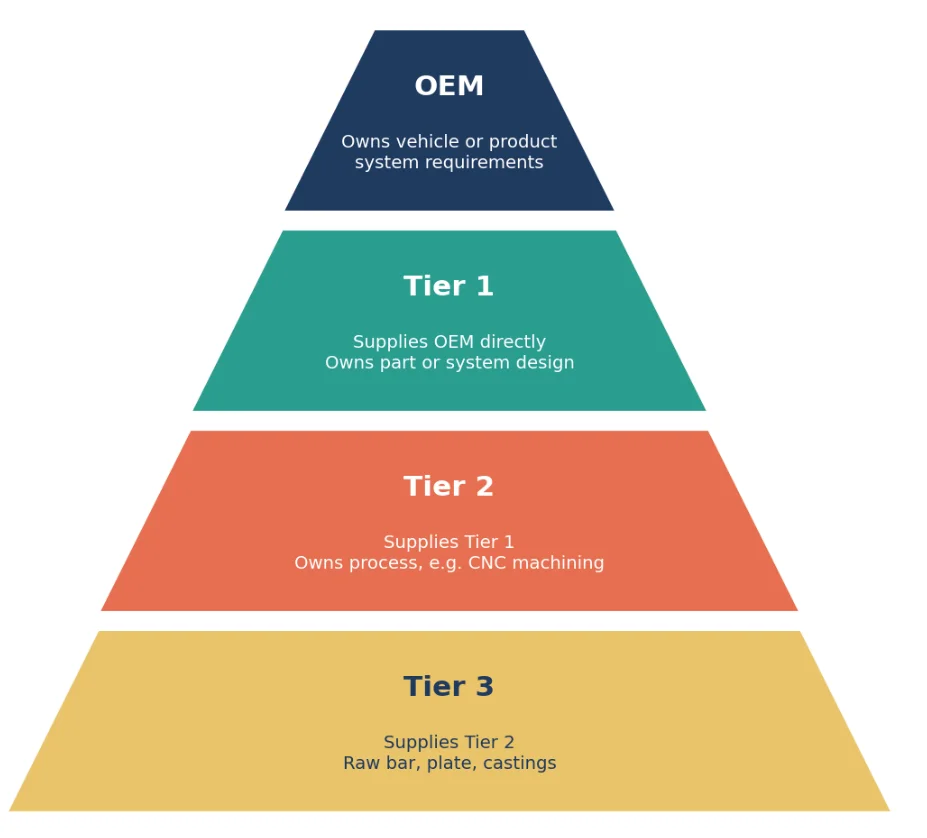
Engineering Authority of Tier 1
A tier 1 supplier directly deals with the original equipment manufacturer (OEM). It supplies components ranging from fully engineered parts to full assemblies or systems. OEM may delegate the responsibility to the tier 1 supplier for designing, drawing, bill of material, and test planning. But some key aspects like interface, safety, material, and design changes will continue to be approved by the OEM.
Engineering Authority of Tier 2
Tier 2 suppliers normally supply products to Tier 1 suppliers. In CNC machining, such suppliers manufacture parts such as shafts, housings, brackets, and plates. The primary area of jurisdiction for such suppliers normally includes the production process. They select the tools and equipment to be used in manufacturing the approved product. Such suppliers have the right to recommend certain modifications in designs. For instance, they can recommend making the internal radius large in case the small one is difficult to manufacture. However, any modification without customer approval is not allowed.
Why Engineering Authority Matters between Tier 1 and Tier 2?
This is significant since there could be many suppliers for one product. In such situation, OEM defines what the product should be. Then the Tier 1 supplier steps into integrate everything together. Meanwhile, the Tier 2 supplier handles the machining of critical components. The clarity of authority will show who should make the decisions and who needs to sign off on it. There are three critical areas that matters the most in these cases.
Avoid Decision-Making Gaps Between Supplier Tiers
A decision gap happens where both vendors believe that the other will agree to make the changes. This may relate to changes in materials, size, tolerance, heat treatment, surface finish, and inspections. A well-structured responsibility matrix would help solve this problem. It would specify the individual who is authorized to approve any particular change.
Keep Engineering Decisions at the Right Level
The decision-making must always remain within the hands of the team associated with the risk involved. A Tier 2 supplie r typically handles key process choice s like tooling, fixturing, and machining decisions. Any changes that affect the fit and function of a product go to the design authority.
Reduce Rework, Delays, and Responsibility Disputes
Clearly defined authority helps avoid producing parts for an ambiguous or obsolete requirement. Howeve r, any major changes need prope r documentation. This includes updating drawings, recording approval date s, and noting who made the change.
It serves as clear evidence of the decisions made. It also simplifies the audit and quality review process as well as the root cause analysis. More importantly, it prevents disputes in case of non-conformance to requirements.
Tier 1 vs Tier 2 Suppliers in CNC Machining
Both the tier 1 and tier 2 suppliers can employ CNC machining technology, although their role in the supply chain is distinct. The tier 1 supplier would most likely interact with the OEM or final manufacturer. He may be involved in the management of a whole part, assembly, or subsystem. The tier 2 supplier is typically dealing with the tier 1 supplier and focusing on making specific parts.
It is not just the question of who produces the part. Beyond that, it shapes how companies handle product responsibility. It influences manufacturing quality records and also how businesses manage their suppliers. It also has implications for product accountability, manufacturing process control, quality documentation, and supplier management.
|
Area |
Tier 1 supplier |
Tier 2 CNC supplier |
|---|---|---|
|
Role in supply chain |
Ships to the OEM. Manages sub-tier suppliers. |
Ships to Tier 1. Often runs one or two processes. |
|
Product responsibility |
Fit, function, warranty, and system design. |
Part conforms to the released drawing. |
|
Manufacturing |
Assembles, integrates, and may machine in-house. |
Machines, finishes, and inspects single parts. |
|
Quality inspection |
System audits, PPAP to OEM, final tests. |
Part inspection, FAI |
|
Supplier consolidation |
It maintains a broader base and reduces overlapping. |
Stays on the list by offering more processes under one roof. |
Role in Supply Chain
Tier 1 suppliers are usually found right below the OEM. Suppliers must receive product specifications and set up the production steps.
Tier 2 suppliers provide parts to Tier 1 suppliers. In the case of CNC programs, these are shafts, brackets, housings, plates, manifolds, and other precise parts.
The tier is determined by the supplier's relationship, not by the size of the company. Thus, a small CNC firm can be a Tier 1 supplier if it supplies directly to the OEM, and it can be a Tier 2 supplier if it supplies through a Tier 1 firm.
Product Responsibility
Product responsibility pertains to how the end component or sub-assembly will perform. In this case, product responsibility for Tier 1 supplier entails making sure that the assembly fits correctly, interfaces well, is testable, and performs well.
On the other hand, the product responsibility for the Tier 2 supplier will be less than that of the Tier 1 supplier. Tier 2 suppliers produce individual components based on approved drawings and specifications. These requirements cover size, geometric dimensioning and tolerancing (GD&T), materials, surface finish, heat treatment, and other details.
Manufacturing
Tier 1 suppliers receive product specifications and set up the production process. They ensure the final assembly fits correctly, connects properly, tests well, and performs as expected. They also handle assembly, machining, part integration, and coordination with outside suppliers.
Tier 2 CNC suppliers focus on manufacturing. They select the right machines, tools, fixtures, work holding systems, machining steps, and inspection tools to meet all requirements.
For complex parts, CNC suppliers can improve the production path by using alternative tooling, setups, and roughing methods. Suppliers can review documentation, run final inspections, and provide quality records to the OEM.
Quality Inspection
Tier 1 suppliers usually handle quality requirements from customers. Suppliers can review documentation, run final inspections, and provide quality records to the OEM.
Tier 2 suppliers inspect the components that they manufacture. Typical documentation includes dimensional inspection report, material certification, FAI report, and process data.
Inspection process has to be in accordance with the approved drawing and requirements of the customer.
Supplier Consolidation
Tier 1 suppliers generally control several Tier 2 suppliers for machining as well as other processes.
Using fewer suppliers reduces hand-offs and gives companies better control over production. A Tier 2 CNC supplier that handles multiple processes can support larger programs more effectively.
Nevertheless, outside processes have to comply with customer specifications as well. For example, if a Tier 1 customer requires an approved vendor for heat-treatment and coating, the Tier 2 supplier cannot switch vendors.
CNC Supplier: Engineering Authority vs Engineering Capability
Engineering authority is different from engineering capability. Authority involves having the right to make or approve a technical decision. On the other hand, capability involves having the capacity to carry out the decision in a correct manner.
What Engineering Capabilities Should You Expect from a Tier 1 or Tier 2 Supplier?
The best CNC supplier must be able to understand drawings, GD&T, and materials. Suppliers need skills in CAD/CAM, design for manufacturing (DFM), fixturing, tooling, process planning, inspection, and root cause analysis.
The Tier 2 CNC supplier utilizes most of its abilities in making parts from the approved drawing. On the other hand, Tier 1 CNC supplier often has broader capabilities, such as product design, testing, validation, and managing lower-tier suppliers. Excellent engineering support must identify the problem and provide a viable solution.
How to Evaluate a Supplier's Engineering Capability
Instead of relying on claims, ask for a proof. Consider examples of past experience, such as:
- DFM report
- FAI report
- Process plan, setup sheet
- Inspection report
- CMM program
- Corrective action report
- Process capability data
Alternatively, you can provide an actual drawing and ask what inspections the supplier would perform prior to production. Pay attention to various parameters including datums, tolerances, material condition, tooling accessibility, stock size, surface finish, inspection accessibility. In case of critical dimensions, ask for Cpk data from a similar process. Cpk demonstrates how well the process can fit into the specification limits.
How Engineering Support Reduces Manufacturing Risk
Effective engineering support catches potential issues before they turn into manufacturing issues. DFM review can spot issues like thin walls, deep pockets, tight inner corners, poor tool access, difficult part holding, and tight tolerances. Then an in-process check may catch process variation before too much scrap is produced.
Timing is important. Changes to the design or manufacturing process can be made easier prior to the start of the machining process. Unexpected changes during machining, coating, inspection, or assembly cause scrap, rework, and shipping delays.
Failure Mode and Effects Analysis (FMEA) helps manufacturers review and manage risks by rating how severe, frequent, and detectable problems are. To manage these risks, the supplier must know which changes it can make on its own and which ones require approval from the client or the design team.
Product Design Authority: Tier 1 vs Tier 2
Product design authority specifies part specification and function of a part. It includes part geometry, dimensions, interfaces, material, tolerance, and other important product specifications.
CNC supplier may examine all these specifications and offer better alternatives. However, not all production issues cause modification in the drawing. In this situation, the customer will be able to approve a deviation or waiver.
Geometry and Dimensions of Part
Geometry of the part tells about its final shape and dimensions. When the supplier is responsible for design, it is relatively flexible in making design modifications. However, it has to comply with the change and configuration control process.
Some of the common cases include:
- Narrow and deep pockets
- Internal radii are very small
- Moving thin walls while machining
- Limited access to the part by cutting tool
- Setup which makes machining difficult
Tolerances and GD&T
Tolerances indicate the allowable variation in a dimension. GD&T indicates the location, form, and relationships between features of a part. Before manufacture, the CNC company should assess the above criteria. In case the tolerance specification is tighter than necessary, the CNC company may propose a looser tolerance.
For instance, modifying a tolerance from ±0.10 mm to ±0.20 mm may make manufacturing simple and less time-consuming for inspection. However, such modifications may not be viable in cases where the dimension affects fit and sealing. The CNC company should justify the manufacturing effect and obtain approval from the design authority.
Materials and Product Specifications
Material is included in the design of the product. Many properties of parts may be affected by changes in materials. Such properties include hardness, corrosion resistance, heat resistance, weight, strength, and machining ability.
The CNC provider might also propose another grade of material. Such a situation usually occurs when the specified grade is difficult to obtain or machine. Approval from the customer is needed before proceeding. Machining could also be affected by heat treatment. Aging, cold working, and stress relieving are also examples of such processes.
Material certificates and heat numbers can be included in the manufacturing documentation. The document might contain information on the material certificate and condition of heat treatment. This way, the material used in the end-product will be connected to the product specifications.
Drawing and Specification Authority
A drawing is a controlled engineering structure and not merely an image. It provides all essential data on the component, including the required dimensions, tolerances, and material specifications. Additional features may consist of notes, interfaces, and other requirements for a particular product. Manufacturing documents can be made by a CNC supplier from the drawing, but they do not define the product itself.
Who Owns the Engineering Drawing?
The drawing ownership will be determined via the contract, title block, or the document control process. The owner could be the OEM, Tier 1 company, or any other company that has design authority.
The CNC supplier can produce setup sheets, process drawings, CAM programs, and inspection documents. Such an action does not imply that the CNC supplier becomes the designer of a component.
For instance, Tuofa CNC can examine the CAD model, provide DFM feedback, produce the CAM program, and prepare manufacturing documentation. However, such activities do not confer any design rights on the CNC supplier.
The supplier should verify the revision on the drawing. It should agree with PO and all other controlled documents. In case there is revision “C” in the PO while there is revision “D” on the drawing, then there should be a stop and identification of the correct revision.
Who Can Release a New Drawing Revision?
There must be an official revision of the product by the entity or individual who is authorized to design and release. It will depend on the customer or industry.
Certain requirements may exist for automotive, aviation, and medical products. Such requirements can include change approval, configuration management, validation, and review. The supplier may have the capability to implement a modification on a product feature. This does not mean that the supplier has the privilege to release a revised drawing.
Technical capability and design authority are two different things. Design change has to be reviewed prior to releasing the drawing revision. Also, the process of document control has to be followed.
Can a Supplier Change a Drawing Without Approval?
Changes in an approved product requirement by the supplier shall require the required approval. Change may impact the dimension/tolerance, material, interface, surface finish, and critical features.
The supplier is allowed to make any necessary changes in its manufacturing documentations. It does not, however, have the right to silently change the drawing of the customer for production convenience.
A single incident of manufacture problems doesn't necessarily call for an alteration of the drawings. In this instance, the customer may waive the requirement. The approval shall define the part, batch, quantity and timeframe where applicable.
When the supplier is officially responsible for design, it has more flexibility regarding making design changes. The supplier will still be required to observe the change and configuration control process.
Intellectual Property and Data Control
CNC suppliers usually deal with sensitive information including CAD drawings, designs, specifications, inspection reports and test results. The information can reveal the way a product is designed and manufactured. Proper control of data will limit the access, usage, and distribution of the data. The procedures must be discussed before the production process begins.
Who Owns the Engineering Data and Derived IP?
Ownership will depend on the contract terms and relevant laws. Drawings, computer-aided design models, and specifications by the customer will normally be considered customer's controlled information.
The CNC service provider will generate their own manufacturing know-how as well. This will include designs of fixtures, CAM programming, toolpaths, fixture set-ups, and cutting parameters. The ownership of the deliverables should be clearly defined in the contract. It becomes more important where a supplier generates a new fixture or process in a DFM meeting.
What Can the CNC Supplier Do with the Data?
Use of customer's information must be restricted to the agreed activities. The supplier is not supposed to use the CAD model for any other purpose, neither can the model be transferred to any other company. The access by a sub-tier supplier must be approved and confidentiality measures put in place.
NDA and IP Protection
The Non-Disclosure Agreement (NDA) provides the basic guidelines regarding the confidentiality of information. This includes the definition of the information to be covered, its usage, and what will happen at the conclusion of the project.
NDA must be in line with the supply agreement. Secondly, it must include subcontractors, photographs, samples, tooling, software, among others. Good file naming and revision control practices also minimize the chances of using erroneous information by project teams.
What Happens When IP Leaks: Real Consequences
Data leaks could result in revealing product designs before the release or copying of components by another company. Data leaks could also cause legal disputes between companies, customers' audit, legal claims, and loss of future businesses. The chances for that to happen increase significantly as more suppliers and subcontractors get the file. Share only what's needed and document it. Thus, proper intellectual property control should be an element of the supply chain management process.
Manufacturing Engineering Authority: Tier 1 vs Tier 2
The best means of exercising control is through CNC suppliers in manufacturing engineering. After the design has been approved, the supplier usually has the freedom to determine the process of production of that part.
Machine and Process Selection
The machine selection of the supplier is dependent on the size, shape, tolerance, number, and accuracy required of the component. The choice will either be 3 axis, 5 axis, turning, or mill turn machine. If the part is complicated, then using 5 axis machining will cut down the number of setups. While making a simple plate will take less time on a 3 axis machine. Other machining options that the supplier can decide are milling, turning, grinding, and EDM. But changing the approved process by the client will require prior approval from the customer.
Tooling, Fixtures, and Work holding
Generally, the supplier will decide on the type of fixture design to use. The fixture may include soft jaws, clamps, nests, vacuum fixtures, and special purpose fixtures. Work holding should ensure that the part does not move while maintaining part integrity. This is critical for any part which has thin walls and high tolerance. The part should be designed such that it does not have the capability of marking a functional surface and distorting the part. Any customer supplied tooling should be identified and maintained.
Machining Sequence and Process Parameters
The supplier can usually set the machining sequence and cutting data. This includes spindle speed, feed rate, depth of cut, step-over, and tool engagement. Such parameters can be modified to increase tool life, cycle time, surface finish, and machining stability.
How Does DFM Fit into Engineering Authority?
Design For Manufacturing (DFM) bridges the gap between design and manufacturing. It allows a CNC manufacturer to identify issues before the product is manufactured. The CNC manufacturer may recommend a different radius, tolerance, datum, material, or machining. However, a recommendation does not mean approval. The design authority makes the decision on whether the product design will change.
What Can a CNC Supplier Recommend During DFM?
There are times when the CNC supplier may also have ideas on ho a particular part can be made easy to machine. These changes can also help in making the manufacturing process more efficient and safe. These changes include:
- Larger internal radii
- Better tool access
- Thicker walls
- Standard hole sizes
- Fewer machining setups
- Practical tolerances
Proper DFM feedback will provide a rationale behind making such recommendations. A deep pocket, for instance, requires a long cutting tool which may deflect while machining. As a result, the supplier will recommend a larger radius or a new machining process.
Which DFM Changes Require Customer Approval?
Approval is necessary in case of any changes that affect the design and/or performance of the product. For instance, by increasing the tolerance, the cost of the machining process may be reduced, although the bearing fit will also be affected.
It is the responsibility of the supplier to assess the risk associated with the change and obtain approval prior to the change of the released drawing.
What Can the CNC Supplier Optimize Without Changing the Design?
A CNC vendor will always have an opportunity to modify the process without making changes to the approved design. Such modifications will include the tool path, speed of cut, feed rate, fixturing, tool selection, machining order, coolants, and inspection.
These variables modify the manufacturing process of the component but do not alter the design of the part.
Engineering Authority Across Industries: Automotive, Aerospace, and Medical
Engineering authority in regulated industries is more formalized. Automotive, aerospace, and medical companies all have certain regulations for controlling engineering processes. It is not only the supplier level that defines authority. It is also defined by the contract and other factors.
|
Industry |
Core system |
Tier 2 duty |
Change trigger |
|---|---|---|---|
|
Automotive |
IATF 16949, AIAG PPAP |
Support PPAP data, hold Cpk |
Process, tool, material, or site change |
|
Aerospace |
AS9100, AS9102 FAI |
Follow config control, flow-down, and special-process rules |
Any change to the released design or approved process |
|
Medical |
ISO 13485, FDA rules |
Work under supplier agreement and validated process |
Change to a validated process or spec |
Automotive: PPAP Approval and Production Change Control
In automotive projects, PPAP, APQP, control plan, and PFMEA are usually utilized. PPAP is a method for demonstrating the ability of a supplier to manufacture parts in accordance with approved design specifications.
For CNC suppliers, some modifications might require customer approval. Such modifications could involve changes to the material, tooling, process, machine, equipment, and manufacturing location.
Aerospace: Design Authority and Configuration Control
The Aerospace Programs implement tight control over drawings, specification and other design data. The CNC vendor could fabricate a part to approved drawings and not have the design of the product. When the supplier is responsible for the design, it should be spelled out in the agreement. Any modification to the drawings, material, and approved process should conform to the proper approval and configuration procedure. The other method that can be used is First Article Inspection (FAI). This method is useful for verifying the conformity of the first parts to the approved design specifications.
Medical: Supplier Roles Under Design Control
For medical devices, there is a proper control of design, procurement, manufacturing and process changes. CNC machines can manufacture and inspect components according to these requirements. All changes to the design and specifications must be approved in advance.
Tier 1 vs Tier 2: How to Protect Engineering Authority?
Clear definition of roles benefits both suppliers in exercising engineering control. The objective here is straightforward. Control the drawings and approval of any changes through the appropriate channel.
How Tier 1 Protects Product and Design Authority?
The Tier 1 must identify those design choices that it controls and those that the OEM controls. It must also ensure that the Tier 2 suppliers get the most recent design drawings and specifications. Any changes in the design done by the Tier 2 supplier must adhere to the Tier 1 engineering process. Critical changes must not be approved by production e-mail.
How Tier 2 Protects Manufacturing Engineering Authority?
The Tier 2 supplier must document all the processes that are controlled. The controlled documents may include:
- CAM programs
- Setup sheets
- Fixture drawings
- Tooling details
- Inspection programs
- Process parameters
There are situations where the issue might arise from the design of the part itself. It is the responsibility of the supplier to notify the customer about this issue. The supplier should never modify the part without notifying the customer first. Some examples include datum that is difficult to verify, as well as tight tolerance that is hard to control. In such a case, the supplier can propose an alternative solution.
How Tier 1 and Tier 2 Control Engineering Changes?
Both parties should agree upon a specific process for making changes prior to starting the production run. These include:
- Identifying the problem and logging the change request.
- Evaluating the effect on the fit, function, cost, quality and risk of the design.
- Approval by the appropriate authority.
- Releasing the new revision and retiring the old revision from production.
- Applying the change according to the approved documents.
- Verifying the first articles and documenting the results.
Choose a CNC Supplier as Your Tier 1 or Tier 2 Partner?
A right choice of the supplier depends on how much responsibility you are willing to delegate to it. The first-tier supplier can be responsible for a complete component, subassembly, or system. It is the responsibility of the Tier 2 supplier to manufacture parts according to the approved part design.
The size of the supplier is not the only factor for choosing the right one. It is also the responsibility of the customer to verify the capability of the supplier to manufacture the parts. This includes the following processes: machining, inspection, engineering, manufacturing, and work management.
When to Choose a CNC Supplier as a Tier 1 Partner?
For situations where you want more than just machining from the supplier, go for the Tier 1 model. It may include design, assembly, testing, validation, production planning, and supplier management.
If design is within the scope of the supplier, define that in the contract. There should be a clear definition of responsibilities within the contract. This includes decision-making and releasing a new design. The OEM keeps control of the main product requirements. It may give the Tier 1 supplier control over the detailed design of a part or subsystem.
When Should You Use a CNC Supplier as a Tier 2?
Select the Tier 2 configuration if the design of the part is already known and you only require reliable manufacturing. The customer or Tier 1 will retain ownership of the drawings, specifications, material and functional requirements. The CNC vendor will concentrate on machining, inspection, process control and DFM feedback.
Prior to selecting your configuration, define three things:
- Ownership of the design
- Engineering change approval authority
- Owner of the part requirement.
This helps in avoiding future complications.
Conclusion
Whether an item is a Tier 1 or a Tier 2 item does not determine engineering authority. The contract and project specifications determine the process of design management and change requests. An appropriate CNC supplier identifies potential design risks in advance. The supplier provides DFM recommendations and enhances the manufacturing process. However, it will not be allowed to alter the design without proper authorization.
FAQ
Does ISO 9001 or IATF 16949 Give a Supplier Engineering Authority?
No. ISO 9001 and IATF 16949 establish requirements for quality management and process control. However, ISO 9001 and IATF 16949 do not grant a supplier a right to change the design of a customer.
Does DFM Give a CNC Supplier Design Authority?
No. DFM assists a manufacturer in locating the manufacturing issues and recommending design solutions. It is possible for the manufacturer to propose a greater radius, larger tolerance, or easier features. However, any design modifications need to be authorized by the design authority.
Who Has Final Engineering Authority: OEM or Tier 1 Supplier?
The answer is dependent on the nature of the project in hand. The OEM retains control over the key product requirements. In some cases, the OEM grants the Tier 1 supplier the control over the detailed design of parts or subsystems. The contract will have to state who has the authority to modify these requirements.
 Ceramic Cutting Tools: Advantages & Impact on Machining Results