Tel/WeChat:
  Email:


 Home
HomeWhat Is Thread Depth? Design and CNC Machining Guidelines for Accurate Threads

 Published:Aug 14,2026
The deeper the thread the more holding power you have. Do it wrong, and bolts strip, seals leak or joints fail under load. According to fastener engineering data, increasing thread depth from 75% to 100% will provide an additional approximately 5% strength in the joint, but failure to engage the thread enough has been found to be one of the top causes of thread stripping.
This guide will help you understand what the term thread depth refers to, the difference between thread and hole depth and the regulation of thread depth in CNC machining. You will learn how to read a thread depth chart, how to avoid common thread depth errors and how to validate designs with a CNC supplier before going into production.
What Is Thread Depth?
The depth of the thread is the distance cut by the thread into a hole or screw, along the part's axis. It defines the amount of material that is held on to the mating fastener. When purchasing CNC threaded parts for a production run, thread depth is one of the specs that you will look out for early on as it is crucial in determining the strength, sealing and assembly costs for each unit ordered.
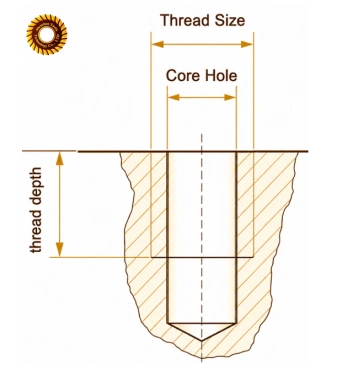
Thread Height vs Full Thread Depth
The height of one thread tooth, from root to crest, is known as thread height. The full thread depth is not the same. The overall length of all the usable and complete threads in the hole. The one number represents one tooth. The other refers to the entire area of thread through which your fastener passes for strength.
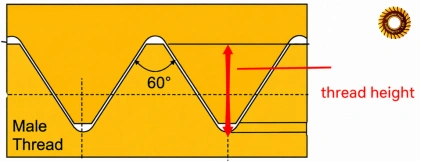
It is very easy for engineers to confuse the two, as both of the terms have the term "depth" loosely applied to shop drawings. When choosing the size and pitch, thread height is determined by the thread standard. Full thread depth is a design decision, and is determined by the depth of the hole cut and tapped.
Thread Engagement Depth vs Full Thread Depth
The term 'thread engagement depth' is used to describe the amount of thread that is engaged as compared to the full thread depth.
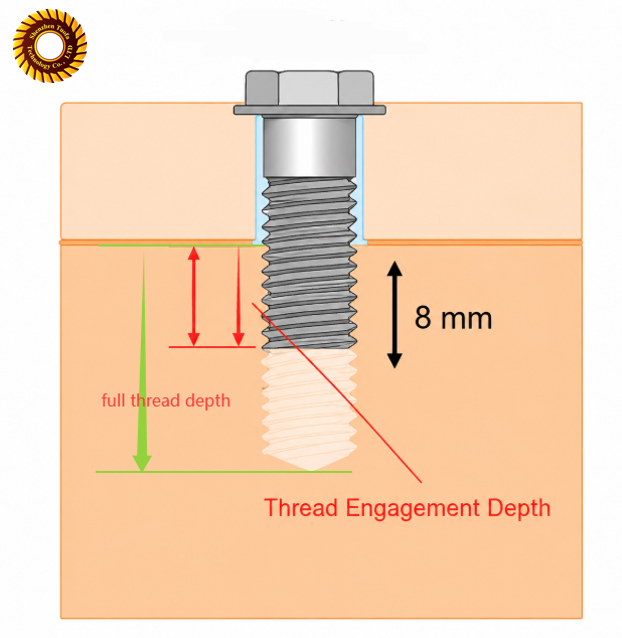
Full thread depth indicates the amount of depth in the threads. The engagement depth can be used to determine the degree to which the mating bolt is actually driven into the thread. The depth of the hole can be greater than the depth of bolt threads. Engagement of one time the diameter gives full strength to the joint. If more full thread depth is desired, for repeated assembly cycles or softer materials, then a greater margin of safety can be provided by using a deeper full thread depth.
Thread Depth Vs. Depth of Cut per Pass.
The depth of cut per pass is not an engineering specification, but rather, a machining term. The Single Point Threading operation manual provided by CNC Home Beyond defines it pass-by-pass for this reason. It is a term used to denote the amount of material that is removed with each cut as the tool is taken to the final full depth of cut. CNC programs break threading up into multiple passes to preserve tool life and maintain tolerance, particularly in stainless steel and titanium, which are hard alloys.
When to Consider Thread Depth?
If you're thinking about adding in thread depth, what are the conditions?
Thread depth specification should be locked down before providing the quote. There are three direct impacts of thread depth on part fitments, loads and sealing of fluid or gas in a threaded connection. There are three direct impacts of thread depth on part fitments, loads and sealing of fluid or gas in a threaded connection. This design review is usually ignored and results in rework post parts cut.
Parts Assembly
Too shallow threads will allow bolts to bottom out before the parts are clamped together. Chip trapping may cause the joint to be jammed if threads are deeper than clearance. Unless the actual length of the fastener in the assembly is specified, the depth should be checked against the actual length of fastener in the assembly, not the nominal size of the hole on the drawing.
Load-Bearing Capacity
The depth of the thread is directly related to the shear strength. A shallow thread will strip when loaded because fewer flanks of the thread will be distributing force. The minimum thread depth for steel-on-steel and other solid materials is 1x fastener diameter, and increases to 1.5x or 2x for aluminum or other softer alloys. The initial few threads have the greatest impact and having them too short compromises the bond far more than the percentage reduction in the thread length would indicate.
Sealing Requirements
Full thread depth is used for the pipe threads and hydraulic fittings to ensure a leak-proof seal. Shallow engagement is one of the most frequent reasons for the failure of a seal in threaded fittings, according to Threading Tools Guide. A seal not fully engaged if the depth is too shallow. On sealing applications, maximum thread depth limitations should be stated to ensure that the seal is compressed prior to its bottoming out in the hole.
Is Thread Depth the Same as Hole Depth?
No. Hole depth - the total depth of hole, including any unthreaded clearance at the bottom. Only the part of the thread that has complete, usable threads is considered the depth of thread. The hole is generally drilled deeper than the thread depth to provide clearance for chips and for tap run-out.
How to Specify Thread Depth And Hole Depth on Drawings?
The total depth of hole and full depth of thread should be shown separately on drawings with a tolerance. It is an ongoing problem leading to quarrels in the shop floor as evidenced by the part specification design guideline from Anixusa. One number is often drafted out and results in confusion on the shop floor. If the drawing is reviewed by Tuofa, the engineers will discuss about the two depths and ensure they are clearly specified before quoting the job.
What Happens If the Thread Depth Is Incorrect?
When the thread depth becomes incorrect, the threads strip or the torque test fails, or the assembly leaks once it gets to the field. One of the common reasons cited in the fastener engineering literature for joint failure is an undersized thread depth in blind holes. After production, identifying this mistake causes wastage of parts and delayed delivery.
How to Control Thread Depth with CNC Machining?
When machining parts in bulk, one can have controllable repeatable depth of thread using CNC machining. The machine records the position of the tool on each axis which ensures that depth remains consistent throughout all the parts produced. Good repeatability requires proper setup, tool selection and programming.
Set the Correct Z-Axis Depth
The Z-axis determines the depth of the hole's cut. Programmers select a target depth calculated from the total value of the drawing's thread depth, and then include a nominal amount for tool lead-in. Threads may not be fully machined at the bottom of the blind hole if the Z-axis is set only by 0.5 mm.
Choose Suitable Threading Methods
The different cutting methods, such as tapping, single-point threading and thread milling, give different depths of cutting. Tapping is fast and cost-effective when dealing with through holes. Thread milling will give better control in case of blind holes because the toolpath takes care of itself since it doesn't experience the full cutting force because there is no contact.
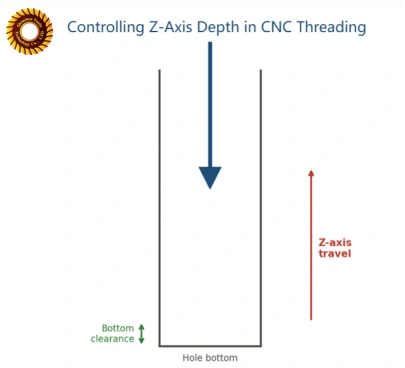
Set the Correct Tool Travel
One should not go to the bottom of the hole to avoid tool breakage while moving the tool. CNC programs take into account the total thread depth plus lead-in minus clearance. This is done correctly in the programming, and this ensures that the cutting tool and the finished part are protected. For multi-tool jobs, travel limits should be considered for the shortest tool in the set, not just the nominal program value, as variation in the length of the tools will compound over a production run.
Reserve Sufficient Bottom Clearance
The distance between the lowest complete thread and the bottom of the hole is called the bottom clearance. It provides it with a place to collect the chips and prevents the tool tip from slamming into solid objects. The typical bottom clearance is 2-3 pitch lengths on blind holes.
In-Process Inspection of Thread Depth
The depth is checked with in-process inspection, not just at final QC. Z axis drift can be detected early to avoid discarding a whole batch. In general, shops with tight tolerances will check for thread depth every few parts manufactured, rather than only at the beginning and end of a job. This is most important on long runs, where the depth may drift over time and the depth at the end of the job would not necessarily reflect the drift.
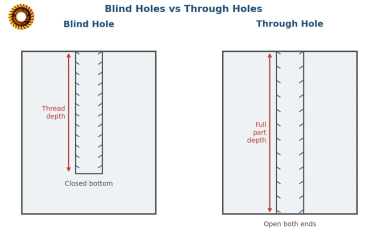
How Does Thread Depth Differ Between Blind Holes a Through Hole
Different thread depth solutions are required for blind holes and through-holes. A blind hole does not have a free bottom end and the depth of the full thread is limited by the depth that can be safely cut. For a through hole, there is no lower limit and the depth of the thread is determined by the thickness of the walls or the engagement required.
Thread Depth in Blind Holes
Blind holes require special care during the process of machining. Chips do not fall through, so they accumulate at the bottom and have the potential of damaging the tap. Bottom clearance should always be included and when using a full thread depth close to the total depth of the hole, choose a bottoming tap or thread mill.
Thread Depth in Fully Threaded Through Holes
Holes that go through allow for more flexibility as the chips flow through the opposite side of the plate. There is no bottom limit for full thread depth, it is typically determined by the engagement length required. This simplifies and reduces the cost of making through holes of consistent depth of chart values.
CNC Machining Comparison
The techniques used to thread blind holes and through holes differ, and the following table summarizes their differences.
|
Parameter |
Blind Holes |
Through Holes |
|---|---|---|
|
Requires Bottom Clearance |
Yes, 2 to 3 times pitch lengths |
No |
|
Chip Ejection |
Difficult, chips accumulate at the bottom |
Easy, chips clear through |
|
Tool Used |
Bottoming Tap, Thread Mill |
Standard Tap, Single-point Tool |
|
Difficult Depth Control |
Higher, Strict tolerance of Z-axis |
Lower, more forgiving |
What are the Common Thread Depth Problems in CNC Machining?
The following table illustrates the common thread depth errors along with their causes and costs to your end part.
|
Problem |
Typical Cause |
Consequence |
|---|---|---|
|
Insufficient Full Thread Depth |
Too shallow Z-axis feed, short drilled hole |
Stripped threads, low pull-out strength |
|
Excessive Thread Depth |
Oversized program for travel distance, no depth limit |
For thin-wall penetration, waste of cycle time |
|
Incomplete Threads Near the Hole Bottom |
Lack of bottom clearance |
Partially formed threads, weak bond |
How Does Thread Depth Affect CNC Machining Cost?
The selection of thread depths will impact the machining time, tool life, and cost of inspection. The following table provides an analysis of the sources of these costs and how they can be controlled.
|
Cost Factor |
Impact on Your Order |
Preventive Measures |
|---|---|---|
|
Machining Time |
Increasing tool travel time, longer cycle time |
Specify only the depth you need |
|
Tool Breakage |
Spare parts, costly tool replacement |
Bottoming taps, thread milling |
|
Chip Clearance |
Reduced speed, faster tool wear |
Peck cycles, coolants flow |
|
Inspection Cost |
Longer inspection time per batch |
Risk-based inspection plan |
How Tuofa Supports Critical Thread Depth Projects?
Whether it is design inspection or end part validation, Tuofa Machining ensures the accuracy of thread depth for the entire process. Tuofa CNC Machining Service will examine your drawing before the cutting begins, not after a batch fails inspection.
Confirm Thread Requirements Before Quotation
Before giving any quotes, we check whether both the THREAD DEPTH and HOLE DEPTH have been provided on the drawings. Also, we examine if depth requirements are compatible with the fastener you will be using.
Identify Thread Depth Risks Before Production
Our rapid prototyping engineers check blind hole depth, wall thickness, material type and other variables to identify potential issues such as tool breakage or potential thin-wall breakthrough prior to production.
Validate Thread Assembly with CNC Prototypes
If you want to custom a parts with threads, Tuofa can produce CNC prototypes before batch production to help you verify the actual assembly of thread. The prototype can be tested with the mating screw, bolt, or other mating component with thread features to confirm that the thread depth of the custom part meet needs. This way can reduce the cost of manufacturing.
Conclusion
In short, it is always important that you know the thickness of the thread on your production order. Mentioning the full thread depth, the minimum thread depth, and the hole depth will guarantee good assembly, load carrying ability, and sealant performance. Right from the very first day of your product design, working with an expert Tuofa CNC parts supplier will reduce the chances of any errors or revisions for both prototypes or even large-scale production.
Check your drawings, check the depth of the thread in your fastener, and also check with a CNC prototype before starting full-scale production. That is how you avoid the shock of finding out that you have the wrong thread depth after all.
FAQ
Why does a blind hole need extra depth?
Since there is no hole in which to evacuate the chips, a blind hole requires extra thread depth. The bottom clearance is made extra deep past the last thread to accommodate any chips and keep the tool from breaking off when drilling into hard material.
Which tools are most accurate for calculating thread strength and area of engagement?
A thread depth gauge and GO gauge will give you fast and reliable results in most cases. CMM or optical inspection gives you accurate depth measurements on file for critical or sealing applications.
Is 1.5D Enough Thread Depth?
Generally, 1x the diameter (1D) is sufficient for achieving full strength in the joint for many standard steel fasteners. A depth of 1.5D provides a safety factor, and is standard for softer materials such as aluminum. The 1.5D may be sufficient depending on material and load requirements, so please refer to your application.
How do you calculate thread depth?
The formula 0.61343 x the pitch is often given in the machining literature, including Practical Machinist, to define height of the thread for a 60 degree thread. Full thread depth is this multiplied by the number of engaged threads. Use a published thread depth chart of the standard sizes, rather than calculating on each part.
Thread Depth Chart
This is a thread depth chart that you can use as a reference point for the most popular metric sizes. Always check the actual length and material of the fastener against a drawing before completing the drawing.
|
Thread Size |
Pitch (mm) |
Minimum Thread Depth (mm) |
Recommended Full Thread Depth (mm) |
|---|---|---|---|
|
M3 |
0.5 |
3.0 |
4.5 |
|
M4 |
0.7 |
4.0 |
6.0 |
|
M5 |
0.8 |
5.0 |
7.5 |
|
M6 |
1.0 |
6.0 |
9.0 |
|
M8 |
1.25 |
8.0 |
12.0 |
|
M10 |
1.5 |
10.0 |
15.0 |
|
M12 |
1.75 |
12.0 |
18.0 |
 How to Get Waterproofing Products? From Design to Machining